Lewis Hamilton’s Pivotal 2024 Season: A Rollercoaster Ride to Ferrari
The year 2024 was always destined to be a momentous one for Lewis Hamilton. Announcing his sensational move to Ferrari for the 2025 season sent shockwaves through the Formula 1 world, casting his final year with Mercedes in an intensely scrutinised light. What followed was arguably his most uneven and interpretative season to date, a complex tapestry woven with threads of frustrating inconsistency and breathtaking brilliance. For those who speculated that his championship-contending days were a relic of the past, there were indeed moments that provided ammunition. Yet, for his ardent supporters, the season also delivered poignant reminders of the seven-time world champion’s unparalleled talent, none more significant than when he gloriously broke a two-and-a-half-year win drought, a testament to his enduring competitive fire.
This critical season served as a fascinating precursor to his Maranello adventure, offering a final, prolonged look at Hamilton’s capabilities and challenges within a struggling top-tier team. His performance in 2024 was not just a narrative of individual struggle or triumph, but also a reflection of Mercedes’ ongoing difficulties in mastering the ‘ground effect’ era regulations. The W15, Mercedes’ latest challenger, was presented as their most concerted effort yet to tame the complexities of these new technical rules. However, to label it their ‘best attempt’ is perhaps damning with faint praise. While the car occasionally displayed flashes of genuine pace, particularly excelling through high-speed corners, it was a temperamental beast. Neither the engineering team nor its highly experienced drivers, Hamilton and George Russell, could consistently unlock its full potential or understand its fickle operating window. This unpredictability became a defining characteristic of Hamilton’s season, forcing him into a reactive rather than proactive mode for much of the calendar.
The Elusive Search for Consistency: Qualifying Woes and Race Day Grit
Hamilton, renowned throughout his career as one of Formula 1’s finest exponents of the single flying lap – a master of extracting maximum performance over one crucial qualifying lap – found himself grappling with unprecedented struggles on Saturdays. His candid assessment of his qualifying effort at the season-opener in Bahrain, where he simply stated it “sucked,” set a tone that, regrettably, never truly improved to his usual standards. Week after week, a recurring theme emerged: Hamilton frequently found himself having to embark on arduous recovery drives on Sundays, battling through the field from a compromised grid position. This necessity to compensate for a poor qualifying performance more than anything else became the defining characteristic of his farewell season as a Mercedes driver, highlighting both the car’s inherent difficulties and the immense challenge he faced in adapting to its quirks.
Starting lower down the grid, often outside the top five where he typically thrives, inevitably placed Hamilton at a strategic disadvantage and severely compromised his race outcomes. The modern Formula 1 grid is fiercely competitive, with even marginal differences in pace being magnified by aero wash and DRS trains, making overtakes a premium commodity. A prime example of this detrimental impact came vividly to life in Las Vegas. Mercedes, against expectations, arrived at the Strip Circuit with a car that appeared to be the class of the field, especially on race pace. However, two uncharacteristic errors from Hamilton during the critical qualifying sessions effectively nullified his potential for victory, guaranteeing his teammate, George Russell, a clearer path to success in what turned out to be a dominant performance for the sister car. It was a stark reminder that even a fraction of a second lost on Saturday could dictate the entire weekend’s narrative.
Lewis Hamilton
| Best | Worst | |
|---|---|---|
| GP start | 2 | 19 |
| GP finish | 1 (x2) | 12 |
| Points | 223 | |
Highs and Lows: A Season of Stark Contrasts
In that Las Vegas race, Hamilton, ever the fighter, recovered superbly from his qualifying setback to secure a commendable one-two finish for the team, demonstrating his enduring race craft and mental fortitude. Yet, such a successful recovery wasn’t always the outcome. The season was punctuated by moments of genuine struggle that left even long-time observers questioning. In the rain-affected race at Interlagos, for instance, while Russell expertly navigated the treacherous conditions to contend for victory, Hamilton rarely found himself in the mix, struggling significantly for pace and grip. This disparity within the same team under identical conditions underscored the W15’s challenging nature and perhaps differing driver preferences in setup.
Another grim chapter unfolded in Losail, Qatar, a physically demanding race characterized by extreme heat and high-speed corners. Hamilton openly expressed his frustration, famously conveying his desire to “park the car” over the radio, a rare public display of desperation from a driver known for his unwavering resolve. Perhaps the most unusual and unexpected low point came in Austin, at the Circuit of the Americas, where, in a truly uncharacteristic error, he spun out of the Grand Prix. These incidents were undeniable nadirs, moments that fueled the narrative of a champion past his prime, grappling with a car that simply didn’t suit his intricate driving style.
The Resurgence: Glimpses of the Old Hamilton and a Monumental Victory
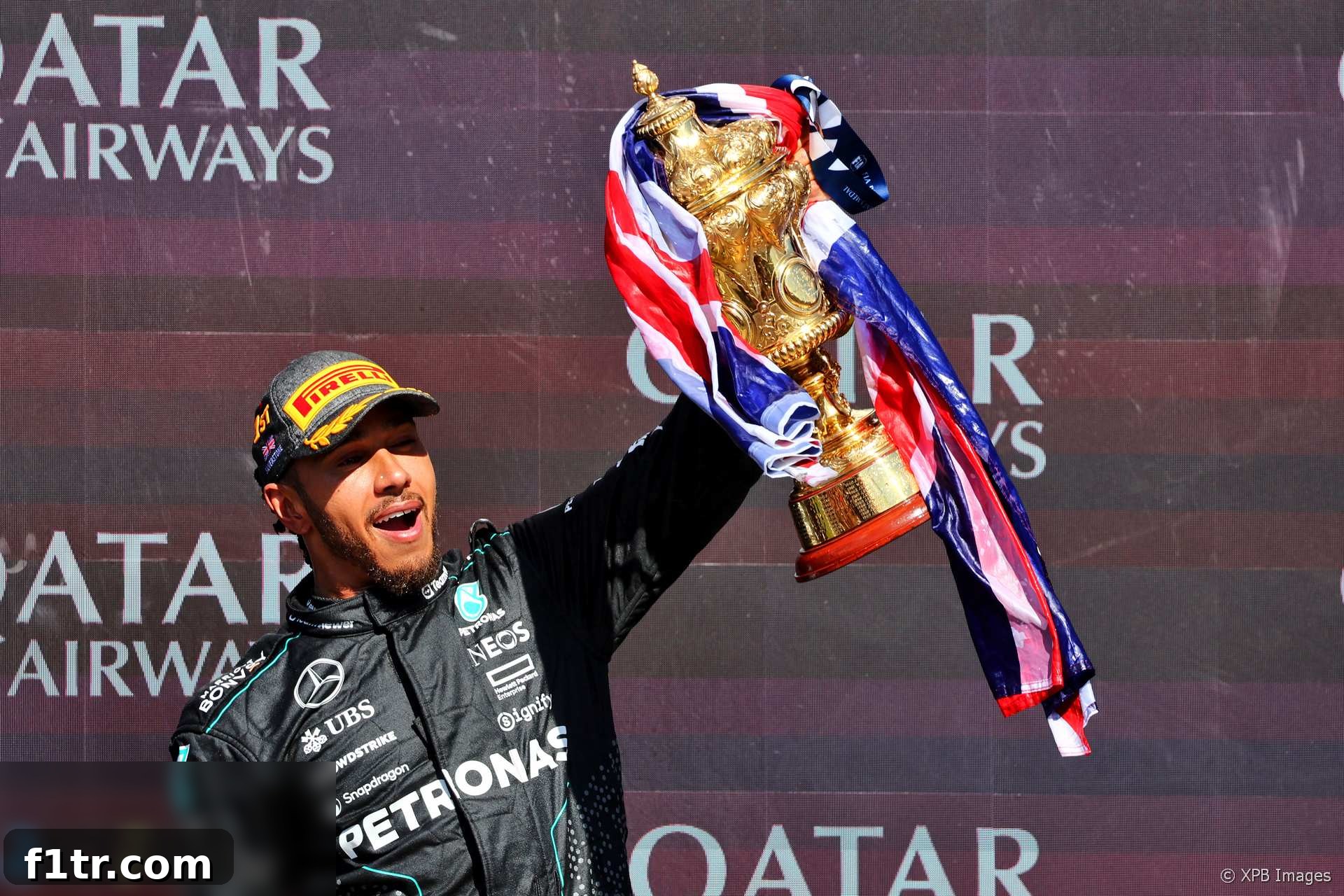
However, to focus solely on the struggles would be to ignore the vibrant counter-narrative of Hamilton’s season – a mid-season resurgence that offered profound hope and undeniable proof of his enduring capabilities. During this period, he appeared to rediscover the incandescent form that has defined his illustrious career, reminding everyone precisely why he holds multiple world championships. At Silverstone, in front of his home crowd and under mixed, challenging conditions, he delivered what many observers hailed as one of the best drives of the entire season. Battling changing grip levels and strategic uncertainties, he executed a masterclass of tire management and race pace to clinch a stunning victory, ending his prolonged wait for a win – a moment charged with immense emotional significance for both him and his legion of fans. This win was not just a statistical entry; it was a powerful statement that the hunger and the skill remained undiminished.
Following Silverstone, the momentum continued. At the Hungaroring, a circuit demanding precision and aggressive defense, he showcased his legendary race craft by effectively keeping Max Verstappen, the season’s dominant force, at bay for a significant period. His defensive driving was remarkably robust and tactical, far more effective than his new teammate could manage, illustrating his unparalleled race management skills. Then came Spa, another demanding circuit where Hamilton executed a strong two-stop strategy. While he ultimately claimed victory due to George Russell’s disqualification, his on-track performance was highly competitive, demonstrating intelligent race craft and the ability to extract maximum performance from the W15 when conditions allowed and strategy aligned.
The Implications for Ferrari: Consistency as the Key to Future Success
Lewis Hamilton’s 2024 season, therefore, presents a far broader and more nuanced range of interpretation than that of most drivers. On one hand, there were occasions where he seemed utterly lost, struggling to find rhythm and pace with a car that remained stubbornly unpredictable. These moments ignited doubts and raised questions about whether the relentless grind of Formula 1 had finally taken its toll. On the other hand, the periods of undeniable brilliance – culminating in that glorious Silverstone victory and other commanding performances – unequivocally proved that the raw speed, the strategic acumen, and the sheer competitive potential still reside within him. It is this tantalizing blend of occasional struggle and profound brilliance that makes his upcoming move to Ferrari so captivating. The critical determinant of his future success at Maranello will undoubtedly be his ability to consistently hit those peaks, to tame the new machinery, and to build a cohesive, winning environment around him. The Scuderia will be hoping that the flashes of genius become the norm, rather than the exception, as they collectively chase an elusive drivers’ championship.
His journey to Ferrari is not just a transfer of a driver; it’s a transfer of ambition, experience, and the hope for a new chapter of glory. The lessons learned, the frustrations endured, and the victories celebrated during this challenging 2024 season with Mercedes will undoubtedly shape his approach and determination in red. The quest for an unprecedented eighth world championship fuels him, and his final season with Mercedes, despite its rollercoaster nature, underscores that the fire still burns brightly. The racing world now eagerly awaits to see if a change of scenery and the iconic red suit can provide the consistent platform Hamilton needs to redefine his legacy once more.
RaceFans’ driver rankings are based partly on the scores awarded to drivers for their performances in each round as well as other factors. This comprehensive analysis incorporates various metrics to provide a holistic view of each driver’s contribution throughout the demanding Formula 1 season.
Further Reading: Formula 1 Insights
- One of F1’s greatest races happened 15 years ago today. Or did it?
- “Overtaking is overtaking”: Domenicali denies F1’s yo-yo racing is “artificial”
- The crashes F1 is trying to prevent may be rare – but the danger is obvious
- F1 returning to India soon after 2027 sounds like wishful thinking
- Verstappen loathes F1’s new generation of cars – but what do his rivals reckon?
Browse all Formula 1 articles