In the high-octane world of Formula 1, where milliseconds define destiny and strategy dictates triumph, McLaren has emerged as a formidable force. Following Lando Norris’s spectacular maiden victory in Miami a mere two months prior, the Woking-based outfit rightfully harbors the conviction that their star driver could have accumulated a staggering five more wins this season. This palpable sense of ‘what if’ permeates the McLaren garage, underscoring their remarkable resurgence and newfound competitive edge at the pinnacle of motorsport.
Indeed, in the wake of his breakthrough success, Lando Norris has firmly established himself as Max Verstappen’s most persistent and credible challenger for championship honors. This elevated status naturally brings intensified scrutiny, and consequently, the strategic missteps and operational glitches on his side of the garage have been meticulously dissected. Every missed opportunity, every strategic gamble that didn’t pay off, now resonates with greater significance as McLaren consistently battles at the sharp end of the grid.
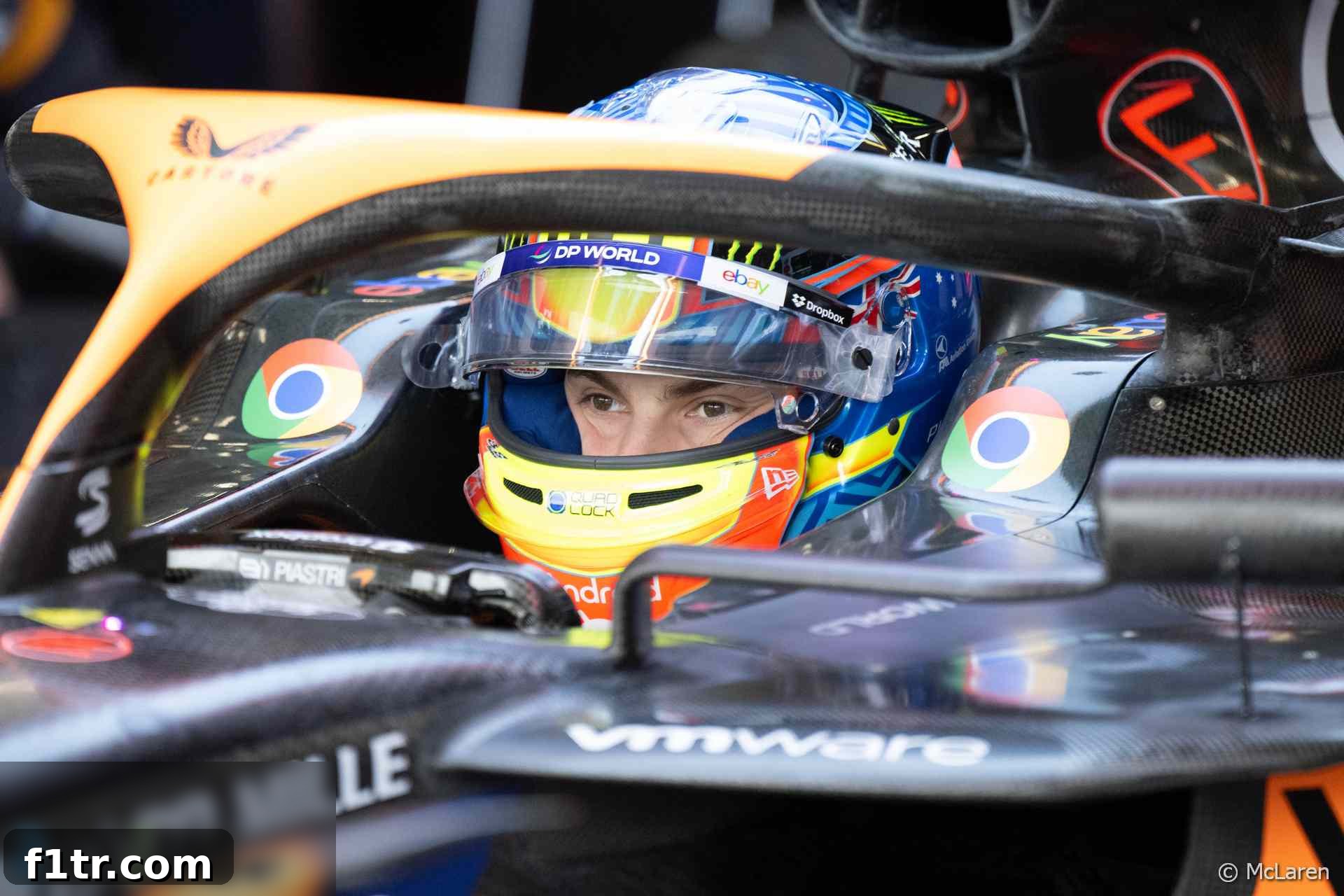
Yet, the narrative of agonizingly close calls and squandered winning opportunities extends beyond Norris. His less seasoned, but equally prodigious, teammate, Oscar Piastri, finds himself in an eerily similar predicament. Despite being only in his second full season in Formula 1, the young Australian has demonstrably let at least three clear chances for a Grand Prix victory slip through his grasp, each instance adding to a growing tally of ‘almosts’ that speak volumes about his raw talent and the McLaren MCL38’s potent performance.
Advert | Become a Supporter & go ad-free
Piastri’s Series of Near Misses: A Detailed Analysis
Piastri’s journey this season has been a testament to his blistering pace and adaptability, frequently matching or even surpassing the performance of his more experienced teammate. However, a cruel combination of circumstance, minor errors, and strategic misfortunes has conspired to keep that elusive first Grand Prix win just out of reach. Each race presented its unique challenge, highlighting the razor-thin margins that separate victory from mere contention in Formula 1.
Imola: A Grid Penalty’s Costly Impact
The Emilia Romagna Grand Prix at Imola stands out as an early indicator of Piastri’s potential. Here, Norris emerged as a significant threat to Verstappen, securing a coveted front-row starting position alongside the Red Bull driver. Intriguingly, Piastri had initially qualified second, putting him ahead of Norris and positioning McLaren for a dream start. However, this promising prospect was dashed when he incurred a three-place grid penalty for impeding Kevin Magnussen during qualifying. This seemingly minor infraction, which McLaren’s strategists might have easily foreseen and avoided with clearer communication or better track awareness, relegated him to fifth on the grid. Starting from the second row, rather than the first, fundamentally altered his race trajectory, preventing him from directly challenging for the lead from the outset. The difference between second and fifth on a circuit like Imola, where overtaking is notoriously difficult, can be the difference between a podium and a win, or a mid-pack battle. The team later acknowledged that with a clean qualifying, Piastri’s pace would have undoubtedly placed him firmly in contention for victory.
Monaco: The Red Flag that Stymied Strategy
Monaco, the jewel in Formula 1’s crown, offered Piastri another golden opportunity. He started a brilliant second, lining up alongside pole-sitter Charles Leclerc. The narrow, unforgiving streets of the principality traditionally turn qualifying into the most crucial session, and Piastri’s performance was nothing short of exceptional. With limited overtaking opportunities, a strong start and clever strategy are paramount. Piastri had excellent tyre management and race pace, putting him in a prime position to challenge Leclerc through an undercut or overcut strategy. However, the first-lap red flag, triggered by a multi-car incident, proved to be an insurmountable obstacle. This early stoppage nullified any strategic advantage, allowing all drivers to change tyres for free. In essence, it removed the only viable opportunity for Piastri to creatively attack Leclerc through pit stop timing, effectively locking in the starting order for the restart and making a victory charge significantly more challenging, despite his raw speed.
Austria: A Track Limits Heartbreak
The Austrian Grand Prix presented yet another twist of fate. In a race where Norris and Verstappen famously collided, Piastri should have been perfectly placed to capitalize on the ensuing chaos and pick up the pieces. He possessed the pace, the car, and the temperament for such an event. George Russell, who started third, managed to do just that, showcasing the advantage of a strong grid position. Piastri, frustratingly, should have been alongside Russell on the grid. However, a contentious track limits call during qualifying, which McLaren staff openly expressed deep frustration about for days afterwards, led to a penalty that dropped him to sixth. This subjective call, often a point of contention in modern F1, denied Piastri a critical second-row start. His ultimate race pace, just 1.9 seconds off Russell’s by the flag, strongly suggested that starting third would have put him in a race-winning position. The fine margins of F1 were once again brutally evident, and a victory was snatched away by the arbitrary nature of official decisions.
Advert | Become a RaceFans supporter andgo ad-free
Strategic Pitfalls and Lessons Learned at the British Grand Prix
Just a week after the Austrian GP, both McLaren drivers faced a new set of challenges at their home race, the British Grand Prix. This time, poor strategic calls by the McLaren pit wall proved costly. In Piastri’s instance, the team’s decision not to pit both drivers simultaneously during an early rain shower severely compromised his race. While Norris came in, Piastri was forced to endure an agonizing extra lap on slick tyres as the track rapidly became saturated. This critical delay meant he was “crawling around” for an entire lap, losing an immense amount of time and positions that were impossible to recover fully. It was a strategic blunder that fundamentally derailed his chances.
Despite this early setback, Piastri displayed remarkable resilience and intelligence in the final stint. He judiciously avoided his teammate’s mistake of opting for the soft tyres, instead choosing the medium compound. His pace on the mediums was nothing short of superb, consistently setting competitive lap times and showcasing the true potential of the MCL38. Had he not been saddled with the significant time deficit incurred due to the strategic error prior to his first stop, there is little doubt that Piastri would have been a serious contender for victory in the closing laps. The race underscored the critical importance of cohesive and responsive team strategy, especially in unpredictable weather conditions.
Piastri’s Perspective: Learning, Adaptability, and Unwavering Confidence
With a mere 34 Grand Prix starts to his name, and already a sprint race winner, Oscar Piastri’s maturity and self-belief belie his limited experience. Given the extraordinary closeness with which he has approached his first Grand Prix victory, the McLaren driver remains undeterred and resolutely confident in his abilities. He firmly believes he’s “definitely ready to do it” in the main event, echoing the sentiment of a champion in waiting.
Piastri draws considerable encouragement from the fact that his near-misses haven’t stemmed from recurring personal errors. Reflecting on his experiences, he shared with RaceFans, “I think the kind of good thing, but kind of bad thing as well, is it’s never been the same thing that’s prevented us from winning.” This insightful observation highlights a crucial aspect of his development: a capacity for learning and adaptation. Each setback has presented a distinct challenge, forcing him and the team to analyze and rectify different issues, rather than being trapped in a cycle of repeated mistakes. This adaptive approach is a hallmark of truly great drivers.
He elaborated further on the varied nature of these missed opportunities: “Obviously today we made a wrong call [referring to the British GP]. In Imola we had an issue in qualifying with traffic. In Austria – the less said about qualifying in Austria the better.” This candid assessment underscores the diverse array of factors at play – from team strategy and operational efficiency to external circumstances and regulatory decisions. The key takeaway for Piastri is that despite these individual failures, the underlying speed and potential are consistently present.
Crucially, Piastri feels that both sides of the McLaren garage now possess a clearer understanding of what it takes to convert these near-misses into actual wins. “But we have good handle now, I think, on both sides of the garage where we felt like we could have won the race. I think we’ve got the hardest part done, we’ve got an incredibly quick car, we just need to capitalise on using it.” This statement radiates confidence, pointing to the belief that the machinery is in place, and the focus must now shift to flawless execution and tactical precision.
Advert | Become a RaceFans supporter andgo ad-free
McLaren’s Strategic Acumen and Future Prospects
Beyond individual driver performance, McLaren’s strategic team has also demonstrated considerable acumen, particularly in anticipating variable conditions. Piastri lauded their decision-making during the recent British Grand Prix weekend, particularly the call to run higher downforce in qualifying in anticipation of a potentially wet race. “I honestly think we made a really good choice. We added downforce into qualifying. We were struggling a little bit in the high speed in the dry anyway. The way the chances were I think we made a really good call on that.” This proactive approach exemplifies McLaren’s improving ability to read races and make informed decisions under pressure, an essential trait for challenging for championships.
He concluded his assessment with a balanced perspective, acknowledging both the team’s strengths and the areas for improvement. “So I think we made 99% of the decisions correct this weekend, just I think probably one on my side with the pit stop and one on Lando’s with the tyre choice.” This self-awareness and willingness to dissect minor flaws, even amidst overall strong performance, is indicative of a team striving for perfection. In the hyper-competitive realm of Formula 1, where the difference between first and second can be measured in fractions of a second or a single strategic miscalculation, these small percentages are magnified.
McLaren’s trajectory is undeniably upward. With a car that is consistently quick and two highly talented drivers pushing each other, the ‘under construction’ phase of their resurgence appears to be nearing completion. The missed opportunities, while frustrating in the moment, serve as invaluable learning experiences for both Piastri and the wider team. As they refine their processes, hone their strategies, and continue to develop their already potent package, it seems not a question of ‘if’, but ‘when’ Oscar Piastri will finally convert one of these promising positions into his maiden Grand Prix victory, further cementing McLaren’s return to the very front of the Formula 1 grid.
More from the World of Formula 1 and McLaren
Stay informed with the latest insights and developments from the competitive Formula 1 season, where McLaren continues to challenge the established order. Explore articles detailing driver performances, strategic breakdowns, and the constant evolution of team dynamics that shape the championship.
- The challenges and triumphs faced by top teams in Formula 1.
- Strategic decisions that define race outcomes.
- Driver perspectives on pressure, performance, and the pursuit of victory.
- Technical advancements and their impact on competitiveness.
- Upcoming races and championship predictions.
Explore more in-depth analysis and exclusive coverage.