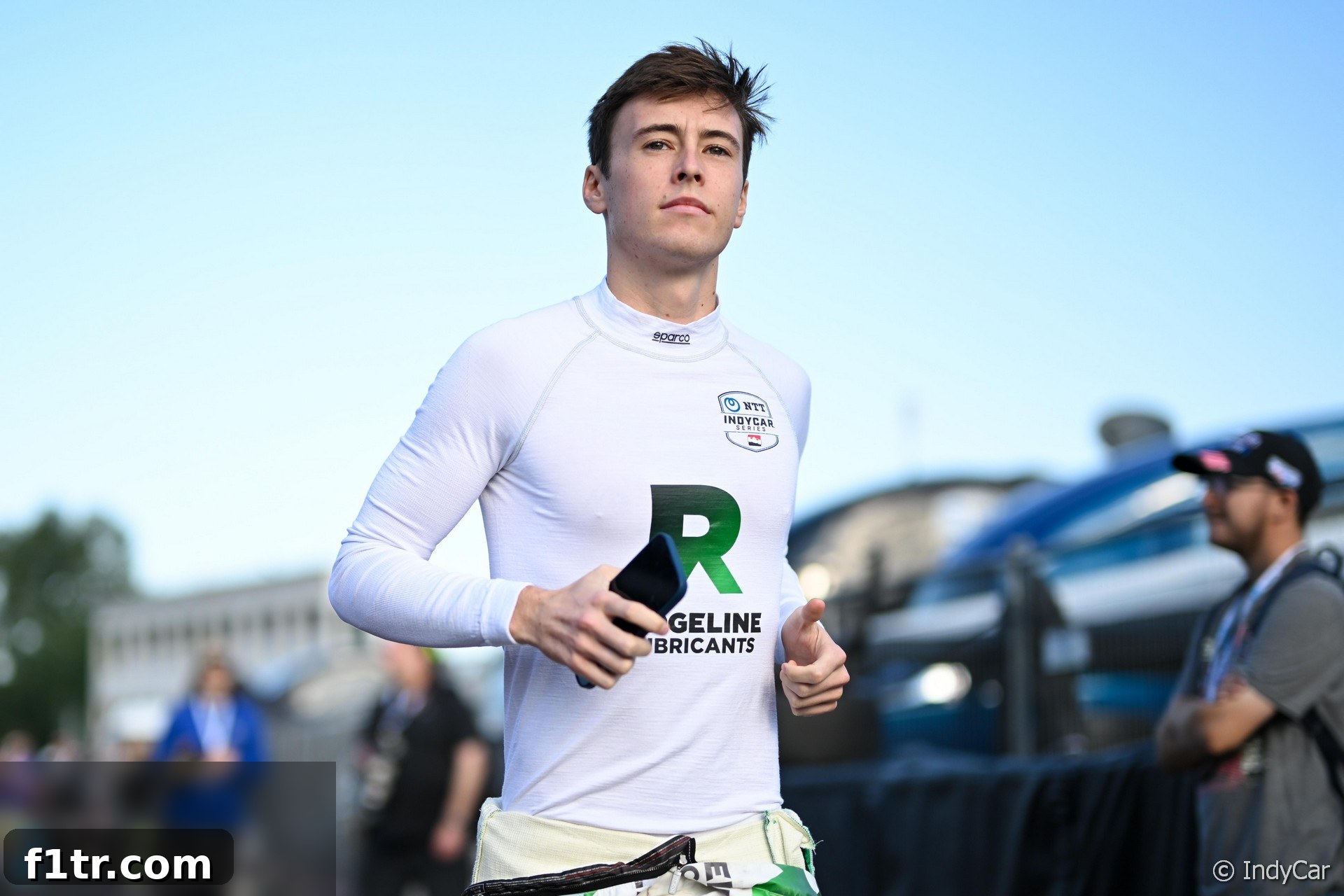
In a remarkable display of talent and tenacity, Marcus Armstrong clinched the coveted IndyCar Rookie of the Year title for the 2023 season, an achievement made all the more impressive by the fact that he missed five of the championship’s 17 rounds. The New Zealander, driving for the powerhouse Chip Ganassi Racing team, proved that consistency and strategic excellence could triumph over a partial schedule, setting a high bar for future rookies in one of the world’s most competitive open-wheel series.
Armstrong’s rookie campaign was exclusively focused on the road and street circuits, opting out of all oval rounds on the calendar. This selective participation meant he was at an inherent disadvantage compared to his full-time competitors. However, by the season’s close, Armstrong had amassed an impressive 214 points, a tally that incredibly matched that of full-time driver Santino Ferrucci. More significantly, he out-scored all his fellow rookies who contested the entire season, solidifying his claim to the prestigious award.
“To win the Rookie of the Year championship, I’m extremely pleased to finally lock that down,” Armstrong stated, reflecting on his season. “Obviously, we didn’t do five races, so it was going to be a tough ask, for sure. But we knew if we executed properly, we had a shot.” His measured approach and consistent delivery were the cornerstones of this unexpected success. Throughout the season, Armstrong demonstrated a keen ability to extract performance from his car and navigate the complexities of IndyCar racing, even on unfamiliar tracks.
His season highlights included a career-best seventh-place finish at the challenging Toronto street circuit, a performance that underscored his adaptability and raw speed. He also secured three eighth-place finishes, notably capping off his sensational debut year with one such result in the season finale at Laguna Seca. These consistent top-10 performances, coupled with an unwavering focus, painted a clear picture of a driver mature beyond his years.
“We finished every race, we were consistent, we had some good results,” Armstrong reflected, underscoring the foundation of his success. While acknowledging that there were moments where he felt more could have been achieved, he emphasized the critical role of reliability. “[But] we were consistent and fast enough to win it without the ovals.” This self-assessment highlights not only his competitive spirit but also a deep understanding of what it takes to succeed in a championship. His ability to consistently bring the car home in strong positions, avoid major incidents, and maximize points on race day proved to be the ultimate differentiator.
The journey from European junior formula series to American open-wheel racing is a significant one, marked by substantial differences in car characteristics, track layouts, and indeed, culture. Armstrong, a former member of the prestigious Ferrari Driver Academy, experienced this transition firsthand. He found life in America and the IndyCar paddock “quite different to racing in Europe,” particularly noting the unique environment within his new team.
“There is certainly a family culture that is embedded inside the team, which is not common in high-performing racing teams,” said Armstrong, articulating a profound observation. In the cut-throat world of motorsport, where competition often breeds an individualistic approach, Ganassi’s ethos stood out. “There’s always a mix between professionalism and a social environment within this team, which I think I like a lot more than what I’ve experienced previously. I feel like they have brought me into their family and really taught me everything.” This blend of professional rigor and personal warmth seemingly provided Armstrong with an ideal environment to thrive, fostering growth not just as a driver but as an individual adapting to a new country and a new racing philosophy.
A significant benefit of joining Chip Ganassi Racing, for any driver, is the opportunity to learn from one of motorsport’s living legends: six-time IndyCar champion and fellow New Zealander, Scott Dixon. Armstrong readily embraced this opportunity, becoming something of a student to his experienced teammate. The value of having a mentor with Dixon’s depth of knowledge and experience, especially one who understands the nuances of an IndyCar, cannot be overstated.
“Everyone’s been open,” Armstrong shared, highlighting the collaborative atmosphere within the team. “I’ve asked Scott a million and one questions, so I’m very annoying. Everyone else, as well. They’ve all answered truthfully – as far as I know! It’s been great.” This candid remark paints a vivid picture of a young driver eager to absorb every piece of information, and a team culture that encourages open communication and mutual support. Dixon’s willingness to share his vast experience, from car setup insights to race craft techniques on specific tracks, undoubtedly played a crucial role in accelerating Armstrong’s learning curve and contributing to his rapid adaptation to the series.
Another area where Armstrong found a notable difference compared to his European racing days was in the allocation of track time. While IndyCar’s rookie drivers have sometimes faced reduced practice sessions at certain events compared to previous years, Armstrong indicated that his overall preparation for races felt more comprehensive than what he was accustomed to in recent seasons, particularly during his time in Formula 2.
“I would say I get more track time than in other series that I’ve done,” he explained. “Like in F2 last year, we were really, really tight on push laps. That’s for another reason, that’s because the tyre just can’t do so many push laps. Here I actually think I’ve done quite a decent amount of laps in the race weekends.” This distinction is critical for driver development. In F2, the high degradation nature of the Pirelli tires means drivers have a limited window for maximum performance laps, making optimal use of track time a constant challenge. In contrast, IndyCar, with its different tire characteristics and often more forgiving weekend schedule, can allow for more laps, enabling drivers to thoroughly understand car dynamics, explore various setups, and hone their race craft without the same level of pressure on tire management during practice.
This increased track time provides a valuable opportunity for rookies like Armstrong to assimilate the unique demands of an IndyCar machine, which is significantly heavier and more powerful than an F2 car, with different aerodynamic characteristics. The ability to extensively test limits, experiment with different lines, and understand how the car behaves under varying fuel loads and tire wear conditions is indispensable for building confidence and consistency. This hands-on experience allows for a deeper connection between driver and machine, a bond that is essential for competing at the sharp end of the IndyCar field.
Armstrong’s impressive rookie season has not gone unnoticed, and his future in American open-wheel racing is now firmly secured. He has already been signed up for a full year in IndyCar for the upcoming season, a testament to his undeniable potential and the belief Chip Ganassi Racing has in him. This full-time commitment means he will now tackle the challenging oval races, adding another layer of complexity and excitement to his burgeoning career. The transition to ovals requires a distinct skillset, demanding pinpoint precision, incredible bravery, and a nuanced understanding of aerodynamic drafting and tire management over long stints. His performance on these high-speed circuits will be a key indicator of his versatility and potential to become a truly complete IndyCar driver.
Looking ahead, Armstrong’s Rookie of the Year title is more than just an award; it’s a powerful statement of intent. It signifies his successful adaptation to a new continent, a new racing culture, and a new breed of motorsport. With a full season ahead, the benefit of experience, and the continued guidance from Chip Ganassi Racing and Scott Dixon, Marcus Armstrong is poised to build upon his strong foundation. Expectations will undoubtedly be higher, but with his proven consistency, rapid learning ability, and innate talent, he is well-equipped to challenge for race wins and potentially even contend for the championship in the seasons to come, further cementing his place as a rising star in the global motorsport landscape.
IndyCar
- IndyCar driver McLaughlin cleared of injury after crashing through barrier at Barber
- Schumacher says his IndyCar feels like ‘an F2 car, just with better tyres’
- IndyCar “way faster than Formula 1” in some corners, says Grosjean
- FIA to award more F1 superlicence points to IndyCar drivers from 2026
- Schumacher to race full-time in IndyCar with RLL in 2026
Browse all IndyCar articles