The Unwritten Rule: Dissecting Lando Norris’s Controversial Team Order Compliance at the Hungarian Grand Prix
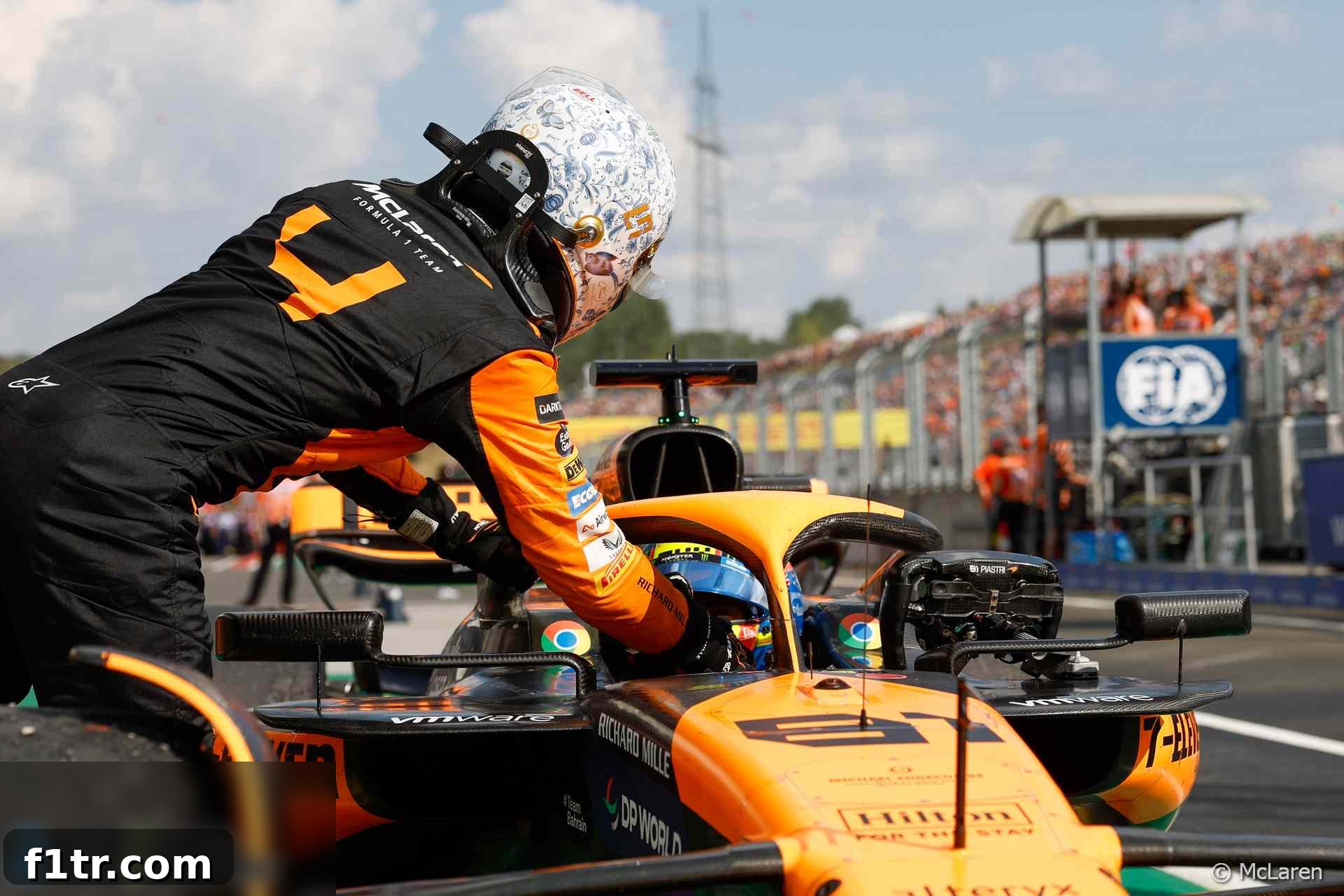
In a rare and intensely debated moment at the Hungaroring, Lando Norris found himself in an unenviable position, yielding the lead of the Hungarian Grand Prix to his McLaren teammate, Oscar Piastri. This decision, prompted by persistent team orders, sparked considerable discussion among fans, pundits, and within the paddock itself, raising fundamental questions about individual ambition versus team loyalty in the high-stakes world of Formula 1.
Advert | Become a Supporter & go ad-free
Strategic Chessboard: How Norris Ended Up Ahead
The situation that led to this controversial call was a consequence of McLaren’s astute strategic maneuvering during the race’s final round of pit stops. Neither Norris nor Piastri was responsible for the initial position swap. Piastri, demonstrating impressive pace and maturity for a rookie, had led the race comfortably up until his final stop. However, a tactical decision was made to pit Norris first, primarily to protect him from the encroaching threat of Lewis Hamilton behind. This “undercut” strategy inadvertently propelled Norris ahead of Piastri once both cars had completed their stops.
While the strategy successfully neutralized Hamilton’s threat and secured a potential one-two finish for McLaren, it created an unforeseen dilemma. McLaren’s management, keen to uphold pre-race agreements or perhaps to preserve team harmony and a sense of fairness, immediately began to request Norris to allow Piastri to reclaim the lead. The team’s rationale was clear: Piastri had earned his position at the front through pure pace, and Norris’s advantage was primarily a strategic outcome, not an organic overtake.
The Dilemma Unfolds: Norris’s Reluctance and Compliance
What followed was a tense and protracted exchange over the team radio, unfolding over more than 20 laps. Norris’s race engineer, Will Joseph, relayed McLaren’s directives with increasing urgency, asking Norris to surrender the lead to his teammate as soon as it was “convenient.” Despite these persistent requests, Norris continued to push, even extending his lead over Piastri to over six seconds. This period highlighted Norris’s competitive spirit and his potential discomfort with the situation, as he clearly possessed the pace to maintain his advantage. Piastri, on slightly fresher tires, appeared unable to match Norris’s rhythm in this final stint, further complicating the team’s directive.
The internal monologue Norris must have experienced during these laps would have been intense: the instinct to win, the desire for championship points, battling against the demands of team loyalty and strategic compliance. Eventually, on the 68th lap of the race, Norris complied, allowing Piastri to move back into the lead. It was a moment laden with significance, not just for the drivers involved, but for the wider understanding of Formula 1’s intricate power dynamics.
For McLaren’s Decision: Upholding Team Harmony and Long-Term Goals
From McLaren’s perspective, the decision to impose team orders was a calculated one, designed to benefit the team’s long-term aspirations rather than a single driver’s immediate glory. As Norris’s race engineer subtly reminded him, vying for a championship, whether this season or in future years, necessitates the unwavering support of the entire team and his teammate. Undermining this crucial dynamic by allowing Norris to capitalize on a strategically-granted advantage could have had detrimental effects on team morale and cooperation, especially given the positive momentum McLaren was enjoying.
Furthermore, the argument for reversing positions stemmed from a sense of justice. Piastri had demonstrated superior pace earlier in the race and had led from the start until the final pit stops. To allow Norris to win due to a pit stop advantage, rather than genuine on-track superiority in that phase, could be seen as unfair to Piastri, a promising rookie who was on the cusp of his maiden F1 victory. McLaren likely sought to reinforce that success should be earned, and that strategic gains leading to positional swaps should sometimes be rectified for internal equity. Prioritizing team cohesion and fairness, especially when a team is rebuilding and finding its form, often outweighs the pursuit of a few extra individual points.
Against Team Orders: The Spirit of Racing and Individual Ambition
Many fans and commentators vehemently argued against McLaren’s decision, emphasizing that team orders fundamentally contravene the core spirit of racing. Formula 1, at its heart, is a competition where drivers should be allowed to race each other freely, pushing limits and striving for victory. Norris, having done nothing wrong by simply being in the lead after a perfectly legitimate strategic move, would have been entirely justified in holding onto that victory.
For Norris, sacrificing seven championship points could prove costly in his pursuit of bridging the gap to dominant drivers like Max Verstappen and vying for a world title. Every point counts in the cutthroat environment of F1. While Piastri would undoubtedly have been distraught to miss out on his maiden win, any grievance should arguably have been directed at the strategic nuances of the team, not at Norris for competing. Forcing a driver to yield when they are demonstrably faster in that moment, as Norris appeared to be in the final stint, undermines their competitive drive and the purity of the sport itself. It transforms a race into a managed procession, diminishing the spectacle for fans who yearn for genuine, unscripted battles on track.
Advert | Become a RaceFans supporter andgo ad-free
The Drivers’ Perspectives: Inside Norris’s Mind
Speaking in the post-race press conference, Lando Norris offered a candid insight into his internal struggle during those fraught final laps. He acknowledged the conflict between his competitive instincts and his role as a team player.
“You’ve got to be selfish in this sport at times. You’ve got to think of yourself,” he stated, highlighting the natural drive of any top-tier competitor. “That’s priority number one, is think of yourself.”
However, Norris quickly balanced this with his understanding of the bigger picture: “I’m also a team player, so my mind was going pretty crazy at the time. I know what we’ve done in the past between Oscar and myself. He’s helped me plenty of times. I think this is a different situation. This is not someone helping one another. I was put into a position, and we were undoing that position change.” His remarks indicate a nuanced understanding of reciprocal support within the team, but also a recognition that this particular instance was about rectifying a strategic outcome rather than a direct act of teammate assistance. Ultimately, Norris’s compliance, though delayed, underscored his commitment to McLaren, even at a personal cost.
For Oscar Piastri, the victory, while historic, must have come with a bittersweet taste. While ecstatic to claim his first win, the circumstances inevitably cast a slight shadow, prompting questions about its legitimacy in the eyes of some. Nonetheless, it marked a significant milestone for the young Australian, showcasing his potential and reinforcing McLaren’s faith in his abilities.
Historical Precedent and the Spirit of F1
Team orders are not new to Formula 1, often stirring controversy and dividing opinions. Incidents like Rubens Barrichello being asked to yield to Michael Schumacher at the 2002 Austrian Grand Prix, or Mark Webber being told “multi 21” at the 2013 Malaysian Grand Prix, are etched into F1 lore as moments where team directives overshadowed pure racing. These events consistently spark debates about sportsmanship, the commercial pressures on teams, and the true essence of what makes F1 exciting.
The Hungarian Grand Prix incident reignited this perennial discussion, prompting fans to ponder whether team orders enhance or diminish the sport. On one hand, they are a legitimate strategic tool for teams to maximize championship points or manage internal dynamics. On the other, they can be perceived as an artificial constraint on racing, robbing fans of genuine competition and undermining the heroic narrative of individual drivers pushing for victory against all odds.
The Fan Verdict: A Divided Opinion
The intense discussion around Norris’s decision was clearly reflected in fan sentiment. A poll conducted after the race asked the crucial question: “Was Norris right to allow Piastri through to win the Hungarian Grand Prix?” The results painted a picture of a divided fanbase, illustrating the complex ethical tightrope McLaren walked.
Was Norris right to allow Piastri through to win the Hungarian Grand Prix?
- No opinion (0%)
- Yes – But Norris should have let Piastri by sooner (51%)
- Yes – Norris was right to let Piastri through in the manner he did (13%)
- Don’t know (2%)
- No – McLaren should never have asked Norris to move aside (26%)
- No – Norris should not have complied with his team’s order to let Piastri by (8%)
Total Voters: 193
The majority, 51%, believed Norris was right but should have yielded sooner, suggesting an acceptance of team orders but a critique of the delay. Another 13% fully supported his delayed compliance. However, a significant 26% argued McLaren should never have issued the order, and 8% believed Norris should have defied it, underscoring the deep divisions and the powerful sentiment against managed outcomes in racing.
This incident at the Hungaroring serves as a potent reminder of the multifaceted challenges faced by Formula 1 teams and drivers. It highlights the constant tension between individual ambition and collective success, a dynamic that will undoubtedly continue to fuel debates and shape the narrative of the sport for years to come.
Advert | Become a RaceFans supporter andgo ad-free
Miss nothing from RaceFans
Get a daily email with all our latest stories – and nothing else. No marketing, no ads. Sign up here:
2024 Hungarian Grand Prix: Further Reading
- Verstappen names Hungarian GP the most stressful moment of his title-winning year
- McLaren team orders “a new situation we’re inexperienced at handling” – Piastri
- Verstappen dismisses critics of “vocal” radio messages and late-night simracing
- Norris’ former McLaren team mates say he was right to give up win
- Mercedes surprised Hamilton’s car was “completely unscathed” in Verstappen clash
Browse all 2024 Hungarian Grand Prix articles