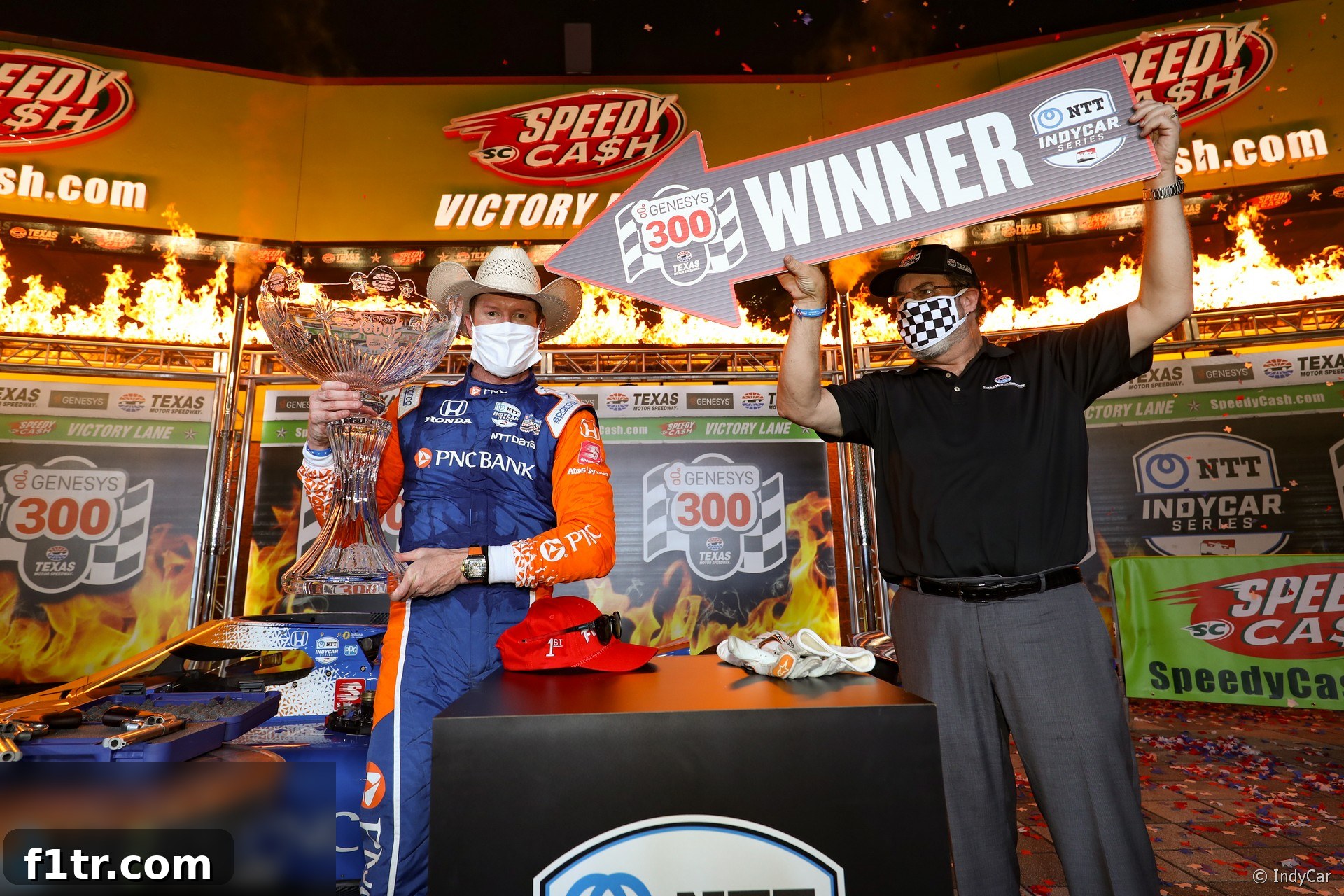
The highly anticipated 2020 NTT IndyCar Series finally kicked off its pandemic-delayed season under the lights of Texas Motor Speedway, delivering a thrilling and strategic spectacle that saw Chip Ganassi Racing’s Scott Dixon dominate to claim his 47th career victory. The race, held behind closed doors without spectators, was a testament to precision driving, impeccable team strategy, and the unpredictable nature of IndyCar racing, culminating in a dramatic late-race incident involving Dixon’s surging teammate, Felix Rosenqvist, who crashed out while attempting a daring overtake.
The unprecedented circumstances of the season opener added an extra layer of intrigue to an already high-stakes event. With teams and drivers operating under strict health protocols, the focus on track performance was sharper than ever. Dixon’s win was not merely a triumph of speed but a masterclass in managing a demanding oval race, particularly against the backdrop of a truncated schedule and the pressure of a championship chase beginning in earnest.
From the outset, the Ganassi duo of Dixon and Rosenqvist demonstrated formidable pace, establishing themselves as the cars to beat. Their formidable performance soon overshadowed the Penske drivers, who, despite starting strong, gradually receded from the front-running battle. This early shift in momentum set the stage for an intra-team battle that would define much of the race.
Defending series champion Josef Newgarden, starting from pole position, initially held a commanding lead. His Penske machine appeared well-balanced, and he looked poised to begin his title defense with a strong result. However, the first round of pit stops proved pivotal. As drivers approached the maximum 35-lap stint length, Dixon’s Chip Ganassi Racing crew executed a strategic masterpiece. By keeping Dixon out for an additional lap before his first stop compared to Newgarden, they allowed the veteran driver to maximize his fuel window and gain crucial track position. This seemingly minor decision propelled Dixon into the lead, a position he would defend with clinical precision for the remainder of the event.
Once at the front, Dixon’s control of the race was absolute. He navigated the challenging high banks of Texas Motor Speedway with an almost effortless grace, maintaining a consistent gap to his nearest rivals. His lead was briefly relinquished only during subsequent pit cycles, moments of high tension where the outcome could swing with a fraction of a second. Despite two caution periods threatening to disrupt his rhythm, Dixon remained unperturbed, expertly managing restarts and re-establishing his dominance. The first caution occurred after a collision between two of the field’s three rookies, Rinus VeeKay and Alex Palou. Palou was an unfortunate victim, being T-boned by VeeKay as he exited the pits, an incident for which Palou was entirely blameless. The second caution was for debris on the track, a common occurrence on high-speed ovals that can often create chaos and opportunity for those behind.
While Dixon seemingly cruised at the front, his teammate Felix Rosenqvist was staging a magnificent charge through the field. Displaying exceptional race craft and aggression, Rosenqvist systematically picked off his competitors. He executed crucial on-track passes against the formidable Penske duo of Simon Pagenaud and Newgarden on laps 76 and 118 respectively. These overtakes were not mere formalities; they were hard-fought maneuvers that showcased Rosenqvist’s burgeoning talent and his determination to challenge for the win. His ability to carve through traffic and maintain blistering pace suggested that Ganassi had a genuine threat to Dixon’s lead.
The gap between the two Ganassi cars began to shrink significantly as Dixon encountered lapped traffic. First, he found himself mired behind Will Power’s third Penske car, then later the heavily delayed Andretti Autosport machine of Alexander Rossi, who had suffered pre-race technical issues. These moments allowed Rosenqvist, running in clear air, to eat into Dixon’s lead, whittling down the deficit by several seconds. With just 32 laps remaining and one final round of pit stops on the horizon, Rosenqvist had closed to within a second of his team mate, setting up a thrilling finale.
The critical moment arrived during the final pit sequence. Chip Ganassi Racing brought Rosenqvist in two laps earlier than Dixon for his last stop. While this strategy aimed to give Rosenqvist clean air and potentially allow him to ‘undercut’ Dixon, the decision ultimately meant Dixon began the final stint still holding the psychological and physical advantage of the lead. As both cars rejoined the track, they immediately found themselves in heavy traffic, a dangerous and exhilarating situation on an oval.
It was here that Rosenqvist’s valiant charge came to a heartbreaking end. In his eagerness to make a move on James Hinchcliffe and clear the traffic, he opted for the high line around the outside. This particular line had proven to be notoriously gripless throughout the evening, a perilous path that many drivers had avoided. Rosenqvist, pushing to the absolute limit, found himself a victim of the track’s unforgiving nature. His car lost traction dramatically, spewing him into the unforgiving barrier with a sickening crunch. It was a cruel blow for a driver who had driven a near-perfect race, a moment of raw racing ambition clashing with the harsh realities of oval racing.
By the time the track was cleared and the final caution lifted, only three laps remained. For Scott Dixon, the path to victory was now clear. With a valuable buffer of lapped cars separating him from the second-place Pagenaud, Dixon calmly brought his car home, securing a dominant and well-deserved victory. The chequered flag waved just seconds after Charlie Kimball spun into the wall on the back straight, an additional testament to the demanding conditions and the relentless nature of the race, even in its final moments.
Rounding out the podium was Josef Newgarden, who recovered from his early strategic disadvantage to claim a respectable third place. He was followed by Zach Veach in fourth and Ed Carpenter in fifth, both delivering solid performances. Conor Daly, piloting the sole Carlin entry after his team had to trim down to a single car at short notice, achieved an impressive sixth place, bringing a much-needed morale boost to the smaller team.
Seventh place went to Colton Herta, but perhaps the most impressive drive of the evening came from Ryan Hunter-Reay. Despite incurring a drive-through penalty at the very start of the race due to late-running technical work on his car, the veteran driver mounted a remarkable comeback, skillfully navigating the field to finish a commendable eighth. This performance underscored his experience and resilience under pressure.
Among the rookies, Oliver Askew was the only one to see the chequered flag, bringing his McLaren SP car home in ninth position, a strong debut in a challenging environment. Tony Kanaan, making his final appearance at Texas Motor Speedway, rounded out the top 10, a fitting farewell for the beloved veteran. Charlie Kimball, despite his late spin, was recorded as a lapped 11th, ahead of Pato O’Ward in the second McLaren SP entry. Will Power, Marco Andretti, and Alexander Rossi completed the top positions, with Rossi, like Hunter-Reay, suffering from pre-race technical woes that hampered his potential.
It was a particularly tough outing for Rahal Letterman Lanigan Racing (RLL). Takuma Sato suffered a devastating crash in qualifying, which was held just three hours before the race start. The damage to his chassis was extensive, and despite the team’s best efforts, it could not be repaired in time for the race. Graham Rahal’s luck was no better; his car’s ECU failed him prior to the formation lap, forcing him to take a penalty and start from the back. These unfortunate circumstances meant RLL’s season began with significant setbacks for both their drivers.
Ultimately, despite the unusual and challenging backdrop of a global pandemic, the NTT IndyCar Series successfully kicked off its season. The sight of drivers swapping their race helmets for face masks upon emerging from their cars became an iconic image of this new era of motorsport. The Texas Motor Speedway race, though without the roar of the crowd, delivered all the high-octane action, strategic brilliance, and dramatic twists that fans have come to expect. Following this intense oval opener, the series will now take a month-long break before reconvening on the Indianapolis road course, promising another unique challenge for the teams and drivers.
IndyCar Insights
For more in-depth analysis and the latest news from the NTT IndyCar Series, explore these related articles:
- IndyCar driver McLaughlin cleared of injury after crashing through barrier at Barber
- Schumacher says his IndyCar feels like ‘an F2 car, just with better tyres’
- IndyCar “way faster than Formula 1” in some corners, says Grosjean
- FIA to award more F1 superlicence points to IndyCar drivers from 2026
- Schumacher to race full-time in IndyCar with RLL in 2026
Browse all IndyCar articles