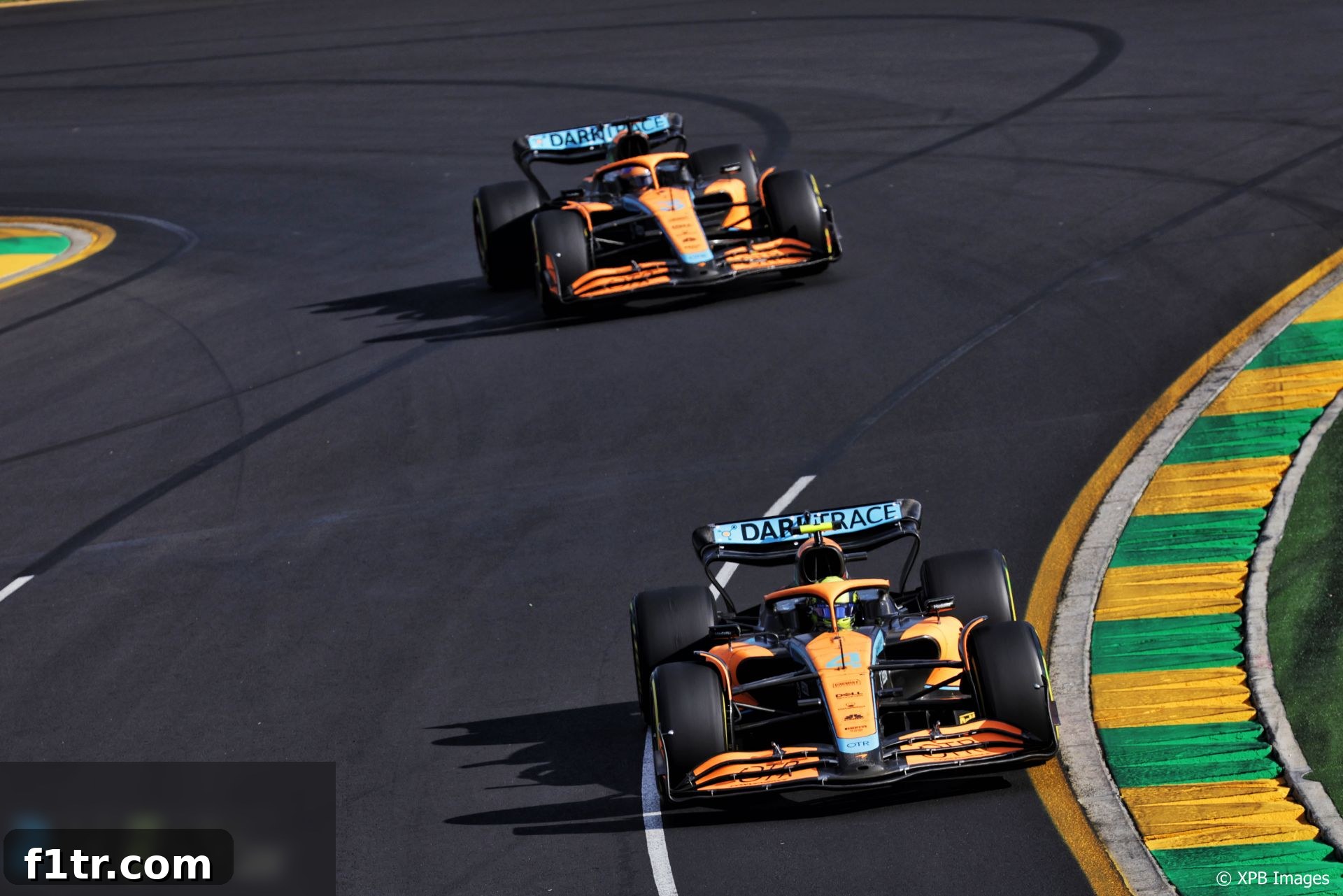
Lando Norris, McLaren F1 team’s rising star, delivered a commendable performance at the 2022 Australian Grand Prix, securing a strong fifth-place finish. This result marked McLaren’s best of the season at that point, yet it came under challenging circumstances. Throughout the closing laps of the race, Norris was instructed to employ a significant “lift-and-coast” fuel-saving strategy, a directive that cost him valuable seconds per lap but was crucial for managing an undisclosed issue with his car.
Advert | Become a Supporter & go ad-free
Norris Navigates Fuel Challenges to Secure Fifth Place
The Australian Grand Prix, held at the newly reconfigured Albert Park Circuit, presented a mix of opportunities and challenges for the McLaren squad. After a difficult start to the 2022 Formula 1 season in Bahrain and Saudi Arabia, where the team struggled significantly with the new generation of cars, Melbourne offered a glimmer of hope. Lando Norris, known for his consistent pace and adaptability, capitalized on the circuit’s smoother characteristics, which seemed to suit the MCL36 car better than previous venues.
However, Norris’s race was far from straightforward. As the 58-lap event neared its conclusion, his race engineer, Will Joseph, began issuing urgent instructions over team radio. The critical message was to implement an aggressive “lift-and-coast” technique. This method involves the driver lifting off the accelerator pedal earlier than usual before braking zones and allowing the car to coast, thereby reducing fuel consumption and heat in specific components. While vital for managing potential issues or optimizing strategy, it inevitably leads to a significant loss of lap time.
Over the final three laps, Norris reportedly lost a crucial six seconds due as he diligently followed these fuel-saving directives. At the start of lap 56, Joseph communicated the severity of the situation and the rationale behind the instructions: “We’re managing an issue. Daniel’s five seconds behind. I want to use [lift and coast] up to those five seconds. Daniel will not put pressure on you.” This radio exchange highlighted not only the technical challenge Norris faced but also McLaren’s strategic decision to protect his position.
Upon crossing the finish line to secure a commendable fifth place, Norris received one final instruction: “Save as much fuel as possible on the in-lap, please.” This reinforced the critical nature of the fuel management issue and the team’s ongoing efforts to ensure the car met post-race scrutineering requirements without any problems.
Team Orders and Ricciardo’s Support
Adding another layer to McLaren’s race strategy was the handling of Lando Norris’s teammate, Daniel Ricciardo. The local hero, driving in front of his home crowd, was running just behind Norris and was also performing strongly, securing sixth place for the team. McLaren’s race engineers quickly communicated with Ricciardo to ensure he understood the unfolding situation and did not inadvertently compromise Norris’s precarious position.
With just two laps remaining, Ricciardo’s race engineer, Tom Stallard, informed him, “We’re managing something on Lando’s car, we don’t want to put him under pressure. It’s okay to close the gap but don’t put him under pressure.” This clear instruction demonstrated McLaren’s commitment to securing the best possible team result and protecting Norris as he navigated the technical difficulties.
Ricciardo, ever the professional, sought clarification: “If he loses power, what do you want me to do?” Stallard’s immediate and pragmatic response was, “Drive past.” He further elaborated on the contingency: “Just don’t hit him, Daniel, that’s all. If he loses power, I just don’t want an accident. But it’s okay if he’s completely lost power, you can go past. I don’t want you to put him under pressure while everything is okay.” This exchange underscored the fine balance F1 teams must maintain between competitive driving, team objectives, and safety protocols, particularly in high-pressure race scenarios.
Advert | Become a RaceFans supporter andgo ad-free
The successful execution of these team orders allowed both Norris and Ricciardo to cross the finish line safely, ensuring McLaren collected valuable constructors’ championship points. Norris’s car subsequently passed all post-race scrutineering checks, validating the effectiveness of the team’s fuel-saving strategy.
Norris’s Post-Race Reflection: A Difficult But Informative Day
Despite securing a fantastic fifth-place finish, Lando Norris’s post-race comments revealed the underlying struggles and challenges he faced throughout the Australian Grand Prix weekend. He described his afternoon as “difficult,” highlighting the constant battle with his machinery.

“We had quite a few problems we had to manage, which wasn’t ideal,” Norris stated, alluding to the undisclosed issue that necessitated the “lift-and-coast” strategy. He acknowledged that the MCL36 had “decent pace in the car,” but noted that “when you’re pushing, you’re always working a little bit more.” This suggested that extracting maximum performance from the car still required significant effort and careful management.
Crucially, Norris tempered any widespread optimism about McLaren’s sudden resurgence. While the team enjoyed their best weekend of the season so far, he firmly believed that the improved results were more attributable to the unique characteristics of the Albert Park circuit than to any fundamental unlocking of performance from the car itself.
“The thing is, if we went back to Bahrain, we’d still be P13 in qualifying and we’d finish two laps down or whatever,” Norris explained candidly. “The car’s exactly the same, which is the problem.” His comments underscored the ongoing challenge for McLaren in understanding and optimizing their 2022 contender across different track types.
Norris further elaborated on the circuit’s influence: “I think we understand it’s just a much quicker track, much smoother and that suits the car a lot more. We can put it in a more optimum range.” The Albert Park circuit, known for its smooth asphalt and flowing corners, evidently minimized some of the inherent weaknesses of the MCL36, such as porpoising or instability experienced on bumpier tracks. Despite the cautious assessment, Norris remained optimistic about learning from the experience: “We’ll take what we’ve learned today and try to carry it with us into the next few races.” This proactive approach is key for McLaren as they strive to consistently improve their car and climb up the competitive grid.
The Australian Grand Prix served as a vital data-gathering exercise for McLaren, providing insights into how the MCL36 performs under specific conditions. While the team still has a considerable amount of development work ahead to address the car’s inherent limitations, Norris’s tenacious drive and the team’s effective strategic management highlighted their potential. The blend of raw talent, strategic acumen, and a pragmatic understanding of their car’s current capabilities will be crucial for McLaren as they navigate the remainder of the challenging 2022 Formula 1 season.
Advert | Become a RaceFans supporter andgo ad-free
2022 Australian Grand Prix Insights and Further Reading
For a deeper dive into the events surrounding the 2022 Australian Grand Prix and other significant moments from the season, explore these related articles:
- Aston Martin’s porpoising “does not allow us to exploit the progress the guys have made”
- Wolff puts Mercedes’ odds of championship victory at “two to eight”
- FIA responds to Verstappen’s criticism of Safety Car performance
- “So this is the end of our race, I guess?” How Alonso’s luckless Australian GP unfolded
- Two-degree temperature rise led to Hamilton’s “difficult position” radio message
Browse all 2022 Australian Grand Prix articles