Five years ago, a revolutionary piece of safety equipment known as the Halo was mandated for all Formula 1 cars. This decision by the FIA, motorsport’s governing body, marked a significant turning point in driver head protection. While hailed by some as a vital step forward, the introduction of the Halo was far from universally welcomed, igniting a fierce debate that would only be settled by its undeniable, life-saving impact.
Initial reactions were largely critical, with many prominent figures in Formula 1 expressing strong reservations. Max Verstappen, then an emerging star, famously labeled the design “ugly” and worried it would “take away some of the passion that F1 is talking about.” Three-time world champion Niki Lauda, a revered figure and an advocate for safety, was equally vocal, asserting it was “100 percent” the wrong decision and that superior solutions must exist. The aesthetic concerns were palpable; many felt the structure compromised the sleek, open-cockpit identity of Formula 1 cars. This immediate backlash underscored the challenging path the FIA faced in implementing such a dramatic change.
Despite the resistance, the FIA, under the steadfast leadership of then-president Jean Todt, persevered. The governing body was resolute in its mission to enhance head protection, not just at the pinnacle of motorsport but across all racing categories. This commitment stemmed from a series of tragic incidents that highlighted the critical vulnerability of drivers to head injuries from flying debris or impacts with surrounding environments.
The Imperative for Innovation: Tragedies That Shaped Safety
The development of the Halo was not a sudden impulse but a carefully considered response to real-world dangers. Two devastating incidents, in particular, underscored the urgent need for improved head protection. In 2009, young British driver Henry Surtees tragically lost his life in a Formula 2 crash at Brands Hatch when he was struck by a wheel. Six years later, in 2015, former Formula 1 driver Justin Wilson succumbed to injuries sustained in an IndyCar race at Pocono after being hit by a car’s nose cone. These heartbreaking events served as stark reminders that despite advancements in chassis and cockpit design, the driver’s head remained perilously exposed, prompting the FIA to intensify its research and development into innovative protective solutions.
When the Halo was finally introduced, FIA safety delegate Charlie Whiting articulated its multi-faceted purpose. “The Halo is there principally to look into the way drivers have been hit by wheels,” he explained, acknowledging the specific nature of some past fatalities. However, its protection extended far beyond just loose wheels. Whiting also highlighted its role in scenarios where cars came into “contact with the environment,” citing examples like Marco Campos’s fatal accident in Magny-Cours and Greg Moore’s in Fontana. He confidently stated that the Halo would “stop a wheel, it will stop large objects and it will protect the driver against incursion from another car, walls, interaction with tyre barriers, all those things.” This comprehensive vision of protection aimed to address a wide spectrum of potential impact scenarios.
Engineering a Life-Saver: The Halo’s Design and Rigorous Testing
The Halo, a titanium structure weighing around 7 kilograms, is designed to withstand immense forces, equivalent to the weight of a double-decker bus. Its distinctive three-point attachment system, anchored to the car’s chassis, creates a protective barrier around the driver’s head. The engineering challenge was formidable: to provide maximum protection without significantly hindering driver visibility or complicating emergency egress. Extensive testing, involving crash simulations, debris impact tests, and numerous driver evaluations, was conducted over several years. This meticulous process ensured the Halo met the FIA’s stringent safety standards, proving its structural integrity and effectiveness under extreme conditions before its mandatory rollout in the 2018 Formula 1 season.
Despite the rigorous development and the clear safety rationale, resistance persisted among many within the F1 paddock and fanbase. However, the FIA remained steadfast, pushing ahead with their plans. After years of development and extensive testing, all cars in Formula 1 were fitted with the Halo for the 2018 season. Five years on, and following a series of dramatic near-misses and life-saving interventions, the initial skepticism has all but vanished, replaced by a universal acceptance of the Halo’s invaluable contribution to driver safety.
From Skepticism to Salvation: Early Demonstrations of the Halo’s Worth
The Halo’s journey from a contentious addition to an indispensable safety feature was paved by real-world incidents that definitively proved its worth. Just months after its introduction, at the 2018 Belgian Grand Prix, the sport witnessed one of its first high-profile demonstrations. Rookie driver Charles Leclerc’s Sauber was involved in a first-lap collision that saw Fernando Alonso’s McLaren launched over the top of his car. The underside of Alonso’s car, including a wheel, scraped directly over Leclerc’s Halo, leaving clear tire marks. Leclerc, visibly shaken but unharmed, was quick to acknowledge its role. He admitted at the time that the Halo “probably helped” save his life. This incident also prompted a significant shift in opinion from one of the Halo’s most vocal critics, Mercedes team principal Toto Wolff, who had infamously joked months prior about wanting to “take a chainsaw” to the device. After witnessing the crash, Wolff conceded it “could have been very nasty” and expressed his profound relief, stating he was “happy that we have the Halo.”
Despite the clear evidence from Spa, some skepticism lingered. Max Verstappen was among those who still questioned the Halo’s direct impact in the Leclerc incident. He argued, “The car never really virtually drops on top of someone else. It would always skid over the top. But because Halo was sticking out so much, of course, it gets hit.” Verstappen suggested that without the Halo, the outcome might have been similar, stating, “The more you build in front of a driver, the more chance it can get hit. I think even if the Halo hadn’t been there he wouldn’t have been hit anyway so I think they made it too dramatic.” This perspective highlighted the ongoing debate and the need for more irrefutable evidence to convince all parties.
Another key concern frequently raised about the Halo was its potential to hinder a driver’s escape from an inverted car, which could place them in greater peril in specific scenarios. This concern was put to the test at the season-ending Abu Dhabi Grand Prix in 2018 when Nico Hulkenberg’s Renault was launched into a spectacular roll by Romain Grosjean on the opening lap, leaving him upside down and perched precariously on a barrier. Initial fears arose about the Halo delaying his egress. However, Charlie Whiting, in what would tragically be his final event as race director before his sudden passing months later, clarified that the Halo was meticulously designed to provide drivers with additional space, not less, for extraction from an overturned vehicle, effectively mitigating this particular safety worry.
As time progressed, more drivers had direct cause to be grateful for the Halo’s protection. At the 2020 Belgian Grand Prix, Antonio Giovinazzi’s Alfa Romeo crashed into a barrier, stripping a wheel from his car. This large, heavy wheel hurtled across the track directly into the path of George Russell, who had virtually no evasive options. Russell vividly recounted the terrifying moment: “I was doomed if I went right as I’d have crashed to him and I was doomed if I went left because I hit his wheels. So for a very split second, it was pretty scary seeing that massive rear tyre flying across the circuit with no idea where it was going to go.” He expressed profound gratitude, adding, “So I’m thankful for the Halo, because obviously, I know in hindsight, even if that was headed towards me, I would have been safe. So we’re all very lucky just to have that system.”
The Ultimate Validation: Romain Grosjean’s Bahrain Miracle
Three months after Russell’s close call, a cataclysmic crash occurred that unequivocally swayed any remaining Halo skeptics, transforming opinion almost overnight. At the start of the 2020 Bahrain Grand Prix, Romain Grosjean – ironically, one of the Halo’s most vocal critics – endured an absolutely horrific accident. His car suffered a monumental 67G impact, splitting in two and bursting into flames after colliding with the barrier on the opening lap. The images of his burning car and the ensuing inferno were genuinely shocking, reminiscent of a bygone, more dangerous era of motorsport. Yet, miraculously, Grosjean walked away from the wreckage, suffering only burns to his hands and ankles, a testament to the incredible advancements in F1 safety. The Halo played a pivotal role, deflecting the barrier and creating a survival cell around his head, allowing him to escape the raging fire. His poignant admission afterward resonated deeply: “I wasn’t for the Halo some years ago but I think it’s the greatest thing that we’ve brought to Formula 1. Without it I wouldn’t be able to speak to you today.”
Grosjean’s miraculous escape was the definitive proof point for the Halo, silencing virtually all dissent. Even Max Verstappen, a staunch early critic, publicly conceded its vital importance. “I think the Halo today saved his life,” he stated. “In the beginning when it came onto the cars I was quite critical about it, that it looked ugly. But you can’t say anything about the safety because today it definitely saved Romain, so I’m very happy about that.” This newfound consensus underscored the profound impact of the Bahrain crash, solidifying the Halo’s place as an indispensable safety feature in Formula 1.
Continued Proof: From Monza to Silverstone
The Halo continued to demonstrate its life-saving capabilities in subsequent seasons. At the 2021 Italian Grand Prix, Lewis Hamilton, who had previously praised the Halo after Grosjean’s crash, experienced a terrifying near-miss of his own. During a collision with Max Verstappen, the Red Bull car’s wheel landed directly on top of Hamilton’s Mercedes. The wheel grazed the top of the seven-time world champion’s helmet before the Halo bore the brunt of the impact, preventing what could have been catastrophic injuries. Mercedes team principal Toto Wolff, reflecting on the incident, stated unequivocally that the Halo had saved Hamilton’s life, adding, “It would have been a horrible accident that I don’t want to even think about if we wouldn’t have had the Halo.”
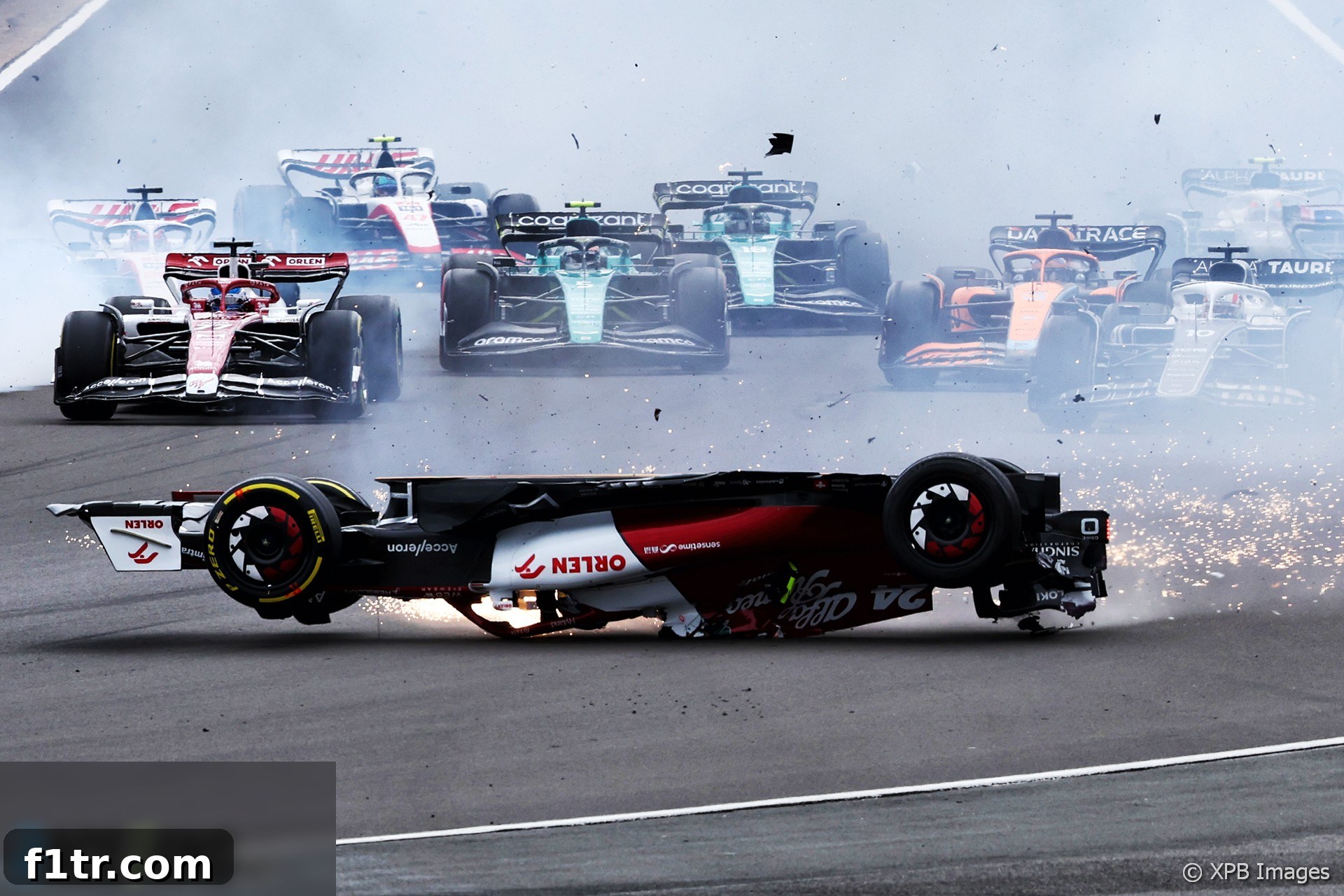
More recently, at Silverstone in 2022, the value of the Halo was once again highlighted by multiple incidents. During the main Formula 1 race, Charles Leclerc’s car was struck by debris from Sergio Perez’s damaged car, a minor incident compared to the two more serious crashes that captured widespread attention. In the morning’s Formula 2 race, Dennis Hauger’s car landed on top of Roy Nissany’s, with the Halo visibly absorbing the impact and protecting Nissany. But an even more graphic demonstration of its effectiveness was just hours away.
Alfa Romeo’s rookie driver, Zhou Guanyu, walked away from a horrifying, multi-car pile-up at the very start of the F1 race. Millions of television viewers and thousands of spectators watched in disbelief as his car flipped over, skidded for hundreds of meters upside down along the asphalt and gravel, and then catapulted violently into the catch fencing and tyre barriers. The severity and visual brutality of the crash were extreme, raising immediate concerns for Zhou’s safety. Could the Halo withstand such an impact, protecting the driver as it was designed to do? The answer, thankfully, was a resounding yes. Zhou, miraculously unharmed, later confirmed on social media, “Halo saved me today.” This latest incident served as another stark reminder of the Halo’s indispensable role in modern Formula 1 safety.
The Evolving Landscape of Motorsport Safety
Safety in motorsport is an ever-evolving field, constantly monitored, reviewed, and enhanced by the FIA. The process is never truly complete, as new challenges and potential hazards emerge with each technological advancement and track design. For instance, following the Silverstone 2022 crash, several drivers suggested that the sport now needs to scrutinize the role played by the high ‘sausage’ kerbs in contributing to the severity of the accident. This ongoing dialogue underscores the FIA’s commitment to continuous improvement, always striving to make racing safer without compromising the spectacle.
Yet, amidst this perpetual pursuit of perfection, the Halo stands as a monumental achievement. From its controversial inception to its current status as a universally accepted and lauded safety device, its journey has been transformative. It has proved its worth time and time again, in a myriad of high-speed, high-impact scenarios, turning potentially fatal crashes into survivable incidents. Five years since its contentious introduction, it is almost impossible to find anyone within the Formula 1 community who would now speak a word against it. The Halo is no longer just a piece of equipment; it is a symbol of Formula 1’s unwavering dedication to driver well-being and a testament to how innovation, when driven by safety, can truly redefine the boundaries of what is possible in motorsport.
Related Articles
- Exploring the Next Generation of F1 Safety Innovations
- How Driver Feedback Shapes Formula 1 Safety Regulations
- The Unsung Heroes: Engineering Excellence Behind F1 Safety
- A Historical Look at Formula 1’s Commitment to Driver Protection
- Beyond the Halo: What’s Next for Motorsport Safety?
Browse all Motorsport Safety articles