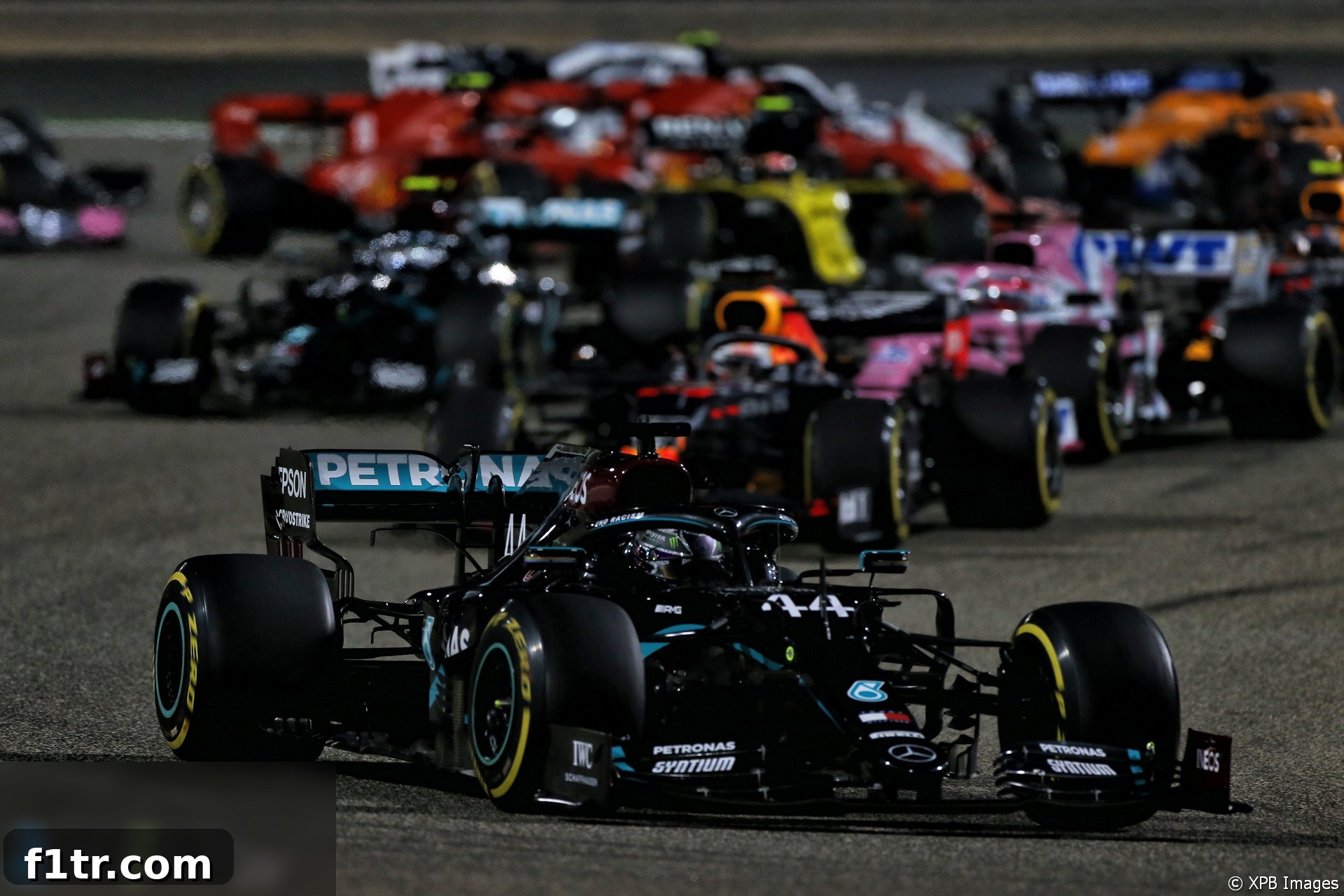
The 2020 Bahrain Grand Prix delivered an unforgettable spectacle of both triumph and terror, etching itself into the annals of Formula 1 history. Lewis Hamilton, the newly crowned seven-time World Champion, secured his eleventh victory of a dominant season, further solidifying his legendary status. However, the race was overshadowed by a horrifying first-lap accident involving Romain Grosjean, a crash that miraculously saw the Haas driver escape an inferno with relatively minor injuries, highlighting the extraordinary advancements in motorsport safety.
The race began under the setting sun, but the tranquility was shattered mere seconds after the lights went out. As the pack surged through the opening corners, Grosjean, driving for Haas, made contact with Daniil Kvyat’s AlphaTauri car at the exit of turn two. The impact sent Grosjean’s car veering sharply to the right, catapulting him head-on into the Armco barrier at turn three. The force of the collision was immense, later measured at a staggering 53G, a testament to the sheer violence of the incident.
The scene that unfolded next sent shockwaves through the entire motorsport community and captivated millions of viewers worldwide. Grosjean’s car, upon impact, was torn in two, its front section piercing through the barrier, while the rear disintegrated. Crucially, the fuel tank ruptured, igniting a massive fireball that engulfed the front half of the car, trapping Grosjean within the flames. For a terrifying 28 seconds, the world held its breath, witnessing one of the most dramatic and dangerous incidents in modern Formula 1.
Yet, amidst the chaos and the inferno, a beacon of hope emerged. In what can only be described as a miraculous escape, Grosjean remained conscious. With incredible presence of mind and courage, he managed to unbuckle himself and, with the assistance of the rapid-response medical car crew, including Dr. Ian Roberts and Alan van der Merwe, he climbed out of the burning wreckage. The swift arrival of safety marshals, who bravely tackled the raging fire, played a critical role in preventing an even more tragic outcome. The images of Grosjean emerging from the flames, his race suit scorched but his spirit unbroken, became an enduring symbol of resilience and the effectiveness of modern F1 safety protocols, including the Halo device which undoubtedly saved his life.
The race was immediately red-flagged, bringing all competition to a halt. The priority shifted entirely to Grosjean’s well-being and the arduous task of repairing the extensively damaged barrier. For almost an hour and a half, the Sakhir circuit fell silent, save for the hum of machinery and the focused work of the track crews. Concrete barriers were painstakingly brought in and installed to replace the compromised Armco, ensuring the structural integrity and safety of the track before any thought of racing could resume. This prolonged delay underscored the severity of the incident and the FIA’s unwavering commitment to driver safety.
When the race finally resumed from a standing start, the drama was far from over. Daniil Kvyat, already involved in the initial Grosjean incident, found himself at the center of another collision just moments after the restart. While battling for position, Kvyat made contact with Lance Stroll’s Racing Point at turn eight, pitching Stroll’s car violently onto its roll hoop. The Racing Point slid upside down for a considerable distance before coming to a rest. Fortunately, Stroll was able to extricate himself from the inverted car seemingly unharmed, but the incident necessitated the deployment of the Safety Car. The race stewards, after reviewing the footage, deemed Kvyat responsible for this second collision, handing him a 10-second time penalty, adding another layer of complexity to his eventful afternoon.
Despite the surrounding chaos, Lewis Hamilton maintained his composure and control throughout. Having started from pole position, his initial getaway was flawless, and he quickly established a lead that never truly looked in doubt. While Valtteri Bottas, his Mercedes teammate, suffered an unfortunate start, losing several places, and then was forced to pit immediately after the restart due to suspected damage, Hamilton executed his race strategy with characteristic precision. His tire management was impeccable, allowing him to dictate the pace and maintain a comfortable buffer over the chasing pack. This victory was yet another demonstration of his unparalleled skill and the dominant performance of the Mercedes-AMG F1 W11 EQ Performance car throughout the 2020 season, further cementing his place as one of the sport’s greatest.
Max Verstappen, in the Red Bull, provided the closest challenge to Hamilton’s supremacy, maintaining a more aggressive pursuit than in several preceding races. While he couldn’t quite match the raw pace of the Mercedes, second place always appeared to be the absolute limit of what his Red Bull RB16 could achieve on this particular day. Demonstrating his relentless competitive spirit, Verstappen created a sufficient gap to the cars behind him, affording him the luxury of an extra pit stop late in the race. This strategic gamble was taken with the sole purpose of attempting to secure the bonus point for the fastest lap, a feat he successfully accomplished, further maximizing his points haul from a strong second-place finish.
The race also unfolded into a magnificent, if ultimately heartbreaking, story for Sergio Perez. Driving for Racing Point, Perez delivered a masterful performance, running consistently in third place for the vast majority of the race. He steadily built and maintained a significant lead over Verstappen’s teammate, Alexander Albon, seemingly destined for a well-deserved podium finish. For many laps, his drive was a textbook example of consistent pace and intelligent race management, placing him firmly in contention for what would have been a crucial result for Racing Point in their battle for third in the Constructors’ Championship.
However, with only four laps remaining, tragedy struck. A plume of smoke suddenly billowed from the rear of his Racing Point, swiftly followed by ominous flames. The devastating engine failure brought his superb race to an abrupt and agonizing halt, forcing him to pull over at the exit of turn 10. The sight of his car engulfed in flames, echoing the earlier Grosjean incident but this time signaling the end of a brilliant drive, was a cruel twist of fate. This heartbreaking retirement, so close to the checkered flag, gifted the final podium position to Alexander Albon, whose Red Bull had been trailing Perez for much of the afternoon. It was a stark reminder of the brutal highs and lows inherent in Formula 1 racing, leaving Perez understandably dejected.
Perez’s dramatic retirement had further ripple effects down the field. Lando Norris, who later expressed his shock at seeing a marshal bravely running across the track to attend to Perez’s burning car, capitalized fully on the Racing Point’s misfortune. He moved up to a commendable fourth place, securing a significant points windfall for McLaren. His teammate, Carlos Sainz Jnr, also had a strong showing, finishing directly behind Norris in fifth. This excellent combined result represented a significant boost for McLaren in their intense battle with Racing Point for third place in the Constructors’ Championship, turning what had been a problematic day for one into a highly productive one for the other.
Elsewhere, Valtteri Bottas showcased his resilience with a determined recovery drive after his early setbacks. By the time the final Safety Car was deployed due to Perez’s retirement, Bottas had fought his way back into eighth place, salvaging valuable points for Mercedes. He finished just behind Pierre Gasly in sixth and Daniel Ricciardo in seventh, both of whom delivered strong performances for AlphaTauri and Renault, respectively. The remaining points positions were claimed by Esteban Ocon in ninth, marking another solid result for Renault, and Charles Leclerc, who managed to secure the final point for Ferrari in tenth place. The Bahrain Grand Prix, in its entirety, was a race that transcended mere competition, becoming a powerful narrative of human courage, engineering marvel, and the relentless, unpredictable drama that defines Formula 1.