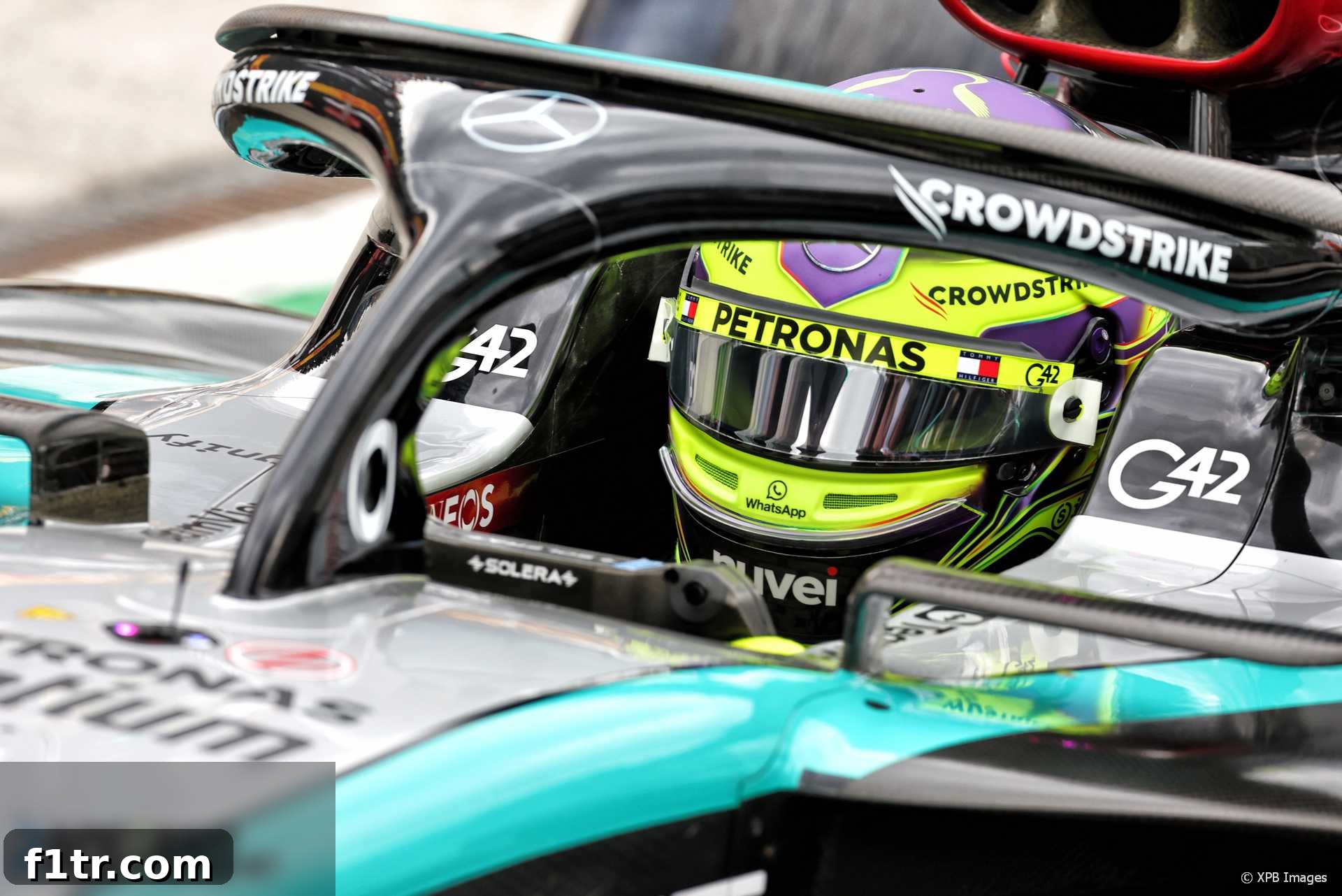
Lewis Hamilton’s Dutch Grand Prix Qualifying Woes: Mercedes Faces Uphill Battle at Zandvoort
A shadow fell over the Mercedes-AMG Petronas Formula One Team garage at the Dutch Grand Prix as seven-time world champion Lewis Hamilton experienced a deeply disappointing qualifying session, culminating in an early exit in Q2. Securing a provisional 12th position on the grid for Sunday’s race at the challenging Zandvoort circuit, Hamilton’s struggles were further compounded by an ongoing stewards’ investigation for allegedly impeding Sergio Perez during Q1 – a penalty that could push him even further down the order. This unexpected setback marks a significant hurdle for the British driver and his team, who had shown promising pace in earlier practice sessions.
The Frustrating Descent in Zandvoort Qualifying
Hamilton’s qualifying session started with a flicker of promise. In Q1, he demonstrated competitive speed, clocking the fifth-fastest time, merely three-tenths of a second shy of the session’s quickest lap. This initial performance suggested that Mercedes had found a respectable rhythm with the W14 on the twisty Zandvoort layout. However, the momentum swiftly evaporated in Q2. Hamilton found himself grappling with an increasingly unstable car, particularly struggling with significant oversteer on his crucial final flying lap. This lack of balance proved detrimental, pushing him more than four-tenths adrift of the best Q2 time and ultimately leading to his elimination.
“My session just went downhill like a domino effect from the moment with Checo,” Hamilton candidly admitted to the official F1 channel, reflecting on the sequence of events. He elaborated on the deteriorating handling: “Then the balance just got more and more snappy, more and more oversteer-y. It was terrible.” This sharp decline in car performance between Q1 and Q2 highlights the delicate knife-edge on which modern Formula 1 cars operate, where even minor changes in track conditions or tire temperatures can have a profound impact on lap times, particularly at a circuit as demanding as Zandvoort.
The impeding incident involving Sergio Perez in Q1 adds another layer of complexity to Hamilton’s difficult weekend. While the specifics of the incident were under review by the stewards, any penalty, such as a grid drop, would make Hamilton’s task of climbing through the field even more daunting. This potential sanction hung heavy over the team, further dampening spirits after an already subpar qualifying performance in the Netherlands.
An Uphill Battle Awaits at the Dutch Grand Prix
The Zandvoort circuit is renowned for its old-school character, featuring high-speed banking and tight, flowing corners. While thrilling for drivers, these characteristics make overtaking notoriously difficult. The narrow track width and limited run-off areas mean that drivers often struggle to find clean air and opportunities to make progress from lower grid positions. For Hamilton, starting from 12th, potentially even lower if a penalty were applied, presented a formidable challenge for the Sunday race.
His immediate reaction conveyed a sense of resignation regarding his prospects for the main event. “It’s definitely very, very frustrating, naturally, but this is what it is,” Hamilton stated. “That’s kind of hard. It’s kind of the weekend done and we have to move on to next week.” This stark assessment underscores the difficulty of recovering from a poor qualifying result at a circuit where track position is paramount. The prospect of battling through midfield traffic, coupled with the risk of further incidents in a tightly packed field, suggested that a strong points finish would require a flawless strategy, impeccable driving, and perhaps a stroke of luck.
Mercedes’ Unfulfilled Expectations: Toto Wolff’s Candid Assessment
The disappointment wasn’t confined to Hamilton alone. Mercedes team principal Toto Wolff openly expressed the team’s unfulfilled aspirations for the Dutch Grand Prix qualifying. “Looking at the previous sessions we were pretty much always among the top three,” Wolff noted, contrasting their promising practice performance with the qualifying outcome. The team had harbored hopes of a much stronger showing, particularly after seeing encouraging signs from both Hamilton and his teammate, George Russell, during the free practice sessions.
George Russell managed to qualify in fourth place, a respectable result given the team’s overall struggles, but even this left Wolff unsatisfied. “Also P4 from George, I think he’s probably done the maximum, but we are not happy with that performance,” he admitted. This sentiment reflects the high standards Mercedes holds itself to, and their ambition to consistently challenge for pole positions and race wins, not just respectable top-five finishes.
Wolff delved into the technical intricacies that plagued their session, describing the W14 as “a car that was on a knife-edge.” He explained, “It was very difficult to nurture through the lap. Lots of understeer, snap oversteer and the moment you go over those temperature thresholds, you have no performance anymore. That’s why we had this freakish moment where Lewis just fell out in Q2.” This detailed explanation paints a picture of a car that is highly sensitive to conditions, where even slight deviations can push it beyond its optimal operating window, leading to a dramatic drop-off in performance. The challenge for Mercedes lies in understanding and mitigating these “freakish moments” to ensure more consistent performance across varying track conditions and tire cycles.
Navigating the W14’s Volatility: A Persistent Technical Challenge
The issues described by Wolff – the delicate balance, the sudden shifts between understeer and oversteer, and the critical tire temperature thresholds – are not entirely new for Mercedes. Throughout the current regulatory era of Formula 1, the team has openly discussed the difficulties in taming their ground-effect cars. While significant progress has been made, particularly in recent races where they’ve shown flashes of strong performance, Zandvoort seems to have exposed some of the W14’s inherent sensitivities once again. The nature of the circuit, with its high-energy demands on tires through sweeping corners and rapid changes of direction, likely exacerbated these characteristics.
Finding the perfect setup that allows the tires to generate optimal grip without overheating or underperforming is a constant battle for all teams, but Mercedes appears to be particularly vulnerable when these parameters are not precisely met. This volatility makes it challenging for drivers to extract consistent performance lap after lap, as demonstrated by Hamilton’s sharp decline from Q1 to Q2. The team’s engineers would be working tirelessly through the night to analyze the telemetry and find solutions that might offer a glimmer of hope for race day, potentially through strategic tire choices or subtle setup adjustments, to improve their competitive standing at the Dutch Grand Prix.
Beyond Zandvoort: A Glimpse into Mercedes’ Future Endeavors
Despite the immediate disappointment, Lewis Hamilton’s veteran experience shines through in his ability to quickly shift focus. His statement, “we have to move on to next week,” underscores a pragmatic approach to a setback. In the demanding world of Formula 1, dwelling on past performance, especially a difficult qualifying session, serves little purpose. The focus must immediately turn to extracting whatever is possible from the upcoming race and then meticulously preparing for the next challenge on the calendar. This resilience is a hallmark of champions and a necessary trait in the high-pressure environment of F1.
For Mercedes, the Dutch Grand Prix serves as another critical data point in their ongoing development journey. Every session, every lap, provides valuable insights into the W14’s characteristics and helps the team understand where improvements are most needed. The aim is not just to recover from a single bad weekend but to build a car that consistently performs at the front, offering both drivers the tools to fight for victories. While the immediate aftermath of qualifying was undeniably frustrating, the underlying determination within the Mercedes camp remained strong. They would leverage this experience, learn from their struggles at Zandvoort, and channel their efforts into ensuring a more competitive outing in the races to come, continuing their relentless pursuit of championship-winning form.
The Road Ahead for Lewis Hamilton and the Mercedes Team
Lewis Hamilton’s resilience throughout his illustrious career is well-documented. He has often demonstrated an extraordinary ability to recover from challenging grid positions, turning what appear to be lost causes into strong points finishes, or even podiums. While Zandvoort presented a stern test for such a comeback drive, one could not entirely discount the possibility of him making significant progress, especially if chaotic race conditions or strategic opportunities were to emerge. The team would be exploring every avenue, from alternative tire strategies to optimizing pit stops, to give Hamilton the best possible chance to salvage his weekend at the Dutch Grand Prix.
For the Mercedes team as a whole, consistency remains the paramount objective. The fluctuations in performance, particularly between different circuits and sometimes even within a single race weekend, are what they are striving to eliminate. Lessons learned from the W14’s behaviour at Zandvoort will be crucial for the ongoing development of the car and for shaping the design philosophy of future challengers. The commitment to return to the very top of Formula 1 is unwavering, and while this particular Dutch Grand Prix qualifying was a significant hurdle, it will undoubtedly fuel their determination to overcome future obstacles and reclaim their position at the pinnacle of motorsport.
2024 Dutch Grand Prix
- Previous technical hires no obstacle to Newey joining Aston Martin – Krack
- Mercedes still unsure whether Spa floor upgrade is working
- McLaren’s Dutch GP upgrade “nowhere near” as significant as Miami package
- “Very hard to pinpoint” why car has become harder to drive – Verstappen
- Only one F1 driver is making worse starts than Norris in 2024
Browse all 2024 Dutch Grand Prix articles