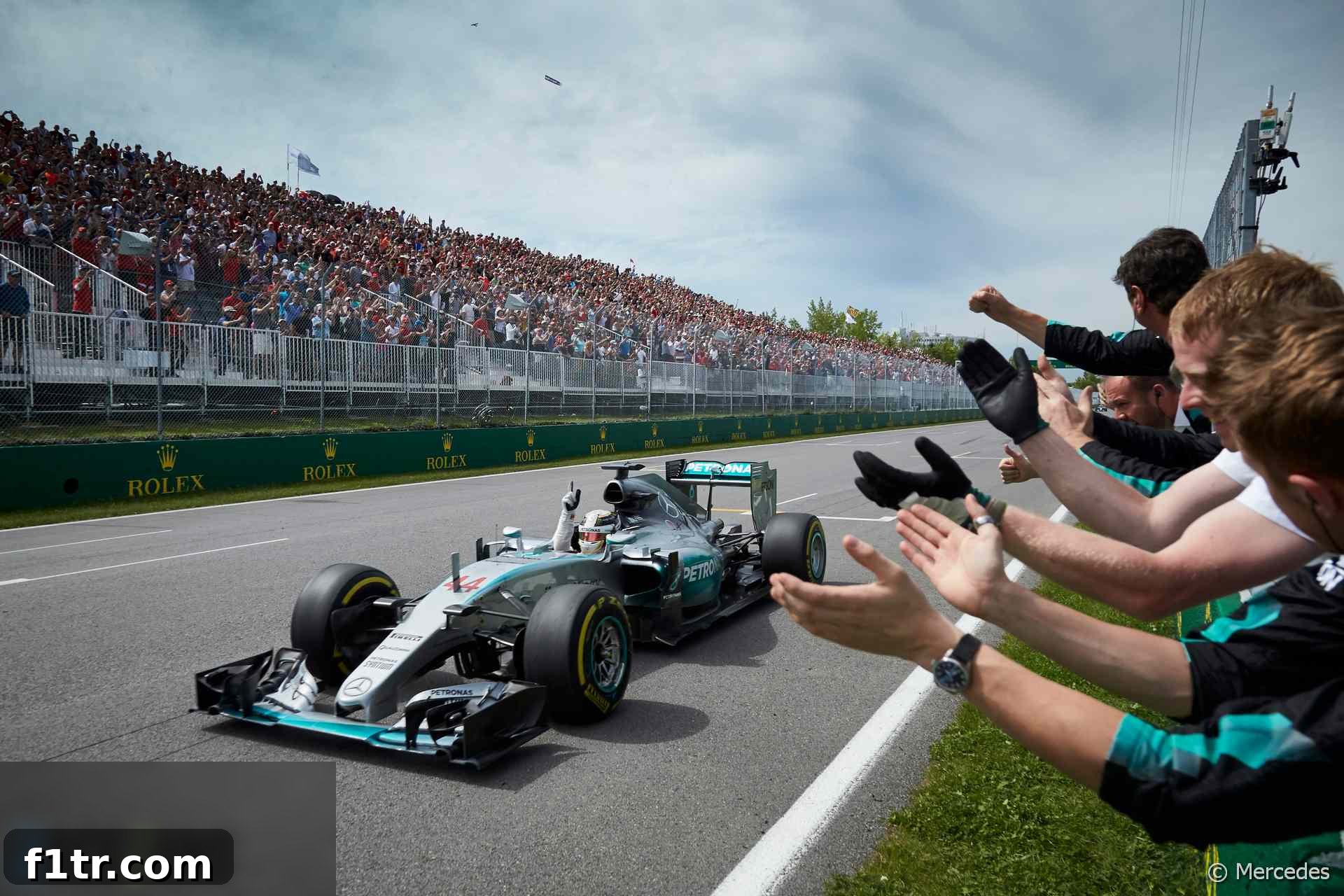
The aftermath of the thrilling and contentious Monaco Grand Prix had left the Formula 1 paddock buzzing with anticipation, but on the verdant Île Notre-Dame in Montreal, the 2015 Canadian Grand Prix unfolded with a more familiar narrative. In a race that largely saw normal service resumed, Lewis Hamilton delivered a masterful performance, securing a dominant victory that reaffirmed his position at the pinnacle of the championship standings. Despite his teammate Nico Rosberg keeping him within a few seconds for much of the race, Hamilton never truly felt under threat, a sentiment he echoed confidently after clinching his fourth win of the 2015 season.
The Circuit Gilles Villeneuve, renowned for its dramatic twists and turns and unpredictable races, presented a unique challenge, not least due to its high fuel consumption demands. Yet, Hamilton navigated these pressures with calm authority, demonstrating why he was the reigning world champion. His control from pole position was absolute, effectively neutralizing any potential challenge from Rosberg and setting the tone for what would become a strategically intense, rather than outright wheel-to-wheel, contest.
Vettel’s Early Gamble and Astonishing Comeback
Unlike the previous year where Rosberg had successfully defended his pole position from Hamilton, the 2015 Canadian Grand Prix saw the tables turned. Hamilton, starting from pole, made a clean getaway, leaving Rosberg with no opportunity to launch an attack into Turn 1. The opening corners were remarkably orderly among the front-runners, with the top five drivers maintaining their grid positions. Further back, Nico Hülkenberg made an incisive move on Pastor Maldonado at Turn 3, snatching sixth place with impressive precision.

Further down the field, Sebastian Vettel, starting a lowly 18th after a challenging qualifying session, found himself in a frustrating predicament. He expressed his disappointment with his initial laps, stating, “In the opening laps I was not very happy with myself. I was very aggressive but I could not find the gaps, I wanted to go crazy but there was no room, so I had to be patient and it’s a shame because these are the moments when if you are lucky you can gain easily five, six, seven or eight seconds in total race time.” His ambition to make early progress was thwarted by dense traffic.
By lap seven, Vettel was embroiled in a three-car tussle for 11th position, trailing Marcus Ericsson and Felipe Massa. Ferrari, recognizing the need for decisive action, opted for an aggressive early pit stop, switching Vettel to the soft tyre compound in a bid to find clear air. However, this bold strategy was immediately hampered by a slow pit stop, costing him at least three crucial seconds as he was dropped off the jacks. The error sent him plummeting to dead last, seemingly nullifying his aggressive gamble. Yet, this setback only fueled Vettel’s determination, setting the stage for one of the most remarkable recovery drives of the day, showcasing his legendary race craft and strategic acumen.
Fuel Saving Becomes the Dominant Strategy
The razor-thin margin of just 12 thousandths of a second that separated the two Mercedes drivers in Q2 on their super-soft tyre runs vanished once the race began. Reacquainted with the same tyre compound, Lewis Hamilton immediately demonstrated a clear performance advantage. He steadily extended his lead over Nico Rosberg, building a comfortable cushion of nearly four seconds after just 19 laps. This early demonstration of pace was critical in establishing his control over the Canadian Grand Prix.
Behind the dominant Mercedes duo, Kimi Raikkonen and Valtteri Bottas were also losing ground, albeit at a similar rate, in a race profoundly shaped by the intense fuel demands of the Circuit Gilles Villeneuve. Unlike the previous year’s scintillating race at Montreal, which benefited from an early Safety Car period that allowed drivers to conserve fuel without sacrificing performance, the 2015 edition ran green from lights to flag. This uninterrupted race placed an immense burden on strategists, who constantly relayed messages to their drivers to implement ‘lift and coast’ techniques – lifting off the throttle earlier than usual before braking to save precious fuel.
This stringent fuel management often compromised outright speed, frustrating many drivers and fundamentally altering the race dynamics. The McLaren drivers, in particular, struggled immensely with a combination of a significant top-end power deficit and abysmal fuel economy. Jenson Button encapsulated their plight with a telling radio message: “You would not believe how early I am lifting off.” The constant need to back off meant they were often vulnerable to overtakes and unable to race competitively for sustained periods.
Fernando Alonso, another McLaren driver, shared Button’s frustration. He preferred to savor the brief moments he could race wheel-to-wheel before the inevitable onset of strict fuel-saving protocols. He was, at times, passed with disconcerting ease by rivals. Despite his car’s limitations, Alonso still showed glimpses of his competitive fire, notably pushing his Ferrari successor, Sebastian Vettel, to the absolute limit during a thrilling wheel-to-wheel battle at the final chicane on lap 19, a testament to his enduring fighting spirit.
Rosberg Tracks Hamilton: A Strategic Chess Match
The significant advantage Lewis Hamilton had built over Nico Rosberg was largely nullified during their crucial pit stops. While Rosberg executed the quickest pit stop of the entire race, Hamilton’s stop was only three-tenths of a second slower. Rosberg managed to gain further ground thanks to a rapid lap immediately preceding his pit stop, combined with a slightly slower out-lap from Hamilton after his tyre change. This effectively brought the gap down to little more than a second, reigniting the intra-team battle.
With Rosberg now glued to Hamilton’s gearbox, a new dynamic emerged: the slipstream effect. Hamilton later explained, “I think because Nico was in my tow he was able to save more fuel. Naturally when you’re behind someone you use less fuel.” This superior fuel economy threatened to provide Rosberg with a crucial power advantage in the closing stages of the race, allowing him to push harder when it mattered most. Hamilton, keenly aware of this threat, had to adjust his own strategy. “I thought I had saved enough but I needed to save some more, so through that period I was just fuel-saving,” he continued, showcasing the mental pressure of managing multiple variables while leading a Grand Prix.
The race leader found himself constantly juggling two critical priorities: meticulously monitoring his fuel gauge and keeping a vigilant eye on his mirrors to ensure Rosberg’s number six Mercedes didn’t suddenly appear within DRS activation range. “I was saving a lot of fuel,” Hamilton reiterated, “and then once I’d saved enough, I was able to get on it a little bit more.” This delicate balancing act highlighted the strategic depth required to win in modern Formula 1.
Rosberg, meanwhile, was experiencing his own challenges, including a warning from his team that his brakes were in “critical” condition due to operating in the hot, turbulent air generated by Hamilton’s W06. Eager for any information that could aid his pursuit, Rosberg repeatedly queried his team about Hamilton’s fuel consumption. However, as had been the case on previous occasions that year, the team was bound by regulations and unable to provide specific data about the other car. Rosberg expressed his frustration later, “I wasn’t to know if Lewis would run into trouble at the end of the race or not, because that could help me judge how much fuel I would need to save at that point in time and when I should try and put the pressure on. But unfortunately that’s been banned, to give that information, so I wasn’t able to get that, which is a pity because it would have helped me judge, maybe put on a better attack if I had that information.” This regulation effectively stifled what could have been a much closer and more direct battle for the lead, leaving Hamilton in control.
Raikkonen’s Slip-Up and the Mid-field Scramble
While the Mercedes battle played out with strategic precision at the front, drama unfolded behind them. In a bewildering repeat of the previous year’s race, Kimi Raikkonen’s Ferrari spun at the exit of the hairpin at the far end of the track. Raikkonen was mystified by the sudden loss of control, attributing it to an unexpected surge of power. This costly error saw him surrender third place to a delighted Valtteri Bottas, severely impacting Ferrari’s podium hopes. Team principal Maurizio Arrivabene admitted their confusion over the incident, remarking, “It may be a case of contributory negligence as he said the same thing happened last year,” and noted another unspecified issue that further delayed Raikkonen later in the race.
These setbacks for Raikkonen provided an opening for Sebastian Vettel’s incredible recovery drive. After efficiently catching Felipe Massa once more, Vettel’s second pit stop was perfectly executed, allowing him to easily leapfrog the Williams driver once Massa finally completed his single, delayed visit to the pits. Like many of his rivals, Vettel leveraged the Circuit Gilles Villeneuve’s generous DRS zones, which facilitated relatively straightforward overtaking opportunities. However, his aggressive attempt to pass Nico Hülkenberg nearly ended in disaster, with the Force India driver spinning but miraculously managing to avoid collecting the Ferrari. Undeterred, Vettel then decisively demoted Pastor Maldonado for fifth place. Having started a daunting 15 places behind his teammate Raikkonen, Vettel crossed the finishing line as the very next car, a testament to his relentless charge and the team’s strategic recovery.
Vettel’s impressive run might have brought him into a battle with Romain Grosjean for position, but the Lotus driver made a clumsy mistake while lapping Will Stevens, losing his own hard-won spot. After reviewing the video evidence, Grosjean admitted fault for the collision. Despite receiving a five-second penalty, Grosjean managed to hold onto the final points-paying position. He finished behind Felipe Massa, who recovered to sixth, Maldonado, Hülkenberg, and Daniil Kvyat’s Red Bull. Kvyat’s Red Bull was notably the only Renault-powered car to finish in the top ten at a track where the French manufacturer’s power unit shortcomings were starkly evident to all.
Rosberg Settles for Second Best as Hamilton Consolidates Lead
For Lewis Hamilton, an undramatic run to victory was precisely what he needed. After the considerable aggravation and controversy surrounding his team’s strategic error in Monaco and a somewhat problematic build-up to the Canadian race, a serene, dominant win was a welcome relief and a powerful statement of intent. It allowed him to reset and reinforce his championship charge, settling any doubts about his focus and performance.
However, the lack of genuine excitement in the race, particularly given that the Circuit Gilles Villeneuve is typically a venue that delivers curveballs and nail-biting finishes, did not bode well for the overall spectacle of the 2015 season. While Rosberg’s victories in Spain and Monaco had hinted at a resurgence and potential for momentum similar to his mid-season surge in 2014, Hamilton’s clinical win in Canada effectively arrested that trend before it had truly begun. He reaffirmed his authority, proving difficult to dislodge from the top step.
Rosberg, despite being far from out of the championship fight, still faced the persistent question of how he could consistently take points off his teammate and transform the championship battle into something more compelling than the somewhat one-sided race in Canada. Hamilton’s performance in Montreal served as a stark reminder of the sheer challenge Rosberg faced in overcoming his teammate’s combination of raw pace, race management, and unwavering confidence. The 2015 Canadian Grand Prix, while a triumph for Hamilton, also highlighted the deepening struggle for Rosberg to find a definitive answer to Hamilton’s relentless superiority, leaving fans eager for a more intense fight in the races to come.
2015 Canadian Grand Prix
- Fifth-placed Vettel wins Driver of the Weekend
- Even Montreal can’t lift F1 from its 2015 torpor
- Sponsor watch: Spain, Monaco and Canada 2015
- 2015 Canadian Grand Prix team radio transcript
- Top ten pictures from the 2015 Canadian Grand Prix
Browse all 2015 Canadian Grand Prix articles
F1 race reviews
- Antonelli lucks in for second win and becomes youngest F1 championship leader
- Emotional Antonelli grabs first Formula 1 victory in Chinese Grand Prix
- Russell sees off Ferrari threat to lead Mercedes one-two in Melbourne
- Norris clinches F1 title by two points as Verstappen wins finale at Yas Marina
- McLaren strategy blunder in Losail hands Verstappen crucial win and shot at title
Read all F1 race reviews