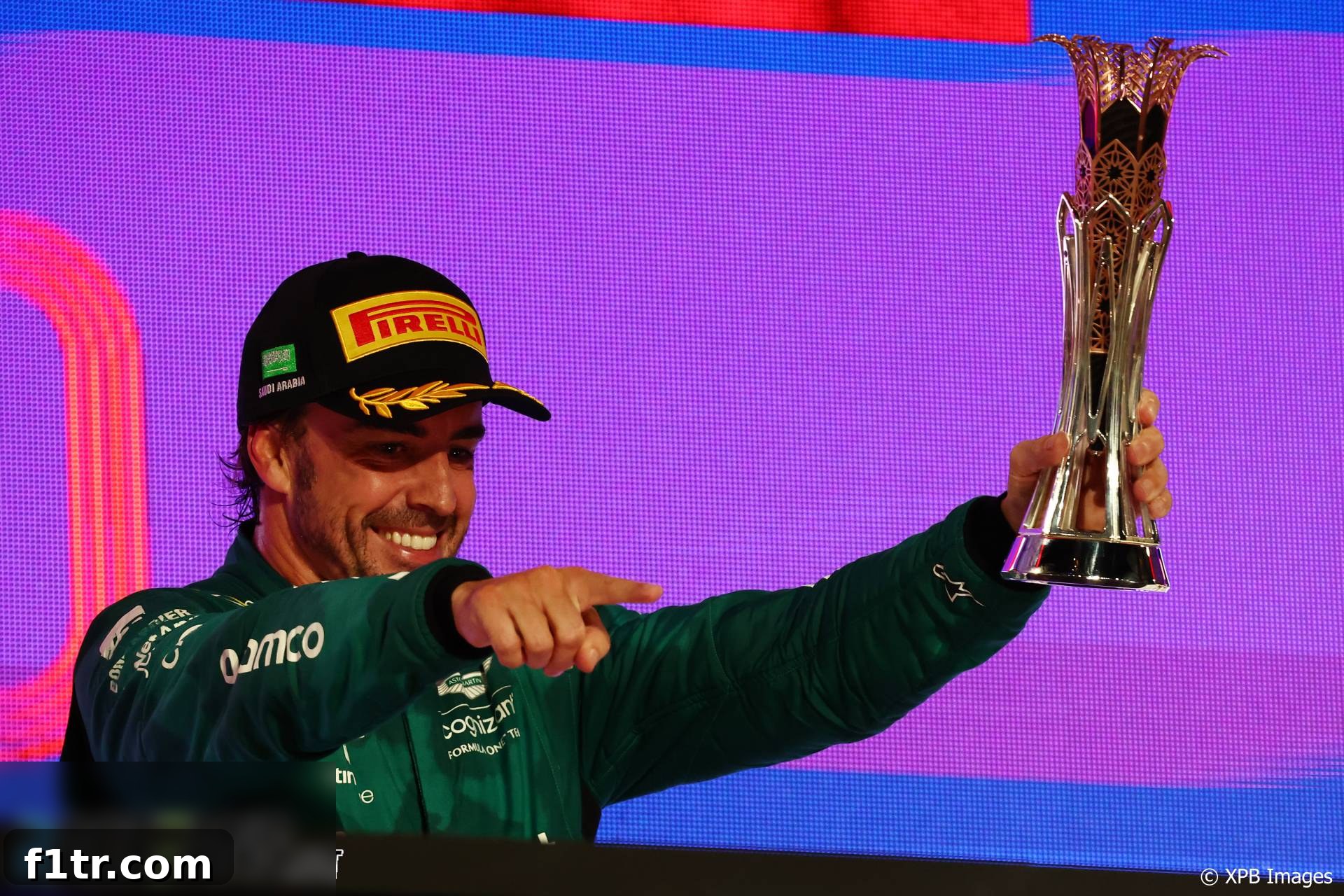
In a dramatic turn of events that sent ripples through the Formula 1 paddock, Fernando Alonso has officially been reinstated to his celebrated third-place finish at the 2023 Saudi Arabian Grand Prix. The initial post-race penalty, which had controversially stripped him of his achievement, was successfully overturned by the stewards following a meticulous review process initiated by the Aston Martin Aramco Cognizant Formula One Team.
The saga began shortly after the checkered flag at the demanding Jeddah Corniche Circuit, where Alonso had delivered a masterful performance to secure what he believed was his 100th career podium. However, jubilation quickly turned to uncertainty when the stewards issued a post-race 10-second time penalty. This additional penalty, tacked onto an earlier five-second infringement, was imposed after officials ruled that Aston Martin mechanics had improperly serviced Alonso’s car during his initial penalty stop. Specifically, the stewards found that a rear jack had touched the number 14 car while Alonso was serving his five-second time penalty, an action deemed a breach of the regulations concerning “working on the car” during a penalty.
The stewards’ initial ruling was unambiguous: “In this case, it was clear, that the car was touched by the rear jack,” they noted in their initial decision. They further elaborated, “Based on the representation made to the stewards that there was an agreed position that touching the car would amount to ‘working’ on the car, the stewards decided to impose a penalty.” This interpretation led to the severe 10-second penalty, which demoted Alonso from third place to fourth, promoting Mercedes driver George Russell to the final podium spot.
The Aston Martin Appeal: A Right of Review
However, the Aston Martin team, convinced they had adhered to the established procedures, swiftly moved to challenge the decision. Shortly after midnight local time, the sport’s governing body, the FIA, confirmed that Fernando Alonso had been summoned to a “right of review” hearing. This critical procedural mechanism, outlined in Article 14.1.1 of the International Sporting Code (ISC), allows a team to request a re-examination of a stewards’ decision if new, significant, and relevant evidence can be presented that was unavailable at the time of the original ruling.
The team’s petition argued that the very basis of the stewards’ initial decision – the alleged existence of a clear, agreed-upon understanding that a jack touching the car constituted “working” on it – was incorrect. They meticulously prepared their case, gathering evidence to demonstrate a lack of such a definitive agreement among all parties, including the FIA and the teams themselves.
Overturning the Verdict: The FIA’s Reassessment
Around 18 minutes after the review began, Fernando Alonso, perhaps with an insider’s premonition or genuine optimism, posted a celebration of his third-place finish on social media. “100th podium,” he wrote. “What an amazing team we have and fast car! Proud of you Aston Martin.” His confidence was soon validated when the FIA officially confirmed that Alonso’s penalty had indeed been overturned. Consequently, he rightfully regained third place in the race classification, and George Russell was demoted back to fourth.
The core of Aston Martin’s successful appeal hinged on demonstrating that the stewards were mistaken in their initial assertion that touching the car with a jack unequivocally constituted “working” on it, thereby violating Article 54.4(c) of the Sporting Regulations. The review panel, after carefully considering Aston Martin’s arguments and new evidence, concluded: “We concluded that there was no clear agreement, as was suggested to the stewards previously, that could be relied upon to determine that parties had agreed that a jack touching a car would amount to working on the car, without more.”
This admission by the stewards highlighted a critical lack of clarity in the existing operational guidelines, specifically regarding the precise definition and scope of “working on the car” during a pit lane penalty. It underscored the necessity for absolute precision in Formula 1’s intricate rulebook, especially when such interpretations can have significant ramifications for race results and championship standings. “In the circumstances, we considered that our original decision to impose a penalty on car 14 needed to be reversed and we did so accordingly,” the stewards acknowledged, rectifying their initial judgment.
FIA Statement on Alonso’s Penalty Reversal
The stewards received a letter dated 19th March 2023 from Aston Martin Aramco Cognizant Formula One Team with a petition for review pursuant to article 14.1.1 of the International Sporting Code (ISC) of this stewards panel’s decision to impose a 10-second penalty to car 14 for failing to serve the penalty properly.
In support of the petition for review, the stewards were shown minutes of the latest SAC meeting and video evidence of seven different instances where cars were touched by the jack while serving a similar penalty to the one imposed on car 14 without being penalised.
The clear submission by the team was that the alleged representation of an agreement between the FIA and the teams that touching the car in any way, including with a jack, would constitute ‘working’ on the car for the purposes of Article 54.4 (c) of the Sporting Regulations, was incorrect and therefore the basis of the steward’s decision was wrong.
In the light of the petition, the stewards had to decide if there was a ‘significant and relevant new element [that was] discovered which was unavailable to the parties seeking the review at the time of the decision concerned’.
If there was such an element(s) then the stewards would need to consider whether the decision needed to be modified in any way.
Having reviewed the video evidence presented and having heard from the team representative of Aston Martin and the relevant members from the FIA, the stewards determined that there did exist significant and relevant new evidence as required under Article 14.1.1 to trigger a review of the decision, in particular the video evidence and the verbal evidence from the team and from the FIA. It was clear to us that the substratum of the original decision, namely the representation of there being an agreement, was called into question by the new evidence.
We therefore proceeded to hear the substance of the request for review.
Having reviewed the new evidence, we concluded that there was no clear agreement, as was suggested to the stewards previously, that could be relied upon to determine that parties had agreed that a jack touching a car would amount to working on the car, without more.
In the circumstances, we considered that our original decision to impose a penalty on car 14 needed to be reversed and we did so accordingly.
Implications and the Road Ahead for F1 Regulations
This incident at the Saudi Arabian Grand Prix highlights the crucial importance of clear, unambiguous regulations in a sport where split-second decisions and intricate procedures are paramount. The presentation of minutes from the Sporting Advisory Committee (SAC) meetings and video evidence of seven previous, unpenalised instances of jack contact proved instrumental in Aston Martin’s successful appeal. This collective body of evidence effectively demonstrated a lack of consistent enforcement or a clear consensus on the rule’s interpretation, a fundamental requirement for its fair application.
For Fernando Alonso, this ruling not only restores his well-deserved podium but also officially marks his incredible 100th career podium in Formula 1. It is a testament to his enduring talent and the remarkable resurgence of the Aston Martin team, who have quickly emerged as strong contenders in the 2023 season. The incident also momentarily impacted the constructors’ championship battle, placing Mercedes ahead of Aston Martin, before being corrected back to reflect Aston Martin’s stronger points haul.
The episode serves as a vital lesson for the FIA and all Formula 1 teams. It underscores the need for continuous review and clarification of technical and sporting regulations to prevent future ambiguities that could lead to such high-profile controversies. Transparency, consistency, and a shared understanding of the rules are essential for maintaining the integrity of the sport and ensuring fair competition. Moving forward, it is anticipated that the FIA will engage in further discussions with teams to establish clearer guidelines regarding pit stop procedures, specifically what constitutes “working on the car” during a penalty, thereby avoiding similar disputes in the future.
2023 Saudi Arabian Grand Prix Further Reading
- “Total transparency” needed over Ben Sulayem allegations – Russell
- FIA president Ben Sulayem under investigation for interfering in F1 race – report
- Two races, no points: How 2023 compares to McLaren’s worst starts to a season
- Don’t complain about Red Bull dominating F1, they deserve it – Sainz
- Alfa Romeo identify “massive debris” which ruined Bottas’ race
Browse all 2023 Saudi Arabian Grand Prix articles