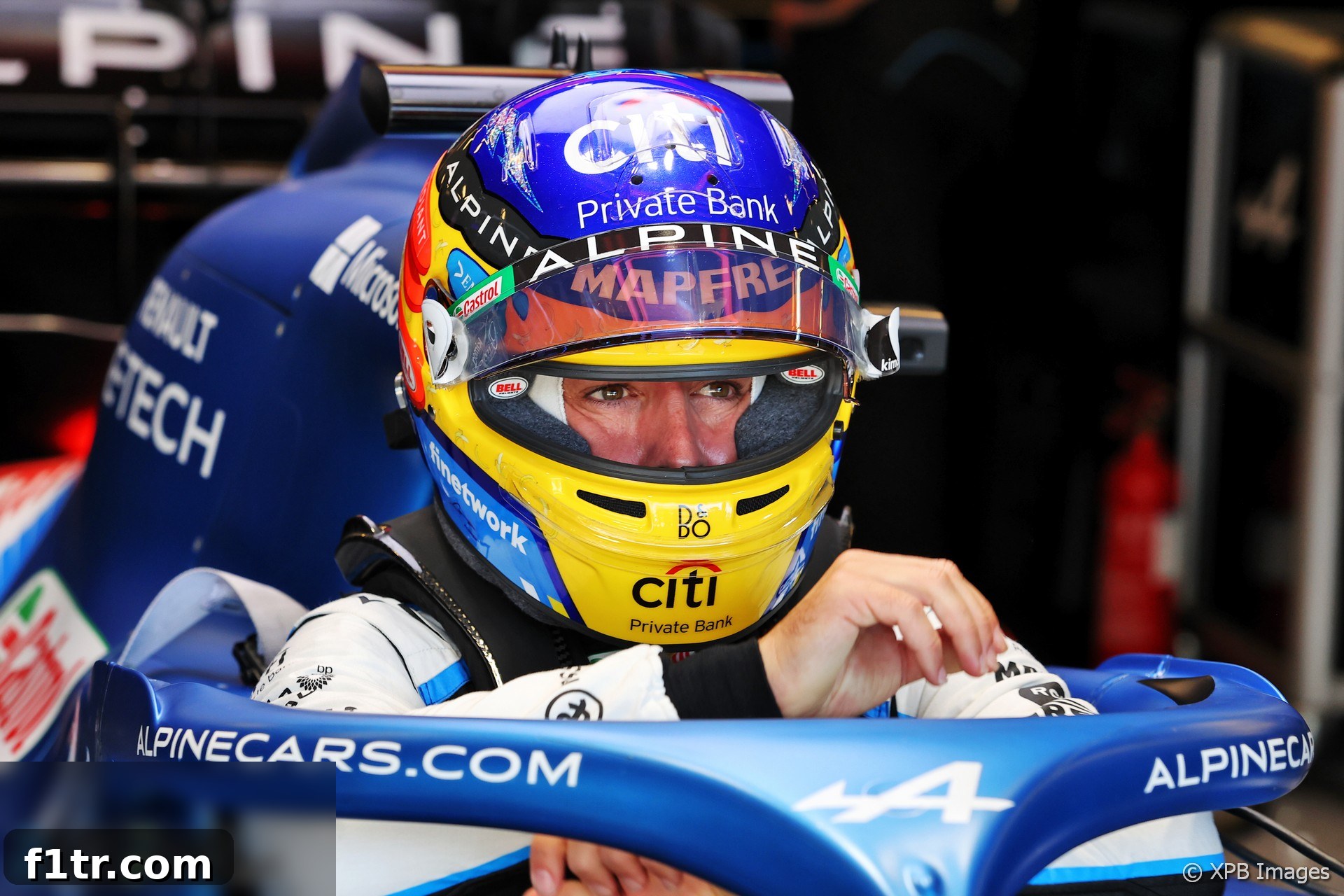
In a bold strategic move ahead of the United States Grand Prix, the Alpine F1 Team decided to equip Fernando Alonso’s car with a new power unit. This decision, while a calculated gamble for future performance, inherently triggered a grid penalty, sending the two-time world champion to the very back of the starting grid. Alonso openly conceded that this tactical choice was a direct consequence of Alpine’s concerning and unexpected lack of competitiveness throughout the weekend at the prestigious Circuit of the Americas (COTA).
Advert | Become a Supporter & go ad-free
Alpine’s Unforeseen Performance Dip at COTA
The initial free practice sessions at COTA presented a challenging scenario for the Alpine F1 Team. Both Alonso and his teammate, Esteban Ocon, found themselves struggling significantly to extract pace and achieve a stable car balance. This performance deficit stood in stark contrast to their more competitive showings in recent Grand Prix weekends. The alarming lack of speed immediately prompted the team to reassess their objectives for the event and formulate a revised strategy to navigate the demanding American circuit.
Alonso’s candid assessment, “We seemed uncompetitive. So we need to understand that,” perfectly encapsulated the team’s predicament. This indicated a deeper issue than just minor setup tweaks, suggesting a fundamental struggle to unlock the car’s full potential on the unique characteristics of the COTA track. The decision to introduce a new power unit, typically reserved for crucial moments or when reliability is genuinely compromised, highlighted the severity of Alpine’s performance woes. While the team confirmed that the existing unit had no inherent reliability issues, the power unit swap served a strategic dual purpose:
- Firstly, it allowed Alpine to absorb the grid penalty on a weekend where scoring significant points already appeared unlikely due to their pace deficit, thus minimizing its immediate competitive impact.
- Secondly, it provided an opportunity to introduce a fresh power unit, potentially with minor upgrades or simply a rejuvenated component, for upcoming races where Alpine anticipated a return to their more usual competitive form. This tactical sacrifice is a common practice in modern Formula 1, especially when a team faces an uphill battle and seeks to optimize its long-term championship outlook.
The Intricacies of Qualifying with a Grid Penalty
For drivers already facing grid penalties, the qualifying session transforms into a complex strategic exercise, vastly different from the conventional pursuit of the fastest possible lap. Fernando Alonso found himself in this unique situation, sharing the back-of-the-grid fate with notable competitors such as Sebastian Vettel and George Russell, all due to power unit changes. For these penalized drivers, the primary objective in Q2 was not to advance to Q3, but rather to optimize their starting positions relative to each other while critically preserving a fresh set of tires for Sunday’s main event. Commencing the race on used tires from a Q3 appearance can significantly compromise a driver’s strategic options and overall race pace, making tire conservation a paramount concern.
Alonso eloquently described the delicate balance required: “We had to see if we could overtake George and Vettel somehow without [lapping too quickly] because you don’t want to set a too quick lap and then accidentally go to Q3 and then you start with the old tyres.” This intricate dance demanded precise judgment – setting a lap time just quick enough to secure a favorable starting position among the penalized cohort, yet deliberately avoiding a pace that would inadvertently propel them into the final qualifying segment. It is a nuanced and often overlooked aspect of F1 qualifying that highlights the strategic depth required, even when starting from the rear.
Teamwork Amidst Adversity: Alonso and Ocon’s Q2 Endeavor
Despite his own strategic limitations, Fernando Alonso demonstrated admirable team spirit by attempting to assist his teammate, Esteban Ocon, during the Q2 session. In a classic display of intra-team collaboration, Alonso provided Ocon with a slipstream on his final flying lap, a well-known tactic designed to shave precious tenths of a second off a lap time. However, even with this valuable assistance, neither Alpine driver managed to break into the top ten, ultimately failing to reach Q3. “We tried to work as a team a little bit, try to help there if I could,” Alonso reflected, acknowledging the collective effort. “But we were not fast enough. It was a help, yes, but we are still missing a couple of tenths to be in the fight.”
Alonso’s candid assessment underscored the fundamental challenge: a pervasive lack of inherent pace within the Alpine A521 at COTA, which even well-executed strategic teamwork could not fully mitigate. The collective failure of both Alpine cars to progress to Q3 was a significant and concerning indicator of their struggles. Historically, the team has been a consistent presence in the final qualifying segment, often securing valuable grid positions. This widespread performance dip hinted at deeper, more systemic issues than just minor setup adjustments, possibly pointing towards a fundamental mismatch between the car’s characteristics and the COTA circuit layout, or perhaps an unexpected struggle with specific tire compounds under the Texan climate. It served as a potent reminder of Formula 1’s unforgiving nature, where even subtle performance discrepancies can have amplified consequences on the grid.
Searching for Answers: Alpine’s Post-Qualifying Deep Dive
The palpable disappointment in the Alpine garage after qualifying was undeniable. Alonso stressed the critical and urgent need for a comprehensive analysis to accurately pinpoint the root cause of their sudden and dramatic drop in performance. “The worst thing for us is that we didn’t have the pace this weekend in any of the practice [sessions],” he lamented. This consistent underperformance, evident across all Free Practice sessions from FP1 through to FP3, strongly suggested that the issues were not isolated to specific track conditions or fleeting driver errors, but rather deeply embedded in the car’s setup, aerodynamic package, or fundamental operating window at COTA.
The team had indeed engaged in relentless work overnight between Friday and Saturday, implementing numerous changes to the car’s setup in a determined attempt to rectify the situation. These adjustments, meticulously informed by data gathered from FP1 and FP2, were specifically designed to improve the car’s balance, mechanical grip, and overall responsiveness. However, as Alonso confirmed, these significant efforts yielded only limited success. “After FP1 and FP2 we had some ideas on where we could improve the car. So overnight we did a lot of changes but this morning, [it was] still not as competitive as it was in the last two grands prix, so there’s still more analysis to be made.” The persistence of their struggles despite substantial modifications underscored the sheer complexity of the problem and the absolute necessity for a more profound understanding of why the Alpine A521 was simply not performing to its expected standards on this particular circuit. This deep dive into the data would be crucial for the remainder of the season and future car development.
The Road Ahead: Aiming for Points from the Back of the Grid
Despite the formidable challenge of a grid penalty and the significant performance hurdles, Fernando Alonso, a veteran competitor renowned for his resilience, maintained a pragmatic yet optimistic outlook regarding the prospect of scoring points in the race. Starting from the very back of the grid presents an immense task, yet COTA, with its unique layout featuring long straights, varied corner sequences, and elevation changes, does offer a reasonable number of overtaking opportunities. Alonso’s vast experience, strategic acumen, and exceptional race craft would be indispensable in navigating the tightly packed midfield, capitalizing on any incidents, and exploiting potential safety car periods.
“Reliability is still good, no issues there, so let’s see if tomorrow we can still score points from last,” he stated, highlighting the one consistent positive for Alpine – the proven robustness of their machinery. The objectives for Sunday’s race would be multifaceted: for Alonso, to maximize his points potential despite his starting position; and for Ocon, to maintain a solid position and secure any available championship points. For the team as a whole, the race would also serve as an invaluable extended test session, providing crucial real-world data for their ongoing analysis. Understanding how the car behaves under full race conditions, particularly concerning tire degradation, fuel management, and aerodynamic efficiency, would be absolutely critical for future car development and for informing their approach to similar circuits in the remaining races of the season. Every single lap completed at COTA, even from the back of the pack, would contribute significantly to their diagnostic efforts and help pinpoint areas for improvement.
Broader Implications for Alpine’s Championship Campaign
The unexpected and significant dip in performance at COTA posed pertinent questions regarding Alpine’s overall trajectory in the highly competitive 2021 Formula 1 season. Having previously demonstrated strong form and even securing a memorable victory earlier in the year, maintaining consistency is paramount for consolidating their position in the Constructors’ Championship. While a single challenging weekend does not define an entire season, swiftly understanding and rectifying such performance anomalies is crucial for a team with championship aspirations, even if those are currently aimed at battling for supremacy within the fiercely contested midfield.
The relentless nature of Formula 1 means that rival teams are continuously pushing the boundaries of development, often bringing upgrades to each race. A sudden lack of pace from Alpine could indicate that other teams have made significant performance strides, or that Alpine’s car struggled uniquely with specific track characteristics at COTA that exposed inherent weaknesses in its design or setup philosophy. COTA, with its distinct blend of high-speed esses, heavy braking zones, and highly technical sections, serves as a comprehensive and unforgiving test of a car’s overall package.
The wealth of data collected from this weekend will be absolutely vital for guiding the team’s ongoing development efforts, not just for the immediate future of the current season but also, crucially, for informing their approach to the highly anticipated 2022 technical regulations and car design. As the Formula 1 season progresses through its demanding calendar, every Grand Prix presents a new engineering challenge and an invaluable opportunity for teams to learn, adapt, and refine their machinery. Alpine’s dedicated engineers will now meticulously pore over every piece of telemetry from COTA, rigorously comparing it against their extensive simulations and the performance data from more successful weekends. The overarching goal will be to identify specific areas where the car demonstrably underperformed – perhaps in aerodynamic efficiency through COTA’s fast corners, mechanical grip over its bumpy surfaces, or power unit deployment strategies in the unique high-altitude conditions of Austin. This meticulous, forensic analysis forms the backbone of Formula 1 development, ensuring that any temporary step backward is swiftly followed by a determined, data-driven leap forward in performance.
Advert | Become a RaceFans supporter andgo ad-free
2021 United States Grand Prix Insights
For more detailed perspectives and analysis from the 2021 United States Grand Prix weekend, explore these related articles:
- Mercedes encouraged despite ‘toughest race for a long time’ in Austin
- For the sake of the title fight, F1 must get a grip on its track limits problem
- Pit stop problems costing Ferrari “quite a lot of points” – Sainz
- Sold-out crowd of 380,000 at COTA shows F1 can add third US race – Brawn
- While the pressure’s off I can “push myself” more – Russell
Browse all 2021 United States Grand Prix articles