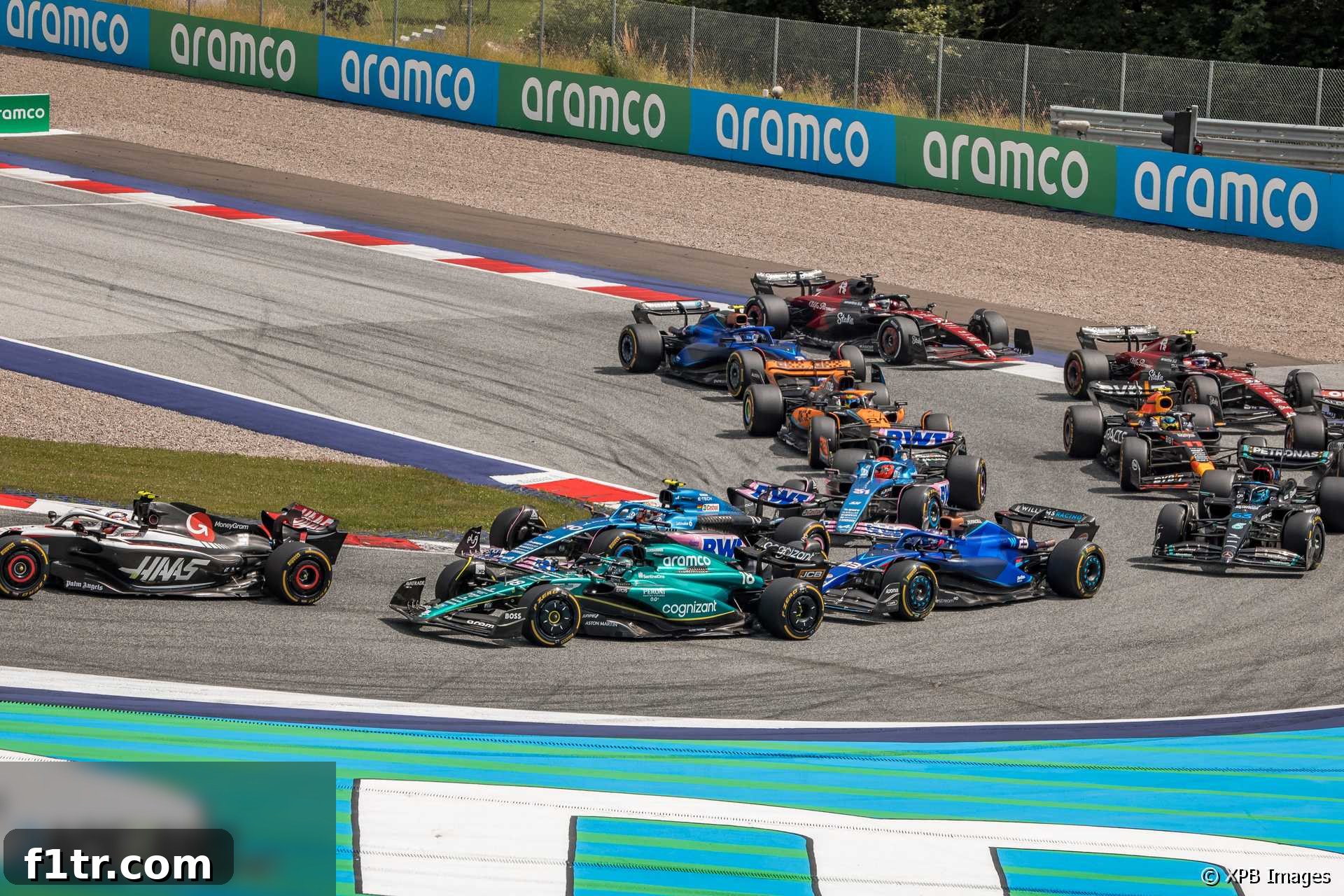
The aftermath of the Austrian Grand Prix unfurled into a significant procedural review, culminating in a dramatic shake-up of the official race results. Spearheading this review was Aston Martin, whose formal protest following the initial classification sparked a meticulous re-evaluation of track limits infringements that ultimately led to substantial penalties for numerous drivers and a revised final order. This incident at the Red Bull Ring not only highlighted the persistent challenges of track limits enforcement in modern Formula 1 but also ignited a broader discussion about the practicality and fairness of current regulations and circuit design.
Aston Martin lodged their protest with the FIA stewards, asserting that a significant number of track limits breaches had gone unpunished during the Grand Prix. Their contention stemmed from the belief that several competitors had gained an unfair advantage by repeatedly exceeding the defined boundaries of the circuit, particularly in specific corners known for being problematic. The stewards, after careful consideration, deemed the protest admissible, acknowledging the merit in Aston Martin’s argument and triggering an extensive investigative process.
The scale of the problem quickly became apparent. While seven drivers had initially received penalties during the race for committing at least four track limits violations, the FIA’s subsequent revelation painted a much larger picture. Race control had documented over a thousand suspected instances of drivers straying beyond the white lines throughout the Grand Prix. This staggering figure underscored the sheer volume of data that needed to be processed and the inherent difficulty in monitoring every single infraction in real-time, under race conditions, with the current technological setup.
Following Aston Martin’s intervention, the stewards embarked on a comprehensive review. This involved meticulously examining the vast dataset of deleted lap times and telemetry, cross-referencing it with video evidence, to identify any infringements that had not been previously flagged for penalty. This detailed post-race analysis revealed what the stewards described as “a number of track limit infringements had not previously been referred to the stewards for potential penalty.” The conclusion was clear: “It was determined that some of these infringements warranted a penalty that was not previously applied when the Provisional Classification was published.”
The Revised Penalties: A Race Order Reshuffled
The outcome of this extensive review was the issuance of a further 12 penalties, distributed among eight different drivers. These additional sanctions significantly altered the final classification, reshaping the points distribution and highlighting the critical importance of adhering to track limits. The most heavily affected driver was Esteban Ocon of Alpine, who received four separate penalties, accumulating a total of 30 seconds added to his race time. This significant time addition severely impacted his final position, demonstrating the severe repercussions of persistent infringements.
Nyck de Vries also faced multiple penalties, with a cumulative 15 seconds added to his race time. Other prominent drivers were not immune; Lewis Hamilton, Carlos Sainz Jnr, Pierre Gasly, Alexander Albon, and Logan Sargeant each received a 10-second time penalty. Yuki Tsunoda, who had already been handed a 10-second penalty during the race, received a further five seconds, underscoring the severity of his repeated violations. These cumulative penalties collectively painted a picture of widespread track limit transgressions that necessitated firm action from the FIA.
The stewards clarified the specific penalty system applied during their review, particularly noting adjustments for drivers with multiple infractions. They explained: “For four infringements, a five-second time penalty; for five infringements, a 10 second time penalty.” Crucially, they introduced a ‘reset’ mechanism due to the “excessive number of infringements.” This meant that after accumulating a certain number of penalties, the count of infringements would restart. “After another four infringements, a five-second time penalty will apply; after five, a 10 second time penalty,” the stewards elaborated. This tiered system aimed to address the unprecedented volume of breaches while maintaining a structured approach to penalization.
The Red Bull Ring’s Persistent Problem and Calls for a Solution
The 2023 Austrian Grand Prix was not an isolated incident; the Red Bull Ring has a history of track limits issues, largely due to its high-speed nature and the configuration of certain corners, particularly Turns 9 and 10. The vast run-off areas, designed for safety, inadvertently encourage drivers to push beyond the white lines to gain marginal lap time. This inherent design challenge puts constant pressure on race control and the stewards, leading to situations like the one witnessed in Austria.
In their official report, the FIA stewards did not mince words, issuing a strong recommendation: “very strongly recommend that a solution be found to the track limits situation at this circuit.” This statement reflects the frustration and difficulty faced by officials in consistently policing the rules under such challenging circumstances. The sheer volume of potential infringements during the race made it almost impossible for real-time adjudication, necessitating the lengthy post-race review that led to the revised results.
The incident reignited debates within the Formula 1 community regarding potential solutions. Many voices, including drivers, team principals, and pundits, suggested that a more robust, perhaps automated, system is needed to detect and penalize track limits. Others called for physical changes to the circuit itself. Introducing gravel traps or more aggressive kerbs in critical corners, rather than vast asphalt run-offs, could act as a natural deterrent, making it physically costly for drivers to exceed track limits. However, any such changes would need to carefully balance safety considerations with the imperative of fair competition.
Implications for Formula 1 and Future Enforcement
The revised results of the Austrian Grand Prix carried significant implications, not just for the drivers involved but for the championship standings and the integrity of the sport. Points allocations were altered, impacting team and driver championships. Beyond the immediate changes, the incident served as a stark reminder of the challenges inherent in policing track limits in an era of extreme precision and speed. It emphasized the need for consistent, transparent, and enforceable regulations that can be applied effectively across all circuits.
The episode also put a spotlight on the role of protests in Formula 1. Aston Martin’s successful challenge demonstrated that teams have a vital role to play in ensuring fair competition and holding the governing body accountable. It highlighted that even after the checkered flag falls, the results are not always final, especially when procedural irregularities or overlooked infringements are brought to light.
Looking ahead, the FIA and Formula 1 will undoubtedly take the lessons learned from the Red Bull Ring to heart. There is a clear imperative to explore technological advancements that can assist in real-time monitoring of track limits, reducing the reliance on manual review and ensuring greater consistency. Furthermore, discussions with circuit owners and designers about modifications to problematic corners are likely to intensify. The ultimate goal remains to find a sustainable solution that allows drivers to race hard while clearly defining and effectively enforcing the boundaries of fair play, thereby preventing a repeat of the “track limits farce” that overshadowed the 2023 Austrian Grand Prix.
2023 Austrian Grand Prix Coverage
- Mercedes left scratching heads by lack of performance at Austrian GP
- Verstappen’s determination to grab every point makes him a record-breaker
- Austrian GP track limits farce was avoidable like ‘IndyGate’ and Spa 2021 – Brown
- Alpine now “definitely beatable” for McLaren after upgrade – Brown
- Paddock Diary: 2023 Austrian Grand Prix
Browse all 2023 Austrian Grand Prix articles