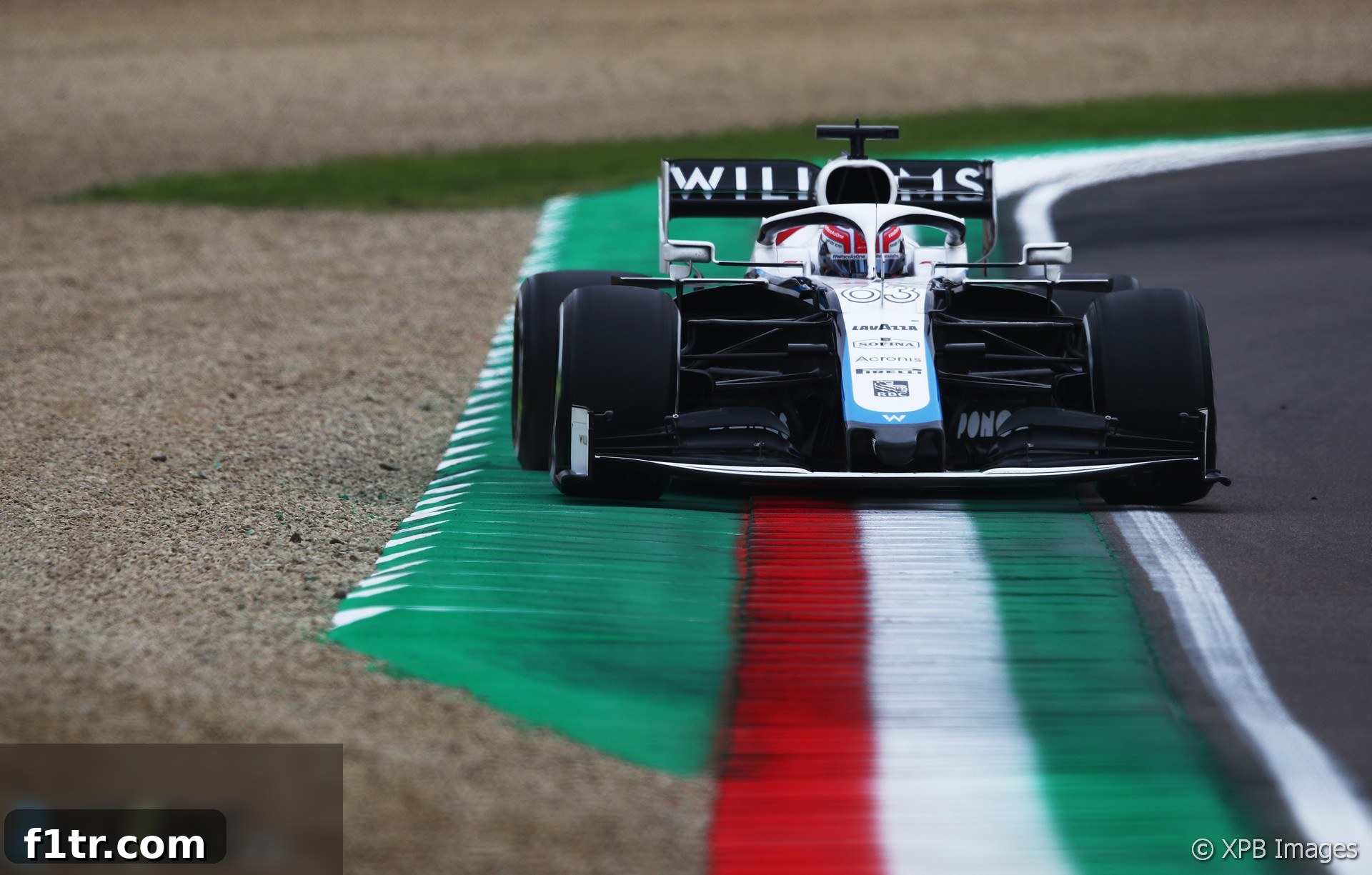
George Russell, a name synonymous with immense talent and future promise in Formula 1, found himself in an unenviable position following the 2020 Emilia-Romagna Grand Prix at Imola. The young British driver, at the wheel of his Williams, openly admitted that a crash during a Safety Car period, which abruptly ended his chances of scoring his maiden Formula 1 points, was unequivocally the “biggest mistake” of his burgeoning career. This candid confession offered a glimpse into the immense pressure and high stakes that define the pinnacle of motorsport, especially for a driver striving to make his mark with a team battling at the back of the grid.
A Costly Error Under the Safety Car at Imola
The incident unfolded on lap 53 of a tense race, with Russell comfortably holding onto 10th position – a truly remarkable feat for Williams at the time, given their performance struggles. Under the Safety Car, deployed following Max Verstappen’s dramatic tyre failure, Russell was diligently working to maintain temperature in his 40-lap old hard compound tyres. However, as he navigated the downhill approach to the challenging Acqua Minerale section of the historic Imola circuit, he lost control of his car. The unforgiving barriers offered no quarter, and Russell’s Williams FW43 slammed into them, bringing a crushing end to what had been a meticulously executed race up to that point. The sight of his car in the wall, with a potential points finish snatched away, was a stark and painful image for both Russell and his dedicated team.
Russell’s immediate reaction was one of profound disappointment and self-criticism. He offered no excuses, taking full responsibility for the error that extinguished his hopes of securing a valuable championship point. “It’s definitely the biggest mistake I have ever made in my career,” Russell stated, his voice laced with regret. He elaborated on the intense effort he was putting in to keep the tyres alive, a critical but delicate balancing act under Safety Car conditions where grip levels plummet rapidly.
The Perilous Pursuit of Tyre Temperature and Grip
Maintaining optimal tyre temperature is a perpetual challenge in Formula 1, especially on colder days or during Safety Car periods when speeds are significantly reduced. Russell was operating on hard compound tyres that had already completed a substantial 40 laps. These durable but slower tyres are notoriously difficult to keep in their ideal operating window, particularly when they cool down. As Russell explained, he was “pushing like hell from the start to finish” and, under the Safety Car, was “just giving it absolutely everything to keep the tyres in. Really trying to find the limit.” This aggressive approach, born out of necessity to prevent the tyres from becoming dangerously cold and slick, ultimately proved to be his undoing.
The nuances of tyre management extend beyond mere temperature. The hard compound, while offering longevity, provides less natural grip than softer compounds. When these tyres cool, their grip diminishes exponentially, turning them into unpredictable entities. Drivers must weave and brake aggressively to generate friction and heat, a risky manoeuvre on a cold track with limited adhesion. Russell’s attempt to find this precarious limit, coupled with hitting a small bump as he changed gear, proved to be a fatal combination. “There are absolutely no excuses. I hit a small bump as I changed gear and I was already in the wall before I could save it. It’s just absolutely gutting,” he candidly admitted, highlighting the razor-thin margins for error that define Formula 1.
The Weight of Elusive Points for Williams and Russell
For George Russell, scoring a world championship point has remained an agonizingly elusive goal throughout his Formula 1 career. Despite consistent strong qualifying performances, often extracting more pace from the Williams than arguably possible, circumstances or misfortune have consistently conspired against him in races. The 10th place at Imola represented not just a potential personal milestone, but a monumental achievement for the Williams Racing team. At that stage of the 2020 season, Williams was battling fiercely at the very rear of the grid, desperately seeking any opportunity to break into the top ten and register their first championship points.
A single point, while seemingly insignificant in the grand scheme of the constructors’ championship, carries immense weight for a team like Williams. It boosts morale, validates the hard work of hundreds of individuals, and can even have financial implications. Russell understood this implicitly. His disappointment was amplified by the realization that he had not only let himself down but also the entire team that had poured endless effort into giving him a competitive package that weekend.
Russell drew a comparison between his current predicament and past mistakes in junior categories. In feeder series like Formula 2 or GP3, a mistake might cost a race, but the next opportunity to rectify it often arrives swiftly, with similar competitive machinery. In Formula 1, especially with a team fighting at the tail end, such opportunities are rare and precious. “I’m kicking myself even more because previously in junior series if I were to make a mistake and, say, lose a race, you know that you go to the next one and you’re in that position again,” Russell reflected. The rarity of finding himself in a points-scoring position, particularly with Williams, made the Imola error all the more bitter. Despite the setback, he commended his team’s performance, acknowledging, “I think the team did an amazing job this weekend. There’s a lot of things to take away that were positive to be in that position.”
The Hypothesized Battle with Kimi Räikkönen
Adding another layer of pain to the incident was Russell’s firm belief that he could have held off Kimi Räikkönen at the impending Safety Car restart. The Alfa Romeo driver, who had pitted for fresh soft tyres under the Safety Car, would have undoubtedly possessed a significant grip advantage. However, Williams had strategically set up Russell’s car for superior straight-line speed, a characteristic they hoped would be their defensive weapon.
“We set the car up to have good straight-line speed this weekend,” Russell explained, outlining his tactical thinking. He knew the challenge Räikkönen presented, especially with the Finn on “new hot tyres” while his own had plummeted in temperature. Despite this clear disadvantage in tyre performance, Russell remained confident in his ability to defend. “I think we could have [held Räikkönen off]. I think we had enough of a pace advantage on the straight to be able to hold him off. It would be very, very tricky, but I believe I could have held him off.”
This hypothetical duel highlights the intricate strategies and split-second decisions that define Formula 1. Russell’s confidence, despite the odds, underscores his competitive spirit and astute understanding of racecraft. The inability to test this theory on track, due to his uncharacteristic error, likely compounded his frustration, leaving him to wonder what might have been. It’s a testament to his belief in both himself and the setup of his Williams car that he felt capable of warding off a world champion on superior rubber.
A Defining Moment in a Promising Career
George Russell’s career trajectory has consistently pointed towards a future at the very top of Formula 1. Praised for his exceptional qualifying pace, technical feedback, and racecraft, he has long been touted as a future world champion. The Imola incident, while undoubtedly a low point, serves as a crucial, albeit harsh, learning experience. In the unforgiving world of F1, where the smallest lapse in concentration can have monumental consequences, such moments are often what forge the greatest drivers.
This mistake, publicly acknowledged with such candor, showcases a level of maturity and accountability that bodes well for his future. Rather than deflecting blame, Russell faced the error head-on, indicating a strong character and a commitment to self-improvement. It’s these moments of adversity that often define a driver’s mental strength and resilience, ultimately contributing to their growth.
The 2020 Emilia-Romagna Grand Prix: A Race of Unexpected Turns
The 2020 Emilia-Romagna Grand Prix was, in many respects, a race filled with drama and unexpected turns, even beyond Russell’s incident. From Pierre Gasly’s early retirement after a strong qualifying, to Lance Stroll’s near-miss with a marshal, and Max Verstappen’s dramatic puncture while running second, Imola delivered a spectacle characteristic of its historic and challenging nature. Russell’s crash was a significant part of this narrative, underscoring the relentless pressure drivers face and the fine margins separating success from despair. The race ultimately saw Lewis Hamilton take another dominant victory, but for many, it was the dramatic midfield battles and unforeseen incidents that truly captured the essence of Formula 1.
Conclusion: Learning from the “Biggest Mistake”
George Russell’s self-proclaimed “biggest mistake” at the 2020 Emilia-Romagna Grand Prix was a poignant reminder of the brutal realities of Formula 1. It underscored the immense pressure, the unforgiving nature of high-speed racing, and the critical importance of every single decision, especially under Safety Car conditions. While the immediate aftermath was undoubtedly filled with heartbreak and frustration for Russell and the entire Williams team, the incident also served as a profound learning opportunity.
Russell’s ability to candidly acknowledge his error, take full responsibility, and articulate his thought process demonstrated a level of maturity beyond his years. This resilience and commitment to understanding and overcoming setbacks are precisely the qualities that define true champions. As he continues his journey in Formula 1, this moment at Imola will undoubtedly be etched into his memory, serving as a powerful lesson that will contribute to his evolution as a driver. The road to Formula 1 greatness is rarely smooth, and sometimes, it’s the biggest mistakes that pave the way for future triumphs.
2020 Emilia-Romagna Grand Prix Related Articles
- Gasly says potential lost podium at Imola was his most painful retirement yet
- An F1 marshal explains why Stroll’s Imola near-miss raises safety concerns
- McLaren must seek “smallest gains” in qualifying to fight for third
- Pirelli begins probe into Verstappen tyre failure
- 2020 Emilia-Romagna Grand Prix Star Performers
Browse all 2020 Emilia-Romagna Grand Prix articles