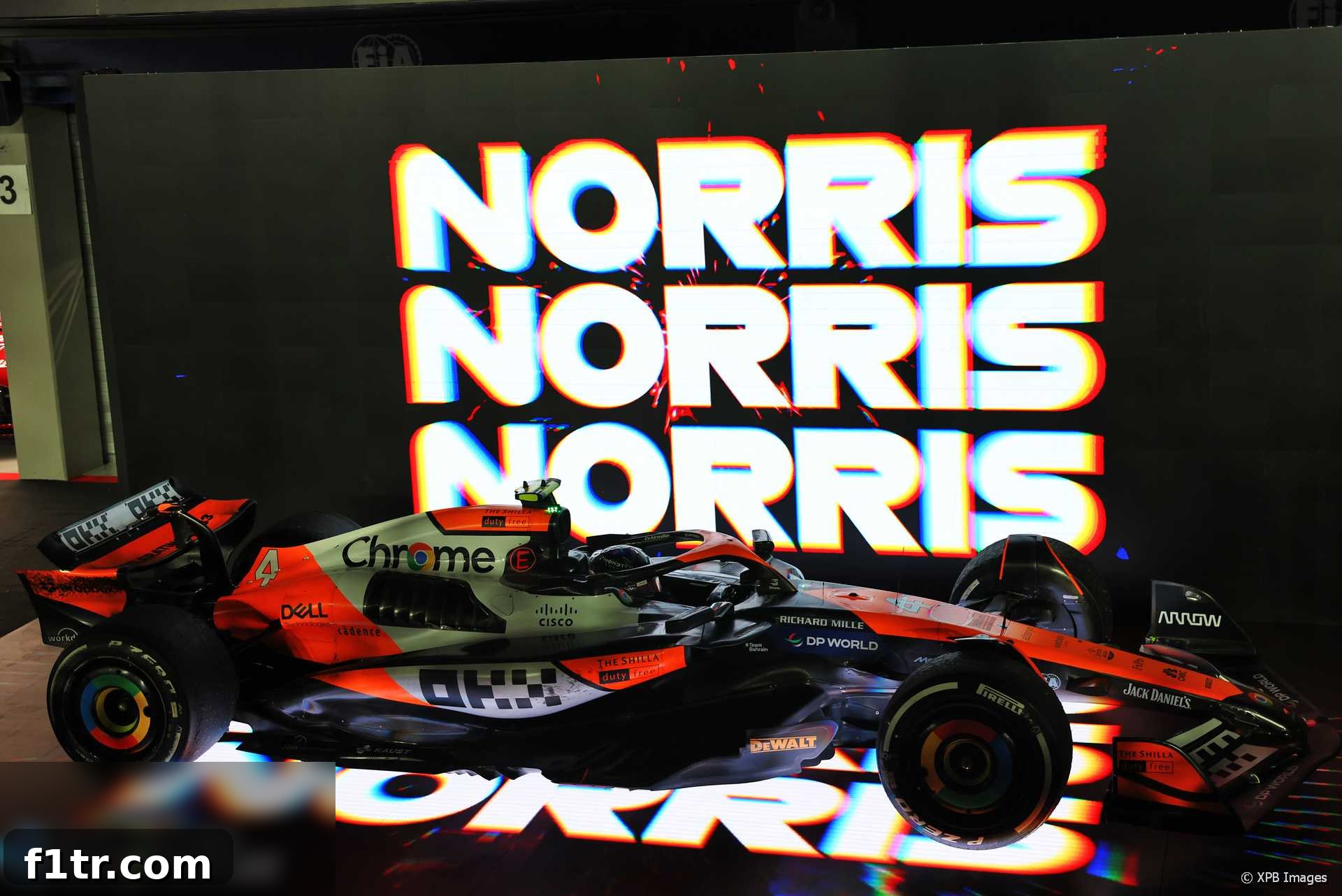
Lando Norris recently reflected on McLaren’s outstanding performance at the Singapore Grand Prix, a victory that resonated even more profoundly in the wake of the ‘mini DRS’ rear wing controversy that had previously put the team under scrutiny. His emphatic win, leading by a substantial margin for much of the race, served as a powerful testament to the inherent strength and consistent development of the McLaren MCL38.
The controversy surrounding McLaren’s rear wing design first emerged during the Azerbaijan Grand Prix weekend. Rivals had raised concerns that the wing exhibited excessive flexibility under peak aerodynamic loads at high speeds, potentially offering an unfair performance advantage akin to a ‘mini DRS’ effect. Following discussions and a deeper technical analysis, McLaren proactively agreed to modify the design, ensuring full compliance with technical regulations. This adjustment, made weeks prior to the Singapore race, added an extra layer of significance to Norris’s dominant display, effectively silencing critics and reinforcing the team’s genuine progress.
Speaking after his victory on the demanding streets of Singapore, Norris emphasized the continuity and evolution of McLaren’s machinery. “We’ve not changed anything on the car from here to last weekend or the weekend before,” he stated, highlighting the team’s consistent developmental path. He further elaborated on the compliance efforts: “We’ve even had to make tweaks to some of our wings and things that people have complained about. But we’ve still had a great weekend and probably one of our most dominant weekends here.” This assertion directly countered any lingering suggestions that the previous wing design was central to their competitiveness, instead attributing success to a more fundamental improvement in the car’s overall package.
Norris unequivocally dismissed the notion that the ‘mini DRS’ had been a decisive factor in McLaren’s enhanced performance. “I don’t think that’s made the difference, honestly,” he remarked with conviction. “It was just that the car’s been mega for a good amount of time.” This sentiment underscores a crucial aspect of modern Formula 1: success is rarely due to a single component, but rather a meticulously engineered synergy of aerodynamics, chassis, power unit integration, and operational execution. McLaren’s trajectory through the season had shown a clear upward trend, with the team consistently challenging at the front, especially on circuits that suited their car’s characteristics.
The journey to this dominant win wasn’t without its personal challenges for Norris. He admitted to moments of self-criticism and missed opportunities in previous races where he felt he possessed the pace to win. “I’ve not been able to come out on top for quite a few of them when I felt like I had the pace and I had the ability to do,” he confessed. “Some of that is down to my own fault and not executing things well enough.” This candid reflection highlights the immense pressure and razor-thin margins that define F1 at the highest level, where even minor errors can cost a victory. It also speaks to his growth as a driver, learning from past experiences and refining his race craft.
However, the Singapore Grand Prix proved to be a different story. “So I’ve paid the price for not doing a good enough job at times. But when I lead after turn one and things are a bit more straightforward then we can have a day like today,” Norris explained. A clean start and securing the lead early on significantly simplified his race strategy and allowed him to dictate the pace. On a street circuit like Singapore, renowned for its narrow confines and unforgiving walls, track position is paramount, and leading from the front minimizes exposure to potential incidents and aerodynamic turbulence from other cars.
Despite his commanding lead, Norris did acknowledge two minor incidents during the race, where he made light contact with the barriers at turns 10 and 14. These fleeting brushes with the unforgiving concrete walls are common occurrences on demanding street circuits, even for the most precise drivers. Yet, he reported that the contact did not seem to have any discernible impact on the car’s handling or performance. “The team said that there was something with the front wing maybe being a little bit off,” he recounted. “I hit the front wing against the barrier, so it might have tweaked it a touch, but I don’t think probably much to change it.”
The intricate engineering of modern Formula 1 cars means that even seemingly minor impacts can have complex consequences, altering the delicate aerodynamic balance. Norris, however, noted the difficulty in immediately discerning such subtle changes from within the cockpit at race speeds. “But it’s hard to know,” he mused. “On these cars, as soon as you tweak something a tiny bit, it can have quite a big impact, but nothing that I was probably feeling.” This demonstrates the incredible sensitivity of these machines and the innate feel drivers develop, even if a marginal performance degradation might not be immediately apparent.
One of the errors, in particular, was attributed not to a lapse in concentration, but to the challenging aerodynamic environment created when closing in on cars he was about to lap. “You have a little bit less grip, a little bit less downforce,” Norris explained, describing the effect of “dirty air” or turbulent air generated by cars ahead. This disruption of clean airflow over the following car’s aerodynamic surfaces severely reduces its efficiency, making braking and cornering more unpredictable. “The tyres are going away a little bit. It just caught me out.” He clarified, “So it wasn’t like a lack of concentration or anything. It was just a bit of a surprise to me.” This offers valuable insight into the dynamic and often unforgiving nature of racing at the highest level, where external factors can swiftly alter the car’s behavior.
Lando Norris’s victory at the Singapore Grand Prix stands as a significant milestone for both the driver and the McLaren team. It solidified his reputation as a genuine race winner and underscored McLaren’s impressive journey of recovery and development within the competitive landscape of Formula 1. By delivering a dominant performance without reliance on controversial aerodynamic components, the team sent a clear message about their organic progress and the efficacy of their sustained engineering efforts. The win was a powerful affirmation that McLaren’s current trajectory is built on solid foundations, promising an exciting future for the team and its highly talented young driver.
Looking ahead, this victory provides McLaren with immense momentum as the season progresses. It validates the hard work of countless individuals at the factory and on track, demonstrating that their current car concept is highly competitive across various circuit types. For Norris, it’s a crucial confidence boost, proving his ability to convert pole positions or strong starting grid slots into decisive race wins. The Singapore triumph is not merely a single race victory; it’s a statement of intent, signaling McLaren’s return to the upper echelons of Formula 1 and positioning Norris as a consistent contender for future championships.
Further Reading on the 2024 Singapore Grand Prix
- Ricciardo’s brake woe and why Perez thought he had an engine problem: Singapore GP radio
- ‘Perez is only quicker when he has DRS’: How Hulkenberg’s Haas beat a Red Bull – again
- Mercedes explain “clear mistake” strategy call which left Hamilton “so angry”
- “Sometimes I wonder why I do this”: How Hamilton endured a slog to sixth in Singapore
- F1’s rules need surgery as well as sticking plaster after fastest lap controversy