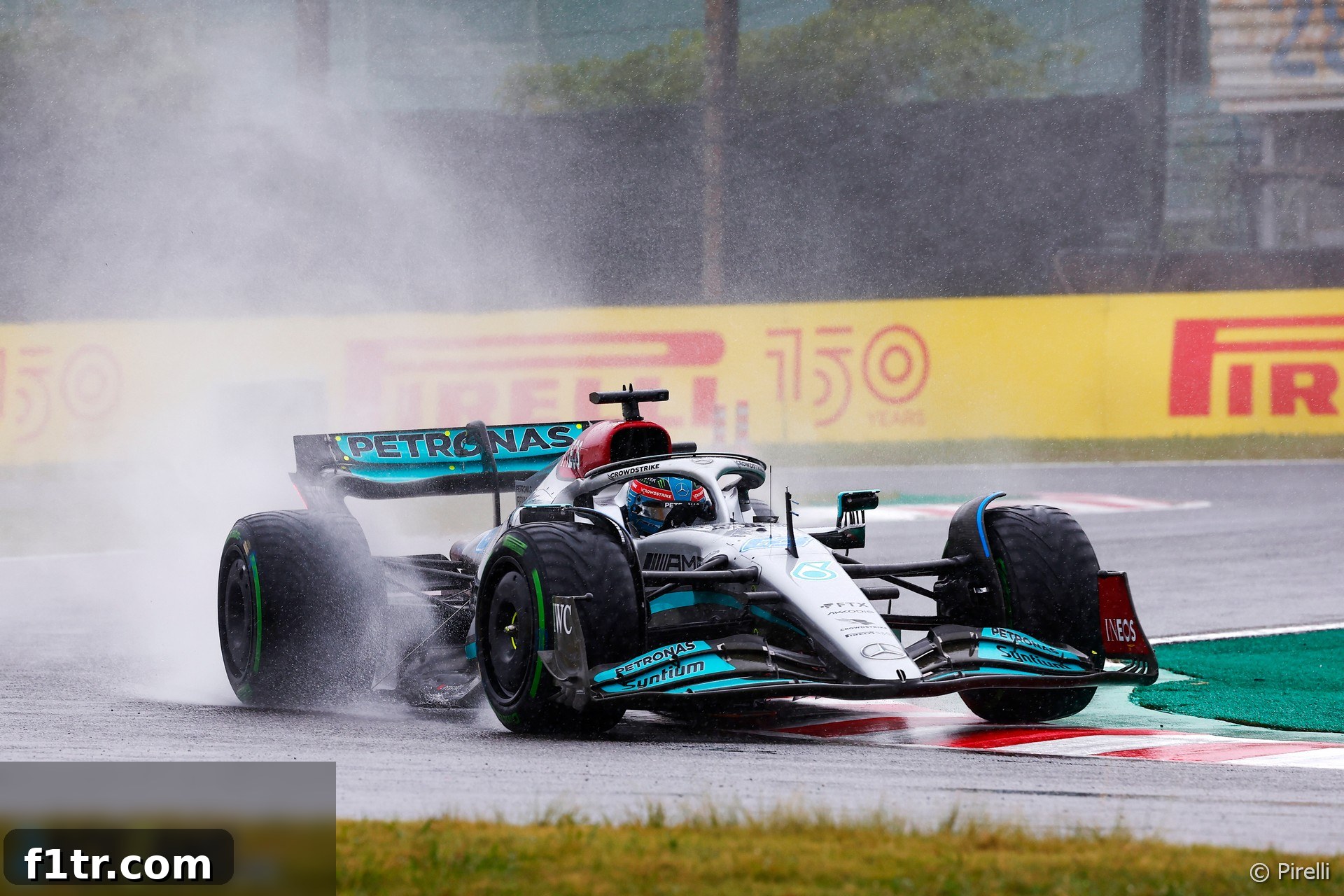
George Russell Reigns Supreme in Rain-Soaked Japanese Grand Prix FP2
Mercedes Leads a Challenging Wet Practice Session at Iconic Suzuka
George Russell delivered a stellar performance to emerge as the fastest driver, leading a dominant Mercedes 1-2 in a challenging, rain-soaked second practice session for the Japanese Grand Prix at Suzuka. His teammate, Lewis Hamilton, secured the second-fastest time, underscoring the team’s unexpected prowess in the treacherous conditions that gripped the iconic Japanese circuit. The Silver Arrows outpaced their fierce rivals, the two Red Bull drivers, Max Verstappen and Sergio Perez, signalling a fascinating dynamic for the remainder of the weekend.
Friday’s afternoon session, an extended 90 minutes in duration, unfolded entirely under the grey, wet skies of Suzuka, mirroring the conditions experienced during the morning’s opening practice. The continuous downpour meant the legendary circuit remained fully saturated, presenting a significant test for all 20 drivers and their machinery. The unusually long session was initially slated to include vital testing for Pirelli’s 2023 prototype tyres. However, the unrelenting wet weather forced a change of plans, with the tyre test abandoned. Despite this, the session maintained its extended timeframe, offering teams more track time to fine-tune their wet-weather setups, a crucial factor given the persistent rain.
Key Incidents and Early Challenges Define Wet FP2
The session began with a notable absence: Mick Schumacher of Haas was sidelined. His unfortunate crash after the chequered flag in FP1 had left his car with significant damage, necessitating a chassis change. The Haas team faced a race against time, unsure whether the impact had cracked the chassis itself, preventing Schumacher from participating in the entirety of FP2 and adding a layer of concern for his weekend prospects.
As the pit lane lights turned green, Nicholas Latifi was the first brave soul to venture onto the sodden track in his Williams. He was soon joined by other eager drivers, including Carlos Sainz Jnr. The Ferrari driver quickly demonstrated the perilous nature of the Suzuka circuit, running wide and briefly dipping into the gravel at the fast and demanding Degner corners. Despite this early scare, Sainz managed to compose himself and impressively set the early fastest time, clocking a 1’49.615 on full wet tyres, highlighting his adaptability even amidst challenging circumstances.
Latifi, however, provided one of the session’s most peculiar moments. Approaching the infamous chicane section of the circuit, the Canadian driver appeared to misjudge his entry entirely. Instead of navigating the complex turns, he inexplicably turned off the main racing line and onto a service road designed to link the west side of the circuit. This unprecedented navigational misjudgment left the Williams driver awkwardly spinning his car around in the gravel to reverse and sheepishly rejoin the actual race track, a clear indicator of the incredibly low visibility and challenging grip levels.
Mercedes Seizes Momentum on Intermediate Tyres
After the initial half-hour, during which all drivers ran on the heavy-duty wet tyres, the strategic shift began. The two Mercedes drivers, Lewis Hamilton and George Russell, were among the first to gamble on the intermediate tyres. This proved to be a masterstroke. Hamilton immediately surged to the top of the timings, laying down a formidable 1’44.298. Russell, not to be outdone, quickly followed, slotting into second place, just under a quarter of a second adrift of his illustrious teammate. This decisive move showcased not only Mercedes’ strategic acumen but also the W13’s surprising comfort and performance advantage in these tricky intermediate conditions.
As the Mercedes pair set the benchmark, the rest of the field gradually began to follow suit, making the switch to intermediate tyres. However, grip remained a premium commodity across the expansive Suzuka layout, with drivers continually battling for traction. Home hero Yuki Tsunoda encountered a minor excursion, running off track at the Degners and lightly bouncing over the gravel. More dramatically, Charles Leclerc sent a collective gasp through the Ferrari garage when he slid off the track at the tight hairpin and into the gravel trap. Fortunately for the Monegasque driver, he maintained his composure, safely reversed out of the gravel, and rejoined the circuit without significant damage, averting a potentially costly incident.
Red Bull’s Challenge and Mercedes’ Unrelenting Dominance
World Championship leader Max Verstappen then made his move, momentarily climbing to the top of the timesheets with a lap of 1’43.571, seemingly putting Red Bull back in contention. However, his lead was short-lived. George Russell and Lewis Hamilton responded almost immediately, both finding significant improvements that saw them go over half a second quicker than the Red Bull, emphatically retaking the top two positions. This performance underlined Mercedes’ unexpected superiority in the damp conditions, a stark contrast to their usual struggles earlier in the season.
Sergio Perez, Verstappen’s teammate, also made progress, slotting into fourth place, just under half a tenth slower than the Dutchman. However, even the experienced Mexican was not immune to the circuit’s demands, running off track at the hairpin before smoothly rejoining the circuit in an almost identical fashion to Leclerc before him. These repeated incidents at the hairpin and Degner corners highlighted the fine margins drivers were operating within, even on intermediate tyres.
Concluding Stages and Final Standings from Friday’s Practice
With approximately half an hour remaining in the extended session, reports from some drivers suggested that the rain was intensifying. Despite these concerns, unlike the fluctuating conditions of the first practice session, the weather remained relatively consistent throughout the latter stages of FP2. A healthy number of cars continued to circulate, pushing the limits as the natural light levels began to fade into the Japanese evening, adding another dimension to the challenge.
Ultimately, there were no further significant improvements at the very top of the timesheets during the final phase of the session. This cemented George Russell’s position as the fastest driver at the conclusion of a thoroughly wet and eventful first day of practice at Suzuka. Lewis Hamilton held onto second place, demonstrating strong form and finishing almost a quarter of a second adrift of his younger teammate. Max Verstappen secured third for Red Bull, a further six-tenths back, indicating that while Red Bull was competitive, Mercedes had found a crucial edge in the wet. Sergio Perez ended the day in fourth, showcasing Red Bull’s consistent pace even if not outright dominant.
Rounding out the top ten were notable performances from Kevin Magnussen, who brought his Haas to an impressive fifth place, ahead of Carlos Sainz Jnr. Veteran Fernando Alonso continued to show his class in seventh for Alpine, followed by Valtteri Bottas in the Alfa Romeo, Esteban Ocon in the second Alpine, and Zhou Guanyu completing the top ten for Alfa Romeo. The results set an intriguing precedent for a potentially damp qualifying or race day, with Mercedes unexpectedly emerging as a strong contender in the challenging Suzuka conditions.
2022 Japanese Grand Prix Second Practice Result
| Position | Number | Driver | Team | Model | Time | Gap | Laps |
|---|---|---|---|---|---|---|---|
| 1 | 63 | George Russell | Mercedes | W13 | 1’41.935 | 23 | |
| 2 | 44 | Lewis Hamilton | Mercedes | W13 | 1’42.170 | 0.235 | 22 |
| 3 | 1 | Max Verstappen | Red Bull | RB18 | 1’42.786 | 0.851 | 24 |
| 4 | 11 | Sergio Perez | Red Bull | RB18 | 1’42.834 | 0.899 | 26 |
| 5 | 20 | Kevin Magnussen | Haas-Ferrari | VF-22 | 1’43.187 | 1.252 | 17 |
| 6 | 55 | Carlos Sainz Jnr | Ferrari | F1-75 | 1’43.204 | 1.269 | 23 |
| 7 | 14 | Fernando Alonso | Alpine-Renault | A522 | 1’43.533 | 1.598 | 14 |
| 8 | 77 | Valtteri Bottas | Alfa Romeo-Ferrari | C42 | 1’43.733 | 1.798 | 20 |
| 9 | 31 | Esteban Ocon | Alpine-Renault | A522 | 1’43.884 | 1.949 | 13 |
| 10 | 24 | Zhou Guanyu | Alfa Romeo-Ferrari | C42 | 1’44.525 | 2.590 | 17 |
| 11 | 16 | Charles Leclerc | Ferrari | F1-75 | 1’44.709 | 2.774 | 10 |
| 12 | 6 | Nicholas Latifi | Williams-Mercedes | FW44 | 1’44.962 | 3.027 | 16 |
| 13 | 23 | Alexander Albon | Williams-Mercedes | FW44 | 1’45.039 | 3.104 | 15 |
| 14 | 22 | Yuki Tsunoda | AlphaTauri-Red Bull | AT03 | 1’45.257 | 3.322 | 26 |
| 15 | 5 | Sebastian Vettel | Aston Martin-Mercedes | AMR22 | 1’45.261 | 3.326 | 23 |
| 16 | 4 | Lando Norris | McLaren-Mercedes | MCL36 | 1’45.885 | 3.950 | 11 |
| 17 | 3 | Daniel Ricciardo | McLaren-Mercedes | MCL36 | 1’46.030 | 4.095 | 9 |
| 18 | 18 | Lance Stroll | Aston Martin-Mercedes | AMR22 | 1’46.776 | 4.841 | 21 |
| 19 | 10 | Pierre Gasly | AlphaTauri-Red Bull | AT03 | 1’47.109 | 5.174 | 13 |
| 20 | 47 | Mick Schumacher | Haas-Ferrari | VF-22 | No time | 0 |
More from the 2022 Japanese Grand Prix
Dive deeper into the events and discussions surrounding the thrilling 2022 Japanese Grand Prix with these related articles:
- From F1 to Formula Ford, 2022 was the year of the championship anti-climax
- Suzuka points confusion didn’t take shine off title win – Verstappen
- FIA to publish findings of inquiry into use of crane during Japanese GP
- Does F1 only need slicks and wets? The case for dropping intermediate tyres
- Hamilton’s work ethic “has not changed at all” in face of difficult 2022 campaign
Browse all 2022 Japanese Grand Prix articles