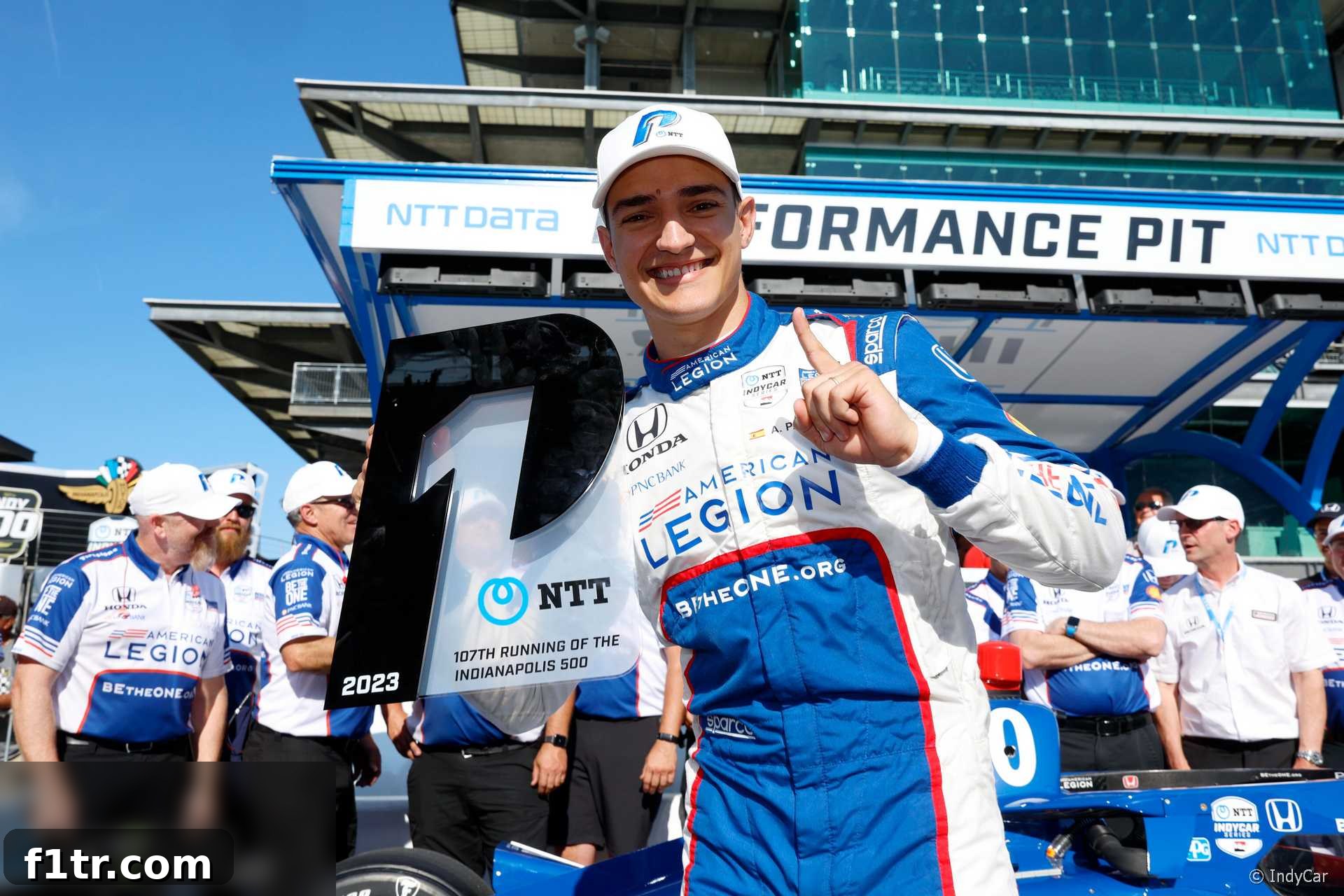
Alex Palou Claims Historic Pole Position for the 107th Indianapolis 500
In a thrilling display of speed and precision, Alex Palou delivered a stunning performance to clinch pole position for the 107th running of the Indianapolis 500. The Chip Ganassi Racing driver will lead the field of 33 cars, headlining a front row that shattered previous records and officially marking this year’s event as featuring the fastest field in the storied history of “The Greatest Spectacle in Racing.” Palou’s remarkable achievement sets the stage for what promises to be an unforgettable race day at the iconic Indianapolis Motor Speedway.
Palou’s Record-Breaking Pole Run
Alex Palou, the 2021 IndyCar Series champion and a former runner-up at the Indianapolis 500, demonstrated absolute mastery during the Fast Six qualifying session. His four-lap average speed was an astonishing 234.217 miles per hour (376.935 kilometers per hour). This incredible pace not only secured his first-ever pole at Indianapolis but also etched his name into the history books as the fastest pole-sitter ever at the Speedway.
Palou was the third driver to tackle the legendary 2.5-mile oval during the pressure-cooker Fast Six shootout. Earlier in the afternoon, during the Top 12 qualifying runs, he had only managed the fourth-fastest time, hinting at the intense competition. However, when it mattered most, Palou unleashed a formidable run, starting with an electrifying first lap that averaged 235.131 mph. While his speed tapered off slightly over the subsequent three laps, the initial burst was more than enough to establish a commanding provisional pole position, a lead that proved insurmountable for his rivals.
The Thrilling Front Row: A Battle of Milliseconds
The fight for pole position was exceptionally tight, underscoring the fierce competition inherent in IndyCar racing. Rinus VeeKay, piloting the Ed Carpenter Racing machine, emerged as Palou’s closest challenger. VeeKay’s four-lap average speed was an incredible 234.211 miles per hour, falling short of Palou’s mark by an infinitesimal 0.006 mph – a mere four milliseconds. This microscopic margin highlights the extraordinary demands of Indianapolis 500 qualifying, where fractions of a second can mean the difference between starting on pole and missing out. VeeKay’s second-place starting position is a testament to his team’s resilience, especially after his #21 car suffered a blown header in the morning practice session, requiring a significant recovery effort.
Completing the record-setting front row is Felix Rosenqvist of Arrow McLaren. Rosenqvist had been consistently fast throughout the qualifying sessions, topping the charts yesterday and earlier today in the Top 12. He secured third place with an average speed of 234.114 mph. This marks Rosenqvist’s first front-row start at the Indy 500, a significant achievement for the Swede and a strong indication of McLaren’s competitive strength.
Breaking Speed Barriers: A New Era for Indy
The speeds achieved by the front-row trio of Palou, VeeKay, and Rosenqvist were not just impressive; they collectively surpassed the previous record for the fastest pole position qualifying run in Indianapolis Motor Speedway history. That benchmark of 234.046 mph was set by Palou’s Chip Ganassi Racing teammate, Scott Dixon, just last year. Dixon himself had broken the long-standing record held by the late Scott Brayton, who tragically lost his life in a practice accident in 1996, just days after winning pole.
While the overall field speed and the pole position record have been shattered, Arie Luyendyk’s all-time single-lap record run of 236.986 mph (381.392 kmh), set on the second day of time trials in 1996 under a different qualifying format, remains intact. Nevertheless, the consistent high speeds across the entire 33-car field underscore the incredible evolution of IndyCar technology, driver skill, and track conditions.
Chip Ganassi Racing’s Dominance and the Quest for Victory
Palou’s pole position marks an incredible third consecutive Indy 500 pole for Chip Ganassi Racing, showcasing their unparalleled preparation and performance at the Speedway. Scott Dixon had previously taken pole honors in both 2021 and 2022, with Palou starting alongside him on the front row in the latter. This consistent pole form highlights CGR’s deep understanding of the Indianapolis Motor Speedway and their ability to extract maximum speed from their Honda-powered Dallara chassis.
The challenge now for Alex Palou is to convert his pole position into a victory. The Indy 500 pole winner has not won the race since Simon Pagenaud achieved the feat in 2019. This statistic adds another layer of intrigue and pressure for Palou, who will be aiming to break this trend and claim the coveted Borg-Warner Trophy.
The Grid Unfolds: Veterans, Rookies, and Resurgent Teams
Beyond the lightning-fast front row, the rest of the 33-car field is packed with talent, former champions, and compelling storylines. Santino Ferrucci qualified an impressive fourth for the long-beleaguered AJ Foyt Racing, a legendary team that has suddenly found a real resurgence in speed with both of their entries. This strong showing is a welcome development for a team with such a rich history at Indy.
Pato O’Ward, another strong contender, will start fifth, matching his car number. Scott Dixon, the 2008 Indy 500 race winner who has spent the last 15 years desperately searching for a second victory at the Brickyard, will start sixth. His experience and strategic prowess will make him a formidable threat from the second row.
Row-by-Row Breakdown: Depth of Talent
The third row of the grid is a testament to the depth of experience in the field, featuring three Indianapolis 500 winners. The 2016 centenary champion, Alexander Rossi, will start seventh in car number seven. Two-time winner Takuma Sato, known for his aggressive racing style, will start eighth. And in an emotional turn, Tony Kanaan, in his 22nd and final run at the Indy 500, will start ninth, hoping to cap off his illustrious career with another victory.
Defending Indianapolis 500 winner Marcus Ericsson will line up on the inside of the fourth row, starting tenth. Beside him, in the middle, will be the fastest rookie in the field, Benjamin Pedersen, in 11th position, driving the second revitalized Foyt car. On the outside of the fourth row, in 12th, sits the 2018 race winner and defending IndyCar Series champion, Will Power. The strong presence of defending champions and promising rookies so early in the grid ensures an exciting start to the race.
The remaining drivers fill out the fourth through tenth rows, comprising those who qualified on the first day, followed by the three drivers who survived the intense Last Chance qualifying session on Sunday afternoon to secure their spots on the 11th row. Collectively, this year’s 33-car field achieved an average qualifying speed of 232.184 miles per hour, officially resetting the record for the fastest Indianapolis 500 field, a record previously set in 2021.
Anticipation Builds for Race Day
The incredible speeds and nail-biting competition witnessed during qualifying have only heightened the anticipation for the 107th Indianapolis 500. Next Sunday, the world will turn its attention to the Indianapolis Motor Speedway for what promises to be an epic contest. The green flag for the race is scheduled for 12:45 PM EDT (local time), translating to 5:45 PM BST. All eyes will be on Alex Palou as he attempts to convert his historic pole into a victory, but with such a fast and competitive field, the outcome is far from certain. The tradition, the speed, and the sheer challenge of the Indianapolis 500 continue to captivate racing fans worldwide, and this year’s edition is poised to add another thrilling chapter to its legendary history.
Indianapolis 500 Qualifying Results
| Position | Car | Driver | Team | Engine |
|---|---|---|---|---|
| 1 | 10 | Alex Palou | Ganassi | Honda |
| 2 | 21 | Rinus VeeKay | Carpenter | Chevrolet |
| 3 | 6 | Felix Rosenqvist | McLaren | Chevrolet |
| 4 | 14 | Santino Ferrucci | Foyt | Chevrolet |
| 5 | 5 | Pato O’Ward | McLaren | Chevrolet |
| 6 | 9 | Scott Dixon | Ganassi | Honda |
| 7 | 7 | Alexander Rossi | McLaren | Chevrolet |
| 8 | 11 | Takuma Sato | Ganassi | Honda |
| 9 | 66 | Tony Kanaan | McLaren | Chevrolet |
| 10 | 8 | Marcus Ericsson | Ganassi | Honda |
| 11 | 55 | Benjamin Pedersen | Foyt | Chevrolet |
| 12 | 12 | Will Power | Penske | Chevrolet |
| 13 | 33 | Ed Carpenter | Carpenter | Chevrolet |
| 14 | 3 | Scott McLaughlin | Penske | Chevrolet |
| 15 | 27 | Kyle Kirkwood | Andretti | Honda |
| 16 | 20 | Conor Daly | Carpenter | Chevrolet |
| 17 | 2 | Josef Newgarden | Penske | Chevrolet |
| 18 | 23 | Ryan Hunter-Reay | Dreyer & Reinbold | Chevrolet |
| 19 | 28 | Romain Grosjean | Andretti | Honda |
| 20 | 106 | Helio Castroneves | Meyer Shank | Honda |
| 21 | 26 | Colton Herta | Andretti | Honda |
| 22 | 60 | Simon Pagenaud | Meyer Shank | Honda |
| 23 | 18 | David Malukas | Coyne/HMD | Honda |
| 24 | 98 | Marco Andretti | Andretti | Honda |
| 25 | 24 | Stefan Wilson | DRR/Cusick | Chevrolet |
| 26 | 29 | Devlin DeFrancesco | Andretti | Honda |
| 27 | 78 | Agustin Canapino | Juncos Hollinger | Chevrolet |
| 28 | 77 | Callum Ilott | Juncos Hollinger | Chevrolet |
| 29 | 50 | RC Enerson | Abel | Chevrolet |
| 30 | 44 | Katherine Legge | RLL | Honda |
| 31 | 45 | Christian Lundgaard | RLL | Honda |
| 32 | 51 | Sting Ray Robb | Coyne/RWR | Honda |
| 33 | 30 | Jack Harvey | RLL | Honda |
More IndyCar News & Analysis
- IndyCar driver McLaughlin cleared of injury after crashing through barrier at Barber
- Schumacher says his IndyCar feels like ‘an F2 car, just with better tyres’
- IndyCar “way faster than Formula 1” in some corners, says Grosjean
- FIA to award more F1 superlicence points to IndyCar drivers from 2026
- Schumacher to race full-time in IndyCar with RLL in 2026