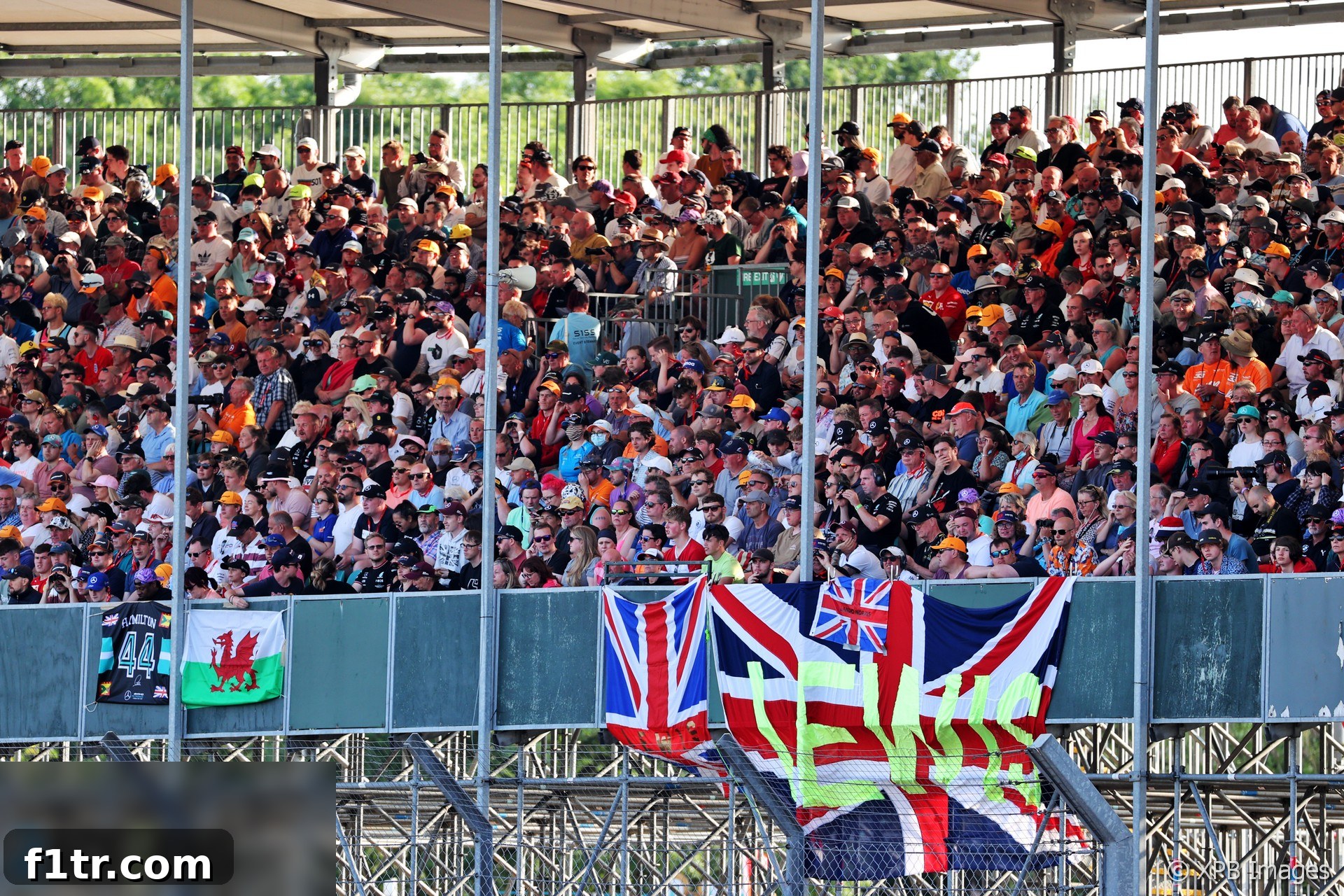
The staging of the British Grand Prix at Silverstone with capacity crowds was far more than just another race weekend; it was a pivotal moment, crucial for the long-term survival of ‘Britain’s Home of Motor Racing’ and, indeed, for its owner, the esteemed British Racing Drivers’ Club (BRDC). For decades, this iconic circuit has been the heart of British motorsport, facing financial ebbs and flows, but no challenge has been as existential as the one posed by the recent global pandemic.
Advert | Become a Supporter & go ad-free
While the grand prix – and, by extension, the historic venue itself – has, over the years, navigated a mercurial relationship with profitability, no other event has threatened the very fabric of British motorsport’s ‘holy trinity’ – the race, the circuit, and the club – to the profound degree that the COVID-19 crisis has. The ramifications of closed doors and cancelled events reverberated throughout the entire motorsport ecosystem, pushing many organizations, including Silverstone, to the brink.
The Financial Crucible: How COVID-19 Shook Silverstone’s Foundations
As insightfully revealed last year, Formula 1 took drastic measures by cancelling and/or renegotiating all its 2020 grand prix contracts once the true, devastating extent of the pandemic became undeniably apparent. However, for the subsequent year, F1 reportedly adopted an uncompromising stance with promoters: pay up for your allocated slots or risk losing future opportunities, irrespective of the challenging global circumstances. This firm position created a significant divide; some government-backed events, such as those typically held in Singapore and Melbourne, possessed the financial fortitude to settle their dues, while privately-owned venues like Silverstone found themselves in an incredibly precarious position, lacking such governmental cushions.
Although F1’s 2020 moratorium on hosting fees provided immediate relief to promoters, venues such as Silverstone fundamentally rely on the immense bonanzas generated by their annual Formula 1 Grand Prix weekends. These events are not merely races; they are colossal revenue generators, providing essential turnover and critical cash-flow vital for off-setting their substantial annual operating costs and overheads. To put this into perspective, approximately 60% of Silverstone’s impressive £60 million annual turnover is directly attributable to the Formula 1 Grand Prix. The remaining revenue is diversified across a range of other activities, including the promotion of other races, driving schools, corporate launches, and popular track days, but none come close to the financial impact of F1.
It is true that the Midlands circuit courageously hosted two back-to-back behind-closed-doors events in 2020, for which F1 provided a modest reimbursement to the British Racing Drivers’ Club. However, it was primarily through the immense goodwill and loyalty of its dedicated fans (and club members) who, commendably, did not demand immediate refunds after their attendances were denied, that Silverstone managed to balance its precarious cash flow. A mass run on refunds, a scenario that was a very real threat, would almost certainly have tipped the promoter over the edge, necessitating either a desperate government bail-out or, tragically, even worse financial consequences.
While the 2020 accounts for the operating company, Silverstone Circuits Ltd, were not yet due at the time of this assessment, early estimates suggested a significant loss for that year, approaching £3 million. This substantial deficit followed a 2019 report, published at the height of the pandemic’s initial impact, which starkly highlighted the profound threats posed by COVID-19 to the company’s very future. In 2019, on a turnover of £60 million, Silverstone had managed to turn a modest profit of £800,000, underscoring just how razor-thin the margins were for an event of this magnitude.
The 2019 report also referenced “new funding arrangements with the company’s new main banking partner” and carry-over losses incurred “after an impairment loss was suffered through an unsuccessful track resurfacing operation in 2018.” That year saw the Moto GP round controversially cancelled, leading to the refunding of 40,000 tickets. This historical context illustrates that the pandemic did not merely create a new crisis but rather a ‘perfect storm,’ striking a venue already ill-equipped to weather even intermittent drizzles, let alone a prolonged global downpour.
Advert | Become a RaceFans supporter andgo ad-free
The Return of the Roar: Government Pilot Scheme and Full Capacity
Thus, for the indispensable future of the British Grand Prix, it was absolutely crucial that Silverstone be granted a full-house exemption via the British government’s ambitious major events pilot scheme. This initiative, known as the Events Research Programme (ERP), was designed to explore how large-scale events could safely resume amidst ongoing public health concerns. The program also saw other iconic sporting events host substantial crowds, notably Wimbledon, which successfully staged its finals with a capacity Centre Court crowd of 15,000 in attendance. Similarly, the Euro 2020 final at Wembley Stadium last week played to a vibrant live crowd of 60,000. Silverstone’s eagerly anticipated Sunday full-house for the Grand Prix was set to more than double that figure, moving live attendance levels up yet another gear and setting a new benchmark for mass gatherings in the post-pandemic era.
As always, there was no shortage of fervent support for the seven-time world champion Lewis Hamilton. Thus, it was rather ironic that Silverstone opted to name its iconic main straight for this very race after the local hero – Hamilton, who was born just 60 kilometers away in Stevenage – despite his publicly voiced warnings against fully opening the gates for such a large crowd. This move highlighted a fascinating tension between celebrating a national hero and navigating the complex public health implications of large gatherings.
“It’s been great that we’ve had people even at the last race and I have not heard any negative things from the last race,” Hamilton stated after the French Grand Prix, where spectators were admitted in controlled blocks of 5,000. He continued, emphasizing his cautious approach: “But I like to err on the side of caution and slowly build up rather than go full pelt and using our British fans as a test pen.” Hamilton’s remarks came in direct response to the news that Silverstone would host the largest single-day crowd since the pandemic began, showcasing his commitment to public safety alongside his passion for the sport.
F1’s Resilient Recovery: A Glimpse into a Crowded Future
The overarching good news for Formula 1, and indeed for the global event industry, is that the trend for fan attendance is undeniably upwards and accelerating. From 15,000 passionate fans on race day at Paul Ricard, to an impressive 80,000 predominantly Dutch supporters who turned up to cheer on Max Verstappen in Austria just a fortnight prior, and the staggering 140,000 at Silverstone, culminating in yet another full-house in Hungary just ahead of F1’s vital summer break, the desire for live motorsport is evident. Indications from various government bodies are increasingly positive, suggesting that iconic circuits like Spa-Francorchamps, Zandvoort, and Monza will also be granted full capacity exemptions by their respective national authorities. This burgeoning optimism means that the balance of the 2021 European season is highly anticipated to play out to vibrant, capacity crowds, signaling a robust recovery for the sport.
As for the remainder of the challenging 2021 F1 calendar, it remains largely a matter of waiting and seeing how the global situation evolves. Russia and Turkey are likely candidates for full crowds, buoyed by their respective vaccination programs and government policies. However, Japan will, in all probability, judiciously delay a definitive decision regarding attendance until the full effects and public health outcomes of the recently concluded Olympic Games are comprehensively known and assessed. The final block of long-haul events cannot yet be predicted with absolute certainty, but current indications suggest that the USA, Mexican, and Brazilian rounds are poised to proceed – albeit the latter probably without the benefit of crowds, reflecting the varying regional challenges.
That leaves three crucial calendar slots yet to be firmly decided: a replacement for the previously cancelled Australian Grand Prix, plus the two lucrative Middle Eastern races in Saudi Arabia and Abu Dhabi, respectively. The smart money within the paddock and industry circles is firmly placed on a second 2021 race in Bahrain, replacing Melbourne’s slot, a logistically straightforward solution. However, whispers from the region suggest that intricate negotiations with Qatar for a potential debut race were well advanced before being scuppered by complex politicking and regional rivalries, highlighting the multifaceted challenges in finalizing the global F1 schedule.
All these developments collectively point towards the realization of an ambitious 23-race calendar, a prospect that was initially viewed with considerable skepticism by many within the paddock and motorsport community. With at least 10 of the 13 rounds remaining after the Silverstone race successfully hosting capacity crowds, the outlook is exceptionally positive. This resurgence augurs extremely well for 2022’s highly anticipated ‘new era’ of F1, characterized by radical new car designs and regulations. Fittingly, at Silverstone, the series proudly presented a full-scale model representing the groundbreaking cars which can, hopefully, race in front of fully packed stands worldwide next year, ushering in a new chapter of Formula 1 with renewed fan engagement and financial stability.
Advert | Become a RaceFans supporter andgo ad-free
News Focus
- No happy ending for Ricciardo’s made-for-Netflix redemption arc
- No ‘two alphas’ for Red Bull as team forms its longest-running driver line-up
- Will Mercedes come to the rescue of Ocon’s career a third time?
- How the midfield’s hottest team mate rivalry boiled over
- Petty officialdom or deserved decisions? Five drivers stripped of wins in 2024
Browse all News Focus articles