In the relentless pursuit of performance in Formula 1, every team constantly seeks an edge. For a storied outfit like Williams, grappling with significant challenges, these efforts take on even greater importance. At the German Grand Prix, Williams unveiled its most comprehensive aerodynamic package of the season, strategically labeled “test items” rather than direct “upgrades.” This semantic distinction hints at a cautious yet determined approach, reflecting the extensive nature of the changes and the urgent need to validate them on track. The hope is palpable: these crucial developments for the FW42 could finally be the catalyst needed to bridge the widening performance gap to the rest of the competitive F1 field.
The FW42 has been a difficult car for Williams, struggling for pace and consistency throughout the season. Recognizing the depth of their performance deficit, the team has been relentless in its development efforts, culminating in this substantial package for Germany. This latest iteration of the FW42 features significant revisions, particularly to the bargeboard area and the floor – two critical zones for aerodynamic efficiency and downforce generation in modern F1 cars. The scope of these changes underscores Williams’ commitment to clawing its way back into genuine contention, moving beyond mere survival to a path of renewed competitiveness.
A Comprehensive Overhaul: The New Bargeboard Design
The bargeboard area in Formula 1 is arguably one of the most complex and aerodynamically sensitive regions of the car. Positioned between the front wheels and the sidepods, these intricate arrays of vanes and elements are crucial for managing turbulent airflow generated by the front wheels and directing it efficiently around and under the car. At the previous race, Williams had introduced revisions to the upper half of their bargeboards and the sidepod fins. However, the German GP saw a far more radical transformation. The main bargeboards themselves have been entirely redesigned, presenting a specification so distinct from their predecessors that they are effectively considered all-new components. This represents a fundamental shift in Williams’ aerodynamic philosophy for this critical area.
While some subtle aspects of the overall bargeboard package might retain a conceptual similarity to previous designs, the new set-up is dramatically different in its overall form and function. It now occupies a much greater volume of the permitted bodywork envelope around the car’s sides, aligning the FW42’s design language more closely with the established and successful practices of other front-running F1 teams. This move towards a more conventional, yet optimized, bargeboard architecture suggests Williams is consolidating its design direction based on proven aerodynamic principles rather than experimenting with highly divergent concepts.
Intricate Details: Unpacking the Bargeboard Elements
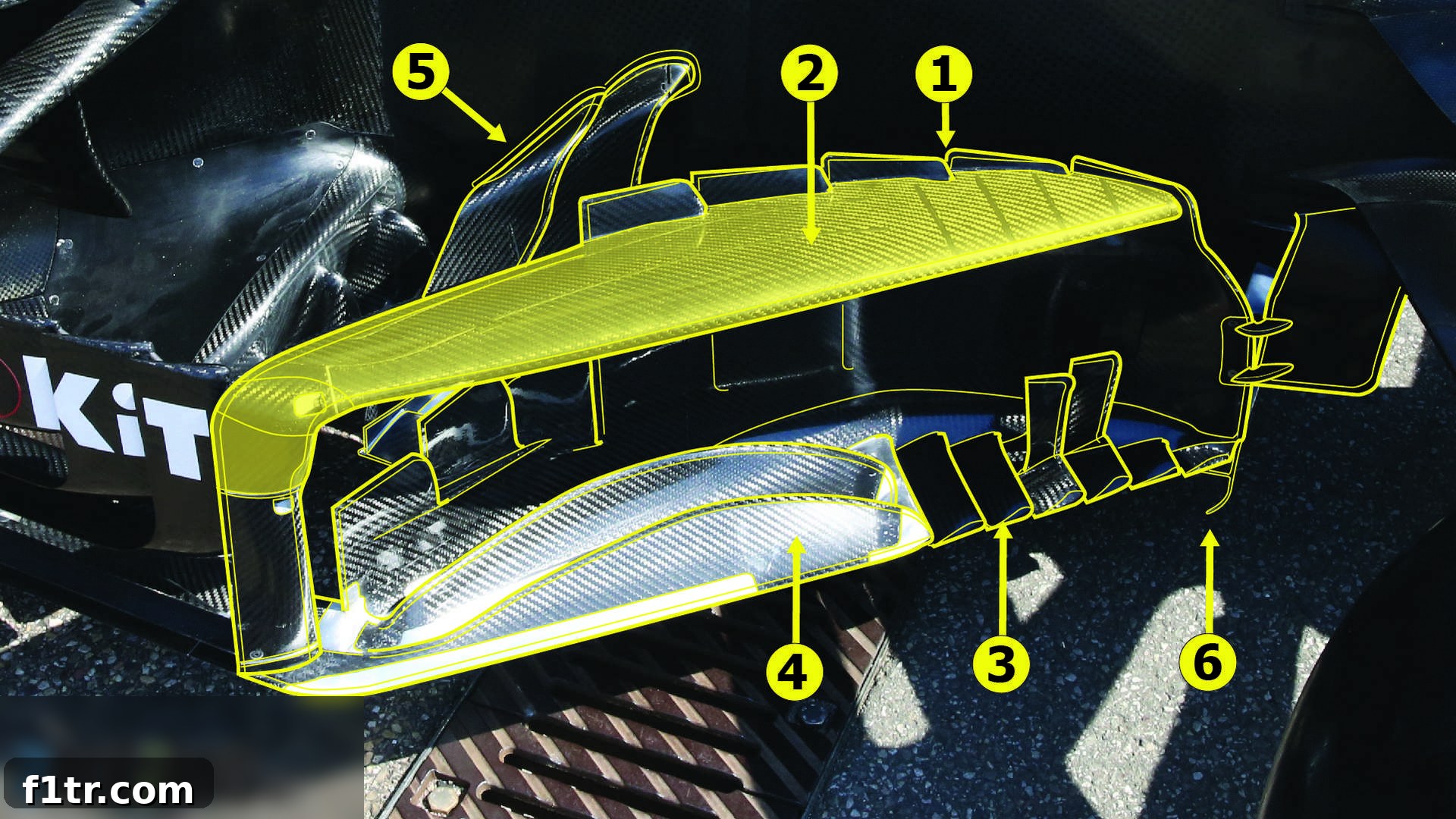
Delving into the specifics, the vertical surfaces of the main bargeboards (1) now feature a far more aggressive and intricate slotted design. These are meticulously formed by five prominent forward fins at the top, which gradually transition into three smaller fins positioned lower down and trailing behind them. This multi-fin configuration is designed to generate and manipulate a series of precise vortices, enhancing the management of airflow from the front wing and channeling it effectively towards the sidepods. The increased number of slots and fins aims to improve airflow stability and reduce drag, crucial for optimizing the car’s overall aerodynamic efficiency.
Spanning across the very top of these main bargeboards is a re-profiled ‘Boomerang’ wing (2). This element plays a pivotal role in directing airflow. It leads directly back to join the sidepod vane, forming a continuous structure designed to initiate a powerful downwash effect. Its primary function is to capture and guide the rising airflow from the front wing, directing it downwards with precision. This carefully managed flow is then channeled towards the intricate undercut of the sidepod and, crucially, onwards towards the rear diffuser. Such precise airflow management is paramount for maximizing the performance of the underfloor and diffuser, which together generate a substantial portion of an F1 car’s total downforce.
The bottom section of the bargeboards, specifically the footplate area, has also undergone a complete transformation. This section is now significantly larger in surface area, indicating a renewed focus on optimizing the interaction between the bargeboards and the car’s floor. At the very front, the design features fewer horizontal fins than before, which might simplify some aspects of the flow structure, but this is compensated by the introduction of a new set of pronounced upstanding fins (3). These vertical elements work in conjunction with the redesigned, scrolled footplate (4) section trailing behind them. The scrolled section is now larger and integrates with the outer front part of the floor in a markedly different way, suggesting an entirely revised strategy for sealing the underfloor and preventing disruptive air ingress.
Williams has, for several seasons, employed an additional pair of turning vanes positioned just behind the main bargeboards. In line with the rest of this extensive aerodynamic overhaul, these too have been revised. The two vanes (5) are now noticeably taller and exhibit a more pronounced fold-over design, meeting the chassis side. This specific shaping is engineered to intensify the downwash effect, further guiding the airflow towards the sidepod undercut. By fine-tuning these elements, Williams aims to create a more coherent and powerful flow structure, which is essential for maximizing the performance of the sidepods and the rear of the car.
The Critical Floor Redesign
In modern Formula 1, the car’s floor is arguably the single most important aerodynamic component, responsible for generating a substantial portion of the overall downforce through the sophisticated Venturi effect created beneath the car. Beyond the comprehensive bargeboard package, Williams has also introduced an entirely new floor. While the immediate focus might be on the visible changes to the floor edge slots, a closer inspection reveals that this is not merely a modification of an existing part. The repositioning of several bonded-in sections and access hatches strongly indicates that this is a completely new floor component, designed from the ground up to integrate synergistically with the revised upstream aerodynamics.
The slot positioned ahead of the rear tires (1), crucial for mitigating the disruptive wake generated by the spinning wheels before it can interfere with the diffuser, appears to retain a similar design philosophy as before. However, the most significant transformation lies along the long outer edge of the floor. The multiple old, short transverse slots that characterized Williams’ previous design have been entirely replaced with the more contemporary and aerodynamically fashionable longitudinal slots (2). This shift reflects a widely adopted trend in F1, as longitudinal slots have proven highly effective in managing complex airflow structures.
These elongated longitudinal slots are engineered to interact precisely with the high-pressure air mass that builds up on top of the floor surface. Their design encourages this high-pressure air to be directed outwards, creating a powerful “outwash” effect. This outwash works in conjunction with the Y250 flow structure – a critical aerodynamic phenomenon originating from the front wing and chassis – to aggressively push the turbulent wake of the front tires away from the sensitive rear of the car. Preventing this disruptive wake from contaminating the diffuser and the rear wing is paramount for maintaining rear-end stability and maximizing downforce. Further enhancing this crucial outwash effect, the new floor slots are structurally supported by small, crescent-shaped aluminum supports (3). These supports are meticulously positioned in line with the intended airflow direction, actively helping to channel and push the air outboard, making the entire outwash system more robust and effective.
As mentioned, the slot directly ahead of the rear tire, designed to reduce tire wake intrusion into the diffuser, remains conceptually similar. The rear brake ducts, mounted above this area, also appear largely unchanged at this stage. However, given the upstream revisions to the bargeboards and the floor, it is highly probable that the diffuser area itself has also been revised. While explicit details might not be available, aerodynamic components in F1 are intrinsically linked, and a change in one area almost invariably necessitates corresponding adjustments downstream to ensure optimal overall performance and aerodynamic harmony. A well-integrated diffuser is essential for capitalizing on the improved airflow from the new floor and bargeboards.
The Nuance of Legality: The T-Tray Splitter Element
Formula 1 regulations are notoriously stringent, and even the smallest details can have significant implications for legality and performance. One such detail pertains to the T-Tray splitter, a critical component at the very front of the car’s floor that defines the start of the underfloor area. Regulations specifically demand that the front edge of this splitter must possess a defined radius, preventing any sharp or knife-like edges for safety reasons and to ensure fair aerodynamic play. This rule famously caught out the Haas team last year, leading to significant controversy. In their case, multiple bodywork elements converged in the same area, inadvertently failing to form a clear, compliant radius. This oversight was questioned by rival teams and, after extensive deliberation with the FIA, resulted in Romain Grosjean losing his points finish at the Italian Grand Prix, highlighting the gravity of such technical infringements.
With the ever-increasing complexity of bargeboard designs and their intricate interaction with the front of the floor, the splitter itself is often not as wide as it once was. Despite this, the requirement for a precisely radiused leading edge remains non-negotiable. To address this highly specific regulation, Williams has introduced a clever “legality part” (6). This element is formed from a small, precisely machined piece of metal, often augmented with a wire or similar component, meticulously shaped to meet the exact wording and dimensional requirements of the splitter leading-edge rules. This kind of innovative, albeit somewhat unconventional, engineering solution is often born from the intense scrutiny of regulations. While technically compliant, such interpretations sometimes stray from the original spirit or intent of the rule, and it is certainly possible that other teams’ technical departments will be taking a very close look at Williams’ solution for potential implications or similar applications.
The Road Ahead: Impact and Future Prospects
Such a substantial wealth of aerodynamic changes, particularly in critical areas like the bargeboards and floor, is undoubtedly designed to yield a tangible improvement in the car’s overall performance. If these new components function as intended, the German GP update package is expected to amplify all the desired effects of modern bargeboard and floor design. This includes a more potent outwash effect to manage the front tire wake, an enhanced downwash towards the sidepod undercut for improved flow to the rear, and a more efficient redistribution of pressure under the floor to generate greater, more consistent downforce. These are typical and fundamental aims for in-season aerodynamic development in Formula 1, and for Williams, they are especially crucial in their concerted effort to regain lost ground and close the significant performance gap to the midfield teams.
However, despite the extensive nature of these updates, it is important to acknowledge the sheer scale of the performance deficit Williams has faced. While this package represents a significant step forward, it is unlikely to be the single, complete solution that will instantly transform their fortunes. The journey back to competitiveness in Formula 1 is a long and arduous one, demanding continuous development and incremental gains. This package should be viewed as a crucial foundation upon which further improvements can be built. Encouragingly, Williams has already indicated that more updates are planned for upcoming races, demonstrating a clear long-term strategy and an unwavering commitment to engineering their way back to the front.
Ultimately, the true success of these “test items” will be measured by their on-track performance and their ability to provide the team with a clearer development direction. For Williams, a team with a legendary history in Formula 1, every step forward is not just about points but about rebuilding confidence, momentum, and ultimately, securing their place among the sport’s competitive elite. This German GP package is a powerful statement of intent, signaling their determination to fight their way back up the grid, one meticulously engineered component at a time.
F1 technology
- McLaren, Red Bull and Ferrari bring rear corner updates to Imola
- Ferrari, McLaren and Red Bull bring upgrades again for Saudi Arabian Grand Prix
- McLaren introduce major floor upgrade for Norris’ car at Mexican Grand Prix
- McLaren, Mercedes and Red Bull detail upgrade packages for United States GP
- Red Bull remove engine cover ‘cannons’ in major RB20 update – but they may return
Browse all F1 technology articles