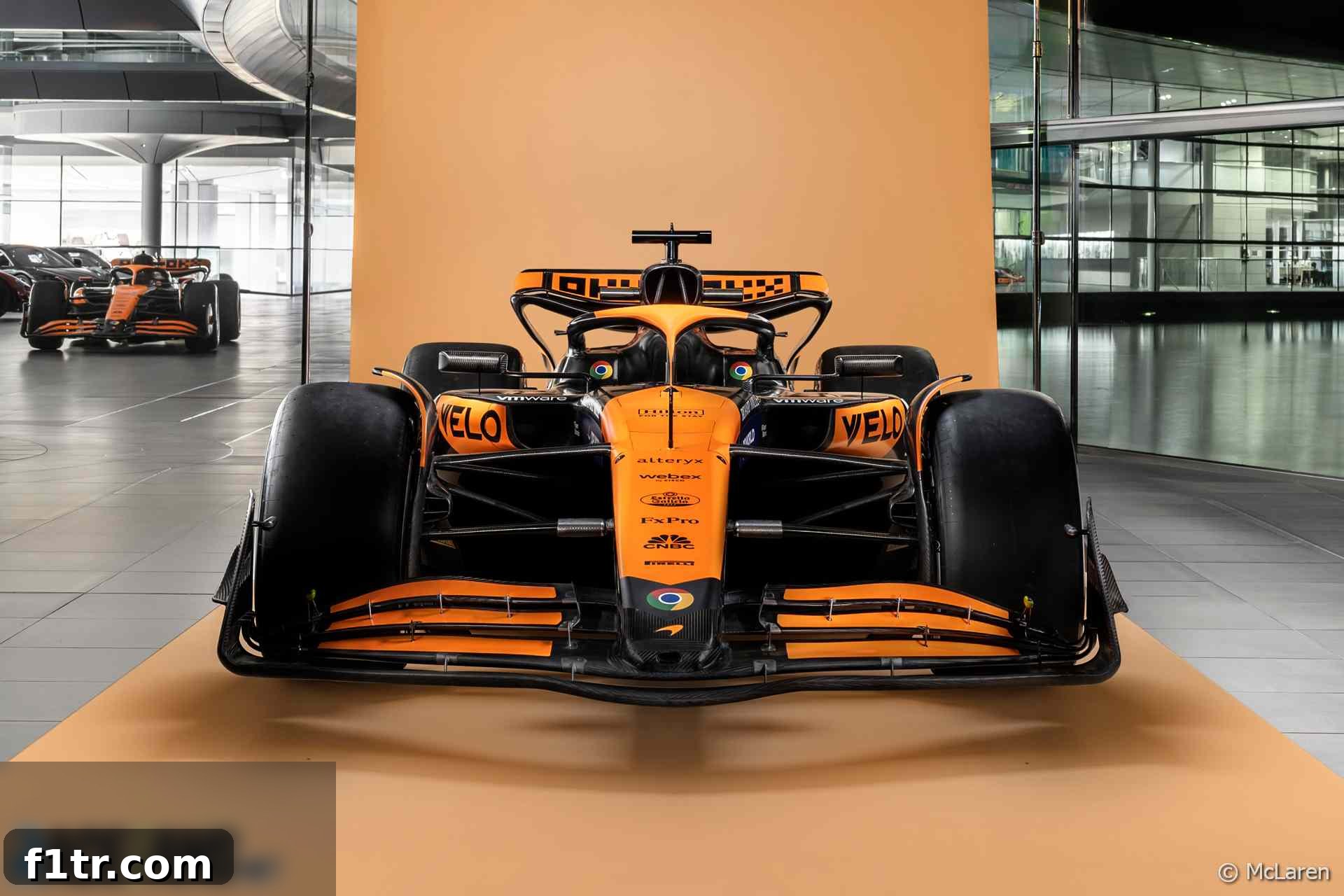
McLaren MCL38: A Strategic Shift in Formula 1 Development for 2024
After an astonishing mid-season resurgence in 2023, McLaren is setting a pragmatic course for the upcoming Formula 1 season. Team Principal Andrea Stella has provided a nuanced outlook on the MCL38, the team’s latest challenger, hinting that the spectacular in-season performance leaps witnessed last year may not be a recurring phenomenon. This perspective signals a deliberate strategic adjustment, prioritizing meticulous refinement and continuous, smaller-scale evolution over dramatic, game-changing overhauls.
The 2023 season was a testament to McLaren’s adaptability and engineering prowess. Starting significantly off the pace, the team introduced substantial upgrade packages at the British and Singapore Grands Prix, which delivered monumental performance gains. These enhancements catapulted McLaren from being midfield strugglers to consistent podium contenders, demonstrating an impressive capacity to understand and exploit the current technical regulations. However, Stella cautions that achieving similar magnitudes of performance improvement with the newly unveiled MCL38 will prove considerably more challenging in 2024.
The Era of Diminishing Returns: F1 Aerodynamic Development in 2024
Andrea Stella articulated his belief that the current Formula 1 regulations are entering a phase where efforts to add lap time will increasingly encounter “diminishing returns.” This phenomenon, he notes, is something new to this regulatory cycle. For the past two years, teams, including McLaren, have benefited from a relatively steep trajectory of aerodynamic development. Engineers have unearthed significant performance gains through novel designs and optimization strategies, allowing for substantial improvements in lap time with each major upgrade package.
However, as teams deepen their understanding of ground effect aerodynamics and exhaust the more straightforward avenues for performance enhancement, the rate of gain naturally decelerates. Stella explained, “I would anticipate that towards the end of the season it will become harder for designers to be able to keep a very steep development rate.” This suggests that the readily accessible performance improvements have largely been exploited, and future advancements will necessitate increasingly complex, subtle, and labor-intensive refinements. For McLaren, this translates into a sharpened focus on sustaining the impressive development momentum achieved over the last twelve months, rather than anticipating another singular ‘silver bullet’ upgrade that fundamentally alters their competitive standing.
This shift implies that the initial design of the MCL38 is more crucial than ever. A well-conceived baseline car, strong from the outset, will be essential for McLaren to remain competitive as the season progresses. Teams that arrive with a fundamental flaw in their concept will find it exponentially harder to recover compared to previous seasons, where large aerodynamic steps were more readily available. The battle will move from revolutionary design changes to incremental optimization, where every millisecond gained through meticulous attention to detail becomes incredibly valuable.
Beyond the Launch Car: McLaren’s Strategic Pipeline of Early Season Updates for the MCL38
In a tactical move common in the secretive world of Formula 1, McLaren intentionally obscured certain design elements in the initial launch images of the MCL38. Stella confirmed that while these images provide a “pretty accurate” representation of the actual car, “nothing too major” was deliberately omitted. Yet, these concealed areas are far from insignificant; they represent advanced development projects slated to deliver crucial early-season performance enhancements.
These strategic omissions primarily pertain to three critical performance domains: further enhanced aerodynamic efficiency, improvements to the mechanical systems of the car, and optimized interaction with the Pirelli tyres. Stella clarified that these were projects initiated with clear potential, but simply could not be finalized and integrated into the car in time for its official presentation. This strategic delay allows McLaren to introduce tangible performance upgrades very early in the season, ensuring that the MCL38 embarks on its competitive journey with a rapid, controlled evolution from its debut specification.
The inherent flexibility of the MCL38’s design is central to this strategy. Stella emphasized that the car’s architecture was conceived with ample provision for these subsequent developments to be integrated seamlessly “later on.” This means there are no fundamental layout or packaging restrictions that would impede the integration of these innovations once they are fully matured and ready for track deployment. It is not a case of missed opportunities for innovation, but rather a deliberate staging of development projects, allowing them the necessary time to reach their full potential before being introduced to the competitive environment. This systematic and phased approach ensures McLaren can deploy updates as soon as they successfully complete rigorous testing and validation, maximizing their impact on early-season competitiveness and demonstrating a mature approach to development.
Three Core Pillars of Performance: The MCL38’s Fundamental Improvements
McLaren’s engineering philosophy for the MCL38 is firmly rooted in three fundamental areas of improvement over its predecessor, the MCL60. These pillars collectively form the bedrock of the car’s performance capabilities and underscore a holistic design approach, aiming for balanced and consistent performance across a diverse range of track conditions and scenarios.
1. Elevated Aerodynamic Efficiency: The Quest for Clean Airflow
The relentless pursuit of aerodynamic efficiency remains the cornerstone of performance in modern Formula 1. For the MCL38, this translates to designing bodywork surfaces that generate the maximum possible downforce while simultaneously minimizing aerodynamic drag. A highly efficient car can achieve superior top speeds on straights, which is crucial for defending and attacking, while also maintaining exceptional grip through corners, enabling higher cornering speeds. This is a perpetual balancing act in F1 design, as downforce generation often comes with the penalty of increased drag. McLaren’s objective with the MCL38 is to significantly optimize this downforce-to-drag ratio, ensuring the car slices through the air with greater effectiveness. This contributes directly to overall lap time gains, improves fuel economy, and provides greater stability at high speeds. Improvements in this complex area are often incredibly subtle, involving intricate modifications to the front and rear wings, floor geometry, sidepod contours, engine cover, and diffuser, all working in concert to meticulously manage airflow around and through the car.
2. Enhanced Mechanical Grip: Foundation for Driver Confidence
While aerodynamic grip dictates much of a car’s outright performance on faster circuits, mechanical grip is absolutely vital for a car’s handling characteristics, especially in slower corners, over track undulations, and during crucial traction zones. This aspect of performance is primarily governed by the car’s sophisticated suspension system, chassis stiffness, precise weight distribution, and differential settings. Improving mechanical grip in the MCL38 means developing a car that is more predictable, responsive, and forgiving to driver inputs. It allows Lando Norris and Oscar Piastri to put power down more effectively out of corners, better absorb track imperfections, and maintain control in challenging conditions. A car with strong mechanical grip inspires greater confidence in its drivers, empowering them to consistently push harder, explore the limits, and extract maximum performance, particularly on street circuits or in mixed weather conditions where aerodynamic downforce might be less dominant.
3. Optimized Interaction with Tyres: The Black Art of Performance
Tyre management is arguably one of the most critical and intricate factors in modern Formula 1, often making the difference between victory and defeat. The MCL38 has been designed with an intensified focus on its interaction with the mandated Pirelli compounds. A car that interacts effectively with its tyres can bring them into their optimal operating temperature window rapidly, maintain their peak performance throughout a stint, and critically, minimize premature degradation. This involves not only complex suspension kinematics and precise weight transfer dynamics but also how the car’s aerodynamics manage airflow over and around the tyres, directly influencing their temperature and wear rates. By improving this interaction, McLaren aims to provide its drivers with a car that is consistently kinder to its tyres, enabling longer stints, more robust race pace, and significantly greater strategic flexibility during Grands Prix. This area of development is particularly challenging due to the highly sensitive nature of F1 tyres and their profound influence on race outcomes and championship aspirations.
Andrea Stella confidently confirmed that McLaren has made tangible and significant progress across all three of these critical performance areas with the MCL38. He explicitly stated, “We’ve been able to improve on all these three areas.” Crucially, he also reiterated that even with these advancements, there remains “potential for further improvements in each of these three areas,” underscoring the team’s ongoing development trajectory and the strategic pipeline of early-season upgrades that are yet to be revealed.
McLaren’s Competitive Landscape and Outlook for the 2024 F1 Season
As McLaren approaches the 2024 Formula 1 season, the team finds itself immersed in an exceptionally competitive environment. While they demonstrated immense potential and a formidable development curve in the latter half of 2023, the top echelon of the grid remains incredibly tight. Red Bull Racing continues to set a formidable benchmark, with established rivals like Mercedes and Ferrari also striving for substantial gains with their respective challengers. McLaren’s tempered expectations regarding large in-season leaps should not be mistaken for a lack of ambition; instead, they represent a refined and highly strategic approach to development.
The focus for McLaren is now squarely on meticulously extracting every fraction of performance through continuous, albeit smaller, increments. This strategic shift places an even greater premium on the initial design quality and underlying performance of the MCL38. A strong baseline car, capable of performing consistently from the very first race, is more crucial than ever, as the scope for ‘game-changing’ mid-season packages appears to be narrowing across the grid. The team’s ability to consistently introduce well-engineered, incremental updates throughout the season will be paramount for maintaining and improving its competitive standing.
Furthermore, operational excellence – encompassing flawless pit stops, robust race strategies, and reliable components – will play an even more significant role in maximizing the performance potential that the MCL38 offers. Andrea Stella’s leadership has been a key factor in McLaren’s recent resurgence, fostering a culture of rigorous engineering, clear communication, and pragmatic decision-making. His transparent assessment of the upcoming development challenges reflects a mature and realistic understanding of the current Formula 1 landscape. McLaren’s 2024 campaign will undoubtedly serve as a critical test of how effectively a team can optimize an already highly developed car, piece by piece, in its determined pursuit of ultimate championship glory.