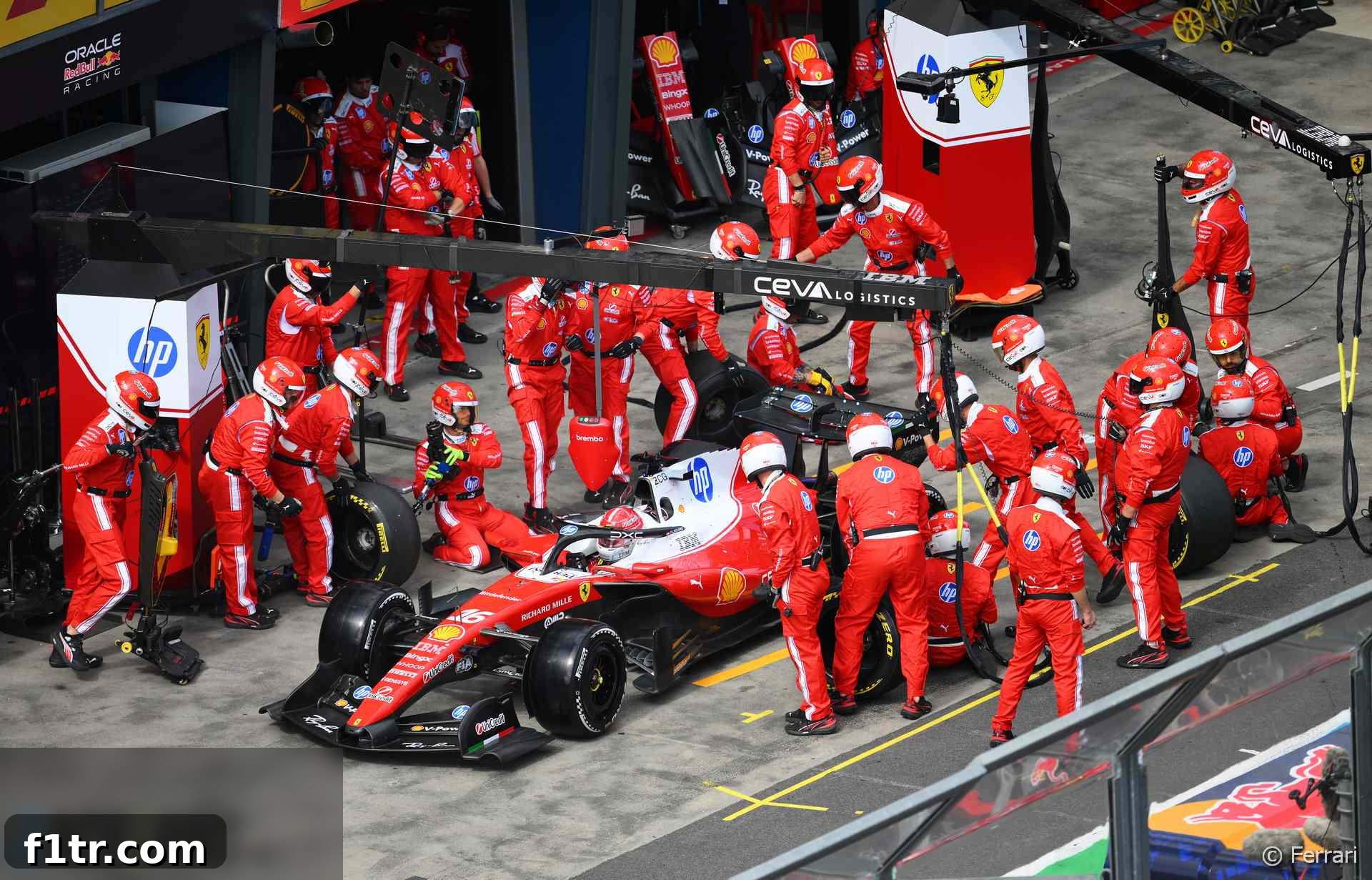
Charles Leclerc found himself at the heart of a significant strategic debate at the Australian Grand Prix, fiercely defending Scuderia Ferrari’s decision not to pit him during the crucial Virtual Safety Car (VSC) period. Despite ultimately sacrificing a potential race victory, Leclerc stood firm on the team’s calculated risk, a choice that allowed rivals Mercedes to capitalize and secure a dominant one-two finish.
The incident unfolded during a pivotal phase of the race, specifically on lap 11, when the first VSC was deployed. Leclerc, leading the pack, was closely followed by George Russell in his Mercedes. Their respective teammates, also in strong positions, trailed just behind, setting the stage for a high-stakes strategic play. This moment presented every team with a critical choice: pit under the VSC for a “cheap stop” and save significant time compared to a regular pit stop, or remain on track with the hope of a different strategic window opening later.
Advert | Become a Supporter & go ad-free
Mercedes, demonstrating decisive strategic thinking, wasted no time. Both of their cars were immediately called into the pits for their sole tire changes of the race. This bold move was a clear indication of their intent to seize the advantage offered by the neutralized conditions. In stark contrast, Ferrari opted to keep both Leclerc and his teammate out on the track. This divergence in strategy immediately sparked discussion and drew questions, with Lewis Hamilton – who later benefited greatly from Mercedes’ call – implicitly challenging Ferrari’s decision. However, Leclerc, embodying the team’s united front, expressed his full acceptance of the strategy.
The Strategic Dilemma: Why Ferrari Didn’t Pit
Ferrari’s decision to forgo the VSC pit stop was not born out of oversight but from a deeply considered strategic outlook. Leclerc articulated that the team went into the Australian Grand Prix anticipating a high likelihood of multiple race interruptions. This expectation was rooted in observations from earlier sessions of the race weekend.
“Looking from FP1 to now, there’s been at every session a car that was stopped, at least one car,” Leclerc explained, highlighting the team’s pre-race data analysis. “We knew that there was a very high chance that this was not going to be the only VSC of the race, and so we thought that it was better for us to maybe wait for another one.” This insight reveals Ferrari’s gamble: they believed that by not reacting to the first VSC, they might position themselves better for a subsequent one, perhaps at a more opportune moment in terms of race distance or tire wear.
Unfortunately for the Scuderia, the subsequent VSC period, which did occur, came with an unforeseen and critical complication: the pit lane entrance was closed. This closure was necessary to allow marshals to safely recover Valtteri Bottas’s Cadillac, which had stopped on track. This turn of events meant that Ferrari was unable to make their planned pit stops during this window, effectively nullifying their strategic waiting game.
Advert | Become a RaceFans supporter andgo ad-free
“That’s always a gamble, of course,” Leclerc conceded, acknowledging the inherent risks in Formula 1 strategy. “We didn’t know that this would happen.” The reality of the pit lane closure forced both Ferrari drivers to pit after the race restarted, a less efficient stop that further compounded their strategic disadvantage. Shortly after their stops, a third VSC was deployed, underscoring the team’s initial prediction of multiple interruptions, but arriving too late to save their strategy.
Consequences and Leclerc’s Unwavering Defense
The immediate consequence of the divergent strategies was clear. By pitting under the first VSC, both Mercedes drivers, George Russell and Lewis Hamilton, saved crucial time and emerged with a significant advantage in track position. They capitalized on this to move into the leading two positions, a lead they maintained until the checkered flag. Russell ultimately clinched the victory, with Hamilton securing a strong second place. Leclerc, despite a spirited drive, found himself fifteen seconds adrift of Russell, ultimately settling for third place.
Despite the outcome, Leclerc remained resolute in his defense of the team’s choice. “I don’t regret it,” he stated emphatically. “It was a wanted choice, a wanted and conscious choice.” This statement underscores not just his personal conviction but also the collective decision-making process within the Ferrari garage. It was a calculated risk, informed by their analysis of the race conditions and the likelihood of future opportunities.
“The reality is we’ve had other VSCs after, and one which was particularly well-placed, but unfortunately for this one, for us, the pit entry was closed and we couldn’t take it,” Leclerc elaborated. “So we were a little bit unlucky on that side, but it was a conscious choice again and I don’t really regret it.” His words highlight the razor-thin margins and unpredictable nature of Formula 1 strategy, where even the most meticulous planning can be undone by unforeseen circumstances, such as a closed pit lane.
The Dynamics of F1 Race Strategy: A High-Stakes Game
Formula 1 race strategy is a complex tapestry woven from pre-race analysis, real-time data interpretation, and swift decision-making under immense pressure. The Australian Grand Prix provided a textbook example of how contrasting approaches can lead to vastly different outcomes. Mercedes’ aggressive, immediate reaction to the VSC paid dividends, proving that sometimes, taking the first available opportunity is the most effective path.
Ferrari, on the other hand, opted for a more patient, analytical approach, betting on a pattern of interruptions they had observed throughout the weekend. This highlights a fundamental tension in motorsport strategy: the balance between reacting to the present moment and anticipating future events. While their analysis of multiple VSCs proved accurate, the specific circumstances of the second VSC deployment – the closed pit lane – turned their calculated gamble into an unfortunate misstep.
The incident also serves as a reminder of the ‘luck’ factor in racing. While strategists strive to minimize reliance on luck, certain elements remain beyond their control. A VSC appearing at an ideal moment can be a boon, just as a closed pit lane at a crucial juncture can be a curse. Leclerc’s calm acceptance, despite the disappointment, reflects a mature understanding of these inherent uncertainties in the sport.
Miss nothing from RaceFans
Get a daily email with all our latest stories – and nothing else. No marketing, no ads. Sign up here:
Looking Ahead: Lessons for Ferrari and Leclerc
While the outcome was not what Ferrari hoped for, Leclerc’s staunch defense of the strategy suggests that the team will not be deterred from taking calculated risks in the future. The experience from the Australian Grand Prix will undoubtedly feed into their strategic models and decision-making processes for upcoming races. It serves as a potent reminder that even a well-researched strategy can be undone by an unexpected variable. For Leclerc and Ferrari, the focus will now shift to learning from this experience and refining their approach to capitalize on future VSC or Safety Car opportunities, ensuring they are prepared for all eventualities – including a closed pit lane.
The dynamic nature of Formula 1 ensures that strategic debates will always be a cornerstone of the sport. Leclerc’s steadfastness in supporting his team’s choice, even when it cost him a win, speaks volumes about the trust and unity within the Ferrari camp. As the season progresses, every strategic call will be scrutinized, but the Australian Grand Prix will stand out as a prime example of the fine line between strategic brilliance and unforeseen misfortune in the world of F1.
2026 Australian Grand Prix
- Briatore “not happy at all” with Alpine’s “very weak” performance
- Drivers want rules changes to cut “dangerous” risk of crash at start
- Russell becomes the 68th different Formula 1 driver to lead the world championship
- Hadjar told Red Bull his car’s performance was “embarrassing” and “just c***”
- “How did you not call the pit?” Ups and downs in Hamilton’s first race with new engineer
Browse all 2026 Australian Grand Prix articles