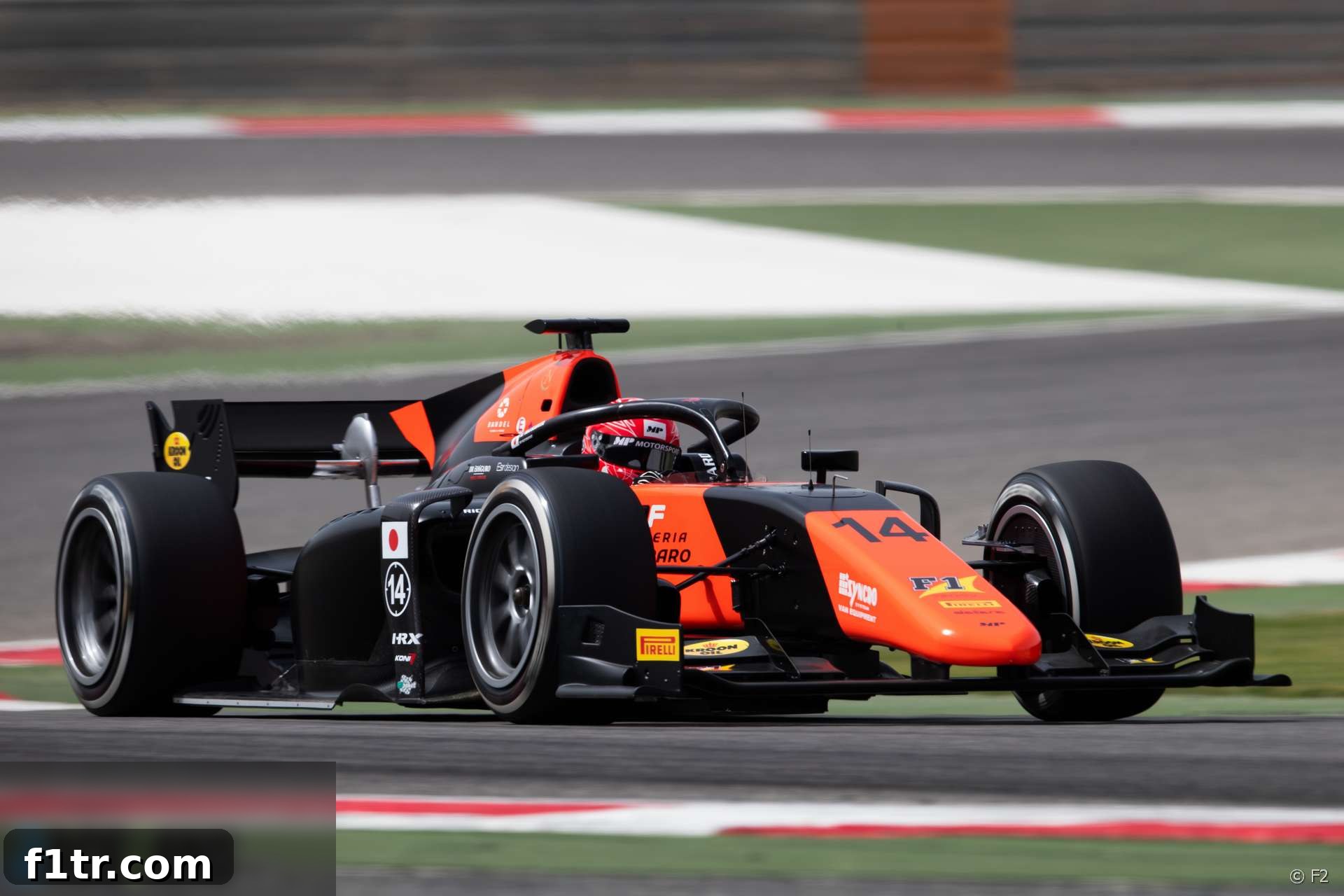
Formula 1 is on the cusp of a significant technical evolution, with the highly anticipated switch to 18-inch tires set to redefine racing dynamics from the 2022 season onwards. This pivotal change, spearheaded by official tire supplier Pirelli, aims to modernize the sport’s aesthetic while introducing new challenges and opportunities for car design and driver strategy. Crucially, the junior category, Formula 2, has already adopted these larger wheels, inadvertently becoming a vital testbed for Pirelli’s advanced development program.
Pirelli’s 18-inch Revolution: How F2 Data Fuels Formula 1 Tire Development
The introduction of 18-inch tires across the motorsport ladder marks a major departure from the smaller 13-inch wheels that have been a staple of Formula 1 for decades. This shift is not merely cosmetic; it profoundly impacts the vehicle’s dynamics, aerodynamics, suspension, and overall performance. Pirelli, as the sole tire supplier for both F1 and F2, finds itself in a unique position. While the 2022 F1 tire development schedule faced unavoidable delays due to global events, the real-world racing environment provided by Formula 2 has offered an invaluable stream of data, helping to bridge the gap in track testing for the pinnacle of motorsport.
Bridging the Gap: How F2 Data Informs F1 Tire Design
Despite distinct differences between the two racing series, the data gleaned from Formula 2’s inaugural season on 18-inch tires is proving immensely beneficial for Pirelli’s Formula 1 project. Formula 1 cars are significantly more powerful, wider, and generate far greater downforce, putting immense energy through their tires. Furthermore, F1 permits the use of tire warmers, a luxury not afforded in F2, where drivers must manage cold tires from the outset. These disparities mean that F2 data cannot be directly translated to F1, but it offers crucial insights into fundamental tire behavior under race conditions, informing Pirelli’s iterative design process.
Mario Isola, Pirelli’s Head of Motorsport, emphasized the strategic importance of this real-world feedback. “We have the opportunity to use these tires in a race environment,” Isola told RaceFans in an exclusive interview. “What we missed during our tyre development tests is using the tyres in a real race environment.” This unique vantage point allows engineers to observe how the new low-profile tires perform in complex scenarios that are almost impossible to replicate in controlled testing environments. The intricacies of competitive racing, with multiple cars battling for position, generate conditions that push tires to their limits in ways that solitary test runs simply cannot.
Unlocking Race Secrets: The Impact of Traffic and Racing Lines
One of the most critical areas where F2 racing has provided illuminating data concerns tire temperature management, especially when cars are running in close proximity. Formula 1 cars are notoriously sensitive to aerodynamic wake from preceding vehicles, which can cause significant tire overheating and a subsequent loss of grip and performance. This phenomenon, often referred to as ‘overheating when following another car,’ is a major factor in the quality of racing, as it makes sustained close-quarters battles challenging for drivers.
“Sometimes when we were talking also in the past about overheating when you follow another car, this is something that we cannot test during our session because we have one or two cars running on-track so it’s almost impossible to have a race simulation,” Isola explained. The F2 races, with their often tightly packed fields and intense wheel-to-wheel action, have delivered invaluable observations on how the new 18-inch tires react to sustained periods in turbulent air, providing Pirelli’s engineers with real-world thermal data that is vital for optimizing rubber compounds and construction for the rigorous demands of Formula 1. Understanding how these tires behave under such stress is paramount to developing compounds that offer both performance and durability in varying race conditions.
Beyond thermal performance, F2’s adoption of the 18-inch rubber has also revealed subtle yet significant changes in driver behavior and car setup. Isola noted that F2 drivers have had to adapt their racing lines at certain circuits due to the different response of the lower-profile tires to kerbs and track undulations. “The fact that they have slightly modified their racing line – that didn’t happen in Paul Ricard, that didn’t happen in Bahrain but it happened [at the Red Bull Ring] – is giving us some indication of what probably is going to happen also in Formula 1,” he said.
The stiffer sidewalls and larger diameter of the 18-inch tires fundamentally alter how the tire interacts with the track surface and car suspension. Drivers are accustomed to using kerbs aggressively to maximize cornering speed, but with the new tire construction, this approach may need refinement. The data from F2 provides early warnings and critical feedback on how F1 teams might need to adjust their suspension geometry, car setups, and even driver techniques to optimize performance and prevent damage. This early insight into driver adaptation is crucial for Pirelli to refine the tire characteristics to suit the world’s most demanding drivers and vehicles.
Navigating Challenges: Pirelli’s Development Amidst a Global Pandemic
The global pandemic of 2020 presented unprecedented challenges across all sectors, and motorsport was no exception. The eagerly anticipated introduction of 18-inch wheels to Formula 1, initially slated for 2021, was consequently postponed by a year to 2022. This delay directly impacted Pirelli’s real-world development program, forcing the suspension of track tests crucial for validating new designs and compounds. Such track sessions, involving modified F1 cars and test drivers, are the cornerstone of tire development, allowing engineers to gather empirical data under representative conditions.
Despite this significant setback, Pirelli was not idle. Mario Isola affirmed the company’s commitment to progress, even without the immediate ability to conduct track tests. “We tried to use the time in the best possible way. We don’t have any opportunity to organise any track test until the beginning of 2021,” he stated. This period of forced track inactivity spurred a greater reliance on alternative development methodologies, demonstrating the resilience and adaptability required in high-stakes motorsport engineering.
Beyond the Track: The Role of Virtual Models and Laboratory Testing
While track testing remains the ultimate validation, modern tire development heavily relies on advanced simulation and laboratory analysis. Pirelli leveraged this period of track test hiatus to intensify its efforts in virtual modeling and physical prototyping. “Luckily, with the four sessions that we ran until February of this year – the first one was with Ferrari in Jerez – we defined a baseline for the 18-inch development that was quite good,” Isola noted. This initial baseline provided a solid foundation upon which further virtual and lab-based development could proceed.
During the lockdown and subsequent restrictions, Pirelli’s engineers focused on sophisticated design analysis using Computer-Aided Design (CAD) and Finite Element Analysis (FEA) software. These tools allow for detailed simulations of tire behavior under various loads, temperatures, and dynamic conditions, predicting how different rubber compounds and constructions will perform. Concurrently, the company continued to produce and test physical prototypes within its state-of-the-art facilities. These laboratory tests involve rigorous evaluations of tire strength, durability, rolling resistance, and heat generation using specialized machinery that can simulate track forces.
“Now, what we are doing is even if we don’t have the possibility to test on track, we still have the possibility to make some design analysis and also physical prototypes that we can test in our facilities,” Isola explained, emphasizing that progress was ongoing. “We are not just losing time because we are not testing on track. What is clear is that we cannot confirm any of our virtual models [or] virtual prototypes because we are not testing on track. But we can do something. We are not just sleeping and waiting for January 2021.” This pragmatic approach underscores the crucial role of in-house research and development in an industry where innovation never truly sleeps, even when the track is silent.
The Performance Equation: Weight, Aerodynamics, and Driver Adaptation
The transition to 18-inch wheels for Formula 1 cars is not without its trade-offs, particularly regarding vehicle weight. The larger wheel rims and associated tire construction inherently add mass. Mario Isola estimates that this switch will increase the overall weight of an F1 car by approximately eight to ten kilograms. In a sport where every gram is meticulously accounted for, an additional 8-10 kg represents a significant weight penalty. Teams will need to work diligently to shed weight elsewhere on the car to mitigate this impact, affecting car design, material choices, and potentially even fuel strategies.
Beyond the direct weight implication, the new tire profile also influences aerodynamic performance. The smaller sidewall of the 18-inch tire reduces the amount of “tire squish,” which in turn alters the airflow around the wheel wells and overall car body. Teams will need to re-optimize their aerodynamic packages to work harmoniously with the new tire dimensions, a process that involves extensive computational fluid dynamics (CFD) analysis and wind tunnel testing. The interplay between tire characteristics, car aerodynamics, and suspension kinematics will be a critical area of development for all teams in the lead-up to 2022.
Ultimately, the success of the 18-inch tire initiative will also hinge on driver adaptation. As seen in F2, changes to racing lines and driving styles are inevitable. Formula 1 drivers, renowned for their ability to push the limits, will need to quickly understand the nuances of the new tires – their grip characteristics, degradation patterns, and reactions to varied track conditions and kerb usage. This will place a premium on simulator work, driver feedback, and collaborative efforts between drivers and engineers to extract maximum performance from the new tire-car package.
Looking Ahead: The Future of F1 Tire Technology
The move to 18-inch tires for Formula 1 is more than just a regulatory change; it represents a forward-thinking step in motorsport tire technology. It brings F1 closer to road car relevance, while also setting new benchmarks for performance and durability. The data gathered from F2, combined with Pirelli’s ongoing in-house development and future F1 track tests, will be instrumental in crafting tires that meet the demanding requirements of the sport. As 2022 approaches, all eyes will be on Pirelli and the teams as they unveil the next generation of Formula 1 cars, poised to race on revolutionary 18-inch rubber.
Related Motorsport Articles
- Understanding the Aerodynamic Impact of Larger F1 Tires
- The Evolution of Tire Technology in High-Performance Racing
- F1 Regulations 2022: A Deep Dive into the Technical Changes
- Pirelli’s Role in Shaping the Future of Formula 1
- Driver Challenges: Adapting to New Tire Profiles in Motorsport
Browse all Formula 1 Technical Articles