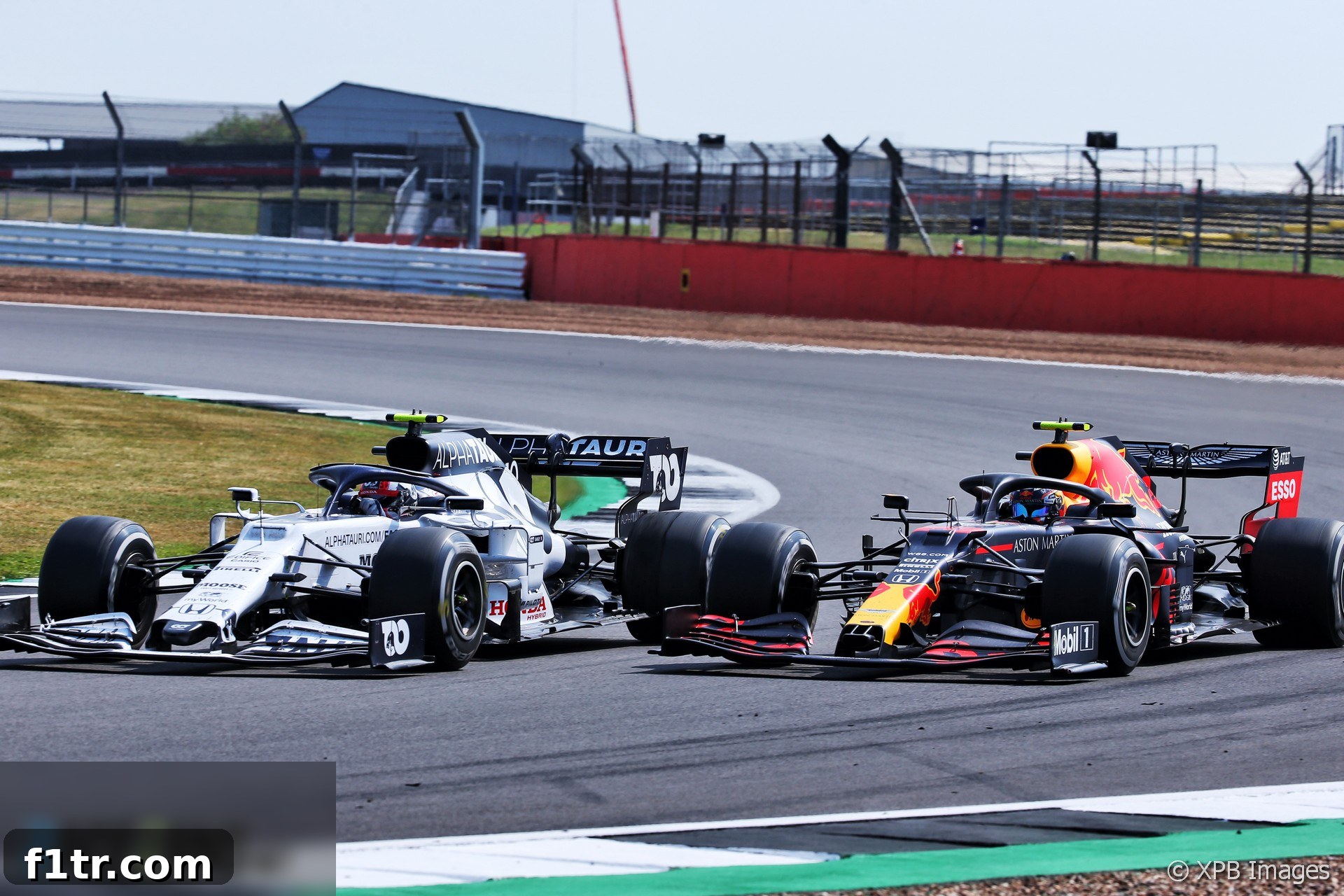
Alexander Albon concluded the Silverstone Grand Prix with a commendable fifth-place finish, a result that left both him and the Red Bull Racing team feeling optimistic about their progress. Despite a challenging start to the race weekend, Albon’s impressive drive on Sunday showcased significant improvements, fueling hopes for stronger performances in the future.
Alexander Albon’s Resilient Silverstone Performance
Albon’s race at Silverstone was a testament to his determination and the underlying pace of the Red Bull RB16. Reflecting on his performance, Albon expressed considerable satisfaction with the car’s handling on race day. “The car was really, really good,” he stated, highlighting a stark contrast to the struggles encountered during Saturday’s qualifying session. However, his race was not without its hurdles. An early first pit stop placed him firmly in heavy traffic, a common predicament in Formula 1 that severely hampers a driver’s ability to maximize their car’s potential and lap times.
Navigating through the congested midfield proved to be a formidable task in the initial stages of the Grand Prix. “I was struggling a lot at the start to get past,” Albon admitted, illustrating the difficulty of overtaking when cars are closely matched and operating within the slipstream of one another. Yet, as the race unfolded and strategic pit stops began to spread the field, Albon found his rhythm. His ability to adapt and push through the pack became evident. “Once we got into the rhythm at the end and had our time to attack and overtake people one by one, the pace was there,” he explained, emphasizing the car’s strong performance once it had clear air and the tires were optimally working.
The stark difference between the car’s performance on Saturday and Sunday became a key talking point for Albon. “The car was amazing today. Honestly, we need to understand why it was so good on Sunday and not Saturday,” he pondered. This observation underlines a critical challenge for Red Bull Racing: unlocking the RB16’s full potential across an entire race weekend, particularly in qualifying when fuel loads are minimal and outright pace is paramount. Addressing this inconsistency is vital for Albon to consistently start higher up the grid and avoid the energy-sapping battles through the midfield.
Red Bull’s Analysis: Praising Albon’s Racecraft
Red Bull Racing’s team principal, Christian Horner, was quick to acknowledge Albon’s impressive race-day performance, highlighting his exceptional racecraft. Albon, who started the race from ninth position, demonstrated a maturity and aggression that belied his experience in a top-tier team. “Alex doesn’t have quiet Sundays at the moment,” Horner remarked, affectionately noting Albon’s knack for being embroiled in exciting on-track battles.
Horner specifically lauded Albon’s overtaking maneuvers, describing his racing as “superb.” He drew attention to some particularly daring passes, including moves around the outside of Copse Corner – a high-speed, challenging section of the Silverstone circuit – and impressive overtakes throughout the first and second sectors. These moves were all the more significant given that the Red Bull car wasn’t always the quickest at the end of the straight, making clean passes reliant on skill and precise timing rather than sheer power advantage. “I thought he drove a very, very good grand prix,” Horner affirmed, echoing the team’s satisfaction with Albon’s execution.
The Qualifying Conundrum: A Team Focus
Despite Albon’s strong race pace, the team principal openly addressed the persistent challenge of qualifying. According to Horner, the primary area for improvement lies in optimizing the car’s handling on low fuel – the specific condition under which qualifying laps are run. In Formula 1, cars behave differently with varying fuel loads. On low fuel, the car becomes lighter and more agile, but also potentially less stable and harder to control at the absolute limit, demanding a delicate balance from both the driver and the engineers. This makes a car that is excellent on full tanks during a race potentially tricky on minimal fuel for a qualifying push.
Horner articulated the immense potential that would be unleashed if Albon could translate his formidable race pace into stronger qualifying results. “So I think as soon as the car becomes more and more drive-able on a Saturday and we start qualifying better… imagine if Alex had started in fourth or fifth with the pace that he had in the race,” he mused. This scenario underscores a fundamental truth in Formula 1: starting position is crucial. A higher grid slot can significantly reduce the need for aggressive overtaking, conserve tires, and allow a driver to dictate their own race strategy more effectively. If Albon could qualify higher, his already strong Sunday performances could elevate him to podium contention regularly.
Christian Horner conveyed the team’s unwavering confidence in Albon’s ability to overcome these qualifying hurdles. “And I’m sure that will come for him, I’ve got no doubts about that,” he stated, projecting belief in Albon’s talent and the team’s capability to provide him with a more stable and predictable car for Saturday sessions. The Red Bull technical team will undoubtedly be channeling their efforts into refining the RB16’s setup for qualifying, aiming to give Albon the platform he needs to demonstrate his true single-lap speed.
The Dynamic of Race Pace vs. Qualifying Performance in F1
The contrast between Alexander Albon’s qualifying struggles and his impressive race-day recovery at Silverstone highlights a common, yet complex, challenge in Formula 1. Teams often face a delicate balancing act: configuring a car for ultimate single-lap pace in qualifying versus optimizing it for consistent performance over a full race distance. A car that is inherently fast over one lap might be too aggressive on its tires or too unstable in traffic during a Grand Prix, and vice-versa.
For Red Bull, the focus appears to be on refining the RB16’s behavior under low fuel conditions. Qualifying demands maximum attack, where a car must be perfectly balanced, with precise handling and immediate response to driver input. Even the slightest instability can cost crucial tenths of a second, which translates to several grid positions in the fiercely competitive world of F1. During a race, with heavier fuel loads and the need for tire preservation, a slightly more forgiving and predictable setup often yields better results. Albon’s ability to manage his tires and carve his way through the field suggests that the RB16 possesses excellent underlying race pace and tire management characteristics once it’s in its operating window.
The engineering challenge for Red Bull is to bridge this gap. This involves intricate adjustments to aerodynamics, suspension settings, and even engine mapping. Finding a setup that allows Albon to extract maximum performance from the tires on a single qualifying lap without compromising the car’s longer-run consistency is key. Success in this area would not only boost Albon’s individual results but also significantly strengthen Red Bull’s challenge in the Constructors’ Championship, providing a consistent second car alongside Max Verstappen.
Looking Ahead: Albon’s Development and Red Bull’s Ambitions
Alexander Albon’s Silverstone performance serves as a crucial confidence booster for both the driver and the team. While the 2020 F1 season presented unique challenges, including a condensed calendar and intense competition, Albon’s resilience and ability to learn from each race have been evident. His progress at Silverstone, particularly his strong recovery drive and the car’s improved race pace, indicates a positive trajectory.
The pressure on young drivers in top teams like Red Bull Racing is immense, but Albon has consistently shown flashes of brilliance. His ability to perform daring overtakes and manage tire wear under pressure speaks volumes about his potential. The team’s commitment to addressing the qualifying issues signals their dedication to nurturing his talent and providing him with the best possible machinery to compete at the front.
As the season progresses, the focus for Albon will be to consistently qualify higher up the grid. With improved Saturday performance, his Sundays could become even more spectacular, allowing him to fight for podium finishes and contribute significantly to Red Bull Racing’s championship aspirations. The Silverstone outing, therefore, was more than just a fifth-place finish; it was a clear sign of progress and a foundation upon which further success can be built.
2020 F1 Season Insights
- Grosjean to make F1 test return tomorrow for first time since Bahrain horror crash
- Pictures: Wrecked chassis from Grosjean’s Bahrain fireball crash to go on display
- Bottas vs Rosberg: Hamilton’s Mercedes team mates compared after 78 races each
- F1 revenues fell by $877 million in Covid-struck 2020 season
- Hamilton and Mercedes finally announce new deal for 2021 season
Browse all 2020 F1 season articles