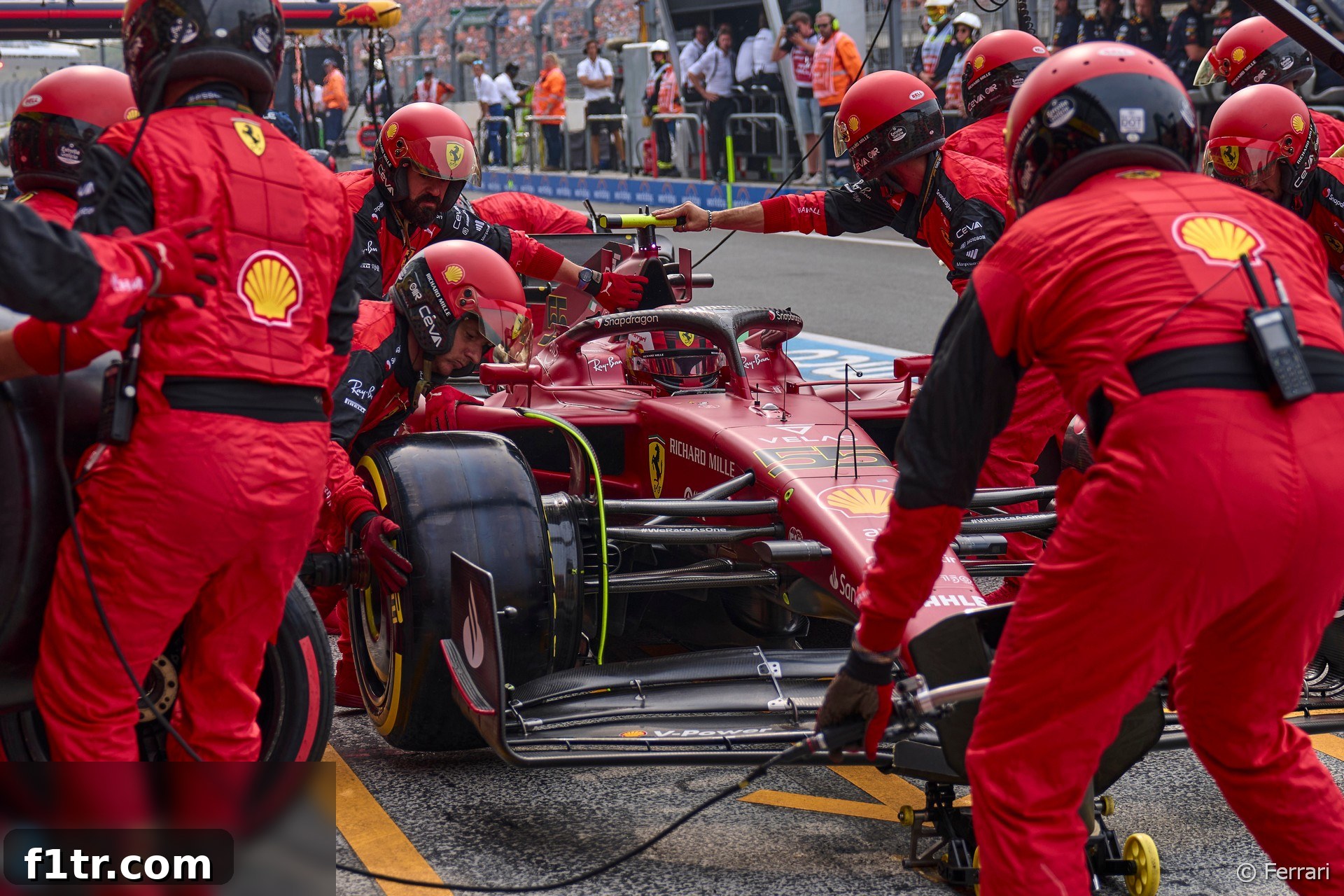
Ferrari’s Dutch Grand Prix Pit Stop Fiasco: An In-Depth Analysis of Carlos Sainz’s Costly Delay
The high-octane world of Formula 1 is a relentless pursuit of perfection, where every millisecond counts. At the 2022 Dutch Grand Prix, Ferrari found itself in the spotlight for all the wrong reasons when a critical pit stop error severely compromised Carlos Sainz Jnr’s race. Ferrari’s strategy director, Inaki Rueda, has since offered a comprehensive explanation, detailing the intricate sequence of events that led to the team’s failure to have all four wheels ready for Sainz during his crucial first pit stop.
Sainz, who started the race from a promising third position, ultimately crossed the finish line in eighth place. This disappointing outcome was not solely due to the infamous five-second time penalty he received for an unsafe release during his final stop. Rather, it was his initial visit to the pits on lap 14 that inflicted the most significant damage. An agonizing delay of over 10 seconds ensued as the crew frantically waited for the left-rear wheel to arrive, a blunder that proved exceptionally costly and fundamentally reshaped Sainz’s race trajectory.
Unpacking the Pit Stop Puzzle: The Reactive Strategy Behind the Delay
In a candid and revealing video published by Ferrari, Inaki Rueda meticulously broke down the strategic considerations and operational missteps. “The first round of pit stops came quite early,” Rueda explained, noting that several competitors began making their first tire changes around laps 10, 12, 13, and 14. This early pit window created a delicate strategic situation for Ferrari, forcing them to react swiftly to maintain their track position.
Rueda emphasized the immediate threat facing Sainz. “With Carlos we were under threat, we had two Mercedes and one Red Bull that could potentially undercut Carlos.” The ‘undercut’ is a powerful strategic maneuver in F1, where a driver pits early for fresh tires to gain a significant pace advantage, allowing them to leapfrog a rival who stays out longer on older, slower rubber. At that specific point in the Dutch Grand Prix, an undercut from competitors like Sergio Perez (Red Bull) or the Mercedes duo would have meant Sainz surrendering vital track position. Consequently, Ferrari’s decision to bring Sainz in, though executed later than their standard operational window, was a direct, reactive response to Perez’s pit call, aimed at fending off this strategic disadvantage.
The Critical Communication Breakdown: Driver vs. Crew Calls
The seamless execution of a Formula 1 pit stop relies on a finely tuned choreography of timing and communication. Rueda highlighted that there are two distinct calls involved in initiating a pit stop: the instruction to the driver and the alert to the pit crew. “The call to the driver in this case came at the right time, Carlos had no problem coming into the box, he knew he was coming in, he had enough time to make the pit lane,” Rueda confirmed. This indicated that Sainz was well-prepared and aware of his impending stop.
However, the crucial second call, the alert to the pit crew, suffered a significant and detrimental delay. Typically, the pit crew is notified approximately 23 to 24 seconds before the car’s arrival. This generous window allows them ample time to move into position, prepare their equipment, and be ready for the blistering speed required. “But in this case because we were reacting to Perez it came later. We only gave our pit crew 17 seconds to react,” Rueda explained. This crucial reduction of six to seven seconds in preparation time, while seemingly minor, proved to be catastrophic in the high-pressure, precision-driven environment of an F1 pit lane. Instead of receiving the signal as Sainz exited the turn 12 hairpin, the call reached the crew only as he entered the final two corners of the lap, severely cutting down their window for readiness.
Zandvoort’s Narrow Confines: A Physical Hurdle for the Pit Crew
The implications of this shortened reaction time were immediate and profound. “Our pit crew need this time to come out into the location and be ready when the driver comes,” Rueda stressed, underscoring the importance of every second. He further elaborated on the meticulous and synchronized choreography required for a successful pit stop: “We have our gunmen, the tyre removers come out and the tyre fitters come crucially through the pit stop area.” Each crew member has a specific, pre-assigned role and a precise position to occupy around the car, poised for the millisecond timing necessary to change all four wheels in less than three seconds.
Due to the condensed warning period, the entire crew was unable to reach their designated positions around Sainz’s car in time to initiate the stop seamlessly. Rueda pinpointed the specific difficulty that arose: the struggle of the rear-left tire fitter. “Carlos came in a bit earlier than usual. The front-left tyre fitter managed to squeeze in between the front wing and the front jack, but the rear-left tyre fitter did not manage to get by,” he detailed. This vital member was physically blocked from reaching his corner of the car.
The unique, notoriously tight, and winding layout of Zandvoort’s pit lane further compounded the problem. “To make matters worse, at Zandvoort we have a very narrow pit lane and this meant that the rear-left tyre fitter had to go around the whole pit crew to make it eventually to his corner,” Rueda revealed. This forced and time-consuming detour meant that while the other three corners of the car were serviced with relative speed, the crucial left-rear tire remained unfitted. The agonizing footage of three wheels already changed while the fourth remained stubbornly out of reach became a stark visual representation of Ferrari’s operational challenges throughout that season.
Strategic Ripple Effects: From Third to Eleventh
The consequences of this pit stop fiasco were immediate and stark. Carlos Sainz, who had been running strongly in third place, plummeted down the order to eleventh. In stark contrast, Sergio Perez, whose earlier pit stop had prompted Ferrari’s reactive call, enjoyed a clean and swift service, dropping only to eighth before quickly recovering to third position even before his second stop. For Sainz, the task of recovering the lost ground and fighting his way back through the field was monumental.
Despite the significant setback, Ferrari pressed on with their initial race strategy. Sainz commenced his second stint on medium compound tires, gradually managing to climb back to fifth place through sheer driving skill. Rueda commented on this phase, stating, “We thought it was a strong tyre, and we were gearing up to do a two-stop from then on.” However, this meticulously planned strategy was soon to be challenged by an unexpected surge from their closest competitors.
Mercedes’ Unexpected Pace Reshapes Ferrari’s Strategy
The dynamic and ever-evolving nature of Formula 1 strategy demands constant adaptability. Ferrari’s strategists soon observed a surprising turn of events regarding their rivals. “We realised that the Mercedes on the medium from the start had considerably more pace than we expected,” Rueda admitted. This unexpectedly strong performance from both George Russell and Lewis Hamilton dramatically altered the competitive landscape. What Ferrari initially perceived as a two-stop race for their Mercedes rivals suddenly shifted. “This meant that now they were in contention for a one-stop and a very competitive one-stop at that,” Rueda highlighted.
The prospect of Mercedes successfully completing the race on a single stop presented Ferrari with a formidable strategic dilemma. If Mercedes could execute a one-stop strategy, Ferrari would then be compelled to overtake them on track—a notoriously challenging feat in modern F1, especially at a circuit like Zandvoort. “Our second stops were done with the Mercedes doing a one-stop in mind, so we wanted to try and come back at Hamilton and Russell with as much pace delta as possible to overtake, because them doing one stop less meant we would have to overtake them on track,” Rueda articulated, explaining Ferrari’s aggressive pursuit of pure pace to compensate for the potential strategic disadvantage.
The Safety Car Twist and Final Verdict
The Dutch Grand Prix then delivered another dramatic twist with a late safety car period, a common occurrence that often serves to completely reset the strategic battleground. Both Mercedes drivers shrewdly seized this opportunity to make a second pit stop, effectively mitigating some of Ferrari’s planned pace advantage and allowing them to switch to fresh soft tires for a final charge. Crucially, they were able to maintain their track position over Sainz.
While Carlos Sainz had gallantly fought his way back into a strong fifth position, his valiant efforts were ultimately overshadowed by the previously mentioned five-second penalty. This penalty, incurred for an unsafe release during his final pit stop, meant he dropped further down the order to an eighth-place finish. This cumulative effect of strategic misjudgment, operational error, and subsequent penalty served as a painful reminder of Ferrari’s recurring operational hiccups throughout a challenging 2022 Formula 1 season.
In reflection, the Dutch Grand Prix pit stop for Carlos Sainz perfectly encapsulated a season where Ferrari frequently grappled with strategy and execution. Inaki Rueda’s detailed explanation clearly illuminates the razor-thin margins that define success and failure in F1. A mere few seconds less warning for a pit crew, when combined with the unique, constricting constraints of a circuit like Zandvoort, can be enough to unravel a promising race performance and severely impact a driver’s championship aspirations. It underscores the immense pressure on strategists to make reactive calls under extreme time constraints and the critical, symbiotic importance of every single team member in the relentless pursuit of Formula 1 victory.
2022 Dutch Grand Prix Insights
- Ferrari’s season of missed chances led to “difficult” criticism for Binotto
- How many victory chances did Hamilton have in his first winless F1 season?
- Why F2’s role as F1’s sustainable fuel guinea pig ‘isn’t going to be a reliability issue’
- Straight-line speed deficit will continue to “bite” Mercedes in qualifying – Wolff
- Verstappen achieves his longest winning streak with second home victory
Browse all 2022 Dutch Grand Prix articles