[raceweekendpromotion]
Yuki Tsunoda Penalised for São Paulo Grand Prix Collision with Lance Stroll
Advert | Become a Supporter & go ad-free
The 2021 Formula 1 São Paulo Grand Prix at the iconic Autódromo José Carlos Pace, affectionately known as Interlagos, delivered an unforgettable spectacle of high-octane racing and strategic brilliance. Amidst the intense battles that defined one of the most thrilling seasons in recent memory, a notable incident involving AlphaTauri rookie Yuki Tsunoda and Aston Martin driver Lance Stroll captured the attention of both race officials and motorsport enthusiasts. This collision not only reshaped the immediate fortunes of both drivers on track but also led to disciplinary action for Tsunoda, adding penalty points to his superlicence and stirring debates about racing ethics and the challenging learning curve for emerging talents in Formula 1.
The Interlagos Collision: A Bold Overtake Attempt Gone Wrong
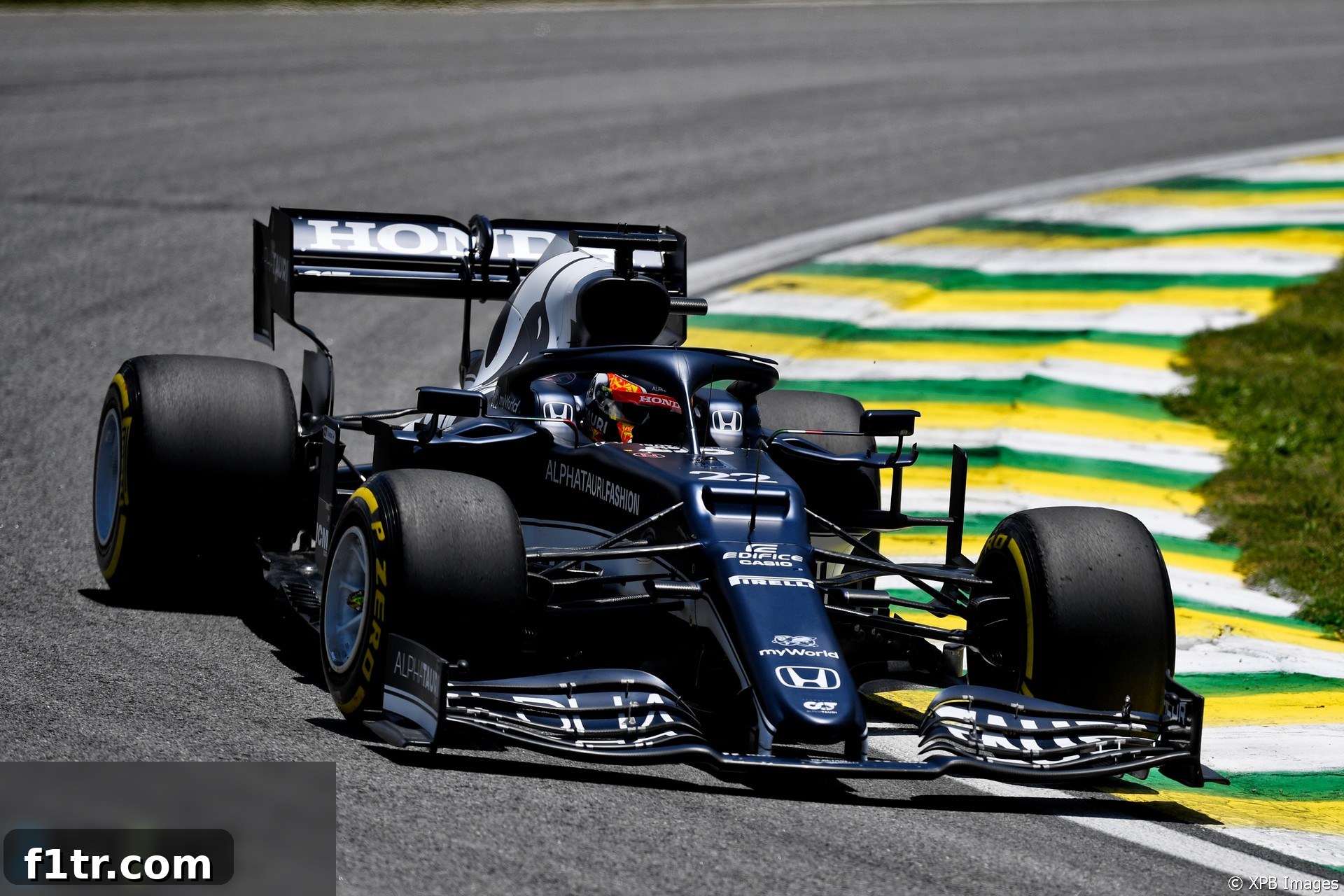
The crucial moment unfolded early in the race, on just the fourth lap, setting a challenging tone for Tsunoda and ultimately ending Stroll’s participation prematurely. As the sole driver to commence the Grand Prix on the softer compound tyres, Yuki Tsunoda was aggressively pushing to maximise his initial grip advantage, aiming to gain valuable track positions against his rivals. His target was Lance Stroll, who was defending 13th place at the time. The Japanese driver’s audacious overtaking attempt took place into the demanding Senna ‘S’ complex – the famous sequence of turns one through three that characterises the beginning of the Interlagos lap. This section, a high-speed downhill left-hander immediately followed by a tighter right, is renowned for its difficulty, requiring pinpoint precision, unwavering bravery, and absolute commitment from drivers.
Capitalising on the slipstream along the long front straight, Tsunoda approached Stroll’s Aston Martin with a considerable speed differential. Opting for the inside line into Turn 1, a classic but risky overtaking spot, the AlphaTauri driver attempted a late-braking manoeuvre. However, his optimistic lunge proved to be beyond the limit of adhesion and control. Tsunoda’s car made unavoidable contact with Stroll’s, resulting in immediate and significant damage to both machines. Tsunoda’s front wing was instantly shattered, forcing him into an unscheduled pit stop for a replacement. Stroll, meanwhile, suffered substantial floor damage on the left side of his Aston Martin, an injury that would prove to be a critical factor in his eventual retirement later in the race.
Stewards’ Ruling: Tsunoda “Wholly at Fault”
Following the conclusion of the São Paulo Grand Prix, the race stewards launched a comprehensive investigation into the incident, meticulously reviewing all available video evidence, onboard footage, and telemetry data. The esteemed panel, comprising Tim Mayer, Matteo Perini, Vitantonio Liuzzi, and Roberto Moreno, subsequently issued their findings in Document number 45. Their statement provided an unambiguous conclusion regarding the culpability for the collision.
“The Stewards reviewed the video evidence and determined that car 22 [Yuki Tsunoda] caused a collision with car 18 [Lance Stroll],” the official statement declared. It further elaborated on the specific circumstances leading to the contact: “Car 22 was slipstreaming car 18 along the front straight and was considerably faster on the inside at Turn 1. However, he braked too late and collided with car 18 in this optimistic manoeuvre. The Stewards find him wholly at fault.”
As a direct consequence of this unequivocal ruling, Yuki Tsunoda was issued a ten-second time penalty during the race itself. This penalty, served concurrently with his pit stop to replace the damaged front wing, severely compromised his chances of recovering into the points-paying positions. He ultimately finished the São Paulo Grand Prix in 15th place, a lap behind the triumphant race winner, Lewis Hamilton, and a full minute behind his AlphaTauri teammate, Pierre Gasly, who secured a commendable seventh-place finish for the team.
The FIA Superlicence Penalty Point System: Tsunoda’s Growing Tally
Beyond the immediate time penalty incurred during the race, the collision had a more enduring and significant implication for Yuki Tsunoda: the addition of two penalty points to his FIA Superlicence. This rigorous system is a cornerstone of Formula 1’s disciplinary framework, meticulously designed to regulate driver conduct, uphold safety standards, and encourage fair racing throughout the highly competitive season. Each penalty point accumulated remains active on a driver’s superlicence for a rolling 12-month period. Should a driver amass a total of 12 penalty points within this designated timeframe, they are automatically subjected to a one-race ban, a severe consequence that can significantly jeopardise their championship aspirations and impact their team’s performance in the Constructors’ standings.
With the acquisition of these two new points, Tsunoda’s current tally now stands at six penalty points on his superlicence. This places him precisely halfway towards the critical threshold that would trigger a race ban. While six points might not be immediately alarming, it underscores the paramount importance of clean driving and incident avoidance, particularly for a rookie navigating the cutthroat environment of Formula 1. These specific penalty points will remain on his record until April 18, 2022, compelling him to maintain an exceptionally cautious and disciplined racing approach for several more months to steer clear of the dreaded 12-point mark. For a young driver still adapting to the demands and pressures of elite motorsport, managing this accumulating tally while simultaneously pushing the absolute limits of his car represents a delicate and demanding balancing act.
Consequences for Both Drivers: A Race of Divergent Fortunes
Yuki Tsunoda’s Challenging Race and Learning Experience
For Yuki Tsunoda, the São Paulo Grand Prix ultimately served as a challenging and impactful lesson in the unforgiving margins of Formula 1 racing. The initial promise of his soft tyre strategy quickly dissipated with the contact. The subsequent unscheduled pit stop and the imposed time penalty relegated him to the rear of the grid, forcing him to spend the remainder of the race battling slower machinery and striving to recover lost ground. While his eventual finishing position of 15th was outside the coveted points, the experience of navigating a competitive, albeit difficult, F1 weekend is invaluable for a rookie’s development. However, the accumulation of penalty points serves as a potent and tangible reminder of the direct consequences stemming from on-track errors.
Lance Stroll’s Unfortunate Retirement and Team Setback
Lance Stroll’s race, which was severely disrupted by the early collision, concluded in complete disappointment and frustration. Despite managing to continue driving for a significant portion of the Grand Prix, the floor damage inflicted by Tsunoda’s car proved to be far more severe and progressive than initially assessed. As the laps wore on, pieces of crucial bodywork began to detach from his Aston Martin, scattering dangerous debris across the track surface. This development necessitated the deployment of a Virtual Safety Car (VSC) to allow marshals to safely clear the track – an event that itself can significantly influence the strategies and outcomes for other competitors.
Ultimately, after battling valiantly for 47 laps with an increasingly compromised and aerodynamically inefficient car, Lance Stroll was regrettably forced to retire from the race. This DNF (Did Not Finish) represented a significant blow for the Aston Martin team, costing them valuable potential points in the tightly contested Constructors’ Championship battle. The incident vividly highlighted how an early-race collision, even if a driver initially attempts to press on, can have long-term and ultimately race-ending detrimental effects on their ability to compete effectively.
Advert | Become a RaceFans supporter andgo ad-free
The Broader Interlagos Narrative: A Race of High Stakes and Drama
The 2021 São Paulo Grand Prix was always destined to be an iconic event, strategically positioned within the thrilling climax of one of Formula 1’s most intense and memorable championship battles. While the collision between Yuki Tsunoda and Lance Stroll was undoubtedly a notable incident, it unfolded against a backdrop of even larger, more dramatic storylines. Most prominently, the epic and controversial duel between title protagonists Lewis Hamilton and Max Verstappen captivated the world. Hamilton’s breathtaking charge from tenth on the grid to secure a phenomenal victory, coupled with the ongoing controversies surrounding stewarding decisions and power unit penalties, firmly cemented the race’s place in F1 history.
Incidents such as the one involving Tsunoda and Stroll serve as powerful testaments to the relentless pressure, the razor-thin margins, and the ultra-competitive nature inherent in Formula 1. Every single position, every aggressive overtaking attempt, and every split-second racing decision carries immense weight, impacting not only the drivers directly involved but also their respective teams’ championship ambitions and future prospects. While Tsunoda’s error can be categorised as a rookie mistake, it provided a vivid illustration of the incredibly fine line that separates audacious bravery from over-ambition in a sport where milliseconds and millimeters can be the ultimate arbiters of success or failure.
As the intense 2021 season drew to its dramatic conclusion, young drivers like Yuki Tsunoda continued their steep and rapid learning curve, understanding implicitly that such incidents are an inevitable part of the journey towards becoming a seasoned F1 competitor, yet also recognising the critical importance of minimising them. The São Paulo Grand Prix, with all its drama and controversy, ultimately highlighted the raw talent, fierce determination, and the unrelenting pursuit of excellence that permeates the entire F1 paddock, from the most seasoned champions to the most promising emerging stars.
More from the 2021 São Paulo Grand Prix
- Red Bull and Mercedes summoned to FIA hearing on review of Sao Paulo incident
- McLaren must “get back to scoring the results that are on the table” – Seidl
- Hamilton makes his second-biggest climb to victory from 10th on the grid
- F1 releases missing video footage from Verstappen’s car of Hamilton incident
- How Alonso and Ocon “pushed team tactics to the ultimate limit” to delay Gasly
Browse all 2021 São Paulo Grand Prix articles