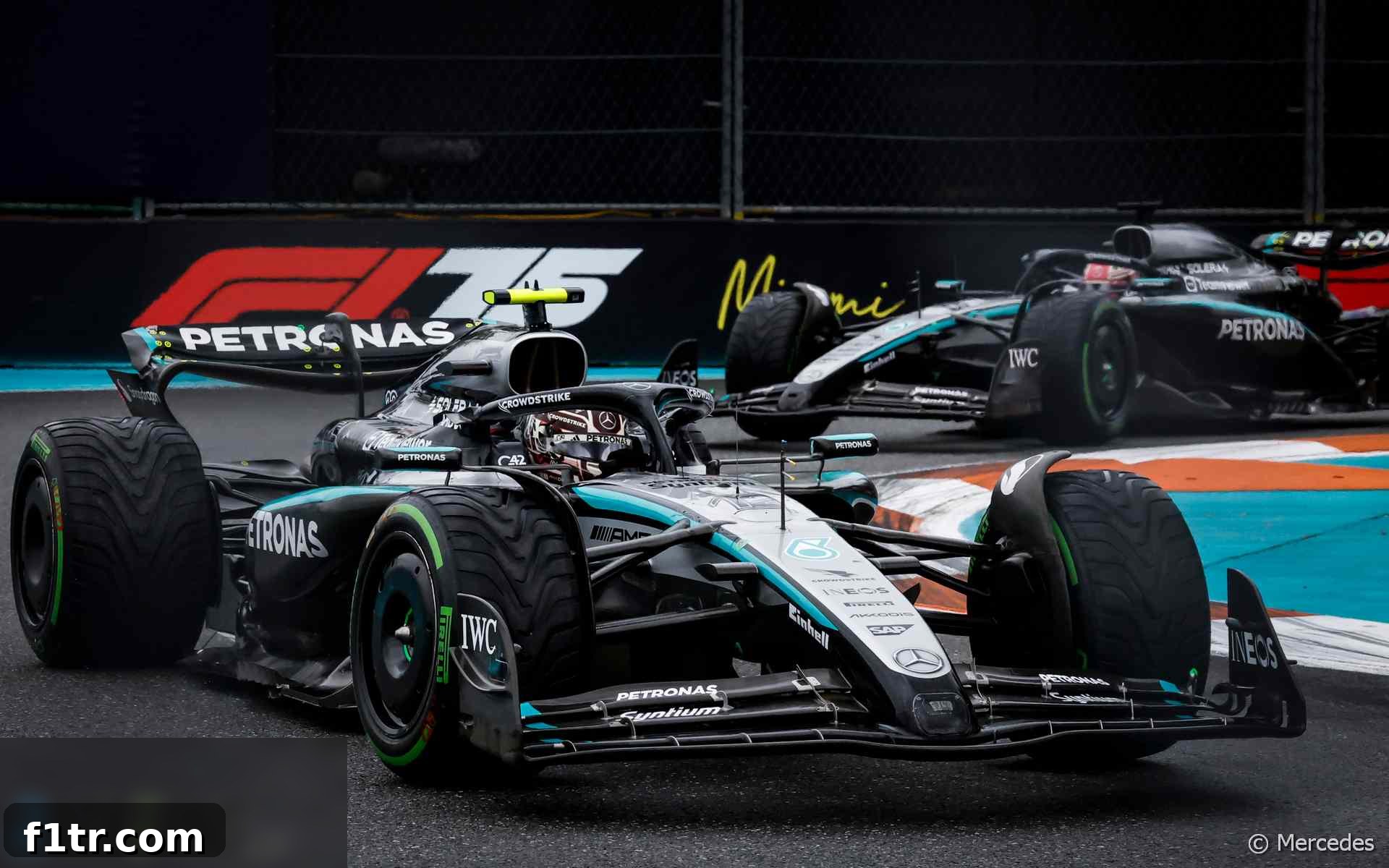
Mercedes-AMG Petronas Formula 1 Team is gearing up to significantly accelerate its upgrade program over the forthcoming races, signaling an ambitious push to build on what has been their most promising start to a season in four years. Despite this improved performance trajectory, the Silver Arrows currently hold second place in the Constructors’ Championship, trailing the formidable McLaren team by a substantial margin exceeding 100 points. This substantial gap underscores the intense competition at the pinnacle of motorsport and highlights the critical importance of effective and timely development.
Advert | Become a Supporter & go ad-free
The journey to closing this performance deficit began with their first officially documented major upgrade package introduced at the Miami Grand Prix last weekend. However, as Mercedes’ Chief Technical Officer, James Allison, revealed in a team video, the development process has been a continuous effort far beyond these official designations. Allison clarified that the team has been consistently introducing improvements to their W15 challenger since the start of the year, describing them not as “enormous or sexy” breakthroughs but rather a “steady trickle” of refinements.
This nuanced explanation sheds light on the continuous evolution inherent in Formula 1 car development. Often, new parts may not be formally classified as ‘upgrades’ in FIA documentation if they represent minor design tweaks, material changes for weight reduction, or reliability enhancements that do not significantly alter aerodynamic or mechanical specifications. While Allison did not explicitly confirm such lightweighting efforts, his comments suggest a strategic, iterative approach to performance enhancement that goes beyond singular, headline-grabbing component changes. The focus on incremental gains is a testament to the meticulous engineering prevalent in F1, where every gram and every millisecond counts.
Looking ahead, Allison hinted at a more visible wave of enhancements, promising that “there’s some that will be more obvious to the outside world in the next handful of races.” This statement has ignited anticipation among fans and pundits alike, who are eager to see how these forthcoming modifications will manifest on track and, crucially, whether they will “improve our fortunes” in the high-stakes battle for constructor and driver supremacy. The timing of these upgrades is critical, as the season progresses at a relentless pace.
Allison acknowledged the immense pressure of the compacted F1 calendar, likening the race schedule to a “machine-gun fashion” onslaught. This unforgiving rhythm presents significant logistical and engineering challenges for teams, making it exceptionally difficult to design, manufacture, test, and implement substantial upgrades within such tight windows. Despite these hurdles, Mercedes is committed to pushing the boundaries of development, hoping that the changes introduced over the next two or three races will “move the dial a bit for us.”
Advert | Become a RaceFans supporter andgo ad-free
The Tyre Temperature Conundrum: Mercedes’ Primary Development Focus
A central pillar of Mercedes’ development strategy for their W15 car is the optimization of tyre temperature management over an entire race distance. This area has been identified as a significant weakness for the team compared to rivals, particularly McLaren, who have demonstrated a clear advantage in maintaining optimal tyre performance throughout long stints. The intricate relationship between tyre temperature, grip, and degradation is one of the most complex and critical factors determining a car’s race pace in modern Formula 1.
Tyres operate within a very narrow temperature window where they deliver peak grip and consistent performance. If they run too hot, they suffer from excessive degradation and blistering, leading to a significant drop in pace. Conversely, if they don’t reach their optimal operating temperature, they lack grip and can be difficult to manage. Mercedes has often shown strong performance in qualifying sessions, which are typically shorter runs on fresh tyres, suggesting the car has inherent speed. However, this pace has frequently failed to translate into competitive race performance on Sundays, primarily due to struggles with tyre longevity and consistency.
Allison emphasized this disparity, stating, “Because we’ve been pretty strong in qualifying for the first several races, I think we can expect to have an okay shout of getting the car reasonably well up the grid in qualifying. With a bit of luck, the upgrades might make that a bit better still.” While improving qualifying remains a secondary goal, the paramount objective is to bridge the gap between their Saturday potential and Sunday reality. “But the main thing we’ll be focusing on is trying to get that race pace under control, trying to make sure that we deliver on the promise of our Saturdays on the Sunday,” Allison added.
Achieving this consistency over a race distance is overwhelmingly about “controlling the temperature of those tyres and making sure the car can therefore use the pace that’s in it.” This indicates that the W15 possesses underlying performance that it cannot fully exploit due to its struggles with tyre thermal management. Addressing this issue will likely involve a multi-faceted approach, encompassing changes to aerodynamics, suspension kinematics, and potentially even brake ducting to influence how heat is generated and dissipated across the tyre surface. The aim is to create a more benign operating window for the Pirelli compounds, allowing drivers to push harder for longer without succumbing to excessive wear or overheating.
Broader Implications for the W15 and the Championship Fight
The success of Mercedes’ upgrade push and their ability to conquer the tyre temperature challenge will have profound implications for their season. While a championship challenge against Red Bull or McLaren might seem distant at this stage, significant improvements could solidify their position as a consistent podium contender and potentially allow them to challenge for race victories. Furthermore, mastering these technical complexities will be crucial for the development of future cars, providing valuable data and insights that can be carried forward into subsequent seasons.
The competitive landscape of Formula 1 is unforgiving. Every team is engaged in a relentless development race, constantly striving to find marginal gains. Mercedes’ decision to ramp up their upgrade program reflects their determination to not just keep pace but to gain an advantage. The upcoming “obvious” upgrades, coupled with a dedicated focus on improving race pace through tyre management, signal a renewed intensity from the Brackley-based squad. Fans will be watching closely to see if these efforts translate into a more competitive and consistent W15 on track, allowing Lewis Hamilton and George Russell to fully unleash the car’s potential and fight closer to the front.
Miss nothing from RaceFans
Get a daily email with all our latest stories – and nothing else. No marketing, no ads. Sign up here:
Advert | Become a RaceFans supporter andgo ad-free
2025 Miami Grand Prix
- Nothing for Ferrari to learn from Miami team orders episode – Vasseur
- Hamilton proud of Ferrari as ‘we’re taking a beating from media and people’s comments’
- McLaren legality never in doubt says Piastri as FIA’s post-race check clears car
- Albon did not disobey team orders in Miami says Vowles after Sainz’s complaint
- McLaren score their most emphatic win since Hamilton’s 2008 Silverstone triumph
Browse all 2025 Miami Grand Prix articles