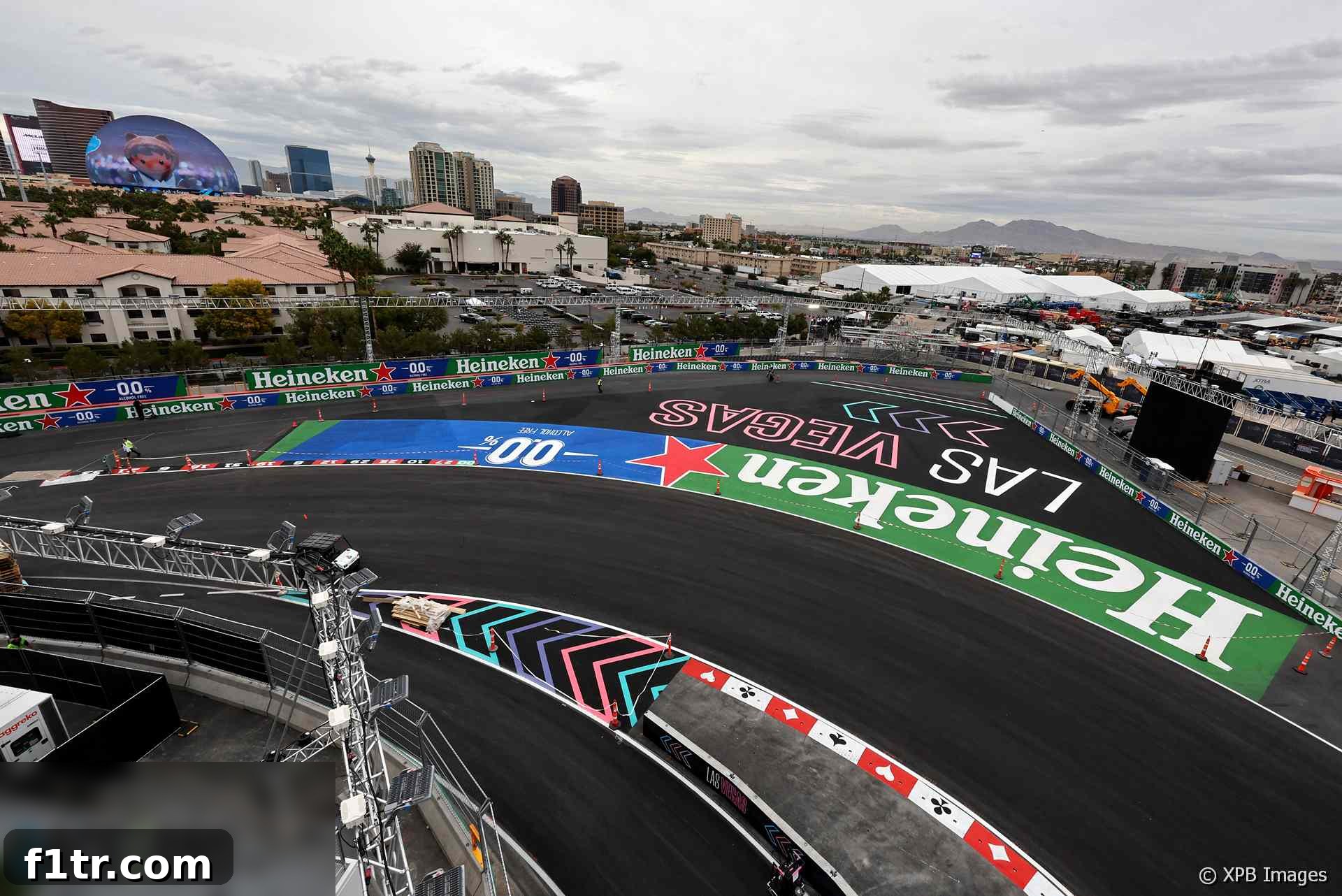
The inaugural Formula 1 Las Vegas Grand Prix is poised to be an event unlike any other on the calendar, but the unique conditions of the Las Vegas Strip Circuit have raised significant concerns among drivers regarding extremely low grip levels. This unprecedented challenge could fundamentally alter the dynamics of the race weekend, presenting teams and drivers with a formidable test in unfamiliar territory.
Our content is made possible by supporters like you. Support us for an ad-free experience.
As Formula 1 prepares for its first practice session late on Thursday night, the ambient temperatures are forecast to drop as low as 12°C. Track temperatures are anticipated to be even colder, creating an exceptionally chilly environment for tyre performance. Early observations have only amplified these anxieties; the circuit appeared noticeably dirty when it first opened for checks on Wednesday. The Formula 1 Safety Car, after just a few exploratory laps around the damp, six-kilometre layout, returned to the pits visibly coated in a thick layer of dust and grime.
This accumulation of debris is a significant worry. While the track surface is expected to improve with sustained running from the F1 cars, a critical factor exacerbating the situation is the absence of supporting race categories. Unlike most Grand Prix weekends, there are no junior series or other championships competing to help ‘rubber in’ the track, which would typically lay down layers of tyre grip. Furthermore, several sections of the circuit, which normally serve as public roads, will be opened to street traffic for extended periods – up to 13 hours at a time – between F1 track sessions. During these intervals, more dust, dirt, and general road contaminants are almost certain to accumulate on the racing line, effectively resetting the track condition and grip levels before each F1 session.
The uncertainty surrounding grip has been a dominant theme among drivers arriving in Las Vegas. Simulation data, while helpful, struggles to accurately replicate such dynamic and challenging surface conditions. “I opened the door at a set of traffic lights last night and dragged my foot over the track and it feels pretty slippery,” remarked Daniel Ricciardo, offering a visceral sense of the initial conditions. The Australian driver believes that despite the circuit featuring several long, high-speed straights, the anticipated low grip might prompt teams to rethink traditional low-downforce setups typically favored for such layouts. “It feels pretty low-grip, so that could maybe switch you to running more downforce,” Ricciardo elaborated. “We’ve got an idea of what it might be like, but I think it’s going to be quite slippery out there,” he concluded, highlighting the unpredictable nature of the challenge ahead.
Our content is made possible by supporters like you. Support us for an ad-free experience.
Fernando Alonso echoed these concerns, particularly apprehensive about the slow rate of track improvement due to the public roads being used daily. The two-time world champion emphasized the critical need for drivers to build confidence in their machinery, especially under braking. “Getting confidence in the car, in the braking areas will be, I think, very important,” he stated. Alonso predicts an unusually high degree of track evolution throughout the weekend, a direct consequence of the unique circumstances. “With the conditions on the track and not having any support races, I think the amount of track evolution during the weekend is going to be bigger than normal,” he explained. “So that will challenge everyone; I guess we will not have two laps the same on the weekend. Every lap of the track will be a little bit better than the lap before from [first practice] to the last lap on the race. We will have to adapt to that changeable grip.” This constant adaptation will demand exceptional skill and flexibility from every driver on the grid.
The challenge extends to tyre management, a crucial aspect of Formula 1 performance. Pirelli, F1’s official tyre supplier, has responded to the anticipated low temperatures and grip by setting unusually high minimum starting tyre pressures: 27psi for the fronts and 24.5psi for the rears. These elevated pressures are designed to prevent the tyres from dropping out of their optimal operating window in the cold conditions, but they also risk making the tyres feel even more rigid and less compliant, potentially reducing mechanical grip further. George Russell highlighted the tyres as the primary concern. “The number one biggest thing’s going to be the tyres with these cold conditions,” he told RaceFans. Russell expressed particular apprehension about the long straights cooling the tyre surfaces excessively, which could lead to graining – a phenomenon where the tyre compound sheds small chunks of rubber due to insufficient temperature or excessive slip, severely compromising grip. “With big long straights, the surface of the tyres are going to be really cold and it’s going to be potentially prone to graining which we’ve seen many times in winter testing,” he explained. “I think it’s going to be very challenging to strike that balance between qualifying performance and race performance,” he added, pointing to a strategic dilemma for teams trying to optimize their setup.
Our content is made possible by supporters like you. Support us for an ad-free experience.
Russell further emphasized the impact of the lack of support races and public road usage: “The fact that we’ve got no support series here means that every single time we drive on track, there’s going to be a huge reset.” This “reset” will be most pronounced overnight when public vehicles traverse the circuit. “Especially overnight, when you’ve got the general public back on the roads, for the first lap in FP1 and FP3 it’s going to be dusty and dirty, but then again for the second sessions of the day as well – and the race, of course, we’re going to go out on Saturday for the race, nobody will have driven on air for 24 hours and you’ll need to take that into consideration.” This constant variability will demand an unprecedented level of adaptability and immediate feedback from drivers and engineers.
Adding another layer of complexity to an already challenging forecast, the weather could introduce further hazards. The official FIA forecast currently indicates a 40% chance of rain during qualifying and a 20% chance during other sessions. While these percentages might seem moderate, the extremely low temperatures mean that any rain falling earlier in the day would take an exceptionally long time to dry out, as was observed on Wednesday. This could transform an already slippery surface into something far more treacherous, making it incredibly difficult for drivers to accurately judge their braking zones, especially at the end of the circuit’s monumental straights. The two-kilometre run down the iconic Strip towards the braking zone for Turn 14 stands out as a particularly critical and potentially hazardous section.
“It’s going to be a challenge for sure, especially if it rains,” stated Esteban Ocon. The Alpine driver articulated the unique peril of cold tyres on a wet, low-grip surface. “If we have some rain on the inters or wets, we are going to arrive with 20 seconds of full [throttle] time, no braking, not using your tyres. It’s going to be tricky to brake and the surface is just going to be at 10 degrees with the tyres. So that’s going to be the challenge of the weekend.” Ocon drew a stark comparison to the notoriously grip-less 2020 Turkish Grand Prix at Istanbul Park, where new asphalt combined with cold and damp conditions created chaotic racing. While he acknowledged that the Las Vegas Tarmac has had time to settle, unlike Istanbul’s fresh surface, the principle of incredibly low grip in adverse conditions remains similar. “The Tarmac had time to settle down [here],” Ocon noted, “the problem in Istanbul was the oil. But until we put the car down tomorrow, we’ll see.” This blend of extreme cold, potential moisture, and an inherently low-grip street circuit promises a race weekend filled with suspense, strategic gambles, and perhaps, a touch of controlled chaos.
Our content is made possible by supporters like you. Support us for an ad-free experience.
More on the 2023 Las Vegas Grand Prix
- Tost blames track inspection oversight for Sainz’s damage in Las Vegas
- Hard to repeat “rare” combination of factors behind Vegas shunt – Norris
- Las Vegas Grand Prix “got a lot more hate than it deserved” – Sargeant
- Williams’ “incredible” Vegas qualifying made us “poor” in race – Vowles
- Piastri is first rookie to take two fastest laps in a season since Hamilton
Browse all 2023 Las Vegas Grand Prix articles