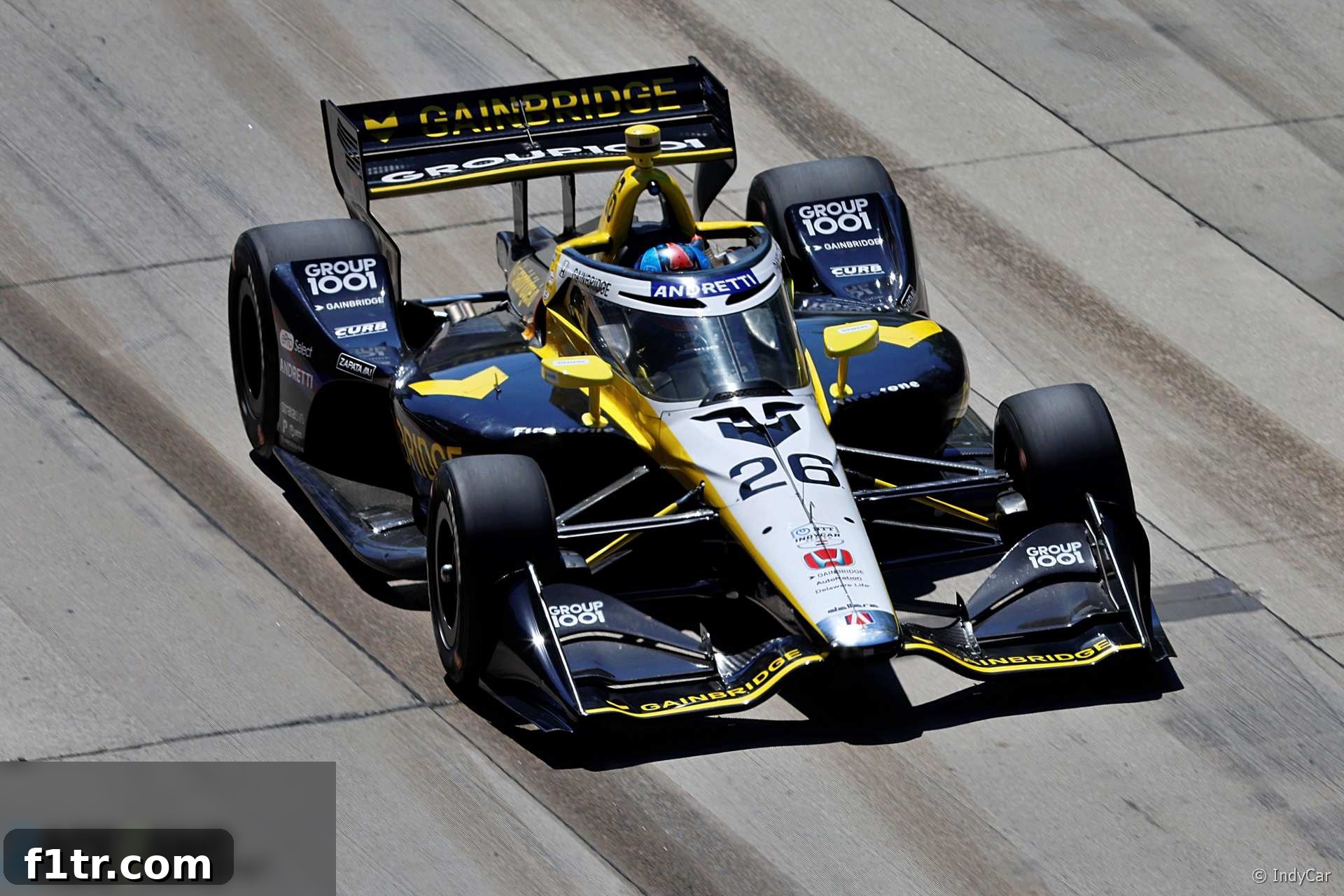
In a qualifying session that perfectly encapsulated the unpredictable and high-stakes nature of street circuit racing, Colton Herta of Andretti Global seized a dramatic pole position for the Detroit Grand Prix. His impressive feat came amidst a flurry of on-track action, strategic considerations, and a pivotal red flag incident involving his teammate, Kyle Kirkwood, which ultimately decided the top starting spots for Sunday’s race.
Advert | Become a Supporter & go ad-free
Herta’s pole, his first in a year, underscores a return to formidable form and positions him optimally for a strong challenge on the demanding Detroit streets. The unique challenges of this temporary urban circuit, with its unforgiving concrete barriers and tight turns, demand absolute precision and courage from every driver. Starting alongside Herta on the coveted front row will be championship leader Alex Palou, who demonstrated his consistent speed and skill throughout the qualifying rounds. The stage is now set for a compelling race day, with Herta and Palou leading a grid packed with talent and eager to conquer the challenging downtown course.
Detroit Grand Prix Qualifying: A Detailed Overview
The qualifying format, designed to progressively narrow the field, saw drivers pushing their limits across multiple segments. Each round presented its own set of hurdles, from managing tire degradation to navigating traffic and avoiding costly errors, all under the intense pressure of securing a prime starting position.
Round 1: Group Stage Battles and Standout Performances
The initial phase of qualifying saw the field split into two groups, each vying for a spot in the subsequent rounds. Group 1 provided an early highlight with McLaren rookie Theo Pourchaire’s remarkable performance. Despite suffering a significant crash during an earlier practice session, which often shakes a driver’s confidence, Pourchaire bounced back with incredible resilience. He not only participated but topped his group, an extraordinary achievement that showcased his raw talent and adaptability to the demanding IndyCar machinery and the unforgiving street circuit environment. Advancing alongside Pourchaire were seasoned competitors Scott McLaughlin, Josef Newgarden, Kyle Kirkwood, Will Power, and Santino Ferrucci, each demonstrating the controlled aggression necessary to tame the Detroit track.
In Group 2, the pace was set by the ever-impressive Alex Palou. The championship leader underlined his dominant form, laying down a series of quick laps that ensured his progression with ease. Joining Palou in advancing were Christian Lundgaard, Colton Herta, Marcus Ericsson, Pato O’Ward, and Scott Dixon. This group was stacked with former champions and race winners, setting a high benchmark and promising fierce competition as the sessions progressed towards the ultimate Fast Six shootout.
Round 2: The Top Twelve Contend
The second round intensified the competition, with the top six drivers from each group now battling for the elite Fast Six positions. This segment proved to be particularly dramatic, featuring a significant incident that reshaped the immediate grid and added a layer of strategic complexity to the final minutes.
Pato O’Ward’s Frustrating Turn 5 Incident
One of the most notable moments of Round 2 involved Arrow McLaren’s Pato O’Ward. A driver widely expected to contend for pole, O’Ward’s session came to an abrupt and unfortunate end. While attempting to pull off track at Turn 5 to avoid impeding other drivers on a flying lap, O’Ward stalled his car. This seemingly minor misjudgment resulted in a red flag, immediately halting the session. The consequences for O’Ward were severe: the stoppage prevented him from rejoining the session and ultimately denied him a chance to improve his time, knocking him out of contention for the Fast Six. It was a frustrating setback for the talented Mexican driver, highlighting how quickly fortunes can change on a challenging street circuit. Following this interruption, the remaining drivers — Palou, Newgarden, Dixon, McLaughlin, Kirkwood, and Herta — successfully navigated the conditions to secure their coveted spots in the Fast Six shootout.
The Fast Six: A Red Flag Decides Pole
The atmosphere was electric as the Fast Six drivers took to the track, each pushing the limits to claim pole position. Alex Palou initially set a blistering benchmark, clocking a lap time of 1’00.699, reinforcing his status as a front-runner. However, Colton Herta, known for his raw speed, responded with a phenomenal effort in the closing minutes, snatching provisional pole by a crucial tenth and a half. The stage was set for a thrilling final push, but fate had other plans.
With less than a minute remaining on the clock, Kyle Kirkwood, Herta’s Andretti teammate, encountered trouble at the end of the long straight. Pushing hard through Turn 3, Kirkwood ran wide and ended up in the escape road. In a desperate attempt to execute a swift spin-turn and rejoin the track without losing too much time, Kirkwood unfortunately stalled his car. This incident brought out a red flag, suspending the session with only moments to spare. The timing of this red flag proved to be critical and ultimately decisive for Herta’s pole position.
While race control restarted the session, allowing each driver a single guaranteed final flying lap, the interruption had severely compromised their ability to challenge Herta’s time. The unique demands of street circuits, particularly regarding tire preparation, mean that an optimal outlap is crucial for bringing the tires up to temperature and generating peak grip for a qualifying push. With only a single outlap granted after the red flag, drivers found it impossible to properly prepare their tires. Consequently, none of the remaining competitors were able to improve their times, cementing Colton Herta’s hold on pole position. It was a dramatic and somewhat fortunate turn of events for Herta, but one that undeniably showcased his pace and ability to deliver when it counted. This marks a significant milestone for him, ending a year-long wait for a top qualifying spot.
Detroit Grand Prix Starting Grid Analysis
The final qualifying results have painted a compelling picture for Sunday’s Detroit Grand Prix, promising an exciting and strategic race. Colton Herta will lead the field from pole, a testament to his qualifying prowess and the circumstances of the Fast Six. Alongside him on the front row will be Alex Palou, setting up an intriguing battle between two of IndyCar’s most talented drivers from the very start.
The second row features an all-Penske affair, with Josef Newgarden, the reigning Indy 500 champion, starting in third. He is joined by his teammate Scott McLaughlin in fourth, positioning the powerful Penske squad for a strong collective assault on the race. Veteran strategist Scott Dixon will start fifth, always a formidable presence from which to launch an attack. Following him, Kyle Kirkwood, despite his speed earlier in the session, was demoted to sixth place after his times were deleted for causing the red flag in the Fast Six, a penalty that underscores the strict rules governing qualifying incidents.
Rookie sensation Theo Pourchaire will begin his race from an impressive seventh position, a phenomenal recovery and result after his earlier practice crash. He will share the fourth row with the experienced Will Power in eighth. Rounding out the top ten are Marcus Ericsson in ninth and Santino Ferrucci in tenth. These drivers will be keen to make early progress on a circuit where overtaking can be challenging, but opportunities often arise through strategic pit stops and incident management.
Grid Penalties Affect Rahal and Simpson
Further down the grid, some drivers faced penalties that significantly impacted their starting positions for the Detroit Grand Prix. Graham Rahal and Kyffin Simpson were each handed a six-second grid drop. These penalties were imposed due to exceeding their engine allocations, a critical regulation aimed at managing engine usage and component lifespan throughout the demanding IndyCar season. As a direct consequence, Graham Rahal will start from 19th position, while Kyffin Simpson will begin his race from 27th. These substantial drops will undoubtedly add an extra layer of challenge to their Sunday efforts, requiring them to execute flawless races to climb through the competitive field.
Advert | Become a RaceFans supporter andgo ad-free
Detroit Grand Prix: Full Qualifying Result
| Pos. | No. | Driver | Time |
|---|---|---|---|
| 1 | 26 | Colton Herta | 1’00.5475 |
| 2 | 10 | Alex Palou | 1’00.6995 |
| 3 | 2 | Josef Newgarden | 1’00.9607 |
| 4 | 3 | Scott McLaughlin | 1’01.3344 |
| 5 | 9 | Scott Dixon | 1’01.3905 |
| 6 | 27 | Kyle Kirkwood | 1’04.2926 |
| 7 | 6 | Theo Pourchaire | 1’00.7342 |
| 8 | 12 | Will Power | 1’00.7612 |
| 9 | 28 | Marcus Ericsson | 1’00.8505 |
| 10 | 14 | Santino Ferrucci | 1’01.0351 |
| 11 | 45 | Christian Lundgaard | 1’01.1663 |
| 12 | 5 | Pato O’Ward | 1’03.0479 |
| 13 | 20 | Christian Rasmussen | 1’01.3930 |
| 14 | 15 | Graham Rahal | 1’01.1336 |
| 15 | 77 | Romain Grosjean | 1’01.4933 |
| 16 | 30 | Pietro Fittipaldi | 1’01.3684 |
| 17 | 7 | Alexander Rossi | 1’01.5905 |
| 18 | 78 | Agustin Canapino | 1’01.5566 |
| 19 | 21 | Rinus VeeKay | 1’01.6040 |
| 20 | 11 | Marcus Armstrong | 1’01.7406 |
| 21 | 8 | Linus Lundqvist | 1’01.6297 |
| 22 | 60 | Felix Rosenqvist | 1’01.7441 |
| 23 | 4 | Kyffin Simpson | 1’01.7770 |
| 24 | 41 | Sting Robb | 1’01.8454 |
| 25 | 51 | Tristan Vautier | 1’02.2091 |
| 26 | 66 | Helio Castroneves | 1’01.9687 |
| 27 | 18 | Jack Harvey | 1’02.1185 |
Advert | Become a RaceFans supporter andgo ad-free
IndyCar: Further Reading and Insights
For more news, analyses, and exclusive content from the NTT IndyCar Series, dive into our related articles:
- IndyCar driver McLaughlin cleared of injury after crashing through barrier at Barber
- Schumacher says his IndyCar feels like ‘an F2 car, just with better tyres’
- IndyCar “way faster than Formula 1” in some corners, says Grosjean
- FIA to award more F1 superlicence points to IndyCar drivers from 2026
- Schumacher to race full-time in IndyCar with RLL in 2026
Browse all IndyCar articles