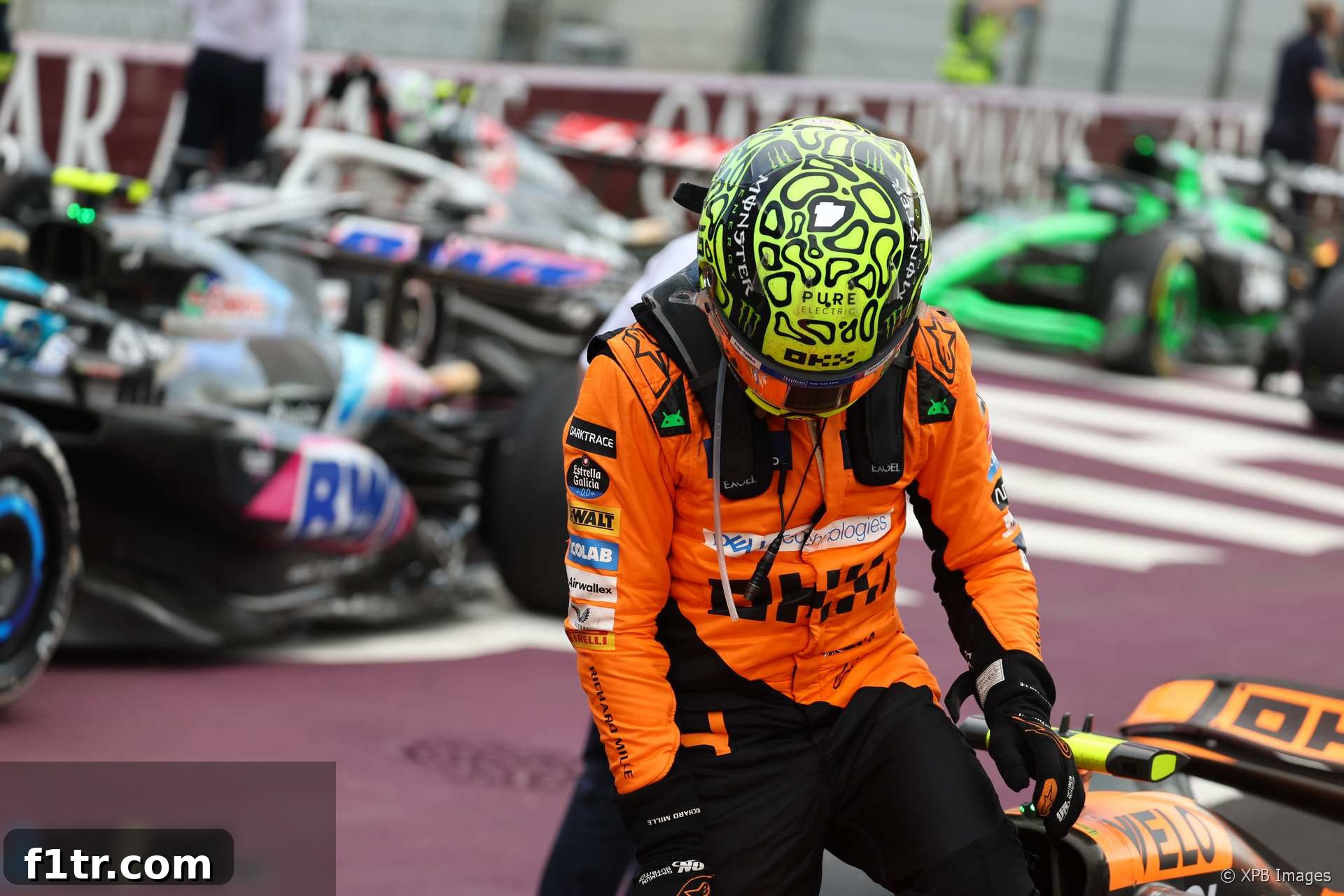
Lando Norris’s Monza Agony: From Pole to Podium, a “Crappy Day” for McLaren’s Star
The hallowed grounds of Monza, often dubbed the “Temple of Speed,” witnessed a whirlwind of emotions during the recent Italian Grand Prix. For McLaren’s prodigious talent, Lando Norris, what began with the elation of pole position ultimately ended in a mix of disappointment and self-reflection, as he concluded the race in third place. Despite securing a valuable podium finish and outscoring his closest championship rival, Norris candidly described his performance as “pretty crappy,” a stark indicator of the high standards he sets for himself and his team.
The weekend had promised so much for the Woking-based squad. McLaren had brilliantly locked out the front row in qualifying, a rare and thrilling sight that ignited hopes of a dominant display at one of Formula 1’s most iconic venues. Fans and pundits alike anticipated a fierce intra-team battle for victory, with Norris leading the charge from the coveted pole position. However, the unforgiving nature of Grand Prix racing, where strategy, tyre management, and split-second decisions dictate fate, soon turned the tide.
The Opening Lap Drama and Ferrari’s Masterstroke
The race start proved to be pivotal for Norris. On the very first lap, he was passed by his determined teammate, Oscar Piastri, a move that immediately shifted the internal dynamics. While an all-McLaren battle ensued, it wasn’t long before a third contender emerged from the pack with an audacious strategy that would ultimately rewrite the script of the race. Charles Leclerc, driving for Ferrari on their home turf, mounted an aggressive one-stop strategy, meticulously executed to perfection. This bold strategic gamble allowed the Scuderia to leapfrog both McLarens, culminating in a triumphant victory for Leclerc that sent the Tifosi into raptures.
Ferrari’s ability to manage their tyres, particularly over an extended stint, proved to be their decisive advantage. Monza, with its long straights and high-speed corners, places immense demands on tyres, especially the front-left. It became clear early on that while McLaren possessed blistering single-lap pace, their race-day tyre wear characteristics were not matching those of their Italian rivals. This discrepancy, as Norris later explained, was a critical factor in the outcome of the Grand Prix.
McLaren’s Race Pace: A Reality Check Amidst High Hopes
Despite McLaren’s sensational front-row lockout, Norris revealed that the team had entered Sunday’s race without the illusion of being the clear favourites. His comments shed light on the complex interplay between qualifying performance and race expectations, particularly at a circuit like Monza where unique aerodynamic setups and tyre management are paramount. “I think the pace was probably as expected,” Norris told the official F1 channel, acknowledging that their pre-race simulations likely painted a realistic picture of their competitive standing.
The true surprise, according to Norris, lay not in McLaren’s own performance but in Ferrari’s unexpected strength in a specific area. “Maybe Ferrari were a bit better than we were expecting, for sure. But not in terms of pace but just in terms of tyre wear, they could just manage the tyres better than we could. So we knew that.” This frank assessment underscores the relentless pursuit of perfection in Formula 1, where marginal gains in tyre degradation can translate into significant strategic advantages and ultimately, race victories.
The Briton further elaborated on a known Achilles’ heel for McLaren. “I think we knew coming into the race we were going to struggle a bit with management of the front-left – it’s a bit of a weakness of ours at the minute. And they just seemed to do a good job. So hats off to Charles – they did a good race.” This insight highlights the technical challenges faced by F1 teams and how specific car characteristics can be exploited by competitors. Monza’s high-speed corners, particularly the Parabolica (now Curva Alboreto), and heavy braking zones put immense strain on the front tyres, making optimal management crucial for maintaining pace throughout a long stint. Ferrari’s ability to mitigate this wear, especially on a single-stop strategy, was a testament to their engineering and strategic acumen.
Norris’s Personal Frustration and the Pursuit of Perfection
While a podium finish is a commendable achievement for any driver in Formula 1, especially given the fierce competition, Norris’s disappointment stemmed from the unmet potential of starting from pole. “I can’t be happy with a third, can I – starting from pole,” he stated, his frustration palpable. This reflects the mindset of a top-tier athlete constantly striving for victory and measuring success against the highest possible benchmark. For Norris, a P3 from P1 felt like an opportunity missed, despite the challenging race circumstances.
His post-race comments revealed a driver engaged in deep self-critique. “A pretty crappy day from my side,” he reiterated, taking personal accountability for aspects of his performance. “I still drove the best I could, obviously some bits weren’t good enough. I’m trying to make up for just not being good enough in other parts of the racing – trying to get fastest lap and stuff like that. One point saved, but being second or first is a lot easier to get points. So some things, clearly, to work on.” This honest reflection speaks volumes about his dedication and relentless pursuit of improvement. Even in challenging races, drivers often push for the fastest lap to salvage an extra championship point, a testament to the finely balanced fight for every advantage in Formula 1.
The drive to constantly improve, even after what many would consider a strong result, is a hallmark of elite performers. For Norris, understanding and addressing the “bits that weren’t good enough” will be key to converting future pole positions into race victories. This introspection, combined with McLaren’s ongoing development, will be crucial as the season progresses.
Championship Implications and Silver Linings
Despite his personal disappointment, Norris’s third-place finish did carry significant championship implications. He managed to finish ahead of the reigning world champion and current points leader, Max Verstappen, thereby taking more valuable points out of Verstappen’s lead in the drivers’ standings. In a season where every single point can prove decisive, preventing a rival from extending their advantage, even marginally, is a crucial outcome. This “one point saved,” as Norris put it, underscores the granular level at which the championship battle is fought.
While the immediate focus for Norris was undoubtedly on the lost opportunity for victory, the broader picture reveals McLaren’s continued strong performance as a team. Locking out the front row in qualifying is a significant achievement, demonstrating the underlying pace and development of the MCL38 chassis. The team has made tremendous strides over the past year, consistently challenging at the sharp end of the grid. Their ability to compete with top teams like Ferrari and Red Bull, even if they sometimes fall short on race day strategy or tyre management, signals a promising trajectory.
The Italian Grand Prix served as a stark reminder that Formula 1 is a multifaceted sport where success is a synergy of driver skill, car performance, and strategic brilliance. For Lando Norris and McLaren, Monza was a day of valuable lessons. While the bitter taste of a missed victory from pole will linger, the insights gained into their car’s strengths and weaknesses, particularly regarding tyre management, will be crucial for refining their approach in the remaining races of the season. The “things to work on” will undoubtedly be a central focus for the team as they aim to convert qualifying dominance into consistent race-day triumphs.
2024 Italian Grand Prix
- ‘I should have won last year but I did stupid stuff’: Norris out to avenge 2024 defeat
- Verstappen faces post-race investigation along with five other drivers and McLaren
- Red Bull lose constructors’ championship lead for first time in two years
- “Never had so much pain in a car”: How Colapinto impressed Williams on his debut
- F1’s most competitive season for 47 years? Four teams now have three wins each
Browse all 2024 Italian Grand Prix articles