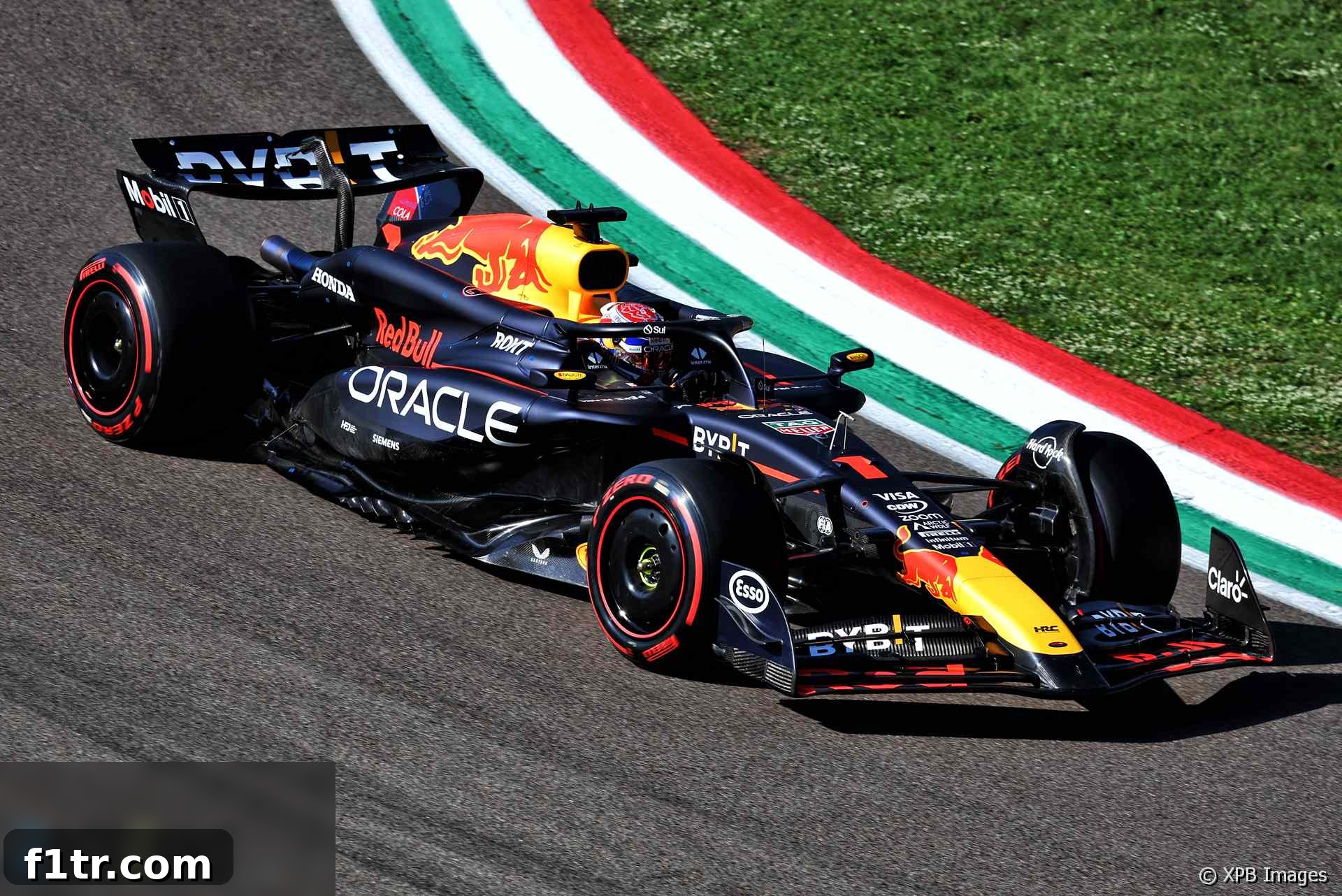
Just weeks ago, the notion of Max Verstappen clinching pole position at Imola for the Emilia Romagna Grand Prix would have been met with little surprise. It was almost an expected outcome, a testament to his and Red Bull’s dominant form early in the season. However, what seemed like a routine affair just a month prior unfolded as anything but on Saturday. Verstappen’s sheer joy, evident after securing pole, underscored the immense challenge he faced and the arduous effort required to overcome a difficult start to the weekend.
Advert | Become a Supporter & go ad-free
“It’s been a while that I’ve felt like we’ve been that far off,” Verstappen candidly admitted following a hard-fought qualifying session. “In Singapore, we were off the whole weekend, so that was just a terrible weekend. But here we were also quite far off and then we managed to turn it around. So it must be at least five, six years, because I don’t really remember being able to turn it around like that.” This candid admission highlights the extraordinary nature of his pole lap and Red Bull’s ability to extract performance when it truly mattered. The team grappled with significant balance issues and setup woes throughout Friday practice, struggling to find the sweet spot for the RB20 on the challenging Imola circuit. Their recovery to pole position is a stark reminder of their operational excellence, but also a signal that the competitive landscape is shifting.
Session data from qualifying revealed just how fine the margins were at the Autodromo Enzo e Dino Ferrari. Verstappen’s decisive advantage came on his final flying lap, where he masterfully utilized a slipstream from Nico Hulkenberg’s Haas at the crucial start of the lap. This tactical brilliance, combined with his unparalleled skill, is estimated to have shaved off enough time to make the critical difference between P1 and P3. Without that tow, the story could have been very different. This narrow gap, however, also strongly suggests that McLaren, with Oscar Piastri and Lando Norris, has genuinely closed the performance gap and potentially drawn level with the championship leaders in terms of outright pace. The formidable challenge they mounted indicates a significant step forward in their development, promising an enthralling battle for supremacy on race day.
With Piastri unfortunately incurring a three-place grid penalty for impeding Kevin Magnussen, it is Lando Norris who will lead the charge against Verstappen from the front row. The crucial question now is how aggressively Norris and Piastri (from P5) can push the reigning world champion throughout the race. Will McLaren’s impressive qualifying pace translate into sustained race performance, or will Ferrari, starting further back with Charles Leclerc and Carlos Sainz, unveil a stronger package in race trim than their Saturday showing suggested? Their home crowd will certainly be hoping for a resurgence. Regardless of who emerges as Verstappen’s primary challenger, all signs point to this Emilia Romagna Grand Prix being arguably the most competitive and intriguing Sunday of the season so far, a true test of strategy, skill, and nerve.
Weather Forecast for Imola Grand Prix
The Imola weekend has, for the most part, offered remarkably consistent and comfortable weather conditions, akin to selecting “clear” settings in a racing simulation game. Both Friday and Saturday saw glorious sunshine with ambient temperatures hovering in the mid-20s Celsius. This stability provided optimal, virtually identical track conditions across all four sessions – two practice sessions and qualifying – allowing teams to gather ample, reliable data for race preparation.
Heading into the weekend, initial forecasts hinted at a dramatic shift for Sunday, with a considerable risk of rain anticipated for the afternoon, precisely around the race start time. Such a change would have injected a significant element of unpredictability and complicated strategic planning. However, as the weekend has progressed and new meteorological data has emerged, that looming threat of rain appears to be steadily diminishing. While a minor risk of precipitation remains from 3:00 PM local time, coinciding with the race start, the probability is now substantially lower than previously forecast. The chance of rain does pick up slightly later in the afternoon, but by the time it reaches its potential peak, the grand prix is expected to be well past its conclusion.
Therefore, drivers and teams can largely anticipate a dry race. Ambient temperatures are once again expected to be in the mid-20s, ensuring consistent engine and tyre performance. There might be slightly more cloud cover compared to the pristine blue skies of Friday and Saturday, which could marginally affect track temperatures but is unlikely to introduce any significant variables. The predictability of dry conditions simplifies tyre choice and strategy, yet intensifies the focus on raw pace and execution.
Advert | Become a RaceFans supporter andgo ad-free
The Critical Start: A Duel to Tamburello
Immediately after qualifying, Lando Norris was quick to highlight the pivotal role the run to the Tamburello chicane will play in Sunday’s race. His assessment underscores the unique challenges and opportunities presented by Imola’s start sequence, where early positioning can be decisive. The first corner at Imola is notoriously tricky, and gaining or losing positions there can significantly shape a driver’s race.
Since its reintroduction to the Formula 1 calendar in 2020, Imola has hosted three Grand Prix races, but only one of these, the inaugural 2020 event, featured a fully dry start. The circuit’s distinctive “dogleg” layout of the pit straight adds an intriguing dynamic to the sprint towards the first corner. Drivers aren’t just accelerating in a straight line; they must contend with a slight bend that forces acute awareness of cars on both sides. This was vividly demonstrated in the Formula 2 sprint race, where tight positioning and aggressive maneuvers highlighted the narrow window for error. In the three previous F1 race starts at Imola – one dry, one fully wet, and one damp – the car on pole position has led the opening lap twice: Valtteri Bottas in 2020 and Max Verstappen in 2022. For Norris, who is eager to challenge Verstappen for the lead, this statistic serves as a stern reminder of Verstappen’s exceptional starting prowess. The Dutchman has gained a total of three positions across those three grid starts and notably held the lead on the one occasion he started from pole.
Norris, however, might find some solace in the fact that pole position is situated on the left-hand side of the grid, furthest from the pit wall. While Verstappen will naturally have the option to assume the advantageous inside line into Turn 1 (Tamburello chicane) if he chooses, Norris might find the outside line more appealing. This strategy, as demonstrated by F2 winner Franco Colapinto and third-placed Zane Maloney during their impressive late passes in the sprint race, could offer a better and wider route into the second part of the chicane. Executing a perfect start and navigating this complex first corner will be paramount for any driver hoping to establish an early advantage and dictate the pace of the Emilia Romagna Grand Prix.
Strategic Imperatives: The One-Stop Challenge at Imola
The lack of fully dry races at Imola since 2020 presents a unique challenge for teams preparing their race strategies. With only limited data on the current 18-inch Pirelli rubber in dry conditions, much of their planning must rely on empirical evidence from the weekend’s practice sessions. Fortunately, the consistent dry weather on Friday and Saturday allowed teams to gather extensive and valuable long-run data, which will be crucial for understanding tire degradation and performance characteristics. Pirelli has also introduced a suite of compounds for this event that are one step softer than those typically used at Imola, meaning the C3 (Hard), C4 (Medium), and C5 (Soft) are in play. This selection generally encourages more pit stops, but Imola’s unique pit lane dynamics introduce a significant counter-factor.
A major strategic consideration for Sunday’s race is the unusually high time penalty associated with making a pit stop at Imola. Due to the extended length of the pit straight and the high speed at which drivers typically traverse it, coming into the pits costs approximately 28 seconds. This substantial time loss makes multiple pit stops a less attractive proposition. Consequently, Pirelli’s Head of Motorsport, Mario Isola, firmly stated that a one-stop strategy is expected to be “almost obligatory” for the Emilia Romagna Grand Prix. “The C3 [hard] and C4 [medium] appear to be competitive over a long run and, fairly predictably, they will be the most popular choices for the race,” Isola explained. He added that “the C5 [softs] eventually being an option for the closing stages, especially if there is a Safety Car.” Teams banking on a Safety Car intervention, which could offer a ‘free’ pit stop, might opt to start on the hard compound to extend their first stint as much as possible, preserving the medium or even the soft tyres for a late-race charge. This approach provides flexibility and keeps options open should the race dynamics change unexpectedly. The intricate balance between tire wear, track position, and the high cost of a pit stop will define the strategic battle.
Advert | Become a RaceFans supporter andgo ad-free
The Art of Overtaking: A Challenge on the Imola Circuit
Imola, back when it was a regular fixture on the F1 calendar following its major revisions after the tragic “black weekend” 30 years ago, gained a reputation for producing relatively little in the way of overtaking action. This characteristic largely persists, despite modern F1 car designs and rule changes aimed at promoting closer racing. While the current pit straight offers more opportunities with a longer full-throttle run to Turn 1 (Tamburello), the circuit’s relatively narrow layout and series of fast, flowing corners still present a formidable challenge for drivers attempting to pass. The old-school nature of the track means that high commitment is required, and finding clean air to make a move is difficult, as cars struggle to follow closely through the intricate corner sequences.
Compounding this difficulty for the 2024 Emilia Romagna Grand Prix is a contentious change to the Drag Reduction System (DRS) activation point. This year, the single DRS zone on the pit straight has been moved 100 meters further down the straight compared to the last race held here in 2022. This shortening of the effective DRS zone is expected to make overtaking into Tamburello even harder. Ferrari’s Charles Leclerc, whose team will be eager to make progress from their starting positions, expressed his perplexity regarding this decision. “It’s one of the most difficult tracks to overtake on,” Leclerc told the official F1 channel. “Also I don’t quite understand why the DRS is shorter this year, which is going to make overtakes a bit more difficult.” This strategic alteration by race control suggests a focus on preserving the challenge of the circuit, but it will undoubtedly put greater emphasis on brilliant out-of-corner traction, impeccable timing, and potentially daring moves under braking into the few genuine overtaking spots. For drivers stuck in traffic, this shortened DRS zone could make for a frustrating afternoon, unless a strategic undercut or an unexpected Safety Car presents an alternative path to gain positions.
Safety Car Impact: A Recurring Factor at Imola
Many drivers have voiced their approval over the recent modifications at Imola, particularly the replacement of extended asphalt run-off areas with traditional gravel traps. This return to natural punishment for mistakes has been implemented in key areas such as Piratella, Acque Minerali, and the exit of Variante Alta. These changes introduce a higher degree of risk, as even minor errors can now result in a car becoming beached, rather than simply running wide and rejoining the track. Throughout the first two days of the weekend, numerous drivers have already put these gravel traps to the test, offering a preview of the increased likelihood of incidents during the Grand Prix.
As a direct consequence of these track changes, the probability of Safety Car periods during the Emilia Romagna Grand Prix has notably increased compared to previous years. This heightened likelihood is further reinforced by historical data from Imola. Across the last three F1 races held here, there have been a total of four Safety Car periods, demonstrating the circuit’s inherent tendency to trigger race disruptions. While three of those four Safety Car deployments occurred during wet or drying track conditions, which inherently increase the risk of incidents, a Safety Car was also deployed during the entirely dry race of 2020. That particular instance was triggered when Max Verstappen retired from the race due to a mechanical problem, sending his car spinning into the gravel at the Villeneuve chicane. This example clearly illustrates that even in dry conditions, the challenging nature of Imola, combined with its unforgiving gravel traps, means that all it takes is one clash between competitors or a single driver error for a Safety Car to be deployed. Such an event would undoubtedly transform the complexion of the race, offering strategic opportunities for some teams while potentially thwarting others, making race management under safety car conditions a crucial element of Sunday’s contest.
Advert | Become a RaceFans supporter andgo ad-free
One to Watch: Magnussen’s High-Stakes Sunday
While much attention will deservedly be focused on the tantalizingly close battle at the front of the field for the Emilia Romagna Grand Prix, there are numerous intriguing storylines further down the grid that warrant a keen eye. Sergio Perez, for instance, finds himself significantly out of position in 11th place after a disappointing qualifying performance, facing pressure to climb back into points. Similarly, Fernando Alonso starts from a lowly 19th after enduring one of his worst F1 qualifying days in recent memory, following car issues and track limits violations. Both seasoned veterans will be looking for significant recovery drives, adding another layer of excitement.
However, one driver whose performance will be particularly compelling to watch is Kevin Magnussen, starting from 18th position in his Haas. His teammate, Nico Hulkenberg, delivered another strong qualifying performance and will be aiming to score points once again. While Magnussen’s starting position makes a similar points finish seem unlikely, his raw pace in Q1 suggested he had far more potential than his final grid slot indicates. He was, in fact, poised to comfortably reach Q2 had he not been blatantly impeded by Oscar Piastri at the end of the first qualifying session. This suggests Magnussen’s true pace is significantly better than his 18th place implies, offering hope for an aggressive push through the field.
Yet, Magnussen’s Sunday is complicated by an even more pressing concern: he currently sits just two penalty points away from receiving a potential race ban. This precarious situation stems from a spate of penalties accumulated earlier in the season, notably for aggressive driving and leaving the track to gain an advantage. With the field expected to be incredibly tight and overtaking opportunities notoriously scarce at Imola, the pressure on Magnussen is immense. Any misjudgment, any minor contact or infringement on Sunday, could see him become the first driver to suffer the ignominy of a race ban under the modern superlicence penalty point system. His need to balance aggression with extreme caution will make his drive a fascinating psychological and tactical exercise, a true high-wire act.
Over to you, RaceFans!
With Max Verstappen facing a reinvigorated McLaren, the strategic complexities of a one-stop race, and the ever-present threat of Safety Cars, the Emilia Romagna Grand Prix promises to be an enthralling event. Will Verstappen manage to single-handedly fend off the fierce challenge from those behind him, or will the competitive field finally catch up? Share your predictions, insights, and views on what promises to be a captivating Sunday race in the comments section below!
Advert | Become a RaceFans supporter andgo ad-free
2024 Emilia-Romagna Grand Prix
- Ferrari expect qualifying gain after spotting rivals’ power strategy tactics
- How Alonso and Stroll copied Verstappen’s tactic plus more unheard Imola radio
- Verstappen beats Hamilton’s winning rate with Emilia-Romagna GP victory
- How Russell resisted losing position to Hamilton “for no reason” with extra stop
- “Lando’s found some pace”: Unheard radio from Verstappen-Norris Imola duel
Browse all 2024 Emilia-Romagna Grand Prix articles