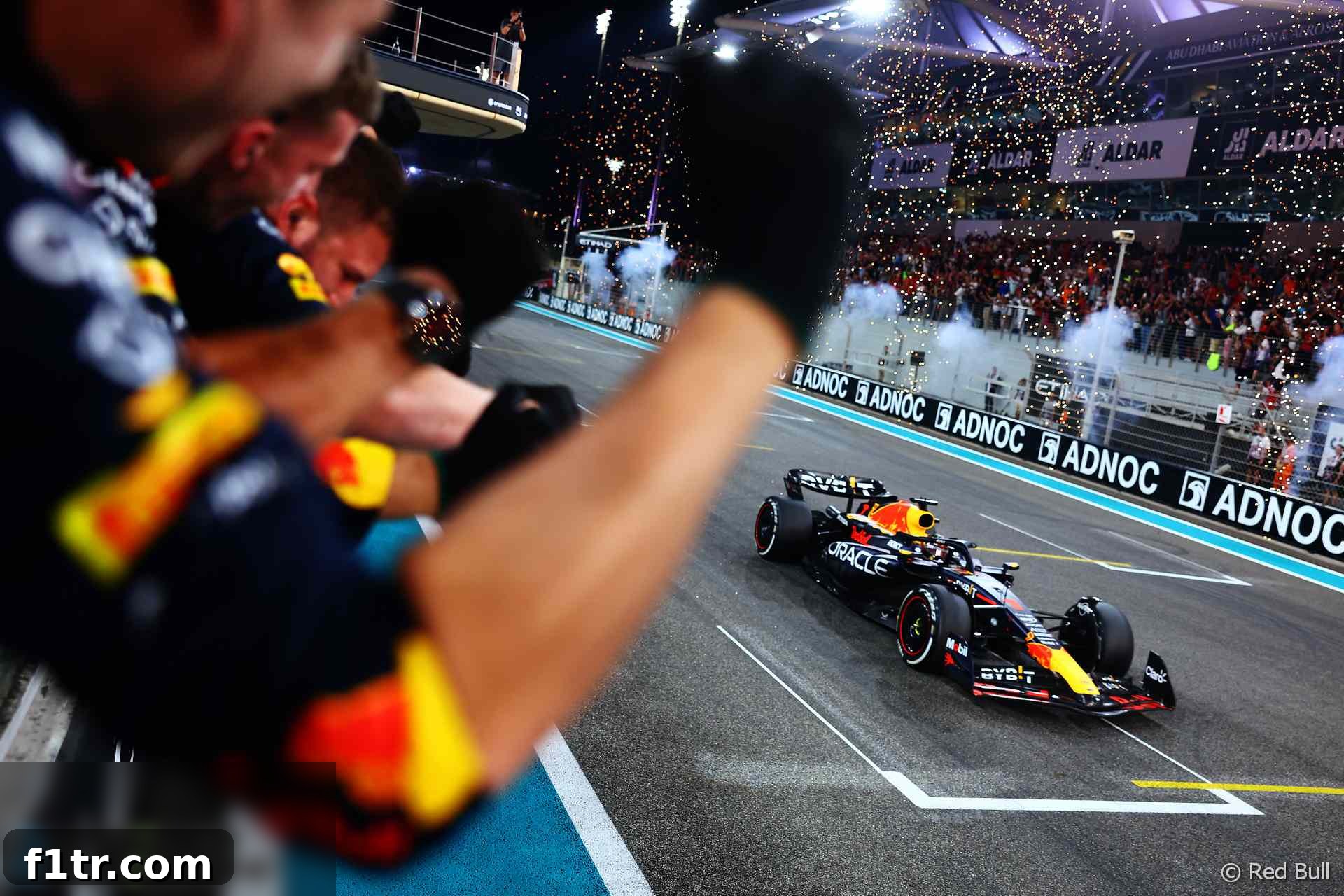
In the annals of Formula 1 history, the year 2023 will undoubtedly be etched as a season of unprecedented dominance. Max Verstappen and Red Bull Racing ascended to a level of success that not only overshadowed their remarkable 2022 campaign but also set new benchmarks across numerous metrics. From the sheer volume of victories to staggering win percentages and the longest winning streaks ever recorded, their achievements painted a picture of absolute mastery. Verstappen’s name now stands alongside legendary figures, boasting records for most wins by a driver in a single season, highest win percentage, and the most laps led by any driver.
Red Bull, mirroring their star driver, secured the most victories by a team in a single season and achieved an astonishing win percentage that speaks volumes about their engineering prowess and operational excellence. This remarkable list of accolades compels a deeper question: Was Max Verstappen’s championship-winning performance in 2023 the most impressive campaign in Formula 1 history? Our team of writers delves into this intriguing debate, offering diverse perspectives on what truly defines an ‘impressive’ season.
Verstappen’s Victories Stand on Their Own Merits
Formula 1 presents perhaps the most daunting challenge when attempting to compare competitors across vastly different eras. The sport’s evolution, from rudimentary mechanics and perilous circuits of the 1950s to the technologically sophisticated and safety-conscious environments of today, renders direct comparisons almost an exercise in futility. The very essence of racing has transformed, making it akin to evaluating distinct sports rather than mere variations of the same one.
Consider iconic campaigns such as Alberto Ascari’s dominant 1952 season, Nigel Mansell’s triumphant 1992 championship year, or even Sebastian Vettel’s commanding performance in 2013. Each of these achievements unfolded within unique sporting landscapes, governed by vastly different regulations, technological constraints, and competitive dynamics. Ascari’s era predates modern aerodynamics and tire technology, Mansell benefited from a car, the FW14B, that offered an almost insurmountable advantage, often securing pole positions by margins of entire seconds rather than the usual tenths Verstappen faced. Similarly, Michael Schumacher’s formidable domination in the early 2000s coincided with Ferrari’s peak financial, technical, and political influence within the sport, allowing for resources and development capabilities that are unimaginable today.
In stark contrast, Verstappen’s 2023 triumph was forged under the stringent conditions of Formula 1’s budget cap era. This period imposes significant limitations on financial expenditure, restricts private testing, and strictly caps aerodynamic development time. Unlike McLaren’s seemingly unstoppable 1988 season, where Ayrton Senna and Alain Prost pushed each other to the absolute limit every single Grand Prix weekend, Verstappen faced minimal pressure from his own teammate, Sergio Perez. This lack of internal competition, however, should not diminish the scale of his individual achievement against a grid that, while not challenging him for the championship, still comprised 19 of the world’s finest drivers and some exceptionally competitive constructors.
Ultimately, a driver can only compete against the opposition present on the grid during their particular era. Pondering whether legends like Schumacher, Senna, or even Lewis Hamilton could have replicated Verstappen’s 2023 success with the RB19 in hand feels like an academic exercise that detracts from the actual, tangible accomplishments. Such hypotheticals, while entertaining, risk overshadowing the very real skill, precision, and relentless dedication demonstrated by the driver who actually delivered this unprecedented success. Therefore, Verstappen’s 2023 championship season should be celebrated for the extraordinary achievement it is, standing proudly on its own merits, destined to be remembered and admired for many years to come.
A Memorable Achievement, Yet Perhaps Not the Most Memorable Season
Max Verstappen’s journey to universal acclaim hasn’t been without its hurdles. Following the contentious conclusion of the 2021 season in Abu Dhabi, where he secured his first world title, many questioned his legitimacy as a worthy champion, despite having challenged a seven-time world champion until the very last lap. However, the subsequent two years have seen Verstappen comprehensively silence his critics, establishing an era of dominance where very few drivers have been able to challenge him for race wins or pole positions. His 2022 season was impressive, but 2023 took his command of the sport to an entirely new level.
Heading into the 2023 season, it was clear Verstappen was a front-runner, but the prevailing questions were: By how much would he win, and which competitor would step up to push him, potentially forcing him into mistakes? The answers to these questions became unequivocally clear as the season unfolded: ‘a lot’ and ‘no one.’ Verstappen operated in a league of his own, showcasing a relentless confidence that bordered on invincibility. Not even his Red Bull teammate, Sergio Perez, in identical machinery, could consistently match his pace or performance. This unparalleled consistency and speed meant he had no interest in easing off the throttle, setting new records with almost every passing Grand Prix.
Despite the apparent ease with which he often secured victories, the sheer magnitude of Verstappen’s achievement should not be underestimated. His calm demeanor on any given race weekend belies the immense energy, mental fortitude, and unwavering dedication required to perform at such an extraordinary level, week after week. A brief listen to his team radio during instances when he wasn’t leading a race quickly reveals the fierce competitive spirit and intense desire for victory that drives him. It’s a testament to his professionalism and talent. However, the lack of a consistent, clear opponent to challenge him for the championship undeniably cast a different light on the season itself.
This absence of a formidable rival, while highlighting Verstappen’s exceptional skill, left many fans yearning for more intense wheel-to-wheel battles and championship drama. The most memorable and impressive seasons in Formula 1 history are often characterized by razor-thin margins, nail-biting twists, and turns that keep spectators on the edge of their seats until the very final race. While watching one driver win nearly twenty races in a season is a staggering feat, it can, for some, diminish the excitement and long-term memorability of the overall campaign. Yet, it’s crucial to acknowledge that even without a direct rival for the title, Verstappen still outperformed 19 of the world’s elite drivers, demonstrating supreme mastery over his car and the competition. Winning a world championship title, regardless of the circumstances, is always an impressive feat; it’s simply that some titles are etched more vividly in the collective memory of the sport than others.
Impressive Campaign or an Impression Left Behind? A Comparison with Sebastien Loeb
When evaluating the ‘impressiveness’ of a sporting campaign, a key factor often lies in its ability to actively create an impression – to captivate audiences, shift perceptions, and even draw attention from those typically outside its immediate fanbase. While Max Verstappen’s 2023 season certainly delivered predictable success, the question remains whether it generated the same kind of far-reaching impact and widespread awe as other legendary performances. This leads to a fascinating comparison with Sebastien Loeb’s 2008 World Rally Championship (WRC) campaign, a season that resonated deeply across the broader motorsport world.
In 2008, a 34-year-old Sebastien Loeb utterly dominated the WRC, securing a record-breaking fifth consecutive title. His season was an astonishing display of versatility and control, winning 11 rallies – four on asphalt and seven on gravel – and finishing on the podium in two others. Despite two non-scores, he clinched the championship by a significant 19 points, a margin equivalent to nearly two victories. This meant he could have skipped the final two rounds and still been crowned champion. What made Loeb’s 2008 season particularly impressive was that it represented his most dominant period, yet it also coincided with one of his most challenged, as his Citroen team was locked in an intense battle with Ford for the manufacturers’ title. At that point, Loeb had contributed an astounding 47 of Citroen’s last 50 rally wins, a parallel to Verstappen’s contribution of 45 out of Red Bull’s last 50 F1 victories.
Loeb’s 2008 performance transcended the rally world. Only 22 drivers in the WRC’s 51-year history have won 10 or more rallies, and Loeb remains unique in achieving double-digit wins in a single season. Such was the commanding nature of his 2008 campaign that motorsport fanatics across disciplines began clamoring to see what Loeb could achieve in different machinery and against other forms of opposition. The widespread curiosity was whether he could embrace even bigger challenges and tougher opponents, solidifying his position as arguably the greatest driver in the world, even in comparison to Formula 1 stars.
Loeb himself believed he could make the transition to F1, and his talent was recognized by Red Bull, who ran him in several F1 tests that same year. While Red Bull was not yet the dominant force it would become, it was already establishing its reputation for scouting exceptional driving talent. Loeb represented a hugely exciting prospect for Formula 1. Ultimately, a lack of the necessary Super Licence prevented his planned F1 debut in 2009, and despite exploring opportunities for 2010, he never raced in Formula 1. However, his later career saw him diversify into top-level circuit racing, including a second-place finish at the 2006 Le Mans 24 Hours, and rallycross, where he also secured victories. There’s something profoundly impactful about his 2008 WRC season that ignited the imagination of the entire motorsport industry, envisioning him sweeping away the opposition regardless of the machinery he commanded.
Moments of True Excellence Amidst Dominance
While Max Verstappen’s relentless annihilation of the competition in 2023 could, at times, lead to a somewhat predictable viewing experience, the season was nevertheless punctuated by moments of sheer brilliance. These specific instances left no doubt that his success stemmed from far more than merely possessing a vastly superior car or having a teammate who often struggled to extract its full potential. Verstappen consistently demonstrated he is the ultimate competitor, perpetually attuned to any opportunity to gain an advantage, a trait that underlines his individual genius.
Consider some standout examples of his exceptional race craft and strategic thinking. At the Jeddah Corniche Circuit, after a compromised qualifying session limited him to P15, Verstappen executed a sensational recovery drive to finish second behind his teammate. Not content with second, he ensured he claimed the bonus point for the fastest lap on the very final tour, a critical move that maintained his lead in the championship standings. This meticulous attention to detail and unwavering pursuit of every available point showcased his competitive drive.
His seemingly effortless cruise to victory in Miami must have been utterly disheartening for Sergio Perez. Despite starting from pole position, Perez found Verstappen breathing down his neck. Verstappen never fell more than 6.4 seconds behind early in the race, and as the afternoon unfolded, it became abundantly clear that his RB19 was significantly quicker than his teammate’s. It is a rare and truly remarkable feat to witness a driver win as comfortably as he did from ninth on the grid, highlighting his exceptional ability to manage tires, strategy, and overtake with precision.
The Monaco Grand Prix provided another unforgettable display of his prowess. With Aston Martin at their early-season peak and Fernando Alonso posing a genuine threat for pole position – a critical advantage on the narrow streets of Monaco – Verstappen delivered a final lap in Q3 that was nothing short of breathtaking. He pushed the limits, brushing barriers and clouting walls through the final sector, to snatch pole by a mere eight-hundredths of a second. On race day, as rain began to fall and tire temperatures plummeted, Verstappen maintained his composure, navigating the treacherous conditions on worn tires without making any significant errors, securing a hard-fought victory.
On the rare occasions when Red Bull’s rivals genuinely made him work for a win, Verstappen invariably rose to the challenge. Carlos Sainz Jr. mounted a strong fight at Monza, and even on the single weekend where the RB19 was not the class of the field – in Singapore – Verstappen’s performance stood out. Despite the car’s unexpected struggles, he demonstrated decent race pace, and had the Safety Car period not gone against him, he could very well have been in contention for a podium finish, or even better, showcasing his ability to maximize performance even when the machinery isn’t optimal.
The contemporary Formula 1 calendar, with its increasing number of races and the addition of sprint events, has become an exercise in quantity over quality, pushing the total number of competitive sessions significantly higher. The 2023 season, in particular, often dissolved into what felt like an eternal procession with Verstappen at the helm, while the rest of the field battled amongst themselves for the remaining positions. However, even if the weakness of the competition sometimes offered fewer opportunities to witness Verstappen’s true limits, it was undeniably clear that he was operating at an exceptionally high level. This sustained excellence will undoubtedly serve him well should he face a tougher fight in the upcoming seasons.
One hopes that such a challenge materializes soon. We seldom witnessed Verstappen engaged in intense, wheel-to-wheel combat with another driver throughout 2023. When such moments did occur, his opponent often had little incentive to put up a prolonged fight, knowing that the Red Bull car was usually too quick to be truly beaten. Race-craft has always been one of Verstappen’s greatest strengths, yet ironically, in his most successful season to date, fans had fewer chances to truly witness it in action. While he may not have won quite as many races in 2022, the visible effort and skill he displayed in those contests arguably made that season, in certain aspects, more outwardly impressive to the casual observer.
Over to you
Do you agree or disagree with our writers’ assessments of Max Verstappen’s 2023 season? Do Red Bull Racing deserve even greater credit for their unparalleled achievements in what proved to be a historic year for the sport? Share your perspectives and join the conversation in the comments section below.
Round Table
- RaceFans’ writers name their favourite motorsport moments of 2023
- Unsung heroes: Four stars not in cars from the 2023 Formula 1 season
- Verstappen’s season was the most successful ever – but was it the most impressive?
- What are F1’s newest three-times champion’s most outstanding drives to date?
- Do Red Bull get the credit they deserve for their unrivalled success?
Browse all Round Table articles