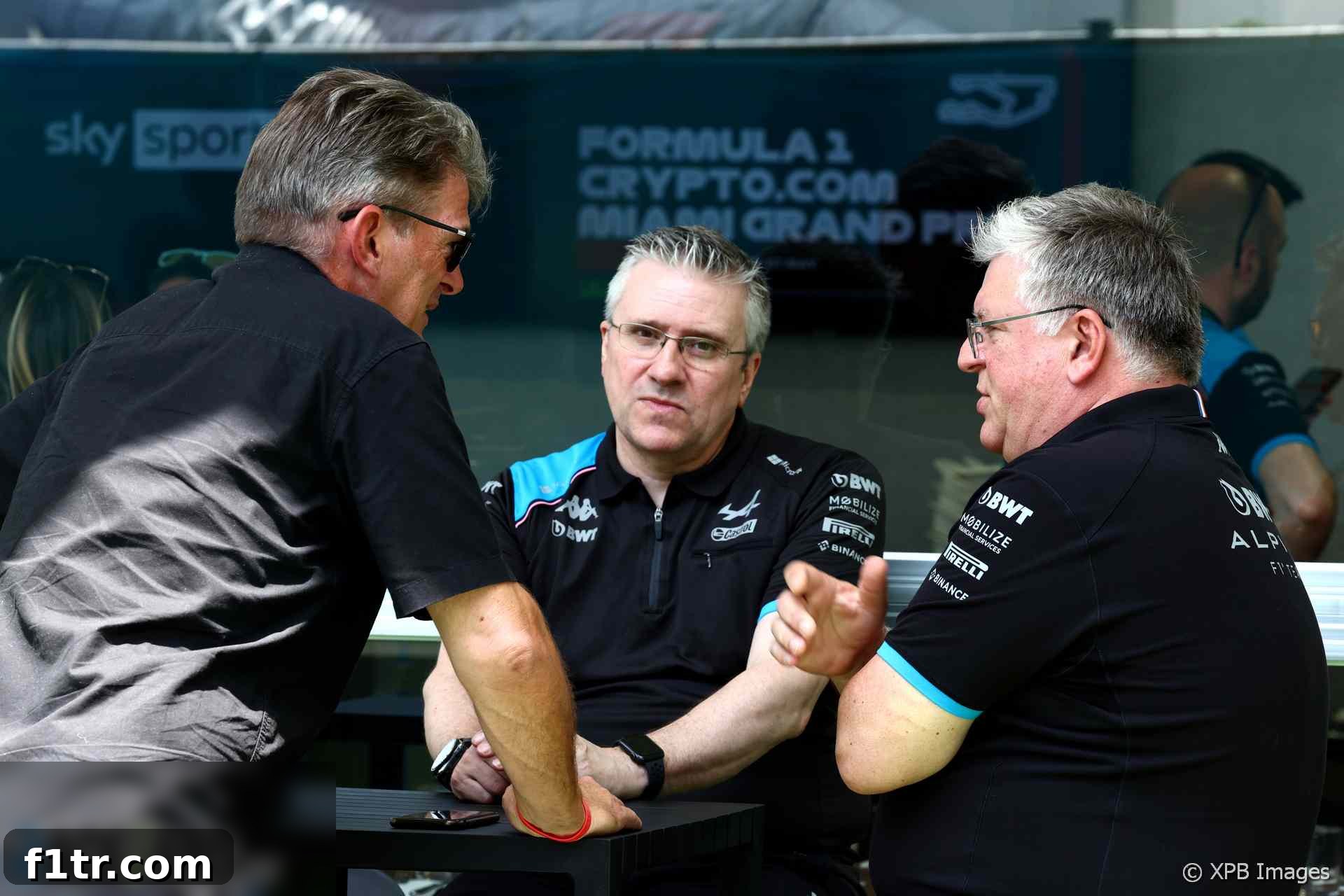
The highly competitive and often volatile world of Formula 1 has once again seen significant management upheaval, bringing into sharp focus the demanding nature of leading a team to success. Amidst a wave of high-profile departures at the Alpine F1 team, Pat Fry, formerly their chief technical officer, has offered a revealing insight into the circumstances surrounding the exit of former team principal Otmar Szafnauer and his own decision to embark on a new challenge with Williams Racing. Fry’s candid reflections paint a picture of a team grappling with strategic direction and internal drive, while also expressing optimism for the future of his new venture.
Pat Fry, a seasoned veteran in Formula 1 engineering with a career spanning several decades and multiple championship-winning teams, joined the Enstone-based outfit, then known as Renault, in 2020. His mandate was clear: to help rebuild the team and steer it towards the front of the grid. However, his tenure at Alpine concluded earlier this year, almost concurrently with the departure of team principal Otmar Szafnauer, who had only been at the helm for a mere 17 months. According to Fry, Szafnauer’s dismissal was premature, arguing that the Romanian-American executive was not afforded a sufficient window to implement the changes necessary to uplift the team’s performance.
Alpine’s Management Turmoil: A Question of Time and Vision
Fry’s assessment of Szafnauer’s situation is particularly poignant, highlighting the immense pressure and often unrealistic expectations placed upon F1 team leaders. “I’m not so sure that Otmar got a fair chance at fixing the place because to some degree, metaphorically, your hands are tied, I guess,” Fry remarked. This statement alludes to potential underlying structural or political constraints within the Alpine organization, which might have hindered Szafnauer’s ability to exert full control and execute his strategic vision. Running a Formula 1 team, especially one backed by a major automotive manufacturer like Renault, involves navigating complex corporate hierarchies and achieving alignment across various departments, a task that can often extend beyond the traditional scope of a team principal’s responsibilities.
During Fry’s three-year stint at Enstone, the team demonstrated tangible progress, ascending from fifth in the constructors’ standings in 2020 and 2021 to a commendable fourth place in 2022. This upward trajectory, Fry insists, was a testament to the hard work and dedication of the technical team. “The first three years I was there we improved Enstone dramatically. Year-on-year we built a better car. If you put the three cars next to each other, each one was a massive step and that’s credit for everyone there,” he proudly stated. He further emphasized the improved collaboration among the diverse technical teams, which was crucial in fostering an environment conducive to engineering advancements. The ability to consistently develop a better package season after season is a fundamental benchmark of success in F1, and Fry’s comments confirm that the team’s technical core was indeed delivering on its mandate.
The Quest for Excellence: Why Fry Sought New Horizons
Despite the technical improvements and the team’s rise to fourth place, Fry harbored a deeper ambition that he felt was not fully reciprocated within Alpine. His return to Enstone was driven by a nostalgic yet powerful desire to restore the team to the pinnacle of motorsport, reminiscent of its glorious past as Benetton in the 1990s and Renault in the 2000s. “I’d gone back there with that ‘going back to the place you started your career and try and rebuild it’ [feeling],” he explained, acknowledging the significant progress made from “a distant fifth” to “a solid fourth.”
However, this progress, while commendable, ultimately fell short of Fry’s ultimate aspirations. He began to perceive a fundamental disconnect regarding the team’s long-term goals and the intensity required to achieve them. “But I didn’t feel there was the enthusiasm or the drive to move forward beyond fourth and I decided in the start of March that I want to be pushing things forward. I don’t just want to sit there and not be able to do things,” Fry confessed. This perceived lack of collective drive and an organizational setup that he felt wasn’t geared towards relentless pursuit of the top spots ultimately led to his decision to seek a new challenge. The chasm between merely “saying you want to be first” and the monumental effort required to “achieve it” became a critical factor in his departure, suggesting that perhaps the cultural foundation at Alpine was not aligned with the extreme demands of championship contention.
A New Dawn at Grove: Pat Fry’s Vision for Williams Racing
Fry’s move to Williams Racing marks a significant coup for the historic British team, currently undergoing a comprehensive rebuilding phase under the astute leadership of team principal James Vowles. Fry, who was Vowles’ first major technical hiring, is convinced that at Williams, he has found the environment and the backing necessary to realize his ambitions. “James had been talking to me for a little while and it wasn’t until another couple of months after that that I decided to come here,” he revealed, indicating a thoughtful and deliberate decision-making process.
The primary draw for Fry at Williams is the unequivocal commitment from the very top of the organization. “I think the thing that excites me about this opportunity is that the board is fully onboard with what it’s going to take to move this place forward. They’re willing to invest what it takes and support us in building a team,” he enthusiastically declared. This strong, unified vision and willingness to commit resources stand in stark contrast to his experiences at Alpine, where he felt an underlying reluctance to push beyond a certain threshold. For Fry, the prospect of revitalizing Williams, an iconic British motorsport institution, resonates deeply with his “romantic view” of rebuilding a team, akin to his initial hopes at Enstone but now with what he perceives as a more robust and supportive framework. Vowles’ proactive approach and the board’s full backing are key ingredients that promise to unlock Williams’ dormant potential, assuring Fry that he will not be “limited in what we can achieve.”
Alpine’s Post-Fry Era: Navigating Uncertainty
In the wake of these high-profile departures, Alpine has been left to navigate a period of considerable uncertainty. Bruno Famin has stepped in as interim team principal, tasked with steadying the ship amidst ongoing speculation about further management changes. The team recently faced rumors concerning the departure of racing director Davide Brivio, who joined Alpine at the beginning of 2021 after a successful career in MotoGP. When confronted with these rumors, Famin adopted a familiar stance, stating, “We do not comment on rumours. I cannot say anything about that.” This non-committal response, while standard practice in F1, does little to quell the impression of an organization still finding its footing and potentially grappling with internal instability. The constant churn in senior leadership can be disruptive, impacting morale, long-term planning, and ultimately, on-track performance. The challenge for Alpine now is to demonstrate a clear and consistent strategic direction, reassuring its personnel and external stakeholders that it has a robust plan to achieve its stated ambition of challenging for championships.
The narratives of Pat Fry, Otmar Szafnauer, and the contrasting ambitions of Alpine and Williams underscore a fundamental truth in Formula 1: success is not merely about technical prowess or financial investment, but equally about clear leadership, an aligned vision, and an unwavering drive to excel from every level of the organization. As Fry embarks on his journey to rebuild Williams, his insights serve as a compelling case study on the intricate dynamics that define the pursuit of glory in the pinnacle of motorsport.
Further Reading and Related Articles
- Mercedes’ team photo shows we still have a long way to go on diversity – Hamilton
- Why luck was a factor in Perez’s penalty for “joke” comment
- Bottas and Zhou see encouraging signs from overhauled 2024 car
- Only Verstappen got the best from his car every weekend, rival team bosses admit
- How Sainz suffered the worst season finale for a driver since Schumacher in 1997
Browse all 2023 Abu Dhabi Grand Prix articles