The Unjust Blame: Revisiting Fernando Alonso’s Role in McLaren’s 2007 ‘Spygate’ Scandal
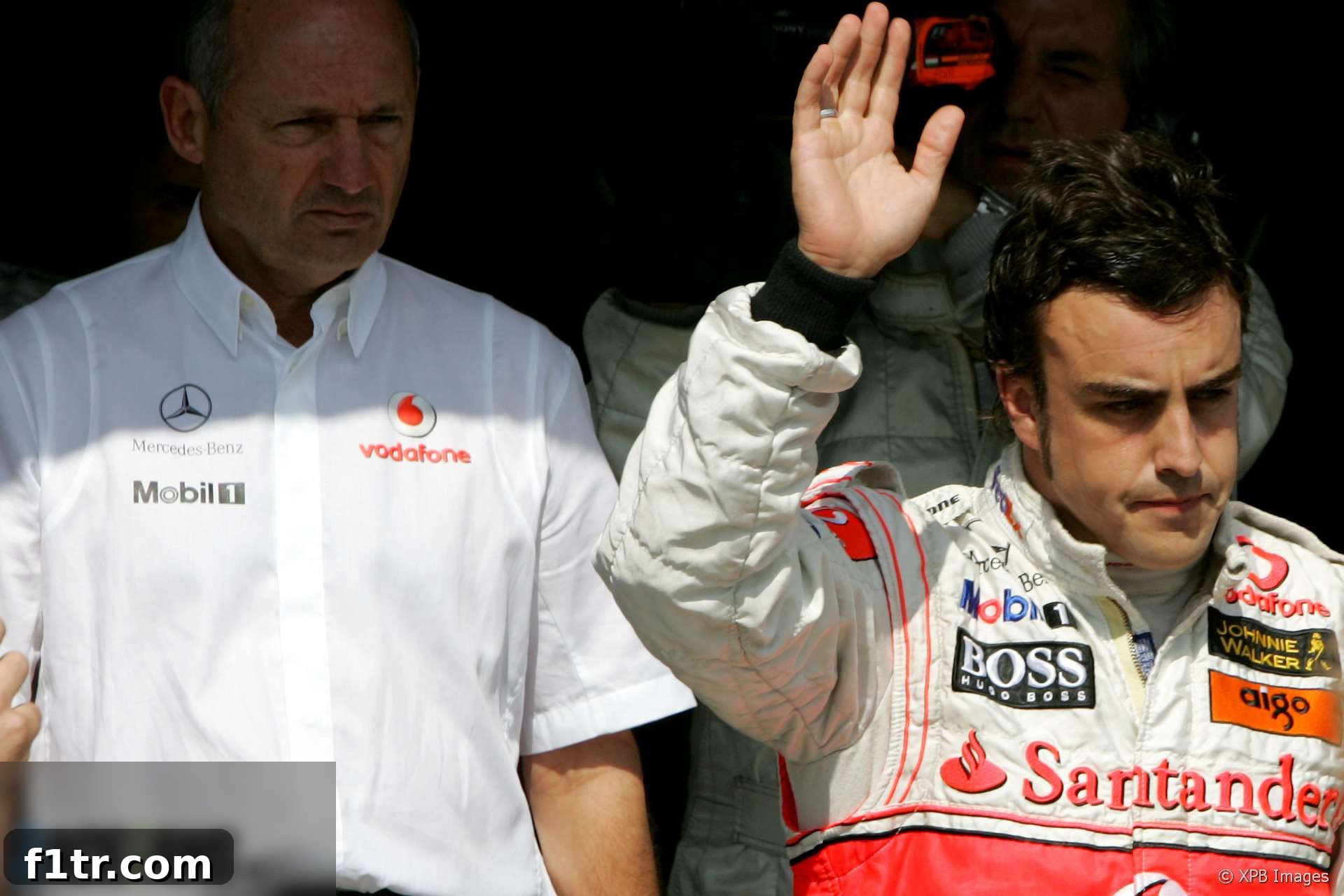
The year 2007 remains etched in the annals of Formula 1 history, not just for its thrilling on-track battles, but for the explosive off-track drama known as ‘Spygate.’ At its core, the scandal saw McLaren, one of the sport’s most prestigious teams, embroiled in allegations of possessing confidential Ferrari data, ultimately leading to a staggering $100 million fine and exclusion from the Constructors’ Championship. For years, a shadow of suspicion lingered over two-time world champion Fernando Alonso, with many within McLaren believing he was instrumental in revealing crucial information to the FIA. However, new insights from his former teammate and McLaren test driver, Pedro de la Rosa, suggest that Alonso was wrongly accused, becoming an undeserving scapegoat in a deeply divisive period for the team.
Advert | Become a Supporter & go ad-free
Spygate Unveiled: The Genesis of a Scandal
The roots of the ‘Spygate’ saga trace back to March 2007 when McLaren technical director Mike Coughlan was found in possession of a 780-page dossier containing highly sensitive technical details about Ferrari’s 2007 car. This information had allegedly been supplied by Nigel Stepney, a former Ferrari engineer. The implications were immense: a leading team potentially gaining an unfair advantage by accessing a rival’s intellectual property. The FIA, Formula 1’s governing body, swiftly launched an investigation.
Initially, an FIA World Motor Sport Council hearing in July 2007 found McLaren not guilty, citing insufficient evidence that the Ferrari data had been used to influence the design or performance of their car. This verdict, however, was short-lived. New, damning evidence soon surfaced, forcing the FIA to reconvene a second hearing. This fresh information included a series of emails and text messages exchanged between Alonso, De la Rosa, and Coughlan, which indicated that the Ferrari data was more widely known within McLaren than initially admitted. It was at this juncture that internal tensions within McLaren reached a boiling point, and the finger of blame began to point directly at Fernando Alonso.
Internal Strife: Alonso, Hamilton, and the Breakdown of Trust
The 2007 season was already fraught with internal tension for McLaren. Alonso, the reigning world champion, had joined the team expecting clear number one status. However, he found himself in an unexpected and fierce rivalry with his rookie teammate, Lewis Hamilton. Hamilton, then in his debut year, proved to be an exceptionally strong rival, immediately challenging Alonso for supremacy. This intense competition created a highly charged atmosphere, exacerbated by McLaren team principal Ron Dennis’s struggle to manage the escalating rivalry.
Advert | Become a Supporter & go ad-free
Pedro de la Rosa vividly recalls the deteriorating relations within the team. “That situation was like a divorce inside the team,” De la Rosa told the official F1 website. “The relationship was not good before, but that was like the complete divorce.” This already fragile situation shattered completely during the Hungarian Grand Prix weekend. A qualifying incident, where Alonso was perceived to have deliberately impeded Hamilton, led to a furious confrontation between Alonso and Ron Dennis. It was after this heated exchange that some within McLaren suspected Alonso of providing the new information to the FIA, effectively leveraging the scandal to gain an advantage or simply as an act of retaliation against the team.
“The fact the FIA knew about it raised many questions over who had passed this information to the FIA. And everyone seemed to blame Fernando for something that we didn’t know and we have zero evidence that he did,” De la Rosa explained, underscoring the lack of concrete proof against the Spaniard. He elaborated on the unfairness of the accusation: “But the FIA knew, it could be from Ferrari, it could be from any anyone because there was many people in the team that knew about the weight distribution of Ferrari or whatever. So it was it was unfair in the way that Fernando was blamed for something that I don’t think he did. So it was the it was the divorce point, because he was looked at someone that had damaged McLaren.” This perception branded Alonso as a traitor in the eyes of many, creating an irreparable rift that ultimately led to his departure from McLaren at the end of the season.
The Email Trail and De la Rosa’s Ardent Defense
Among the key pieces of evidence presented by the FIA were extracts from a series of emails between De la Rosa and Alonso. These communications discussed the sensitive information Mike Coughlan had acquired from Ferrari’s Nigel Stepney. One notable email, dated March 25th, 2007, detailed how “Mr De la Rosa states that tests had been carried out on a flexible rear wing which Mr De la Rosa says is ‘a copy of the system we think Ferrari uses’.” Such direct references to Ferrari’s technical solutions seemed to validate the FIA’s concerns about McLaren’s exploitation of rival data.
However, De la Rosa vehemently maintains that these communications, while appearing incriminating, were merely reflective of the common practice of information gathering in Formula 1. He dismisses the notion that McLaren gained any significant competitive advantage or fundamentally altered their car’s development based on this information. “Still I wake up some nights with a cold sweat because I still don’t understand why we were fined 100 million,” he stated, highlighting the lingering trauma and perceived injustice of the penalty.
He continued to dismantle the narrative of a calculated espionage effort: “There was this theory that we were engineering a copy department of Ferrari or that we were engineering a way into Ferrari or trying to get information from Ferrari. There was nothing of that.” De la Rosa explained the reality of information exchange in the paddock, suggesting the intelligence obtained was far from a meticulously planned leak. “We were a racing team that as with any other competitor, we tried to find information from them, which everyone does in Formula 1. The information we had about Ferrari was the typical information you share [at] a coffee machine, just speaking with engineers: Do you know what weight distribution Ferrari has, these type of questions that obviously someone in the team had the information because of a friendship at Ferrari and we shared this information.”
For De la Rosa, the crucial point was the impact—or lack thereof—on McLaren’s actual racing program. “Did we change anything of our development, of our testing program? Nothing. Nothing changed. We didn’t use that information.” This assertion, if true, dramatically changes the perception of the scandal from deliberate espionage to mere possession of unsolicited, and ultimately unused, data. The McLaren test driver’s account paints a picture of a team that, while perhaps negligent in handling the information, did not actively benefit from it in their car’s development or on-track performance.
The McLaren Perspective and the Weight of the Penalty
The Ferrari dossier first came to light through an almost farcical incident: Mike Coughlan’s wife took the documents to be photocopied at a shop in Woking, near McLaren’s base, raising suspicions that were subsequently reported to Ferrari. De la Rosa’s reflection on this event offers further insight: “People have to understand that that information that was passed, I never saw it. It was never in the team. It was Mike’s wife that did the photocopies. Why did you think she did it? Because Mike didn’t know what to do with the information. He was not taking it seriously.” This suggests a degree of disorganization and a lack of clear intent to weaponize the information, rather than a systematic effort to illicitly gain an advantage.
While acknowledging that McLaren did “something wrong,” De la Rosa believes the punishment was disproportionate to the offense. “But was it 100 million worth? My God, I mean, I thought we got thrashed by that type of penalty. We lost all the points in the world in the constructors’ championship. Eventually we lost the championship in the drivers as well.” The penalty was indeed unprecedented, shattering McLaren’s constructors’ championship aspirations and potentially impacting the drivers’ title fight, which Lewis Hamilton ultimately lost to Kimi Räikkönen by a single point. De la Rosa argues that similar levels of information exchange, albeit perhaps less explicit, are a persistent, if unspoken, reality in the competitive world of Formula 1. “in many teams I’ve been in Formula 1 because I’ve been in many teams, there’s always information flying around from other teams, other competitive teams.” This perspective challenges the singularity of McLaren’s perceived transgression, suggesting that while they were caught, similar dynamics might exist elsewhere.
Long-Term Ramifications for Alonso’s Career
The ‘Spygate’ scandal cast a long shadow over Fernando Alonso’s career, even years after the 2007 season. His perceived role in the affair was often cited as a deterrent for future opportunities. A prime example came three years prior when Toto Wolff, team principal of Mercedes (McLaren’s engine supplier in 2007), indicated that Alonso would not be considered for a drive with the dominant team due to his “history with Mercedes.” This comment suggested a deep-seated distrust that lingered for over a decade, potentially costing Alonso a seat in a car that has since won multiple championships.
However, De la Rosa dismisses the idea that ‘Spygate’ alone prevented Alonso from joining Mercedes. While acknowledging Alonso’s sometimes abrasive personality, he emphasizes the unfairness of the blame. “I think that we all make many mistakes,” De la Rosa reflected. “At the end of the day, Fernando, he’s a critical guy, he says things to the face when he doesn’t how people are working or doing things, and I think he got a lot of the blame for actually something that was not… I mean, let’s be honest, the guy didn’t do anything wrong.” For De la Rosa, Alonso was simply a casualty of a larger conflict. “He was blamed for the this spy scandal, Spygate, then he shouldn’t have been. And I think that the during the years, everyone has realised that Fernando was just caught in the middle of the fight like I was as well and many, many people. But there was other fights going on at the high levels that we were not aware of actually at that point.” This suggests that the internal politics and rivalries at the highest echelons of Formula 1 played a far greater role than Alonso’s actions, making him a convenient target in a complex web of blame.
Advert | Become a RaceFans supporter andgo ad-free
The Enduring Legacy of Spygate: A Call for Reassessment
The 2007 ‘Spygate’ scandal remains one of Formula 1’s most contentious episodes, a stark reminder of the intense pressures and rivalries that define the sport. McLaren’s unprecedented fine and championship exclusion served as a powerful deterrent against industrial espionage. Yet, Pedro de la Rosa’s recent revelations compel a re-evaluation of Fernando Alonso’s perceived culpability. His testimony paints a picture of a driver caught in the crossfire of internal team strife and a highly public investigation, rather than a deliberate saboteur. The strained relationships with Ron Dennis and Lewis Hamilton, coupled with Alonso’s forthright personality, may have made him an easy target for blame, overshadowing the nuanced realities of information exchange in F1.
While the full truth of ‘Spygate’ may never be entirely uncovered, De la Rosa’s insights offer a crucial alternative narrative, advocating for a more empathetic understanding of Alonso’s position. It suggests that the immense pressure, the fierce intra-team rivalry, and perhaps misinterpretations of intentions led to an unfair vilification of a driver who, according to his former teammate, was simply “caught in the middle.” As time provides distance and allows for reflection, the consensus around Alonso’s role in one of F1’s most infamous scandals may yet shift, vindicating the two-time world champion as an unjust recipient of blame.
F1 History and Related Articles
- When did F1 last have a mid-season break longer than five weeks? 1990
- Did Norris actually win Formula 1’s closest championship fight of all time?
- Hamilton is Ferrari’s first new driver in 44 years to complete season without a podium
- Ferrari are on course to lose an F1 record they’ve held since 2004
- Red Bull in 2010 or Ferrari in 1979? Past title fights illustrate McLaren’s current dilemma
Browse all history articles