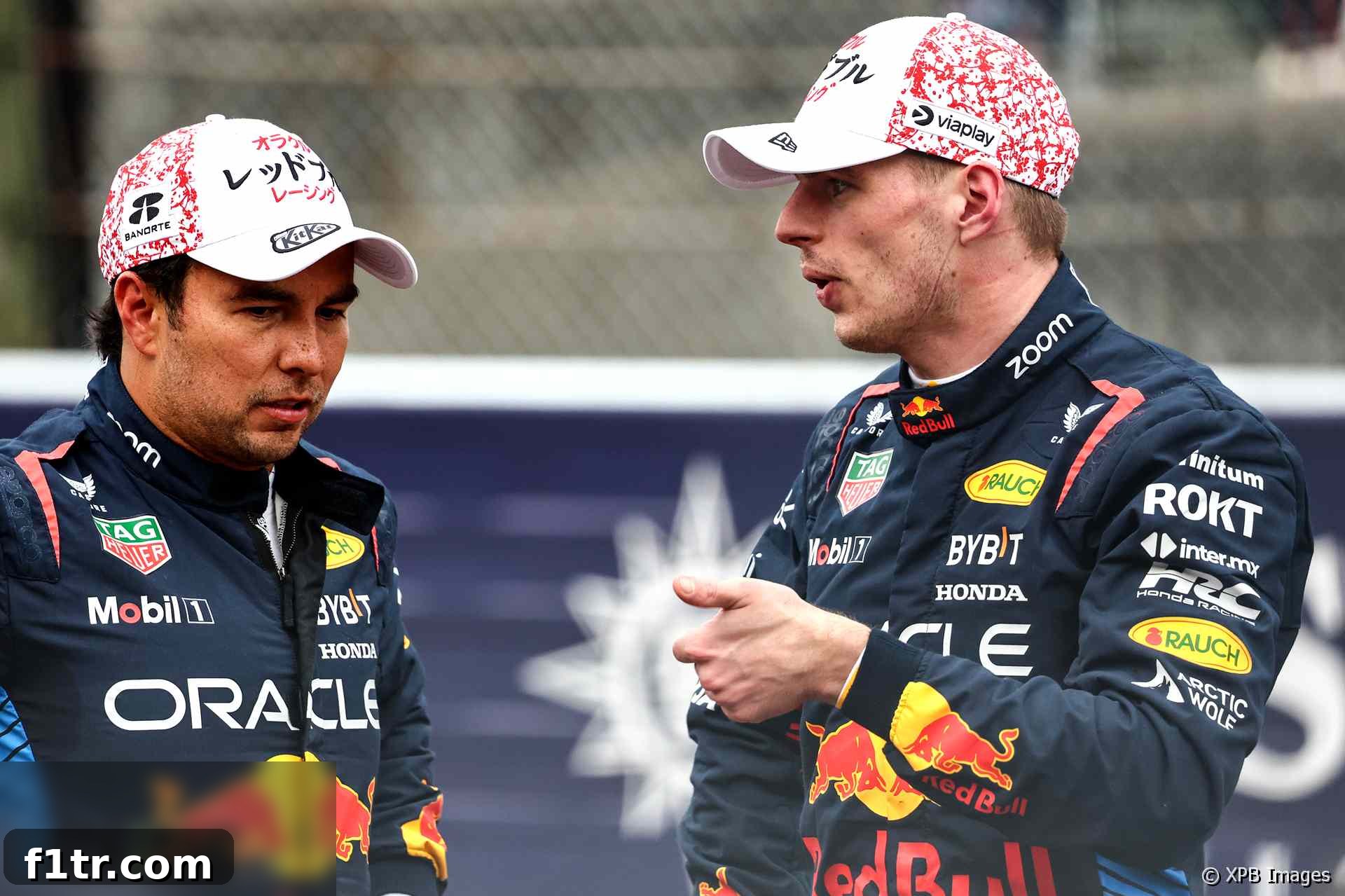
Verstappen Clinches Japanese Grand Prix Pole Amidst Tyre Challenge at Suzuka
Max Verstappen, the reigning Formula 1 world champion, demonstrated his unparalleled skill by securing pole position for the Japanese Grand Prix at the iconic Suzuka Circuit. In a fiercely contested qualifying session, Verstappen narrowly outperformed his Red Bull Racing teammate, Sergio Perez, by less than a tenth of a second – marking the closest margin for pole position seen so far in the current season. This remarkable performance underscores Red Bull’s continued dominance, yet both drivers’ post-session comments hinted at the unique challenges posed by the demanding Suzuka track, particularly concerning tyre degradation and potential race pace.
Verstappen’s Imperfect Pole: A Testament to Skill
Despite clinching his fourth consecutive pole position of the season, Max Verstappen was quick to admit that his fastest lap in Q3 was not the epitome of perfection. Speaking to his race engineer, Gianpiero Lambiase, immediately after his blistering lap, Verstappen conceded that he had “lost it a bit at the end.” This self-critical assessment stemmed from his front tyres fading noticeably by the time he navigated the high-speed demands of the final corners. Such an admission from a driver of Verstappen’s calibre highlights not only the razor-thin margins at the pinnacle of motorsport but also the incredible difficulty of extracting maximum performance from a Formula 1 car on a circuit as punishing as Suzuka.
Verstappen elaborated on the nuanced nature of qualifying at Suzuka, a track renowned for its aggressive tarmac and a layout that relentlessly tests a car’s aerodynamic and mechanical grip. “It was quite close at the end,” he stated. “I think, overall, this track is very sensitive with the tyres, with the Tarmac being really aggressive. When you really want to go to the limit, it doesn’t always work out.” His comments underscore the delicate balance between pushing for ultimate speed and managing the tyres over a full qualifying lap. Despite the minor imperfections, the Dutchman’s ability to still deliver a pole-winning lap is a clear indicator of his exceptional talent and the inherent speed of the Red Bull RB20. Securing pole position here is not merely about outright pace; it’s a profound understanding of the car’s limits and the track’s demands, even when things are not absolutely flawless.
Sergio Perez’s Near Miss and the Tyre Conundrum
Hot on Verstappen’s heels, Sergio Perez showcased a strong performance, securing an all-Red Bull front row. The Mexican driver’s lap was a mere fraction slower than his teammate’s, demonstrating his growing confidence and improved consistency in the 2024 season. Perez echoed Verstappen’s sentiments regarding the immense challenge of maintaining tyre performance throughout the demanding Suzuka lap. “It was close today. Really close with Max,” Perez commented, acknowledging the tight battle for pole.
Perez described his lap as feeling “good,” but conceded that the circuit made it “quite tricky out there, especially closing out the laps.” He pinpointed the final section, particularly the chicane, as an area where it was “quite easy to lose a couple of tenths.” This shared experience between the two Red Bull drivers underscores a critical aspect of Suzuka: its relentless nature. The high-speed ‘S’ curves and long, sweeping corners place immense lateral loads on the tyres, leading to significant thermal degradation. By the time drivers reach the tighter, slower sections towards the end of the lap, the tyres have already been pushed to their absolute limits, making precision and grip management paramount. Perez’s frustration at just missing out on pole, despite a strong effort, highlights the fine margins that define success at this level.
Suzuka’s Unique Tyre Challenge: A Deep Dive
The Suzuka International Racing Course is a legendary fixture on the Formula 1 calendar, revered by drivers and fans alike for its unique figure-eight layout and a series of challenging, high-speed corners. What makes Suzuka particularly taxing on tyres, as both Verstappen and Perez alluded to, is its highly abrasive tarmac combined with a sequence of long, sustained high-g turns. Sections like the ‘S’ Curves and Spoon Curve demand continuous load on the tyres, heating them rapidly and leading to significant wear and degradation over a single lap.
During qualifying, drivers aim to extract every ounce of performance, pushing the tyres to their absolute thermal and mechanical limits. However, this aggressive approach often results in the tyres “giving up” towards the end of the lap, as experienced by Verstappen. This phenomenon is critical, as even a slight loss of grip can translate into crucial tenths of a second. For the race, this presents an even greater strategic challenge. Teams must meticulously plan their pit stops and tyre compounds, factoring in Suzuka’s propensity for high degradation. The ability to manage tyres effectively, especially the front axle under braking and through the fast corners, often dictates success in the Japanese Grand Prix. This inherent characteristic of Suzuka ensures that tyre management remains a central theme, adding an extra layer of strategic depth and driver skill requirement to the event.
Race Pace Uncertainty: Is Red Bull’s Dominance Under Threat?
Despite securing a dominant front-row lockout, Sergio Perez’s remarks post-qualifying introduced an element of intrigue and potential uncertainty regarding Red Bull’s prospects for the race. While an all-Red Bull front row typically signals an expectation of a comfortable victory, Perez offered a more cautious assessment. “I think we are in a good position for tomorrow,” he stated, but critically added, “I think our long run pace hasn’t been that strong this morning, but we were quite upbeat. So hopefully tomorrow we will be able to be strong.”
This statement deviates from the usual confidence often exuded by Red Bull after a dominant qualifying display. It suggests that while their single-lap pace is formidable, their ability to maintain that performance over a full race distance, particularly against potential challenges from competitors, might not be as assured as many expect. The pre-race long run simulations are crucial for understanding a car’s behaviour with heavy fuel and degrading tyres. If Red Bull’s data from Friday’s practice sessions indicates a less-than-optimal long-run performance, it could open the door for other teams. Ferrari, Mercedes, and even Aston Martin have shown flashes of strong race pace in various conditions this season, and Suzuka’s unique demands could amplify any weaknesses in tyre management or car balance over stints.
Perez’s honesty could be a strategic move to manage expectations, or it could be a genuine reflection of the data collected during practice. Regardless, it adds an exciting dimension to the Japanese Grand Prix. Will Red Bull’s formidable qualifying advantage translate into unchallenged race control, or will the tyre degradation and the competitive field turn Sunday into a more unpredictable affair? The answers will lie in how effectively Red Bull can adapt their strategy and how well their drivers manage the demanding conditions over the race distance.
The 2024 F1 Season: A Broader Context for Suzuka
The 2024 Formula 1 season has, in many ways, picked up where 2023 left off, with Red Bull Racing and Max Verstappen setting a blistering pace. However, the narrative isn’t one of complete stagnation. While Verstappen has maintained his exceptional form, the competitive landscape behind him appears to be shifting. Teams like Ferrari have shown significant improvements in strategy and car performance, and Mercedes is actively working to overcome its car’s inconsistencies. This broader context makes Perez’s comments about race pace particularly noteworthy.
Suzuka, as the fourth round of the championship, often serves as a crucial benchmark for teams, revealing the true strengths and weaknesses of their packages. The circuit demands a finely balanced car, powerful engine, and exceptional aerodynamic efficiency – all areas where Red Bull has historically excelled. However, as other teams continue to develop and bring updates, the margins are inevitably shrinking. The qualifying session at Suzuka, with its smallest pole margin of the season, might be an early indicator of a tightening field, especially in race conditions where tyre degradation and strategic decisions play a more significant role than pure single-lap speed. The Japanese Grand Prix is therefore not just another race, but a critical test of endurance, strategy, and adaptation for all teams and drivers.
Anticipating the Race: Strategy and Excitement
With an all-Red Bull front row locked in, the Japanese Grand Prix promises an intriguing battle, not just between the Red Bull teammates, but potentially with the chasing pack. The critical factors for Sunday will undoubtedly revolve around tyre strategy, pit stop execution, and the ability of drivers to manage their compounds on Suzuka’s aggressive surface. An early safety car or unexpected weather change could further shuffle the deck, turning a potentially straightforward race into a strategic chess match.
The stage is set for a captivating race at Suzuka. While Max Verstappen starts from the optimal position, the hints of race pace concerns from Sergio Perez, coupled with the track’s demanding nature, suggest that the 2024 Japanese Grand Prix might offer more than just a comfortable Red Bull procession. Fans can look forward to a thrilling contest where every lap, every pit stop, and every strategic decision will be under intense scrutiny, as teams battle for supremacy on one of Formula 1’s most revered circuits.
2024 Japanese Grand Prix Related Articles
- “Am I in a race here or what?”: How Ferrari aced their Suzuka strategies
- Suzuka showed Mercedes “have a more stable platform” now
- Ferrari’s strategy gains in 2024 are “purely down to the car” – Sainz
- Tsunoda ‘at Verstappen and Alonso’s level’ with Suzuka performance – Marko
- Japan was first race where Red Bull’s winning margin was bigger than last year
Browse all 2024 Japanese Grand Prix articles