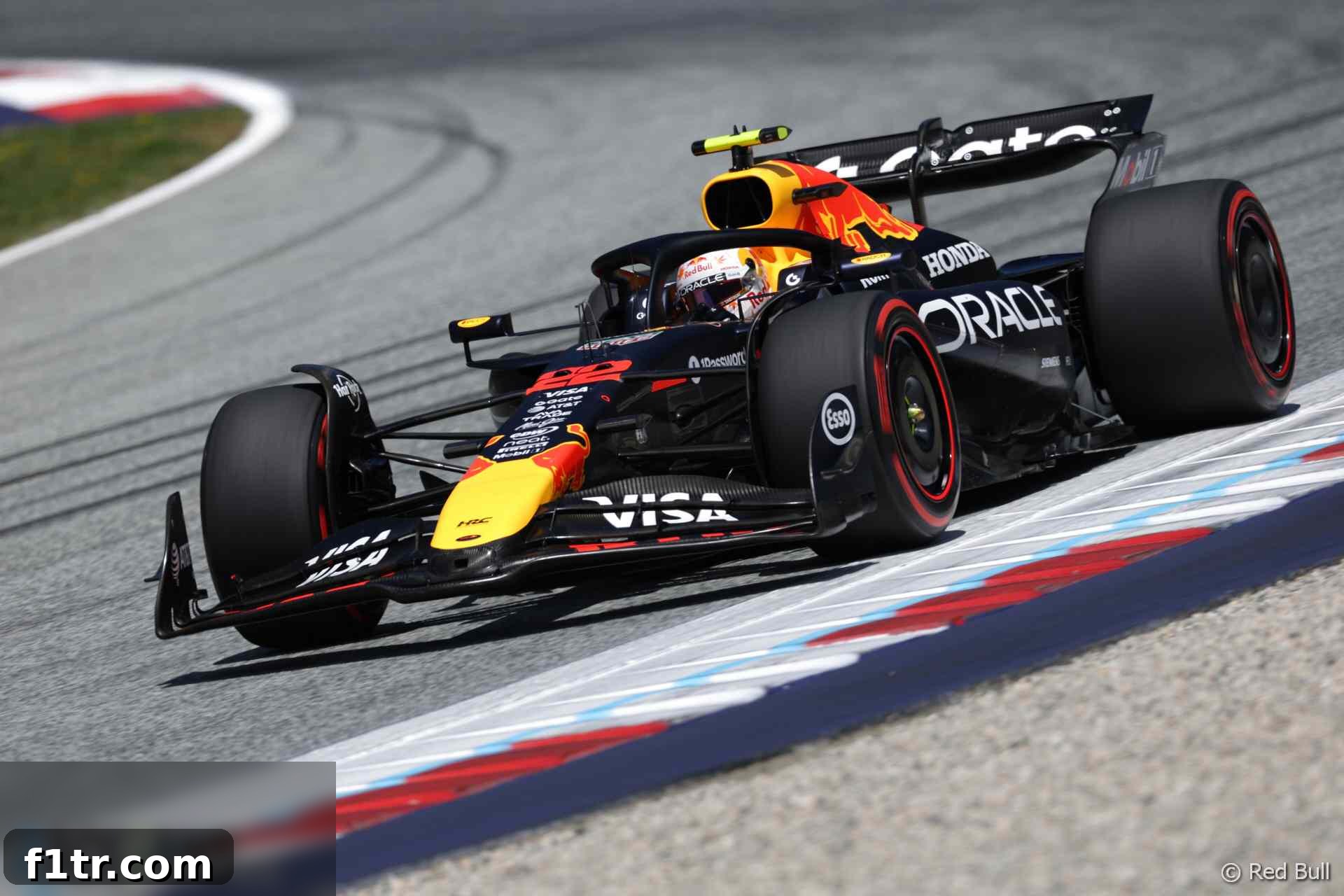
Yuki Tsunoda faced a perplexing setback at the Red Bull Ring, where an inexplicable shift in his car’s balance led to his early elimination in the first round of qualifying. The Red Bull driver, who had shown promising pace earlier in the weekend, was left struggling to comprehend the sudden change that severely hampered his performance during the crucial qualifying session for the Austrian Grand Prix.
Set to start the race from a disappointing 18th position on the grid, Tsunoda’s Q1 exit was particularly jarring. Despite lapping within a mere three-tenths of a second of his highly decorated teammate, Max Verstappen, the compact nature of the Austrian circuit meant this small time difference translated into a colossal 12-place grid penalty between the two Red Bull drivers. This stark contrast underscored the fine margins that define Formula 1 qualifying, especially on shorter tracks where every tenth, and even hundredth, of a second is amplified.
The Unforeseen Challenge: A Balance Anomaly
Speaking to the official F1 channel after the session, a visibly frustrated Tsunoda articulated his bewilderment. “I don’t know why, I have to check, but the balance was completely off on the last lap,” he explained. His initial push lap had felt encouraging, suggesting a decent foundation, yet the subsequent attempt yielded entirely different results. “It felt quite good on the first push, but in the second push it was somehow just completely off.” This sudden and drastic change, occurring between laps, presented a profound challenge for the young driver.
Tsunoda was adamant that his preparation had been meticulous. “I don’t think I’ve done anything wrong with the warm-up or everything else,” he stated, dismissing potential driver error in preparation. The mystery of the car’s behavior remained. “To be honest, the balance is completely different. So it’s hard to explain that.” Such an unexpected and unidentifiable issue can be particularly demoralizing for a driver, as it leaves them feeling powerless and without a clear direction for immediate improvement. It highlights the complex interplay between driver feel, car setup, and track conditions that are integral to Formula 1 performance.
A Recurring Pattern: Struggles with Setup
This weekend marked Tsunoda’s ninth outing with the Red Bull team, having joined as a replacement for Liam Lawson. His tenure with the senior team has been characterized by flashes of potential intertwined with persistent struggles to find a consistent and comfortable car setup. The Red Bull Ring’s Q1 elimination was not an isolated incident; it represented his third Q1 exit in the last five rounds, pointing to an underlying challenge in adapting the car to his driving style or the specific demands of varying circuits.
Earlier in the Austrian Grand Prix weekend, Tsunoda had indeed shown glimpses of better pace, hinting at a more competitive performance. However, as qualifying commenced, the gap between his pace and that of his teammate, Max Verstappen, widened considerably. “Even if the pace is good, ending up like this is so frustrating,” he admitted, reflecting on the disparity between his practice performance and his qualifying result. This inconsistency underscores the pressure on him to translate promising free practice form into tangible qualifying results, especially in a team as demanding as Red Bull.
The core of the problem, as Tsunoda perceived it, lay in the elusive nature of the car’s ultimate performance envelope. “To be honest, I was feeling good, and ended up like this. The balance is, in the end – just somehow I’m not able to put it all together all the time. So I just have to talk with the engineers.” This candid assessment points to a deeper engineering challenge, where the team needs to work with Tsunoda to unlock consistent performance across all sessions, rather than just in segments.
The Team Dynamic: Comparisons and Implications
The context of Tsunoda’s Q1 elimination becomes even more significant when compared to the performances of his former team, Racing Bulls. Both drivers from the Red Bull sister team, Racing Bulls, managed to qualify ahead of Tsunoda. Notably, Liam Lawson, the very driver Tsunoda replaced at Red Bull, delivered an outstanding performance, securing a P6 start. Lawson’s impressive qualifying was made even more remarkable by the fact that he qualified ahead of Max Verstappen, whose final lap was compromised by a yellow flag incident, preventing him from improving his time.
Adding to Tsunoda’s woes, Isack Hadjar, the other Racing Bulls driver, also outqualified him, securing the 13th spot on the grid. This scenario presents a complex narrative for Red Bull. While Verstappen’s pace and the yellow flag incident explain some of the disparity, Tsunoda’s performance relative to his former team’s drivers, especially Lawson, intensifies the scrutiny on his position within the top team. The optics of the driver replacing Lawson struggling while Lawson himself shines in the junior team undoubtedly raises questions about performance consistency and potential future driver lineups within the Red Bull family.
The Red Bull Ring is a circuit known for its high-speed sections and tricky corners, demanding a finely tuned car and absolute confidence from the driver. A sudden loss of balance, as experienced by Tsunoda, can be attributed to a myriad of factors, including subtle changes in track temperature, tyre degradation, or even minor aerodynamic inconsistencies. Pinpointing the exact cause in the heat of the moment, especially under qualifying pressure, is a monumental task. This unexplained issue meant Tsunoda couldn’t extract the maximum performance from his car, leading to his frustrating early exit.
Looking Ahead: The Road to Recovery
Tsunoda’s Q1 exit at the Red Bull Ring extends a challenging run for the young driver, marking what has been described as the longest point-less streak for a Red Bull driver in 16 years. This statistic, combined with his recent qualifying struggles, amplifies the pressure on him to deliver results. The immediate priority for Tsunoda and his engineering team will be a thorough debrief and analysis to understand the root cause of the sudden balance shift. Without a clear explanation, it becomes difficult to implement targeted solutions and prevent a recurrence.
The upcoming races will be crucial for Tsunoda to demonstrate his ability to consistently perform at the elite level expected of a Red Bull driver. Overcoming such unexplained technical issues, while simultaneously battling the psychological impact of repeated setbacks, will be a true test of his resilience. The talent is evident, but the consistency and ability to maximize the car’s potential under all conditions are what will ultimately define his future with the team. The Red Bull hierarchy is known for its rigorous performance metrics, and Tsunoda will need to quickly turn the tide to solidify his position and silence the critics.
Advert | Become a RaceFans supporter andgo ad-free
Miss nothing from RaceFans
Get a daily email with all our latest stories – and nothing else. No marketing, no ads. Sign up here:
2025 Austrian Grand Prix
- Wiping Verstappen out in Austria wasn’t as bad as Monza debut crash – Antonelli
- Piastri explains “f*** me up” radio message after third run-in with an Alpine at Austrian GP
- Bortoleto admits he made a “mistake” in fight with “very smart” Alonso at Austrian GP
- Tsunoda on longest point-less run for a Red Bull driver in 16 years: Austrian GP stats
- “Confused” Russell couldn’t tell if Leclerc was “trying to help me or Lewis” at start
Browse all 2025 Austrian Grand Prix articles