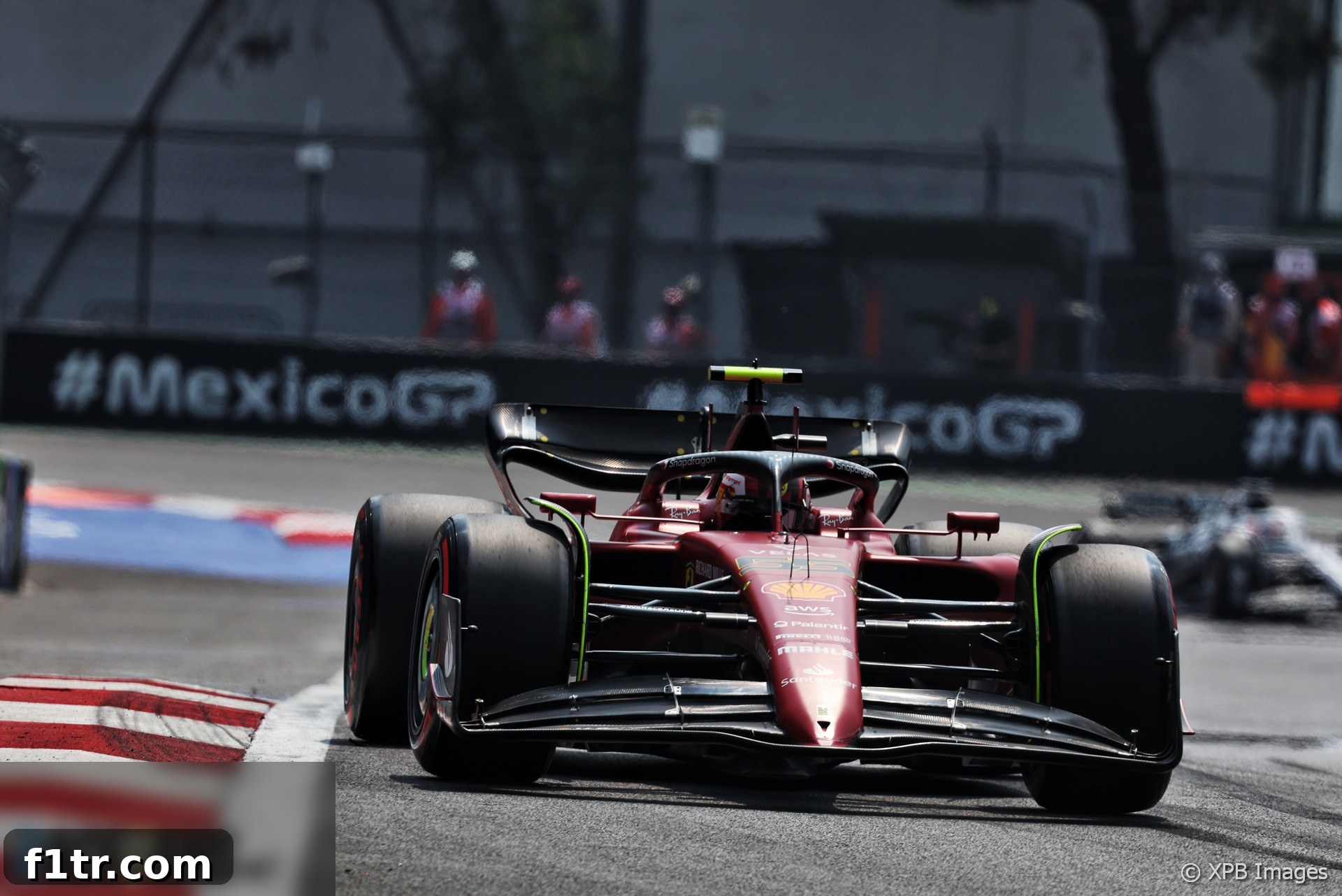
The highly anticipated 2022 Mexican Grand Prix weekend kicked off with a dramatic first free practice session at the Autódromo Hermanos Rodríguez. Carlos Sainz Jnr of Ferrari emerged fastest, clocking a formidable 1’20.707. However, his strong showing was overshadowed by a litany of technical problems that plagued numerous teams and drivers throughout the session, setting a challenging tone for the remaining weekend.
Ferrari Sets Early Pace Amidst Mechanical Woes in Mexico
Under clear skies and warm temperatures, hovering in the mid-20s Celsius, the Formula 1 cars roared onto the high-altitude circuit in Mexico City. Ferrari wasted no time in demonstrating their potential, with Carlos Sainz setting the benchmark. His best lap, a 1’20.707, narrowly edged out his teammate Charles Leclerc by just half a tenth of a second, solidifying a strong one-two for the Scuderia at the top of the timing sheets. This early pace from Ferrari suggests they might be well-suited to the unique demands of the Autódromo Hermanos Rodríguez, a circuit known for its thinner air and reliance on aerodynamic efficiency and mechanical grip.
The Red Bull Racing duo, Sergio Perez and Max Verstappen, finished third and fourth respectively, remarkably setting identical lap times. While competitive, their session was not without incident, hinting at underlying challenges even for the dominant championship team. The high altitude of the circuit, sitting over 2,200 meters above sea level, significantly impacts engine performance and aerodynamic downforce, making setup and reliability crucial. Teams often struggle to cool components and generate sufficient downforce, leading to unexpected technical difficulties, which became a recurring theme of this opening session.
A Cascade of Technical Challenges Across the Grid
From the moment the pit lane opened, it was clear that reliability would be a major storyline. Charles Leclerc’s initial run on hard compound tires was cut short when his team called him in due to an early puncture. Meanwhile, Liam Lawson, one of the five stand-in drivers, experienced a heart-stopping moment at the end of the main straight when his brakes reportedly failed, forcing an immediate return to the garage for urgent checks. This was a stark reminder of the immense pressures and technical complexity of modern F1 machinery.
Local hero Sergio Perez also faced a frustrating start to his home Grand Prix weekend, as bodywork damage to his Red Bull RB18 delayed his participation and limited his valuable track time. Further down the pit lane, McLaren’s Daniel Ricciardo was sidelined for a significant portion of the session with persistent braking problems, requiring his car to be extensively dismantled in an attempt to identify and rectify the issue. Even Mick Schumacher’s Haas drew attention, with mechanics working diligently on its rear wing to resolve an apparent problem with the DRS (Drag Reduction System) flap, highlighting the intricate details teams must manage.
Reigning world champion Max Verstappen initially set the pace on hard tyres with a 1’22.291. However, his first flying lap on the softer compound tyres was abruptly curtailed by a rare spin at turn nine, costing him precious time and data. These collective issues underscore the difficult balancing act teams face at this particular venue, where the unique atmospheric conditions can expose even minor vulnerabilities in car design and setup.
Five Rookies Face the Ultimate F1 Test at Autódromo Hermanos Rodríguez
The first practice session in Mexico City was also notable for featuring five different stand-in drivers, each granted an opportunity to experience a Grand Prix weekend session. These young talents, often vying for future F1 seats or crucial superlicence points, were thrust into one of the sport’s most demanding circuits. Jack Doohan, an F2 driver, made his debut in an F1 session, taking over Esteban Ocon’s Alpine. Pietro Fittipaldi drove Kevin Magnussen’s Haas, while Nyck de Vries, fresh off an impressive F1 debut earlier in the season, stepped into George Russell’s Mercedes. Liam Lawson was given a drive in Yuki Tsunoda’s AlphaTauri, and Logan Sargeant, a prospective future Williams driver, returned to the cockpit of Alexander Albon’s car.
The session presented a steep learning curve for these aspiring F1 stars, compounded by the challenging circuit conditions and the myriad technical issues that plagued the wider field. Jack Doohan’s session was unfortunately cut short by Alpine due to detected anomalies in his power unit data, preventing him from completing his planned run program. Pietro Fittipaldi also saw his time on track end prematurely when he was instructed to stop his Haas at the second corner due to an unspecified problem, bringing out the first red flag of the day.
Perhaps the most dramatic incident involving a stand-in driver came in the closing minutes with Liam Lawson. After struggling with brake issues earlier, Lawson’s AlphaTauri spectacularly pulled off the circuit at the entrance to the stadium section. His left-front brake assembly ignited and caught fire, creating thick plumes of smoke after he had safely vacated the car. Marshals were quick to extinguish the blaze, but the incident prompted the second red flag of the session, effectively ending the practice prematurely. While these young drivers gained invaluable experience, none of them managed to complete the 24 laps necessary to cover 100 kilometers of running, thus missing out on the bonus point for their FIA superlicence tallies.
High Drama and Red Flags Dictate FP1 Flow
The session’s flow was twice interrupted by red flags, a testament to the demanding nature of the Autódromo Hermanos Rodríguez and the early-season reliability challenges. The first stoppage occurred when Pietro Fittipaldi was instructed to park his Haas at Turn 2. This incident led to a five-minute delay as marshals recovered the car, allowing teams a brief respite before the session resumed. However, the hiatus meant that valuable track time was lost, particularly critical for teams still gathering data on new components or testing various setup configurations.
The second red flag, and ultimately the session’s definitive end, came with just under four minutes remaining. Liam Lawson’s AlphaTauri, already suffering from brake issues, dramatically caught fire in the stadium section. The sight of flaming brakes and thick smoke underscored the severity of the problem and the potential safety implications. With such little time left on the clock, race control deemed it unnecessary to restart the session, solidifying Carlos Sainz’s position at the top of the timings. These interruptions highlight the unpredictable nature of early practice sessions and the fine line between pushing the limits and encountering mechanical failure, especially at a high-stress circuit like Mexico City.
The Final Standings: A Glimpse into the Weekend’s Potential
As the checkered flag waved (or rather, as the red flag ended proceedings), Carlos Sainz emerged as the provisional leader, less than a tenth of a second ahead of his Ferrari teammate Charles Leclerc. This strong showing from Ferrari sends a clear message to their rivals, suggesting they are a force to be reckoned with this weekend. Sergio Perez and Max Verstappen, despite their earlier issues, finished a respectable third and fourth, setting identical times, which speaks volumes about the Red Bull car’s inherent pace even when not perfectly optimized.
Lewis Hamilton secured fifth place for Mercedes, indicating that the Silver Arrows might also be in the mix, followed by Fernando Alonso in the Alpine, Valtteri Bottas for Alfa Romeo, and Lando Norris in the McLaren. Pierre Gasly and Sebastian Vettel rounded out the top ten, showcasing the competitive nature of the midfield. As expected, all five stand-in drivers occupied the final five spots on the timing screen, reflecting the challenge of stepping into an F1 car and performing optimally on such a demanding circuit with limited running.
Implications for the Weekend Ahead
The opening practice session for the 2022 Mexican Grand Prix provided a tantalizing glimpse into what promises to be a captivating weekend of Formula 1 action. Ferrari’s strong start, with Carlos Sainz leading the charge, positions them as serious contenders for pole position and potentially the race victory. However, the prevalence of technical issues across multiple teams, including Red Bull, McLaren, and AlphaTauri, suggests that reliability will be a critical factor. Teams now face the arduous task of analyzing vast amounts of data, diagnosing problems, and making crucial setup changes ahead of FP2 and FP3. The high altitude exaggerates every setup nuance and every mechanical weakness, meaning that those who can quickly iron out their difficulties will gain a significant advantage.
The dramatic incidents, particularly the brake fire for Liam Lawson, serve as a stark reminder of the extreme conditions under which these machines operate. As teams head into the rest of the weekend, the focus will undoubtedly shift to fine-tuning setups, managing tyre degradation, and ensuring their cars can withstand the unique stresses of the Autódromo Hermanos Rodríguez. With Ferrari looking strong and Red Bull aiming to recover from a somewhat interrupted session, the battle for supremacy in Mexico City is just beginning, promising excitement and unpredictability for fans worldwide.
2022 Mexican Grand Prix First Practice Result
| Position | Number | Driver | Team | Model | Time | Gap | Laps |
|---|---|---|---|---|---|---|---|
| 1 | 55 | Carlos Sainz Jnr | Ferrari | F1-75 | 1’20.707 | 25 | |
| 2 | 16 | Charles Leclerc | Ferrari | F1-75 | 1’20.753 | 0.046 | 20 |
| 3 | 11 | Sergio Perez | Red Bull | RB18 | 1’20.827 | 0.120 | 22 |
| 4 | 1 | Max Verstappen | Red Bull | RB18 | 1’20.827 | 0.120 | 22 |
| 5 | 44 | Lewis Hamilton | Mercedes | W13 | 1’20.849 | 0.142 | 17 |
| 6 | 14 | Fernando Alonso | Alpine-Renault | A522 | 1’20.899 | 0.192 | 26 |
| 7 | 77 | Valtteri Bottas | Alfa Romeo-Ferrari | C42 | 1’21.083 | 0.376 | 23 |
| 8 | 4 | Lando Norris | McLaren-Mercedes | MCL36 | 1’21.120 | 0.413 | 21 |
| 9 | 10 | Pierre Gasly | AlphaTauri-Red Bull | AT03 | 1’21.310 | 0.603 | 25 |
| 10 | 5 | Sebastian Vettel | Aston Martin-Mercedes | AMR22 | 1’21.525 | 0.818 | 24 |
| 11 | 3 | Daniel Ricciardo | McLaren-Mercedes | MCL36 | 1’21.762 | 1.055 | 16 |
| 12 | 24 | Zhou Guanyu | Alfa Romeo-Ferrari | C42 | 1’21.820 | 1.113 | 20 |
| 13 | 18 | Lance Stroll | Aston Martin-Mercedes | AMR22 | 1’21.865 | 1.158 | 24 |
| 14 | 47 | Mick Schumacher | Haas-Ferrari | VF-22 | 1’21.952 | 1.245 | 22 |
| 15 | 6 | Nicholas Latifi | Williams-Mercedes | FW44 | 1’22.912 | 2.205 | 20 |
| 16 | 40 | Liam Lawson | AlphaTauri-Red Bull | AT03 | 1’23.861 | 3.154 | 19 |
| 17 | 45 | Logan Sargeant | Williams-Mercedes | FW44 | 1’24.246 | 3.539 | 22 |
| 18 | 19 | Nyck De Vries | Mercedes | W13 | 1’24.582 | 3.875 | 20 |
| 19 | 82 | Jack Doohan | Alpine-Renault | A522 | 1’24.615 | 3.908 | 13 |
| 20 | 51 | Pietro Fittipaldi | Haas-Ferrari | VF-22 | 1’26.766 | 6.059 | 9 |
2022 Mexican Grand Prix Related Articles
- How many victory chances did Hamilton have in his first winless F1 season?
- Delay in producing new parts held up Alfa Romeo upgrade
- Doohan’s practice run earns praise, but Alpine undecided over reserve role
- ‘I was in the fight, which hasn’t been often this year’: Ricciardo’s Mexican GP transcript
- Verstappen “will continue to break records for the rest of his career” – rivals
Browse all 2022 Mexican Grand Prix articles