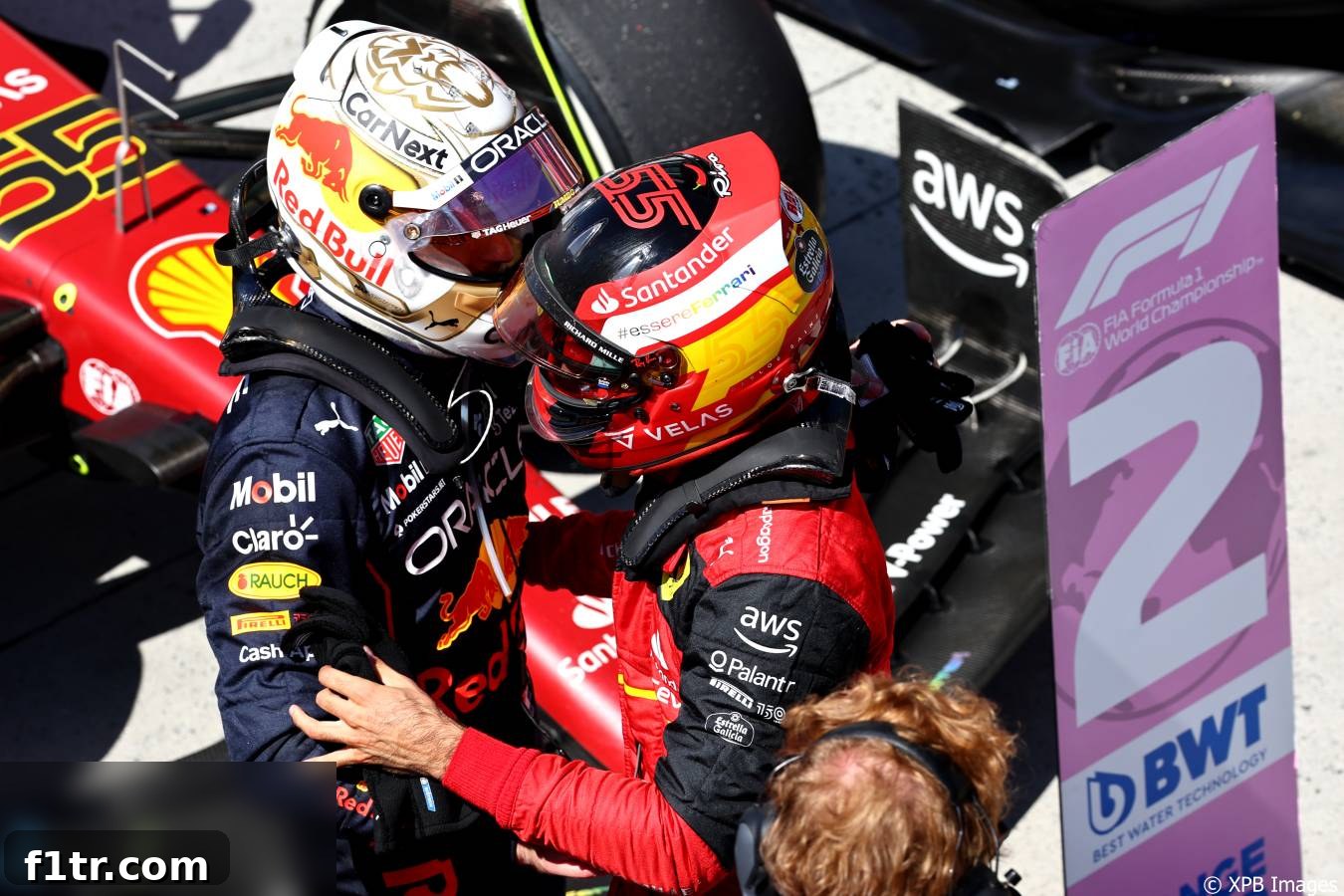
The exhilarating 2022 Canadian Grand Prix delivered a captivating spectacle of strategy, speed, and raw talent, culminating in a dominant display from Red Bull Racing’s Max Verstappen. The reigning world champion masterfully navigated the challenging Circuit Gilles Villeneuve, securing his sixth victory of the season and further cementing his formidable lead in the Formula 1 Drivers’ Championship. It was a race defined by intense battles, pivotal safety car periods, and a relentless pursuit from Ferrari’s Carlos Sainz Jr., who pushed Verstappen to the absolute limit in a nail-biting finish.
From the moment the lights went out in Montreal, the championship leader demonstrated why he is considered one of the sport’s finest. Verstappen’s race craft and strategic acumen were on full display as he fended off the ever-present threat of Sainz, who delivered arguably his strongest performance of the season. The Canadian Grand Prix, known for its unpredictable nature and high-speed demands, lived up to its reputation, providing a thrilling narrative from start to finish. Fans were treated to a classic F1 showdown, highlighting the fine margins that separate victory from defeat at the pinnacle of motorsport.
Advert | Become a Supporter & go ad-free
The opening stages of the race were relatively calm, but the strategic landscape was abruptly reshaped on lap eight when a Virtual Safety Car (VSC) period was triggered. This crucial moment occurred due to the retirement of Verstappen’s teammate, Sergio Perez, whose Red Bull RB18 suffered a suspected gearbox failure. For Verstappen, this presented a golden opportunity. He wasted no time in seizing the initiative, diving into the pits for an early tire change. This quick thinking allowed him to capitalize on the reduced speed under the VSC, gaining valuable track position and mitigating potential time losses that a regular pit stop would incur. It was a decisive move that underscored Red Bull’s sharp operational execution.
Meanwhile, Fernando Alonso, who had surprised many by starting on the front row, quickly lost his second position to a determined Carlos Sainz Jnr on lap three. Sainz, in his Ferrari, looked poised and competitive throughout the Grand Prix. Unlike Verstappen, the Spaniard opted for a different strategy, choosing to extend his first stint. His decision meant he did not pit under the initial VSC. Instead, Sainz held out until a second VSC period emerged later in the race when Mick Schumacher was forced to retire his Haas. This pivotal moment allowed Sainz to make his first pit stop, rejoining the race with fresher tires and maintaining his challenge against Verstappen.
The strategic chess match continued to unfold as the race progressed. Verstappen, having pitted early, made a second pit stop on lap 43, demonstrating Red Bull’s commitment to optimal tire management and track position. Although this temporarily dropped him behind Lewis Hamilton, the Mercedes driver was quickly dispatched by a charging Verstappen. With refreshed tires, the Dutchman immediately began to unleash the full potential of his RB18, systematically chipping away at Sainz’s ten-second lead, often taking a full second per lap out of the Ferrari. The intensity of this chase highlighted Verstappen’s relentless pursuit of victory and the raw pace of his championship-leading car.
However, just as Verstappen appeared to be closing in with unstoppable momentum, the race took another dramatic turn. Yuki Tsunoda, unfortunately, brought out the full Safety Car after crashing his AlphaTauri upon exiting the pits. This incident completely neutralized the race and, crucially, presented Carlos Sainz with a second opportunity to pit without losing significant time. Seizing this lifeline, Sainz swooped into the pits, emerging directly on Verstappen’s tail with a fresh set of tires. The Safety Car period effectively wiped out Verstappen’s hard-earned lead and set the stage for a thrilling sprint to the finish, transforming a comfortable lead into a direct head-to-head confrontation for the win.
With the Safety Car period concluding and the race restarting, the battle for supremacy intensified dramatically. For lap after lap, Carlos Sainz Jnr remained glued to Max Verstappen’s gearbox, operating well within DRS (Drag Reduction System) range. The tension was palpable as the Ferrari driver relentlessly attacked, seeking any opportunity to make a move. Sainz utilized the DRS on the long straights of Circuit Gilles Villeneuve, but Verstappen, demonstrating exceptional defensive driving and superb car control, brilliantly held his ground. Despite Sainz’s best efforts and persistent pressure, the Red Bull driver executed a flawless defense, denying his rival any clear overtaking opportunities. By the final lap, as they approached the iconic final chicane, Sainz had finally dropped out of the one-second DRS window, a testament to Verstappen’s masterful race management. The pair crossed the finish line just a second apart, underscoring the incredibly close and hard-fought nature of their duel.
Behind the leading duo, the Mercedes-AMG Petronas F1 Team continued their encouraging resurgence, securing a strong double points finish. Lewis Hamilton, a seven-time world champion and multiple Canadian Grand Prix winner, delivered a superb performance to claim third place, earning a well-deserved podium finish. His teammate, George Russell, continued his remarkable consistency by finishing fourth. The Mercedes pair showcased improved pace and reliability, holding back Charles Leclerc, who mounted an impressive charge from the back of the grid. Leclerc, starting from the final row due to engine penalties, demonstrated exceptional overtaking prowess to finish fifth, navigating through the field and passing both Alpine drivers after the Safety Car restart – a truly commendable recovery drive that limited the damage to his championship hopes.
The Alpine F1 Team also enjoyed a relatively strong outing, with Esteban Ocon leading the charge for the Enstone-based squad, finishing in a respectable sixth position. However, it was a somewhat disappointing end for his teammate, Fernando Alonso. Despite a stellar qualifying performance that saw him start on the front row, Alonso’s race unravelled in the closing stages due to an engine problem. The two-time world champion ultimately crossed the line in seventh. Adding to his woes, Alonso was noted by the stewards for weaving as he defended his position against the challenging Valtteri Bottas in the final laps, an incident that added further intrigue to the race’s latter stages and could potentially lead to a penalty post-race.
Following closely behind the Alpines were the Alfa Romeo pair, with Valtteri Bottas delivering another consistent performance to secure eighth place, just three-tenths of a second behind Alonso at the line. His teammate, Zhou Guanyu, also continued to show steady progress and maturity in his rookie season, although he finished just outside the points. Rounding out the top ten and securing a valuable point in his home race was Lance Stroll, driving for Aston Martin. His tenth-place finish was a solid result for the Canadian driver and the Silverstone-based team, providing a morale boost in front of his local fans.
The Canadian Grand Prix proved to be a particularly frustrating afternoon for McLaren. The Woking-based team opted to pit both their cars under a Virtual Safety Car period, a strategic decision that unfortunately backfired. Daniel Ricciardo’s pit stop was notably slow, costing him crucial track time and positions. Meanwhile, Lando Norris suffered even greater misfortune when his pit crew struggled to locate the correct tires for his car immediately, leading to a significant delay and a disastrous double stack. These errors compounded to undermine McLaren’s race, preventing them from challenging for strong points and adding to their growing list of operational issues this season.
It was also a challenging day for the Haas F1 Team, who failed to score points despite starting both their drivers on the promising third row of the grid. Kevin Magnussen’s race was compromised early on when he made contact with Lewis Hamilton on the first lap, marking the second time this year such an incident has occurred between the two. The collision resulted in damage to Magnussen’s front wing, forcing the race director to summon him into the pits for a replacement. This unscheduled stop effectively ruined his race. Adding to Haas’s woes, Mick Schumacher was forced to retire while engaged in a spirited scrap with Alfa Romeo’s Zhou Guanyu, capping off a weekend to forget for the American team.
Advert | Become a RaceFans supporter andgo ad-ad-free
The 2022 Canadian Grand Prix will undoubtedly be remembered as a masterclass in strategic execution and defensive driving from Max Verstappen, who further solidified his position at the apex of the Formula 1 championship. Carlos Sainz’s valiant challenge and the exciting battle for the podium provided ample drama, while the various safety car periods reshaped the tactical landscape throughout the afternoon. With Mercedes showing promising signs of recovery and Ferrari’s pace still evident, the remainder of the season promises more thrilling contests. The championship battle, while currently favoring Verstappen, remains a captivating narrative as Formula 1 heads into the European leg of its calendar, leaving fans eagerly anticipating the next chapter in this compelling season.
2022 Canadian Grand Prix Reaction
- Check back shortly for more race reaction