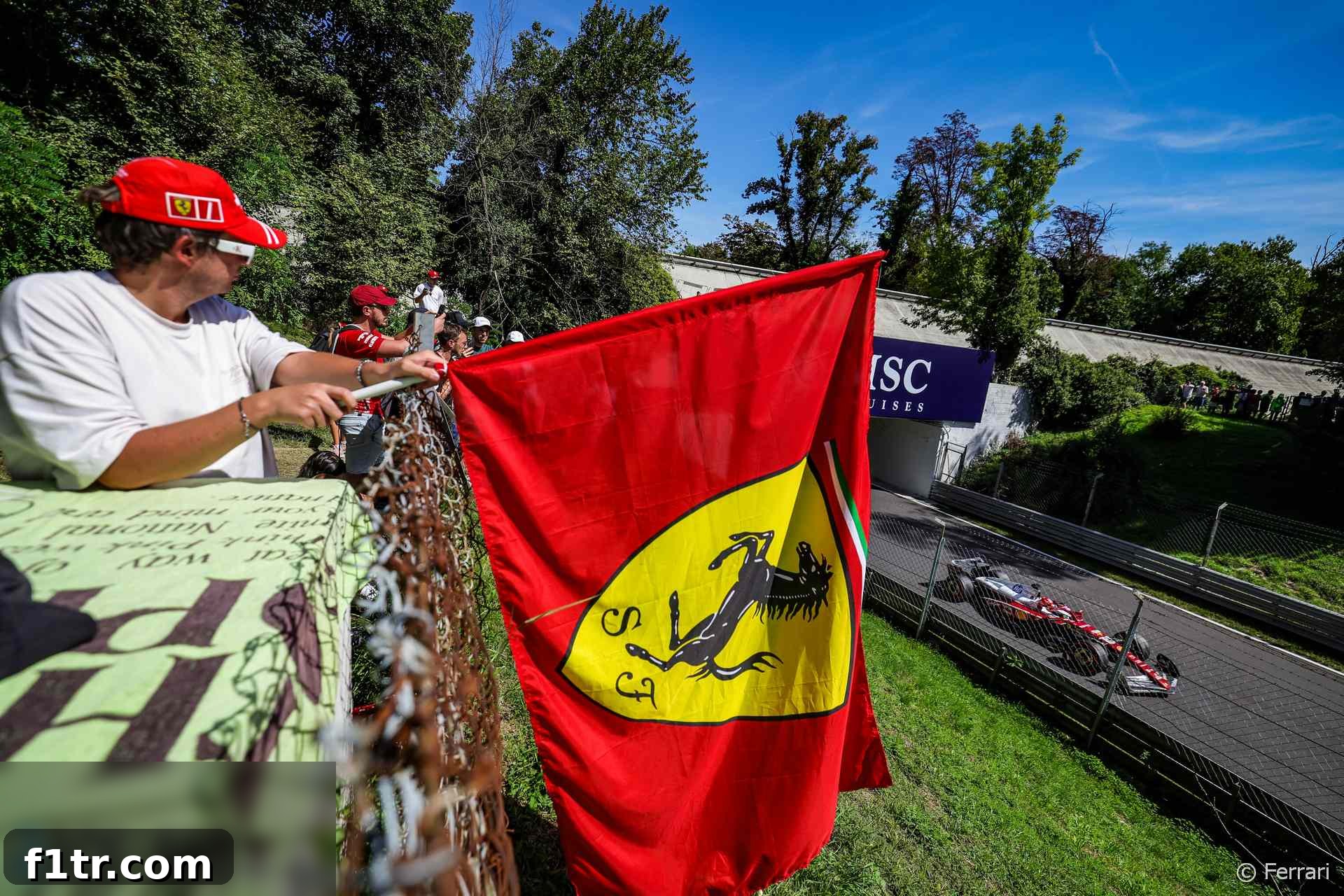
The hallowed grounds of the Autodromo Nazionale Monza, affectionately known as the ‘Temple of Speed’, once again set the stage for one of Formula 1’s most iconic races: the 2025 Italian Grand Prix. On a crisp September afternoon, the air buzzed with anticipation, not just for the high-octane spectacle, but for the crucial championship implications and compelling narratives unfolding across the grid. From strategic gambles to on-track skirmishes and contentious team orders, this race delivered drama until the very last lap.
Verstappen Masters Monza: A Thrilling 2025 Italian Grand Prix Report
The 2025 Italian Grand Prix was a rollercoaster of strategic decisions, intense battles, and unexpected twists, culminating in a commanding victory for Max Verstappen. While the reigning champion asserted his dominance, the race was far from a simple procession, with McLaren’s internal struggle and several midfield incidents adding layers of intrigue to an already gripping contest.
Pre-Race Buzz and Strategic Anticipation at Monza
As the Formula 1 circus descended upon Monza, the atmosphere was electric. The unique characteristics of this historic circuit, with its long straights and challenging chicanes, always promise a blend of raw speed and tactical brilliance. This year, the stakes felt particularly high, with several key drivers and teams eyeing crucial points in their respective campaigns.
Max Verstappen, starting from pole position, was under an unusual kind of pressure. Despite his formidable pace, the Dutchman hadn’t converted his last three pole positions—at Silverstone (fifth), Miami (fourth), and Jeddah (second)—into race victories. This streak raised questions, but Monza, a track where track position is paramount and a straightforward one-stop strategy is often the norm, offered a prime opportunity for him to silence the doubters and reassert his qualifying dominance.
Directly behind Verstappen on the grid were the two McLaren drivers, Lando Norris and Oscar Piastri, who were not only battling for race positions but were also deep in a fiercely contested championship fight. Norris, in particular, was keenly aware of the implications, having conceded a significant 25 points to his teammate Piastri in the preceding round. The prospect of a collision with Verstappen, which could result in a devastating no-score, was a risk he simply couldn’t afford, adding immense strategic complexity for the Woking-based team.
For the fervent Tifosi, all eyes were on Charles Leclerc. The Monegasque driver, starting fourth—the same position from which he clinched victory last year—carried the hopes of Ferrari on his shoulders. Despite his past triumph, the 2025 season had been a challenging one for the Scuderia, with the team still chasing their elusive first race win. A strong performance at home would be an emotional lift for both the team and its passionate fanbase.
Mercedes’ rising star, Andrea Kimi Antonelli, impressed in his home race, qualifying a strong sixth. He lined up on the third row alongside his experienced teammate George Russell, who expressed frustration over missing a chance to utilize medium compound tyres in Q3, believing it could have secured him an even better grid spot.
Gabriel Bortoleto of Sauber continued to showcase his burgeoning talent with another commendable qualifying effort, securing seventh place. This put him in an excellent position to significantly add to his season’s points tally. Sauber’s aggressive low-downforce setup proved particularly effective on Monza’s long straights, making their car remarkably quick and potentially very difficult to overtake during the race.
Lewis Hamilton, making his first Italian Grand Prix appearance as a future Ferrari driver, qualified fifth but faced a grid penalty. He started 10th due to an infraction at the previous event, where he failed to slow sufficiently for yellow flags during a reconnaissance lap, highlighting the strict enforcement of F1 regulations.
The grid itself saw last-minute changes before the race began. Isack Hadjar and Pierre Gasly, both eliminated in Q1, opted for fresh power units, relegating them to a pit lane start. This decision often signifies a long-term strategic play, sacrificing immediate grid position for potential performance gains later in the season.
Tyre strategy was a key talking point in the build-up. The vast majority of the top 13 starters opted for the medium compound tyres, anticipating a robust one-stop race. Further back, drivers like Albon, Ocon, and Stroll, along with pit-lane starters Hadjar and Gasly, chose the hard compounds, signaling intentions for extended first stints. Lawson, however, stood out as the sole driver to gamble on the soft compound, a bold choice aimed at maximizing early pace but risking higher degradation.
Adding to the pre-race intrigue, Aston Martin drivers Fernando Alonso and Lance Stroll were placed under investigation for failing to comply with the race director’s event notes concerning practice starts. These notes specifically mandate drivers performing practice starts to leave adequate room for other cars. While the investigation was set to conclude after the race, the general expectation was for reprimands rather than sporting penalties.
As the drivers embarked on their reconnaissance laps—a routine procedure that, ironically, had landed Lewis Hamilton in hot water a year prior—the sense of anticipation reached fever pitch. Unfortunately for Sauber, Nico Hulkenberg’s race ended prematurely when a critical hydraulic problem forced his retirement even before the official start, a disappointing outcome for the team and driver.
The FIA had earlier confirmed the final starting grid for the Italian Grand Prix. McLaren also confirmed they replaced the throttle assembly on Norris’s car after qualifying, a cautionary measure to ensure optimal performance. For those eager to dive deeper into the strategic nuances, all the key strategy data for the Italian Grand Prix can be found here.
Chaos and Overtakes: The Race Begins at Monza
With the cars impeccably formed on the grid, led by the Red Bull of Max Verstappen, the tension was palpable. The 2025 Italian Grand Prix exploded into life with immediate, heart-stopping drama. Lando Norris made an incredibly aggressive start, briefly running onto the grass in his quest for an early advantage, while Verstappen had to run wide at the Roggia chicane, fiercely defending his position from the attacking McLaren. In the ensuing melee, Charles Leclerc briefly surged into third place, igniting the hopes of the Tifosi.
However, it was Oscar Piastri who delivered the most electrifying moment of the opening seconds, executing a truly brilliant and crucial overtake on the outside of Lesmo 1 to seize the lead. This daring move showcased the young Australian’s audacious talent and instantly reshuffled the front of the pack.
The opening laps were a whirlwind of position changes and fierce battles. By Lap 2, the order was still far from settled. In a somewhat surprising move, Verstappen appeared to strategically allow Norris to pass him into the lead, perhaps seeking to gain a slipstream advantage or manage his tyre temperatures in the early stages. Meanwhile, Leclerc, driven by the roar of the home crowd, swiftly re-passed Piastri at Rettifilo to claim second place. The intensity of these early exchanges was evident, with drivers pushing every limit. Norris’s frustration boiled over the team radio: “What is this idiot doing? He puts me on the grass and then he just cuts the corner,” he exclaimed, in clear reference to Verstappen’s aggressive early defensive maneuvers.
The battles continued unabated throughout the opening phase. On Lap 3, Leclerc mounted a robust defense against Piastri, while Verstappen, now trailing Norris, relentlessly utilized DRS to close the gap. Further back, Gabriel Bortoleto, in the sole remaining Sauber, launched an attack on George Russell for fifth, underscoring the tight competition even in the midfield. By Lap 4, Verstappen had regrouped and, leveraging the powerful DRS, executed a decisive pass on Norris to reclaim the lead. This pivotal move marked the beginning of his assertion of control at the front of the field. Meanwhile, Lewis Hamilton, starting from P10 due to his earlier grid penalty, began his customary charge through the field, moving up to eighth, while Andrea Kimi Antonelli, after a promising start, slipped back to 10th.
Hamilton’s recovery drive continued impressively. On Lap 5, he masterfully deployed DRS to pass Fernando Alonso, climbing to seventh position. Just a lap later, Piastri, refusing to yield ground, fought back admirably to retake third from Leclerc, illustrating the relentless intra-team and intra-pack rivalries. By Lap 7, Hamilton’s march forward continued as he passed Bortoleto with DRS, securing sixth place and demonstrating his exceptional race craft and determination.
Verstappen Establishes Dominance as Strategies Unfold
As the initial flurry of activity subsided and the race settled into a rhythm, Max Verstappen began to assert his undeniable control. By Lap 11, his lead over Lando Norris had stretched to a comfortable 3.4 seconds, with Oscar Piastri trailing his teammate by 4.8 seconds and still battling to shake off Charles Leclerc from DRS range. Norris was visibly struggling to match Verstappen’s blistering pace, the gap between them widening steadily to two seconds. This early dominance from Verstappen hinted at a potentially unchallenged victory, a familiar sight for seasoned Formula 1 observers.
The mid-race period also saw the first round of penalties being issued. Esteban Ocon was handed a five-second time penalty for forcing Lance Stroll off the track at the Roggia chicane, a corner that frequently tests the limits of drivers and often becomes a flashpoint for incidents at Monza. Meanwhile, McLaren’s strategic considerations began to emerge as Lawson made an early pit stop to switch to hard tyres, signaling a potential long second stint or a two-stop strategy, a gamble for track position.
By Lap 15, Verstappen’s lead had grown further to 4.2 seconds. Crucially, he showed no signs of his pace diminishing, nor were the McLarens behind him managing to close the gap. He was firmly establishing his commanding position at the front, dictating the pace and controlling the race from the cockpit of his Red Bull.
Mid-field incidents and strategic plays continued to shape the unfolding race. On Lap 18, a DRS train formed behind Bortoleto, illustrating the inherent difficulty of overtaking even with the assistance of the drag reduction system on Monza’s long straights. However, Yuki Tsunoda, in a crucial misjudgment, dropped too far back from Fernando Alonso, allowing Andrea Kimi Antonelli to seize the opportunity and execute a sharp pass for ninth place, showcasing the young driver’s opportunistic racing instincts. Sauber, facing a challenging day, confirmed that Nico Hulkenberg’s earlier retirement before the race start was indeed due to a hydraulic problem, a frustrating mechanical failure for the team.
The pit stop window began to open around Lap 19. Bearman was among the first to react, pitting from 11th and switching to hard tyres in an attempt to undercut his rivals. Red Bull’s mechanics, in a hurried response to Bearman’s stop, almost fumbled Tsunoda’s tyres during his pit stop on Lap 20. Despite the frantic activity, Tsunoda initially rejoined ahead of Bearman, only to be immediately re-passed by the Haas driver, highlighting the intense battles that continued to rage even in the pit lane. Bortoleto and Alonso pitted together on Lap 21, but a notably slow stop for Sauber meant their driver dropped behind the Aston Martin, and then even further behind Lawson, compounding their earlier misfortune. Alonso, meanwhile, demonstrated his veteran skill, getting incredibly close to Bortoleto as they braked for the pit lane speed limiter line, maximizing his pit entry speed.
Verstappen’s relentless pace meant his lead continued to grow, reaching almost six seconds over Norris by Lap 22, showcasing his superior car and precise driving. Fernando Alonso, meanwhile, experienced an issue, notably slowing on the straight approaching Parabolica on Lap 25. Concurrently, Albon passed Sainz, a move that appeared to be executed under team orders, given the strategic context of the race. Sainz, already under investigation for incorrectly rejoining the track after an off at Roggia—an incident that, unlike a more ambiguous penalty a week prior, appeared to be a clear-cut case—was having a challenging race, accumulating issues and investigations. McLaren, meanwhile, was actively exploring their strategic options, asking Piastri if he could extend his first stint by an additional 15 laps, perhaps eyeing a late charge on soft tyres should a Safety Car intervention materialize.
Mercedes inadvertently triggered a wave of pit stops among the front runners by bringing George Russell in on Lap 28. Norris, showing intermittent signs of life, managed to chip away at Verstappen’s lead by Lap 30, reducing the gap to just under six seconds, a slight glimmer of hope for McLaren. Earlier in the race, Tsunoda and Lawson made contact at the Roggia, both drivers cutting the corner, with Lawson appearing to cede position to Tsunoda shortly thereafter.
Pit Stop Drama, Team Orders, and Final Sprint
The race truly intensified during the critical pit stop phase, where every second and every strategic decision carried immense weight. On Lap 34, Charles Leclerc experienced a dramatic lock-up as he entered the pits, a heart-stopping moment for the Tifosi, but his Ferrari crew executed a lightning-fast stop, allowing him to rejoin in sixth place, just behind Albon. Verstappen’s seemingly impregnable lead, which had been steadily growing, began to slip slightly on Lap 36, falling to 5.3 seconds. This momentary dip in pace, whether due to tyre degradation or strategic management, offered a brief window of opportunity for the chasing McLarens.
Red Bull responded decisively on Lap 37, pitting Verstappen from the lead. He was fitted with a fresh set of hard tyres, a safe and proven strategy given he had two fresh sets available, underscoring their confidence in the car’s long-run pace. McLaren, however, continued to gamble. On Lap 38, both Norris and Piastri stayed out, a clear indication that they were still holding out hope for a late-race Safety Car, which would allow them to switch to soft tyres for a final, high-grip charge – a high-risk, high-reward strategy that could swing the outcome. Carlos Sainz, after his earlier error at the Roggia run-off, received a reprimand, adding to his challenging and incident-filled day.
The stewards had their hands full throughout the race, investigating not only the incident between Sainz and Bearman but also noting another skirmish between Albon and Antonelli, highlighting the relentless pressure and close-quarters racing prevalent across the field. The tangle between Sainz and Bearman at the Roggia was particularly tense; crucially, both drivers managed to recover without major damage, which was a huge relief for Red Bull, as a Safety Car at that point could have disastrously eroded Verstappen’s comfortable lead and thrown the race wide open. The superior grip and freshness of Verstappen’s new hard tyres were immediately apparent as he ruthlessly took well over a second out of Norris on a single lap, who was still bravely battling on very old medium compounds.
A tense moment occurred as Andrea Kimi Antonelli passed Pierre Gasly. Both drivers were just one track limits strike away from a penalty, necessitating an impeccably clean and precise move, which they successfully executed under immense pressure. However, the most significant drama of the race was yet to unfold, deeply involving the McLaren team. On Lap 45, McLaren brought Piastri in first for his pit stop, but not without explicitly reassuring Norris that they would not allow Piastri to undercut his teammate. This promise, however, was almost immediately tested. Norris pitted next, but his front-left tyre change was agonizingly slow—a critical error that ensured he would undoubtedly fall behind Piastri once the pit stop sequence was complete.
The unintentional swap due to the pit stop error quickly evolved into a full-blown strategic quandary, and then, controversially, a direct team order. Piastri, now ahead, found himself within DRS range of Norris with just four laps remaining on Lap 49, setting the stage for a dramatic conclusion. In a move that sparked immediate debate and widespread discussion among fans and pundits alike, McLaren instructed Piastri to let Norris through, and the young Australian complied. This contentious decision, clearly aimed at bolstering Norris’s championship position, raised significant questions about team dynamics, fairness, and the implications for driver morale.
In the end, Max Verstappen crossed the finish line first, securing a dominant and well-deserved victory at the Italian Grand Prix, reaffirming his status as the driver to beat. Andrea Kimi Antonelli, unfortunately, was later handed a five-second time penalty for driving erratically, an unfortunate incident that ultimately jeopardized his points finish and added another layer of complexity to the post-race analysis. While the race concluded with Verstappen on top, the internal politics at McLaren and the various incidents throughout the field ensured that this Italian Grand Prix provided plenty of talking points and will be remembered for more than just the winner.
Race Results and Championship Implications
Max Verstappen’s victory at Monza was a testament to his exceptional skill and the undeniable pace of his Red Bull, solidifying his commanding position in the championship. Despite a brief, chaotic challenge at the start, his relentless performance and faultless execution made him an unstoppable force, demonstrating why he is consistently at the pinnacle of the sport. This win was a crucial statement, particularly after his recent struggles to convert pole positions into victories, proving his ability to deliver when it matters most on a challenging track.
The McLaren saga, however, proved to be one of the race’s most discussed storylines, overshadowing much of the post-race analysis. The critical slow pit stop that inadvertently placed Piastri ahead of Norris, immediately followed by the contentious team order for Piastri to cede position, left a bitter taste for many, even as it secured valuable points for Norris in the tight championship hunt. This incident is likely to be a focal point of scrutiny and debate in the days and weeks to come, prompting intense analysis of McLaren’s strategic decisions and driver management protocols.
Andrea Kimi Antonelli’s five-second penalty for erratic driving ultimately cost him crucial championship points, a tough but valuable lesson for the young talent in his home race. The various investigations involving Carlos Sainz, Oliver Bearman, Alex Albon, and Antonelli underscored the fierce intensity of the midfield battles and the tight regulations governing on-track conduct in Formula 1, where every maneuver is under scrutiny.
For Ferrari, Charles Leclerc’s performance, while not a victory, offered glimmers of hope and demonstrated the team’s continued progress, especially in front of their passionate Tifosi. Lewis Hamilton’s impressive recovery drive from 10th to a respectable points finish was a powerful testament to his enduring skill, experience, and sheer determination, providing Ferrari fans with something to cheer about for his future arrival at the Scuderia.
The 2025 Italian Grand Prix was a showcase of Formula 1 at its absolute best: high-speed drama, bold strategic gambles, and fierce, unyielding competition. While Max Verstappen’s dominance was ultimately clear, the rich subplots and lingering controversies ensure that this race will be remembered as a pivotal and compelling moment in the unfolding 2025 season. For a comprehensive overview of all the action, you can find our full report on the Italian Grand Prix here, alongside the updated championship standings following this thrilling and memorable event.
2025 Italian Grand Prix – Related Articles
For more in-depth analysis and perspectives on the 2025 Italian Grand Prix, explore the articles below:
- No change to McLaren’s team orders after Monza review – Stella
- Bearman did not deserve penalty for Sainz collision at Monza, says Vowles
- Transcript: Hamilton seeking final tenths as he closes gap to Leclerc
- McLaren can clinch F1’s earliest title win since 1988 with as little as fifth place
- How did Verstappen know about Norris’ slow stop in Italy? Red Bull told him
Browse all 2025 Italian Grand Prix articles