The illustrious Monaco Grand Prix circuit, famed for its demanding streets and historic prestige, always presents a unique challenge for Formula 1 teams. Typically, the engineering brief for Monaco is straightforward: maximize downforce at any cost in drag, turning every available aerodynamic surface into a grip-generating tool. However, the 2023 edition arrived under unusual circumstances, fundamentally altering teams’ meticulously planned upgrade schedules and strategic approaches.
Advert | Become a Supporter & go ad-free
This year, the cancellation of the Emilia-Romagna Grand Prix, originally scheduled for the week prior, cast a long shadow over teams’ development plans. Imola, a conventional, permanent circuit, was earmarked as the ideal location for teams to unveil their first major upgrade packages of the season. Its European location simplified logistics for bringing new components, and crucially, its non-sprint format offered a full three hours of practice sessions – ample time for crucial testing and data acquisition before committing to race weekend setups.
While the European location and a non-sprint format applied to Monaco, the circuit itself is anything but conventional. In stark contrast to Imola, Monaco’s track is exceptionally slow and incredibly narrow, characterized by shorter, sharper changes of direction. This presents a significant conundrum for the latest generation of ground effect Formula 1 cars, which are inherently designed to thrive at high speeds where their aerodynamic principles generate maximum downforce. Monaco, with its unrelenting low-speed corners, forces these sophisticated machines out of their comfort zone, demanding a delicate balance of mechanical and aerodynamic grip.
For teams like Mercedes, who had planned a significant upgrade for Imola, postponing its introduction to Monaco was far from ideal. This package, designed to rectify fundamental aerodynamic issues, faced a baptism of fire on a circuit notorious for masking true performance and setup nuances. However, their rivals understood the strategic imperative of introducing upgrades as soon as possible rather than deferring them further. Max Verstappen, the Red Bull driver, highlighted this sentiment: “I would always put it on the car as soon as possible, because you learn always more than leaving it in the garage and not using it.” Despite this, Verstappen admitted it was “really difficult to tell” how competitive Mercedes might be with their new concept. “I think for them as well, to understand the whole new concept, I don’t know where it’s going to put them,” he added, underscoring the uncertainty surrounding such a major overhaul on such an atypical track.
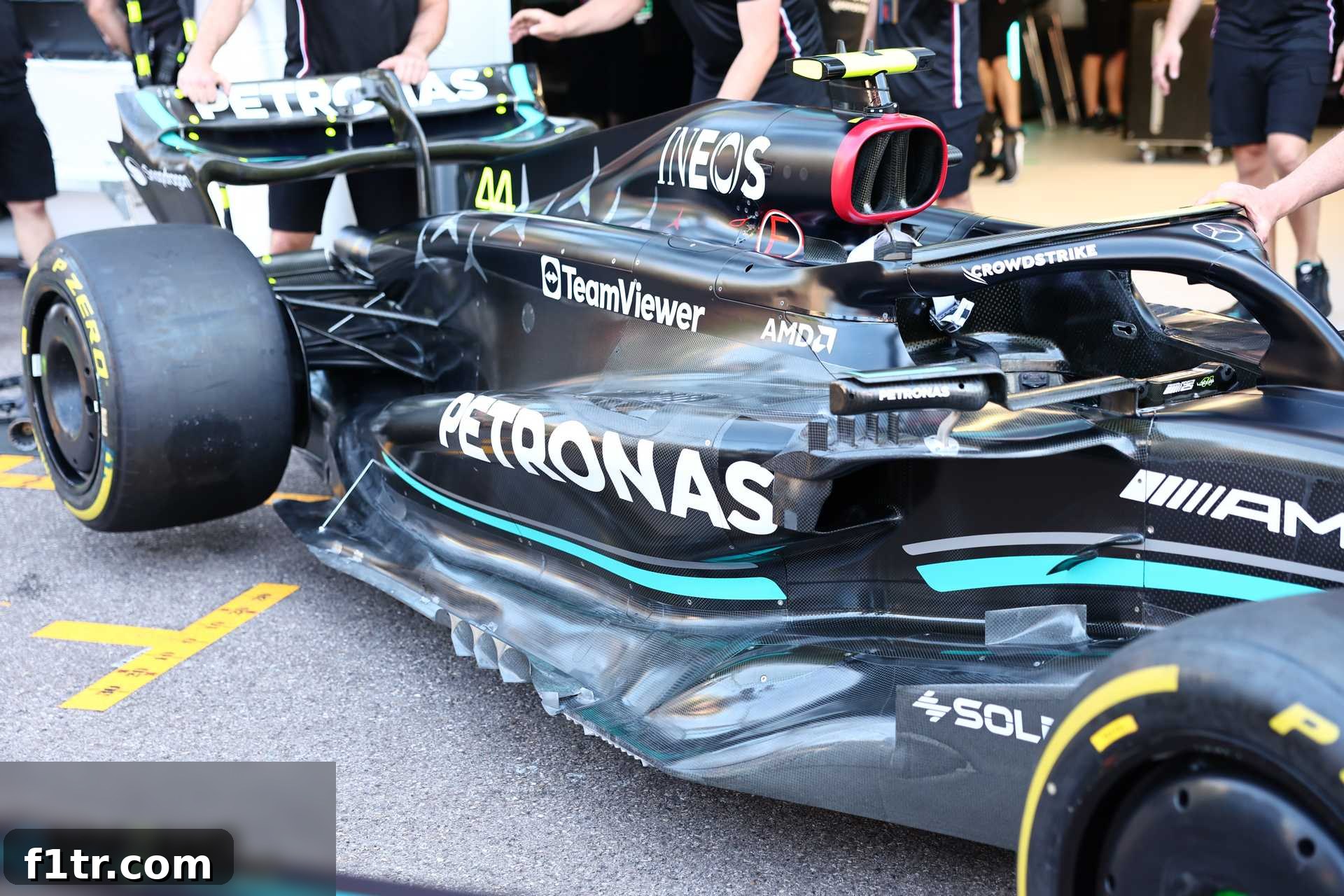
The most anticipated aspect of Mercedes’ significant update package was the replacement of their distinctive ‘zero’ sidepods with a more conventional design. The team explained that these reshaped inlets were designed to “improve flow to the floor edge, which results in more floor load and also improved flow to the rear corner.” This change, indicative of a fundamental shift in their aerodynamic philosophy, was complemented by other modifications to the floor geometry, aimed at boosting rear downforce, and a revised front suspension layout. This comprehensive package represented a bold attempt to address the W14’s performance inconsistencies and extract greater potential from the car.
Mercedes was not alone in bringing its intended Imola upgrade package to Monaco. Ferrari, McLaren, and Alfa Romeo also arrived in the Principality with significant aerodynamic and mechanical revisions, all hoping to unlock performance gains despite the challenging circuit characteristics. Beyond these general performance upgrades, teams also rolled out a suite of Monaco-specific parts. This included cranking up rear wing angles to generate maximum possible downforce – a critical factor on a track with no long straights – and altering steering geometry and suspension layouts to navigate the track’s unique demands, most notably the ultra-tight Fairmont Hotel hairpin, the slowest corner in Formula 1.
2023 Monaco Grand Prix F1 Teams’ Updates: A Deep Dive into Engineering Challenges
The detailed technical descriptions provided by each team shed light on the intricate engineering adaptations required for Monaco and the broader strategic development of their cars. Here’s a breakdown of the key updates:
Red Bull Racing
Rear Wing
For Monaco, Red Bull introduced a specialized rear wing assembly, tailored for the circuit’s low average speed. This iteration featured a greater camber across the span of its bi-plane design, maximizing load generation at lower speeds. The objective was to achieve higher downforce, crucial for navigating Monaco’s numerous tight turns, even if it came at the cost of increased drag, which is less penalizing here. An elevated load beam wing was also deployed as part of this high-downforce suite.
Front Suspension
Red Bull also implemented a front suspension modification focused on reliability and maneuverability specific to Monaco. The trailing edges of the wishbone shrouds were altered to ensure proper clearance with the wheel geometry at the extreme steering lock angles demanded by the Fairmont hairpin and other tight sections of the track. This subtle change was vital for drivers to achieve full steering capability without mechanical interference.
Scuderia Ferrari
Rear Corner
Ferrari brought an updated rear corner package, originally planned for Imola, as part of their standard development cycle. These components, including new brake cooling inlets and suspension fairings, were designed to improve local airflow features and enhance downforce generation around the rear wheels, optimizing aerodynamic efficiency in this critical area.
Rear Wing
In anticipation of Monaco’s high-downforce requirements, Ferrari introduced new higher downforce top and lower rear wing designs. These main plane and flap profiles were heavily loaded, specifically engineered to meet the low-efficiency demands of the circuit where maximum grip is prioritized over aerodynamic drag. This circuit-specific update aimed to provide the stability and traction necessary for competitive lap times.
Advert | Become a RaceFans supporter andgo ad-free
Mercedes-AMG Petronas F1 Team
Front Suspension
Mercedes introduced a performance-enhancing front suspension modification, specifically lifting the inboard pick-up point of the top wishbone’s forward leg. This alteration aimed to improve the positioning of the wishbone’s wake, consequently conditioning the airflow more effectively into the sidepod, and ultimately boosting cooling performance and overall aerodynamic efficiency.
Floor Fences
A notable change was made to the floor fences, with a modification in their camber. This adjustment was designed to increase local load and improve airflow towards the diffuser, resulting in enhanced rear downforce and greater stability for the W14.
Sidepod Inlet
The most visible update was the introduction of a wide and high sidepod inlet, marking a significant departure from their previous ‘zero-pod’ concept. This new design was developed to improve airflow along the floor edge, leading to increased floor load and a more optimized flow towards the rear corner of the car, thereby augmenting overall downforce.
Coke/Engine Cover
Accompanying the new sidepods was a wider bodywork design for the coke bottle and engine cover area. This increased width aimed to generate greater local downforce and improve the flow of air towards the rear wing assembly and rear corner, creating a more cohesive and efficient aerodynamic package.
Rear Wing
Mercedes also implemented a rear wing with an increased flap camber. This modification was intended to boost rear wing load, which in turn reduces the pressure behind the car, thereby enhancing the load on the rear floor and contributing to overall rear-end grip.
Rear Corner
An additional cascade of ‘cake tin’ winglets was introduced at the rear corner. This extra array of winglets was designed to add local aerodynamic load and decrease pressure behind the lower suspension legs, further increasing the localized downforce in this critical area.
Advert | Become a RaceFans supporter andgo ad-free
BWT Alpine F1 Team
Front Suspension
Alpine’s updates included a realignment of the wishbone, pushrod, and track rod fairings in the front suspension. This was primarily a flow conditioning exercise to eliminate local airflow separations and optimize the car’s aerodynamic efficiency. Additionally, the track rod fairing was updated to accommodate the increased steering angles necessary for the Circuit de Monaco’s tight corners.
Sidepod Inlet
A wider sidepod with a deeper gulley was introduced. The deeper gulley was specifically designed to improve airflow towards the top rear wing and beam wing, enhancing their effectiveness. The wider profile of the sidepod aimed to boost floor suction, contributing to increased overall downforce.
Floor Edge
In conjunction with the new sidepod, Alpine implemented a small cut-out in the floor edge. This modification works synergistically with the sidepod changes to optimize flow conditioning and maximize the aerodynamic performance of the underfloor.
Rear Wing
Alpine’s rear wing featured a more loaded top main plane, specifically suited to the high-downforce nature of the Circuit de Monaco. The sole aim of this design was to provide optimal downforce levels, ensuring the best possible lap time on the demanding street circuit.
Beam Wing
Complementing the new top rear wing, the beam wing was also updated with a more loaded, double-element style. This modification worked in tandem with the main rear wing to achieve the highest possible downforce, essential for Monaco’s unique characteristics.
McLaren F1 Team
Advert | Become a Supporter & go ad-free
Floor Fences
McLaren’s floor fence modification was a response to Technical Directive TD-029, which was due to be enforced from Imola. The upper edge of the outermost floor fence was modified to comply with the new regulations, ensuring legality while maintaining aerodynamic performance.
Front Corner
To manage the significant brake energy generated at Monaco, McLaren designed a larger front brake scoop. This circuit-specific cooling update aimed to increase front brake cooling efficiency, preventing overheating and maintaining consistent performance throughout the race.
Rear Corner
A new lower winglet endplate was introduced at the rear corner. This design featured a cut-out aimed at altering local flow structures and optimizing load distribution on both the winglet itself and the rearward underfloor, contributing to enhanced local downforce.
Rear Wing
McLaren brought a high-downforce rear wing assembly specifically for Monaco. This new design sits at the upper end of the available downforce range, perfectly suited to the circuit’s characteristics where maximum aerodynamic grip is paramount.
Beam Wing
A high-downforce beam wing was introduced to complement the new rear wing assembly. This component also operates at the upper end of the load range and works in conjunction with the more loaded upper rear wing to maximize overall rear-end downforce.
Advert | Become a RaceFans supporter andgo ad-free
Alfa Romeo F1 Team Stake
Coke/Engine Cover
Alfa Romeo introduced a redesigned engine cover with a distinct shape and a different connection to the top of the floor. This modification aimed to better direct airflow to augment downforce and improve the car’s overall aerodynamic efficiency, forming part of a wider performance package.
Floor Edge
The team brought a new design for the floor edge and fences, an improvement originally planned for Imola. This update aimed to enhance the aerodynamic performance of the car by optimizing the airflow around the floor and improving local load generation.
Floor Body
A new design for the main floor body was introduced, also part of the broader upgrade package intended for Imola. This fundamental change to the floor’s architecture sought to significantly improve the car’s aerodynamic performance and downforce generation.
Rear Suspension
Redesigned rear suspension covers were implemented to work in conjunction with the new floor. This upgrade aimed to improve the overall aerodynamic performance and maximize the downforce generated by the entire package, especially at the rear of the car.
Rear Corner
Alfa Romeo also introduced redesigned rear brake ducts as part of their comprehensive aerodynamic package. These modifications, alongside the new floor, aimed to enhance the car’s aerodynamic efficiency and maximize downforce in the crucial rear corner area.
Rear Wing
A new profile for the main planes of the rear wing was introduced. This, in conjunction with the beam wing, allowed the team to maximize the aerodynamic performance of its package specifically for the unique, high-downforce demands of the Monaco circuit.
Beam Wing
A new, bi-plane beam wing design replaced the previous stacked arrangement. This change, working with the new rear wing, was critical for maximizing aerodynamic performance and achieving the precise balance required for Monaco’s configuration.
Cooling Louvres
For Monaco, Alfa Romeo introduced a new maximum cooling configuration with increased louvre porosity. This geometry was designed to help the car manage high cooling demands on tracks with low mass airflow, maximizing cooling performance within the specified limits.
Aston Martin Aramco Cognizant F1 Team
Front Suspension
Aston Martin’s front suspension featured a slightly modified twist distribution in the upper wishbone. This subtle re-alignment of the wishbone fairings was aimed at improving their interaction with the onset airflow, thereby enhancing local load generation and overall aerodynamic efficiency in this area.
Front Corner
The lower deflector plan view incidence at the front corner was adjusted within legal limits. This new position offered a more optimal alignment with the altered flow field upstream, resulting from changes around the new front wing tip area, contributing to better local downforce.
Rear Suspension
Small detail changes were made to the rear suspension fairings, specifically to alter section incidence. These modifications were primarily to suit the updated rear brake duct design and the different flow field it created in the surrounding area, ensuring optimal aerodynamic performance.
Rear Corner
Modifications were made to the inlet and exit ducts of the rear brake duct, along with associated changes to elements mounted to the inboard face. These changes aimed to improve internal flow paths, leading to increased cooling efficiency, while the reworked elements optimized performance in the new flow regime.
Rear Wing
Aston Martin deployed a new rear wing with a more aggressive geometry, specifically designed for Monaco. This aggressive wing increases local suction for higher downforce loads, which is acceptable given the lower efficiency requirements of this circuit where drag is less of a penalty.
Advert | Become a RaceFans supporter andgo ad-free
Haas F1 Team
Front Wing
Haas introduced an evolution of their front wing, with modified geometries across the four profiles along its span. The front wing plays a crucial role in shaping the aerodynamic field for the car bodies behind it. This new shape meticulously manages the wake interference with the lower front suspension leg and the front tire, aiming for cleaner airflow and enhanced overall performance.
Front Suspension
Specific modifications were made to the front suspension geometry for the Monaco race. The unique demands of the circuit necessitate these changes to allow the driver precise control through all corners. Small aerodynamic surfaces were also updated to complement these mechanical adjustments, ensuring optimized handling and performance.
Scuderia AlphaTauri
Floor Body
AlphaTauri’s floor body saw significant changes. Underfloor surfaces local to the fences were altered, and upper surfaces behind the outermost floor fence were lowered. Additionally, the floor ‘curl’ detail ahead of the rear tire was modified. These changes, combining with fence geometry adjustments, generate stronger vorticity from the fence shedding edges, leading to increased local load and improved diffuser performance by reducing losses inboard of the rear tire.
Floor Fences
The floor fences themselves were updated with modified camber distributions, synchronized with the changes to the floor body roof surfaces. These integrated changes were designed to yield increased overall downforce and improved aerodynamic efficiency.
Floor Edge
The new floor edge geometry was narrowed to accommodate a new wing element, forming an extension of the previous floor edge wing. This extended element acts as a trailing edge device, lowering local pressure and enhancing floor sealing for increased local downforce.
Diffuser
Modifications were made to the vertical sidewalls of the diffuser. This update aimed to increase outwash, keeping rear tire wakes further outboard. This reduces blockage at the diffuser exit, resulting in increased local load and better diffuser performance.
Sidepod Inlet
AlphaTauri reduced the radiator duct inlet areas by raising the lower lip of the sidepod inlet. This smaller inlet allows for increased mass flow to pass underneath, feeding the floor edges and enabling them to generate increased local downforce.
Coke/Engine Cover
The engine cover’s ‘undercut’ was modified to complement the smaller sidepod inlet. This coordinated update ensures greater mass flow to the floor edges, contributing to increased local downforce and a more aerodynamically cohesive design.
Front Suspension
A mechanical setup change involved moving the outboard track rod rearward relative to the brake drum face. This modification provides a greater road wheel angle for the same steering wheel input, necessary for negotiating the extreme steering demands of the Fairmont hairpin, unique to Monaco.
Rear Wing
AlphaTauri deployed a new rear wing with increased camber and incidence in its upper elements, particularly in the outboard sections. The lower ‘beam’ wing assembly was also a biplane arrangement with increased camber and incidence. While such high-drag wings are inefficient for most circuits, Monaco’s absence of long straights prioritizes maximum downforce over drag, making these wings optimal for the event.
Rear Wing Endplate
The outside face of the lower endplate was modified to include a cambered vane. This vane generates suction from its cambered lower surface, providing increased local load from the endplate and contributing to overall rear downforce.
Advert | Become a RaceFans supporter andgo ad-free
Williams Racing
Rear Wing
Williams introduced a larger, more inclined rear wing profile for Monaco. The upper outboard junctions to the end plates were higher and squarer than their previous medium-downforce wing, and the leading edge of the mainplane sat lower to present a larger area. These more aggressive elements deliver increased load and drag, which are highly efficient and desirable for circuits like Monaco.
Beam Wing
A new beam wing, larger and more inclined than previously run versions, was also deployed. This aggressive element complements the main rear wing, delivering increased load and drag, making it ideal for the high-downforce requirements of the Monaco Grand Prix.
Front Suspension
A key mechanical setup change involved altering the steering arm length. This modification increases the gain between steering wheel rotation and front road wheel angle, directly assisting drivers in achieving the extreme steering angles necessary to negotiate Monaco’s notoriously tight corners.
Front Suspension
Revised cladding was applied to the front suspension elements, including the track rod, upper, and lower wishbones. These changes primarily accommodate the higher front wheel angles required for the circuit, with the cladding optimized to maximize local aerodynamic load and condition the flow structures effectively.
Front Corner
Williams increased the size of the exit of the front brake duct. This circuit-specific cooling update ensures a higher airflow through the front brake cooling system, allowing the car to cope with the unique and demanding brake temperatures encountered in Monaco.
Conclusion: A Strategic High-Wire Act in the Principality
The 2023 Monaco Grand Prix proved to be more than just a race; it was a complex engineering and strategic high-wire act for all Formula 1 teams. The unexpected cancellation of Imola forced a re-evaluation of development timelines, compelling many teams to debut their significant upgrade packages on a circuit that is far from ideal for evaluating fundamental changes. From Mercedes’ bold sidepod transformation to Red Bull’s finely tuned Monaco-specific wings and AlphaTauri’s comprehensive floor overhaul, each team arrived with a unique blend of pre-planned advancements and bespoke adaptations for the unique demands of the Principality.
The detailed modifications across aerodynamics, suspension, and cooling systems underscore the relentless pursuit of performance in Formula 1. While some updates were about maximizing downforce for Monaco’s tight confines, others represented crucial steps in broader seasonal development. The outcome of the race and the subsequent performance on more conventional tracks will ultimately reveal the true success of these strategic gambles, but for one weekend, the streets of Monaco showcased the pinnacle of F1 engineering adapting to unforeseen challenges.
- Mercedes ready to “grind” their way to competitiveness after major W14 update
- Verstappen surpasses Vettel as winner of most races for Red Bull
- How the first team to fit intermediate tyres in Monaco got the call right
- Verstappen’s Monaco pole run was the completion of his 2021 Jeddah lap – Horner
- Haas thrilled as upgrade performance exceeds wind tunnel predictions
Browse all 2023 Monaco Grand Prix articles