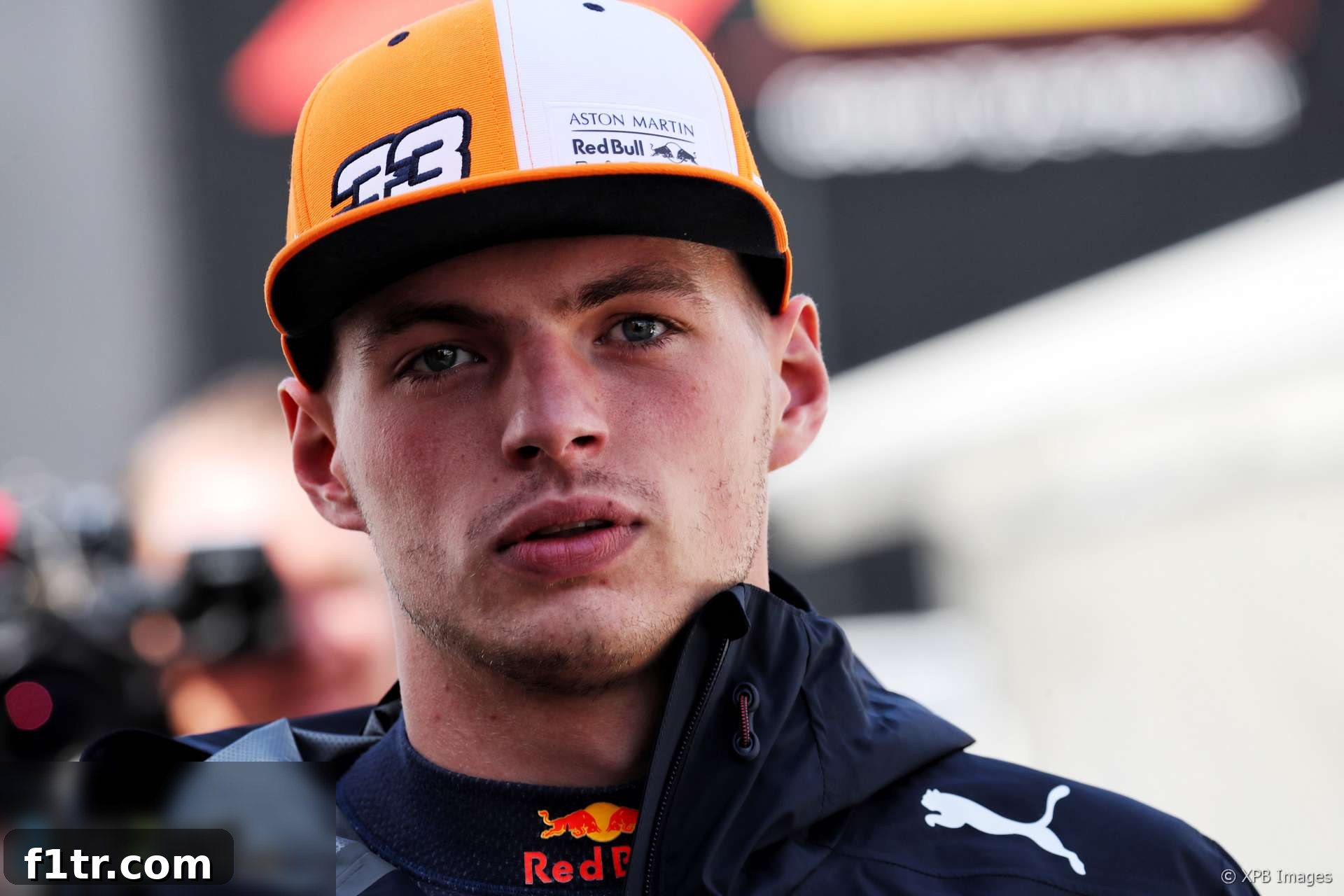
In the high-stakes world of Formula 1, anticipation always runs high, especially when a top team like Red Bull Racing embarks on a new engine partnership. For the 2019 season, all eyes were on Red Bull as they switched from long-term supplier Renault to Honda. Amidst this significant transition, their star driver, Max Verstappen, offered a candid assessment of the Japanese manufacturer’s approach and Red Bull’s immediate championship prospects. Verstappen lauded Honda’s renewed commitment and “much more serious” attitude towards the sport but tempered expectations, suggesting that while significant strides would be made, outright championship contention in 2019 might be a bridge too far.
Verstappen’s Measured Optimism for Honda’s F1 Future
Max Verstappen, known for his direct and honest opinions, shared his thoughts with his media partner Ziggo Sport regarding the upcoming 2019 F1 season. When pressed on whether he expected to be a title contender, Verstappen acknowledged the universal desire but highlighted the inherent difficulties in achieving such a feat in Formula 1. “Everyone wants that,” he stated, “but in Formula 1 that’s a tricky thing.” This realistic viewpoint underscores the monumental challenge of dethroning established front-runners like Mercedes and Ferrari, especially with a brand-new engine partnership still in its nascent stages.
Verstappen further elaborated on the strategic timeline for Red Bull and Honda to reach their ultimate goal of championship glory. He stressed the necessity for a gradual ascent, emphasizing that 2019 would be a foundational year. “At first we will need to take some more steps,” he explained, projecting that while they might come “close” by the end of the year, their full force would likely be unleashed in the subsequent season. “The year after, we should be out in full force,” a clear declaration of intent for the 2020 F1 season, indicating that the initial year with Honda was seen as a crucial period for integration, development, and refinement, rather than an immediate assault on the championship.
Honda’s Resurgence: A “Much More Serious Candidate”
The foundation for Verstappen’s cautious optimism stems from his direct observations of Honda’s operational transformation. Having visited the Honda factory, likely in Sakura, Japan, the young Dutch driver was visibly impressed by the significant advancements and renewed vigour exhibited by the Japanese power unit manufacturer. Honda’s return to Formula 1 in 2015 with McLaren was fraught with immense difficulties, marked by chronic unreliability and a significant power deficit that severely hampered the Woking-based team’s performance. However, following their split from McLaren and subsequent partnership with Red Bull’s junior team, Toro Rosso, in 2018, Honda began to show signs of a genuine turnaround.
Verstappen explicitly highlighted the remarkable progress since those challenging initial years. “Looking at where they came from the last couple of years, they have advanced considerably,” he noted, underscoring the stark contrast between their past struggles and current trajectory. A key indicator of this improvement, according to Verstappen, was the significant enhancement in reliability. “You very rarely see something get broken,” he observed, a crucial factor in Formula 1 where consistent performance over an entire race weekend and season is paramount. This newfound dependability was a testament to Honda’s relentless efforts behind the scenes, addressing the fundamental issues that plagued their earlier iterations.
Beyond mere reliability, Max Verstappen was particularly struck by Honda’s unwavering ambition and access to resources, attributes he deems essential for competing at the pinnacle of motorsport. “The most important thing is that they want to take things to the limit,” he stated, a philosophy that resonates deeply with any competitive driver. He further stressed the critical role of financial and technical backing: “They have the means, which is very important if you want to take on the likes of Ferrari and Mercedes.” This insight points to Honda’s substantial investment in their F1 programme, providing the necessary tools, personnel, and infrastructure to challenge the established giants of the sport.
The commitment demonstrated by Honda went beyond rhetoric. Verstappen revealed tangible evidence of their intense preparation for the 2019 F1 season. “All in all, Honda is a much more serious candidate,” he concluded, citing their extensive testing protocols. “They have already been on the test rig and want a lot of gearboxes from us to prepare themselves for the coming year. They are enormously driven and want to do thousands of miles on the test rig.” This meticulous approach, focusing on rigorous simulation and testing with Red Bull’s chassis components, is a clear indication of a deep, integrated partnership. The desire to accumulate “thousands of miles” on the test rig signifies an aggressive development schedule aimed at optimizing performance, ensuring durability, and seamlessly integrating the power unit with Red Bull’s chassis before the cars even hit the track for pre-season testing.
The Strategic Advantage of a Works Partnership
The move to Honda represented a pivotal strategic shift for Red Bull Racing. For years, Red Bull had operated as a customer team with Renault, a relationship that, while yielding four consecutive Constructors’ and Drivers’ Championships from 2010 to 2013, was often fraught with public criticism and dissatisfaction over engine performance and reliability. Becoming a “works” team with Honda fundamentally alters this dynamic. A works partnership means Red Bull is the primary focus of Honda’s F1 efforts, enjoying a level of integration and development input that is typically reserved for a manufacturer’s own team.
This deep collaboration allows for the power unit and chassis to be developed in tandem, creating a more optimized and harmonious package. For Red Bull, known for its innovative chassis design capabilities, having an engine partner willing to tailor the power unit to their specific aerodynamic and packaging needs is an invaluable asset. This collaborative spirit, coupled with Honda’s significant resources and renewed determination, fuels the belief within Red Bull that they can eventually challenge for the F1 World Championship once more. While Max Verstappen cautioned against immediate title aspirations for 2019, the underlying message was clear: Red Bull and Honda were building towards a future where they would be formidable championship contenders.
Ricciardo’s Shock Departure: Reshaping Red Bull’s Dynamics
The lead-up to the 2019 F1 season was also marked by another significant development for Red Bull Racing: the surprising departure of Daniel Ricciardo. The popular Australian driver, a multiple Grand Prix winner and often considered one of the grid’s top talents, opted to leave Red Bull for Renault, a decision that sent shockwaves through the paddock and, as Max Verstappen confirmed, particularly within the Red Bull camp.
“The whole team was surprised especially that he would be going to Renault,” Verstappen revealed. The surprise wasn’t merely at Ricciardo’s decision to leave a top team, but rather at his choice of destination. In Formula 1, it’s generally understood and accepted when a driver of Ricciardo’s caliber moves to a rival top team like Ferrari or Mercedes. Such moves are often driven by the pursuit of a championship-winning car or a perceived better opportunity for success. However, a switch to Renault, a team still in the rebuilding phase and not yet consistently challenging for podiums, was genuinely unexpected.
The extent of the astonishment within Red Bull was underscored by Christian Horner’s reaction. As Verstappen recounted, Red Bull Team Principal Christian Horner himself found the news difficult to believe. “But even Christian Horner said it himself that he thought that he was making a joke, so that says it all,” Verstappen noted, highlighting the sheer incredulity surrounding Ricciardo’s choice. This reaction reflects the perception that Renault was not yet at a level where it could challenge Red Bull, and thus the move seemed counter-intuitive from a competitive standpoint.
Implications of Ricciardo’s Decision on Red Bull and Verstappen
Daniel Ricciardo’s departure had several profound implications for Red Bull Racing. Firstly, it solidified Verstappen’s position as the undisputed team leader. While they had enjoyed a competitive and often intense rivalry, Ricciardo’s exit removed a direct comparator and elevated Verstappen to the clear number one driver role, a position that came with increased responsibility but also greater influence over the team’s direction. This new dynamic was particularly significant as Red Bull embarked on its crucial new partnership with Honda.
Secondly, it necessitated a reshuffle in Red Bull’s driver lineup. Pierre Gasly was promoted from Toro Rosso to fill the vacant seat alongside Verstappen, a move that brought its own set of challenges and opportunities. The team needed to adapt to a new pairing while simultaneously integrating a completely new power unit. Ricciardo’s decision, while surprising, ultimately refocused Red Bull’s energies entirely on their new Honda partnership and the continued development of Verstappen as their championship spearhead.
In essence, the 2019 F1 season represented a period of significant transition for Red Bull Racing. With a highly committed but still developing Honda power unit and a new, dynamic driver lineup following Ricciardo’s unexpected move, the team aimed for consistent progress rather than immediate dominance. Verstappen’s statements reflect a strategic patience, recognizing that while the foundations for future success were being meticulously laid, capturing the F1 world championship would require a further period of intense development and concerted effort.
2019 F1 Season Insights
- Crying in the Melbourne car park at 2019 grand prix was my career low – Ocon
- McLaren Racing reports reduced £71 million loss in 2019
- Kvyat: Hockenheim podium last year was “my biggest achievement” so far
- How the FIA’s new encrypted fuel flow meter targets Ferrari’s suspected ‘aliasing’ trick
- “He smashed my office door”: 23 must-see moments from ‘Drive to Survive’ season two
Browse all 2019 F1 season articles