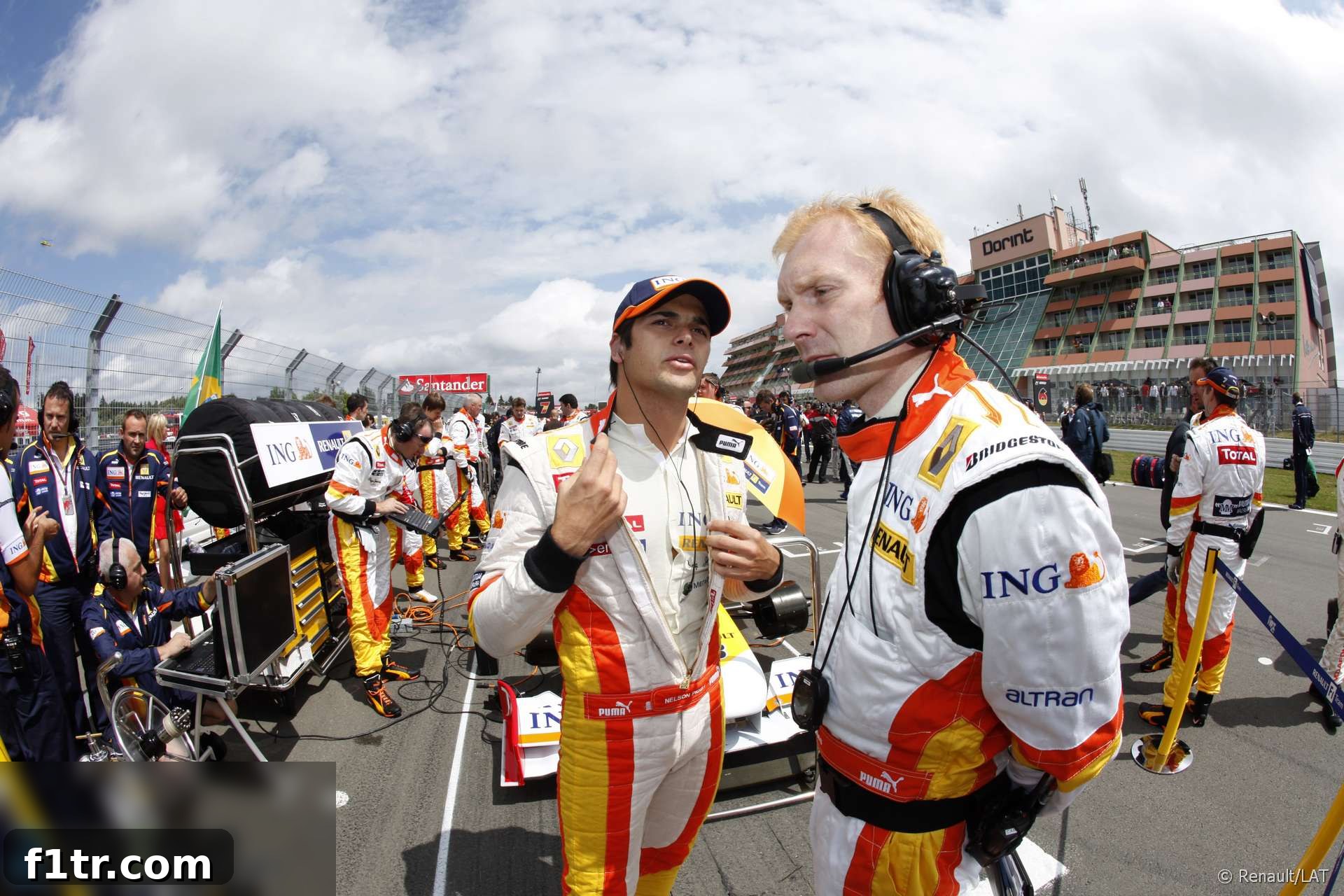
Unveiling Crashgate: Nelson Piquet Jnr’s Explosive Statement on the 2008 Singapore Grand Prix Scandal

The year 2009 saw Formula 1 gripped by one of its most scandalous controversies: “Crashgate.” At its heart was the extraordinary allegation made by Nelson Piquet Jnr, claiming he was ordered by his Renault F1 team boss, Flavio Briatore, and technical director, Pat Symonds, to deliberately crash his car during the 2008 Singapore Grand Prix. This calculated act was allegedly designed to trigger a safety car period, thereby benefiting his teammate, Fernando Alonso, who ultimately won the race.
Weeks before the official FIA hearing, the full, explosive statement made by Nelson Piquet Jnr to the sport’s governing body surfaced online, providing unprecedented insight into the alleged conspiracy. These documents, initially published by F1SA and later circulated widely across motorsport news outlets, laid bare the intricate details of a plot that would send shockwaves through the sport and severely damage the reputations of those involved.
The Allegations Unveiled: Piquet Jnr’s Account
Piquet Jnr’s statement painted a vivid picture of manipulation and coercion, detailing the circumstances that led him to participate in such a dangerous and unsportsmanlike act. His account highlighted his vulnerable state of mind at the time, a crucial element in understanding his compliance with the shocking request.
At the time of this conversation I was in a very fragile and emotional state of mind. This state of mind was brought about by very intense stress due to the fact that Mr Briatore had refused to inform me of whether or not my driver’s contract would be renewed for the next racing year (2009) as is customarily the case in the middle of the year (around July or August). […]
After the meeting with Mr Symonds and Mr Briatore, Mr Symonds took me aside to a quiet corner and, using a map, pointed me to the exact corner of the track where I should crash. This corner was selected because the specific location of the track did not have any cranes that would allow a damaged car to be swiftly lifted off the track, nor did it have any side entrances to the track, which would allow a Safety Marshall to quickly move the damaged car away from the track. Therefore, it was felt that a crash in this specific position would be nearly certain to cause an obstruction on the track which would thus necessitate the deployment of a safety car in order for the track to be cleared and ensure the safe continuation of the race.
Mr Symonds also told me which exact lap to cause the incident upon, so that a strategy could be devised for my team mate Mr Fernando Alonso. […]
During these discussions, no mention was made of any concerns with respect to the security implications of this strategy, either for myself, the public or other drivers. The only comment made in this context was one by Mr Pat Symonds who warned me to ‘be careful, which I took to mean that I should not injure myself.
I intentionally caused the crash by letting go of control of the car just before the relevant corner. In order to make sure I would cause the incident during the correct lap, I asked my team several times via the radio to confirm the lap number, which I would not normally do.
A Driver Under Duress: The Contractual Pressure
Piquet’s testimony revealed the intense psychological pressure he faced from Flavio Briatore. The refusal to confirm his 2009 contract renewal created an environment of extreme anxiety and vulnerability. This contractual uncertainty, strategically employed by Briatore, made Piquet susceptible to extraordinary demands, painting a picture of a young driver whose career hung precariously in the balance. It was within this context of immense personal and professional stress that the alleged order to crash was given, highlighting a severe abuse of power within the team structure.
The Calculated Precision of the Crash
The details provided by Piquet Jnr regarding the crash location were chillingly precise, demonstrating a premeditated and meticulously planned operation. Pat Symonds allegedly identified Turn 17 on the Marina Bay Street Circuit as the ideal spot. This wasn’t merely a random corner; it was chosen specifically because of its logistical deficiencies: the absence of cranes to quickly remove a damaged car and the lack of side entrances for safety marshals. Such a deliberate choice would guarantee an obstruction, thereby necessitating a safety car deployment – the linchpin of their illicit strategy. This level of detail underscored the cold, calculated nature of the plot, far beyond a spontaneous decision.
Orchestrating the Safety Car for Strategic Advantage
Further emphasizing the premeditation, Symonds reportedly dictated the exact lap on which Piquet was to crash. This timing was critical, designed to coincide perfectly with Fernando Alonso’s unique pit stop strategy. The deployment of the safety car at that precise moment would neutralize the field, allowing Alonso, who had pitted early, to gain a significant advantage over his rivals. It was a cynical manipulation of race regulations for strategic gain, directly influencing the outcome of a Grand Prix through illicit means.
Disregard for Safety: A Troubling Omission
Perhaps one of the most disturbing aspects of Piquet’s statement was the apparent lack of concern for safety. Despite orchestrating a deliberate high-speed crash, Piquet claims there was no mention of the potential security implications for himself, other drivers, or even the spectators. The only caution he received was a dismissive “be careful” from Symonds, which Piquet interpreted as a warning not to injure himself rather than a genuine concern for broader safety. This chilling oversight highlighted the reckless abandon with which the team allegedly pursued its strategic objectives, placing competitive advantage above the well-being of individuals and the integrity of the sport.
The Intentional Act: Piquet’s Confession
Piquet Jnr explicitly confessed to intentionally causing the crash, detailing how he relinquished control of his car just before the designated corner. To ensure the incident occurred on the correct lap, he admitted to repeatedly asking his team over the radio to confirm the lap number – an unusual action he wouldn’t typically perform. This crucial detail served as powerful corroborating evidence, demonstrating his direct involvement and providing insight into the mental state of a driver executing a pre-ordained, dangerous maneuver under extreme pressure.
Renault’s Silence and the Impending Hearing
Following the FIA’s official announcement of its investigation into the 2008 Singapore Grand Prix incident, the Renault F1 team issued a statement declaring they would not comment on the matter prior to the hearing scheduled for Monday, September 21st. This silence, while perhaps legally advisable, left Piquet’s damning claims hanging unanswered in the public domain. The motorsport world watched intently, eager to see if Renault would maintain this defensive posture or if they would eventually address the grave allegations directly. The pressure on the team, its management, and its key personnel was immense, with the reputation of one of F1’s most iconic names hanging in the balance.
The release of Piquet’s statement transformed a rumour into a concrete accusation, igniting a fierce debate about ethics, fair play, and the very integrity of Formula 1. It set the stage for one of the most significant hearings in the sport’s history, a hearing that would ultimately lead to severe penalties and a profound re-evaluation of team responsibilities and sporting conduct.
The Documents: Piquet Jnr’s Full FIA Statement
For those wishing to review the original documentation that fueled the “Crashgate” scandal, the following links provide access to the pages of Nelson Piquet Jnr’s full statement to the FIA:
- Page 1 of Nelson Piquet Jnr’s FIA Statement
- Page 2 of Nelson Piquet Jnr’s FIA Statement
- Page 3 of Nelson Piquet Jnr’s FIA Statement
- Page 4 of Nelson Piquet Jnr’s FIA Statement
Source: The initial documents were published by F1SA and subsequently picked up by international media, including Tazio.com.br and F1 Around.
Related Coverage: The Renault Singapore Crash Controversy
Explore more articles related to the infamous “Crashgate” scandal and its significant impact on Formula 1:
- Did Piquet crash on purpose? (Poll)
- Renault face Singapore crash hearing
- Nelson Piquet Jnr and Fernando Alonso in Renault Singapore claim
- Fernando Alonso’s bad luck turns good for win (2008 Singapore Grand Prix)
- 2008 Singapore Grand Prix analysis
- Piquet’s scathing attack on Briatore
- Nelson Piquet Jnr dropped by Renault
- Alonso and the Piquet-Renault fall-out