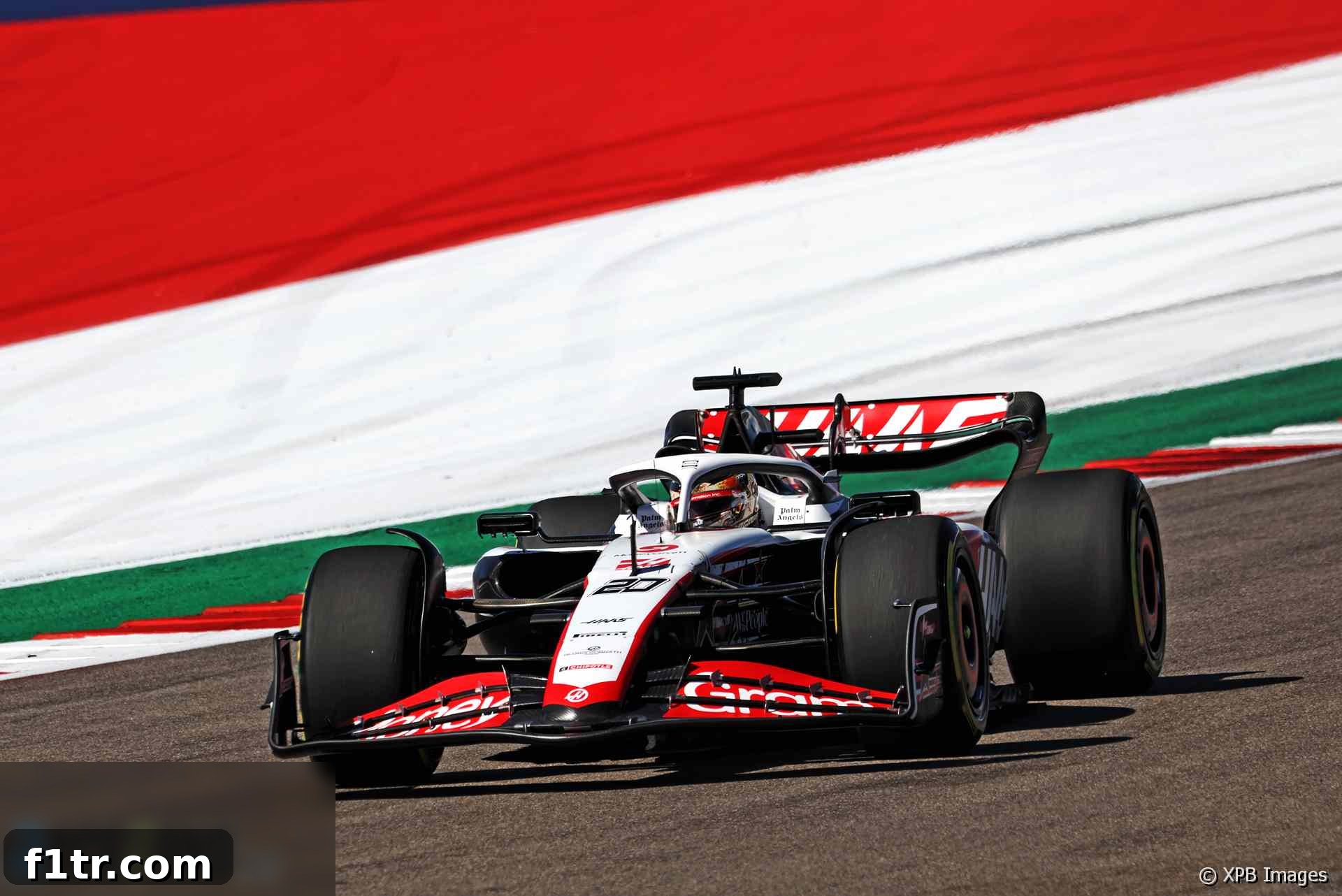
Kevin Magnussen Reflects on Near Miss at US Grand Prix Qualifying: Haas Upgrades Face Ultimate Test
Haas F1 Team driver Kevin Magnussen believes he could have effortlessly secured a spot in the final round of qualifying for the United States Grand Prix, having narrowly missed the cut by a mere two-tenths of a second. The Danish racer expressed his frustration with the missed opportunity at the Circuit of the Americas (COTA), hinting at untapped potential within the heavily upgraded VF-23 challenger.
However, despite the tantalizing glimpse of pace, Magnussen quickly tempered expectations. He stressed that it remains premature to definitively assess the efficacy of the significant upgrade package Haas introduced for the weekend. The true measure of its success, he stated, will only become clear over a full race distance, where the team aims to see a marked improvement in performance and, critically, tyre management.
Kevin Magnussen’s Qualifying Performance: A Frustrating Near Miss at COTA
Magnussen candidly admitted that his unfamiliarity with the extensively modified VF-23 played a role in his inability to crack the top ten in qualifying. Adapting to a car that has undergone such substantial changes often presents a steep learning curve, even for seasoned Formula 1 drivers, and Magnussen was still in the process of extracting its maximum potential.
“There have certainly been some encouraging signs today, both in free practice and during Q1,” Magnussen reported following the qualifying session. “I managed to secure P5 in free practice and then P7 in Q1. Unfortunately, my performance in Q2 wasn’t up to standard. I didn’t execute good laps.”
The Haas driver continued, highlighting the fine margins in Formula 1 qualifying. “I’m still very much in the learning phase with this car. We’re progressively getting to grips with it. Despite making two suboptimal laps in Q2, I was still only around two-tenths away from progressing into Q3. That, to me, indicates a lot of positive underlying potential.” Magnussen’s assessment suggests that even with errors, the inherent speed of the upgraded VF-23 was evident, offering a glimmer of hope for the American team.
In a sport where fractions of a second can dictate fortunes, Magnussen’s conviction that he left time on the table is particularly poignant. He meticulously analyzed his data, confident that he could have easily shaved “two or three tenths” from his Q2 lap time. Recalling a dramatic moment during his critical run, he explained, “In Q2, I almost completely lost control of the car in the first sector. I’m genuinely surprised I didn’t end up crashing given the significant moment I had. So, it was abundantly clear there was a considerable amount more time to be extracted in Q2, which I simply failed to do.” Such an admission underscores both the challenging nature of pushing an unfamiliar car to its limits and the immense pressure drivers face in qualifying.
Haas’s Ambitious Upgrade Package: The Race Day Litmus Test
Throughout the current Formula 1 season, the Haas F1 Team has been consistently hampered by a recurring Achilles’ heel: poor tyre management during races. This issue has frequently seen them qualify strongly, only to slide down the order on Sunday as their tyres degrade faster than those of their competitors. It is precisely this critical area that the new, extensive upgrade package is designed to address, providing a potential lifeline for the team’s championship aspirations.
“The paramount question, the true test, will undoubtedly come on Sunday,” Magnussen emphasized. “We need to ascertain whether the car demonstrates better performance on its tyres over a race distance. That is precisely what we are striving for, what we are truly seeking to achieve. The primary objective isn’t merely to be slightly quicker over a single lap; that is not the fundamental question we need to answer.”
Magnussen’s seasoned perspective offers valuable insight into the team’s priorities. While a strong qualifying performance generates headlines and boosts morale, it ultimately yields no championship points unless it can be translated into sustained race pace. Haas has experienced this frustration before, proving their car capable of a single fast lap but struggling to maintain that pace when it matters most on Sunday. “We have found ourselves in Q3 earlier this year with a car that simply couldn’t perform consistently on Sunday,” he recounted. “So, the real acid test, the definitive evaluation, is always going to be the race day.”
He further elaborated, “I was P6 in qualifying just two or three races ago in Singapore. We are fully aware the car possesses the ability to deliver over a single lap – that is not in dispute. The crucial, overarching question, however, remains squarely focused on Sunday’s performance and our ability to hold pace throughout the Grand Prix.” This historical context from the Singapore Grand Prix weekend serves as a stark reminder of Haas’s ongoing challenge and highlights the critical importance of the new upgrades in rectifying their race day woes.
The Challenge of Comparison: COTA’s Unique Variables
Assessing the true progress made by the Haas F1 Team with their new upgrade package is made inherently complex by the unique characteristics of the Circuit of the Americas. As Magnussen pointed out, comparing performance directly between different venues is seldom straightforward, and COTA presents a particularly challenging scenario.
“I am deliberately holding back from drawing any definitive conclusions at this juncture because we are operating on an entirely different track here,” Magnussen explained. “It’s a different Tarmac surface, the wind conditions are distinctly varied, and we are using different tyre compounds compared to our last outing. All these variables make it exceedingly difficult to conduct a detailed, direct comparison between lap times and overall performance.”
The F1 calendar is a mosaic of diverse circuits, each with its own demands on car setup, aero efficiency, and tyre wear. COTA, with its undulating terrain, high-speed esses, and challenging hairpins, requires a specific setup that may not directly translate from previous races. The ambient temperature, track temperature, and even subtle shifts in wind direction can significantly impact a car’s balance and grip, further complicating any side-by-side analysis of performance data.
Magnussen added that while he perceives “some things” that feel positive with the new package, more track time is essential to truly verify these initial sensations. “With more laps under our belt, we will undoubtedly arrive at a more robust conclusion. However, I suspect that this specific weekend at COTA might not provide us with enough consistent data to draw comprehensive conclusions about the upgrades,” he cautiously projected. This measured approach underscores the scientific rigor required in Formula 1 development, where multiple data points from varied conditions are necessary to validate advancements.
Looking Ahead: The Crucial United States Grand Prix Race
As the focus shifts from the intensity of qualifying to the enduring challenge of the Grand Prix race, all eyes will be on the Haas F1 Team and, specifically, the performance of Kevin Magnussen and his VF-23. The United States Grand Prix is not just another race; for Haas, it represents a crucial opportunity to validate months of hard work and investment in their new upgrade package.
The stakes are high. A successful race day, characterized by improved tyre management and sustained performance, could provide the momentum needed to elevate Haas in the competitive midfield. Conversely, if the upgrades fail to deliver on Sunday, it would cast a long shadow over the remainder of their season and necessitate a re-evaluation of their development direction.
Fans and analysts alike will be closely observing how the VF-23 manages its Pirelli tyres through multiple stints, how its pace holds up against rivals, and whether Magnussen can convert his raw qualifying speed into valuable championship points. The true measure of any Formula 1 car is its race performance, and for Kevin Magnussen and the Haas F1 Team, the answer to their season-long questions lies squarely on the asphalt of the Circuit of the Americas this Sunday. The team is eager for concrete evidence that their significant investment has finally begun to turn the tide, allowing them to compete not just for grid positions, but for consistent points finishes.
Related Formula 1 Content: 2023 United States Grand Prix
- US GP was Mercedes’ best race of 2023 despite disqualification – Wolff
- Singapore and Austin retirements cost me top 10 championship place – Ocon
- United States Grand Prix result unchanged as FIA rejects Haas’ call for review
- Sargeant admits he’s ‘struggled to use all the downforce at times’ in F1
- Mercedes’ Brazilian GP set-up was “conservative” after US GP disqualification
Browse all 2023 United States Grand Prix articles