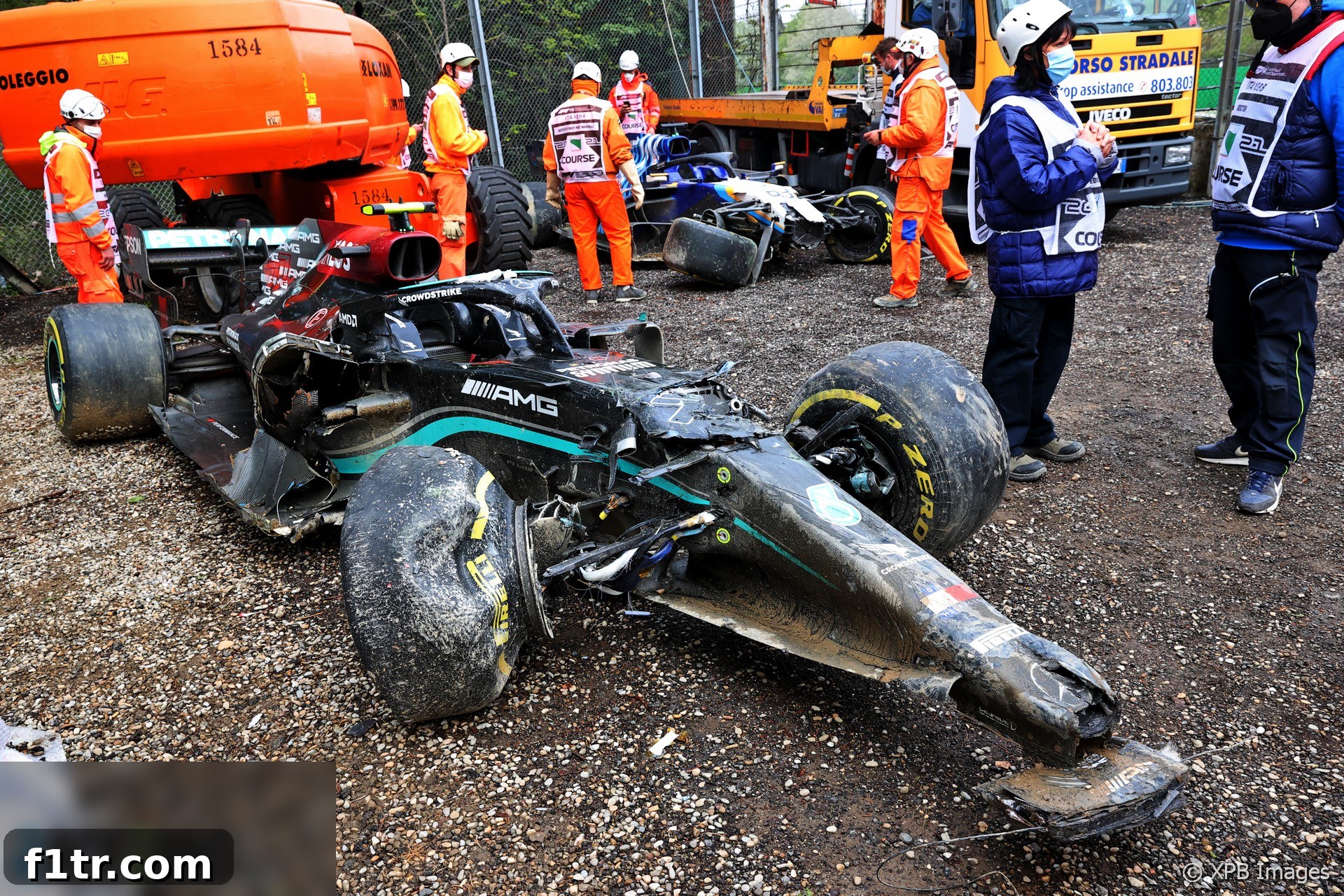
The 2021 Emilia-Romagna Grand Prix at Imola delivered a spectacle of high drama, none more significant than the high-speed collision between Valtteri Bottas and George Russell. This “nasty” accident saw both cars violently crash out of the race, leading Mercedes CEO Toto Wolff to apportion a degree of blame to both drivers involved. While acknowledging the competitive instincts inherent in Formula 1 racing, Wolff unequivocally stated that such incidents between a Mercedes-powered car and a Williams, particularly with Mercedes junior driver Russell at the wheel, were simply unacceptable and avoidable.
The incident unfolded on lap 31, shortly after the Drag Reduction System (DRS) was activated for the first time in the race, intensifying the midfield battles. Russell, driving for Williams, was aggressively challenging Bottas for ninth position. As the pair approached the fearsome Tamburello chicane, Russell opted for the outside line, pulling alongside the Mercedes. However, in a split second that would define the remainder of their race, Russell’s right-hand tyres just brushed the damp grass at the edge of the circuit. This minor contact proved catastrophic; he instantly lost control, pitching his Williams into an uncontrollable spin that speared directly into Bottas’s Mercedes, which was running on the inside.
The impact was brutal and immediate. Both cars, now inextricably linked in a destructive dance, careened off track and slammed into the barriers at high speed. The resulting wreckage was extensive, with a shower of carbon fibre and debris scattering across the circuit. Both drivers were left as helpless passengers, enduring heavy impacts that underscored the inherent dangers of motorsport. The severity of the crash necessitated an immediate red flag, halting the race entirely to allow marshals to clear the extensive debris and repair the damaged trackside barriers.
The immediate aftermath on track was as heated as the collision itself. George Russell was visibly shaken but quickly climbed out of his wrecked Williams, making his way over to the still-recovering Bottas. With clear frustration and anger etched on his face, Russell confronted the Mercedes driver, famously asking if he had been attempting to “kill them both”. Bottas, equally incensed by the premature end to his race and the dramatic nature of the crash, was observed responding with an offensive gesture, highlighting the raw emotions boiling over in that moment of high tension.
Wolff’s Candid Assessment: “It Takes Two to Tango”
In the aftermath, Mercedes team principal Toto Wolff wasted no time in addressing the contentious incident. His initial reaction conveyed a mix of frustration and disappointment, emphasizing the avoidable nature of the crash. “It takes two to tango,” Wolff stated pointedly, encapsulating his view that both drivers shared responsibility for the “nasty accident.” His sentiment was clear: from Mercedes’ global perspective, such an event involving a works car and a junior driver’s team should simply not occur.
Wolff elaborated on his position, acknowledging the differing viewpoints of the drivers involved. “I can understand it from both drivers’ perspectives, but if you look at it from a global perspective, from where we sit at Mercedes, it’s something that shouldn’t be happening. I think both of them think that they are not to blame and I will need to make the point that this is not clear-cut for me.” This declaration set the stage for crucial internal discussions, as Wolff prepared to make it unequivocally clear to both Bottas and Russell that their roles in the “absolutely not necessary” incident would be scrutinized.
Russell’s Ambition vs. Caution: A Delicate Balance
While Wolff understood Russell’s ambition and the natural instinct of a racing driver to seize an opportunity, he also suggested that the young 22-year-old should have exercised greater caution. “It was quite a move on the DRS, but I guess when a driver doesn’t go for a gap, he isn’t a racing driver,” Wolff conceded, acknowledging Russell’s aggressive approach. However, this praise was immediately tempered by a critical observation: “On the other side, maybe it was too aggressive considering that it was a Mercedes and the track was drying up.”
This subtle but significant distinction underscored the unique pressure on Russell. As a Mercedes junior driver widely tipped for a future seat with the factory team, his actions against a Mercedes car, even one driven by a direct competitor like Bottas, carried additional weight. The drying track conditions added another layer of complexity, demanding a higher degree of judgment and precision, particularly when attempting high-speed overtakes on the very limit of adhesion.
The “Gentleman’s Agreement” and Its Aftermath
The collision quickly sparked debate over unwritten rules and racing etiquette. Russell openly accused Bottas of breaking the informal ‘gentleman’s agreement’ among drivers not to make sudden, unpredictable movements when aggressively defending a position. Russell implied that Bottas had made a slight, late defensive weave that contributed to his loss of control on the damp patch. Conversely, Bottas vehemently insisted that he had maintained a consistent line and had left Russell the required racing room at all times leading up to the collision. This disagreement highlights the fine margins and subjective interpretations often inherent in wheel-to-wheel racing incidents, especially when heightened by adverse track conditions and high stakes.
The Imola crash had significant ramifications beyond the immediate race. For Mercedes, it represented a double DNF, a rare and costly setback in their Constructors’ Championship campaign. For Valtteri Bottas, already under immense pressure to perform consistently alongside Lewis Hamilton, the incident only intensified scrutiny on his season. For George Russell, the crash was a double-edged sword. While his aggressive move showcased his potential and desire to compete at the sharp end, the subsequent collision with a Mercedes driver, and Toto Wolff’s public comments, undeniably cast a shadow over his immediate prospects for a future Mercedes seat. The incident forced both drivers to reflect on their approaches, with Russell later issuing a public apology to Bottas and the Mercedes team after what he described as constructive private discussions with Wolff.
Wolff’s “Renault Clio Cup” Remark and Lingering Tensions
In a moment of characteristic wit mixed with underlying seriousness, Toto Wolff referenced a playful past exchange with Russell. Wolff jokingly acknowledged he had previously been “teasing” Russell, telling him that “if he does a good job he can be in a Mercedes, if not we’re doing Renault Clio Cup.” Following the Imola disaster, Wolff delivered the punchline with a wry smile: “Today we are more close to Renault Clio Cup.” This humorous jab, while lighthearted, subtly conveyed the high expectations placed upon Russell and the consequences of failing to meet them, particularly in a potentially career-defining context.
The Imola collision remained a talking point for weeks, sparking debates among fans, pundits, and within the paddock. It underscored the competitive tension in Formula 1, where every position, even outside the points, is fiercely contested. More importantly, it highlighted the delicate balance between aggressive racing and responsible driving, especially for those with aspirations of reaching the pinnacle of the sport. While both drivers moved on, the incident undoubtedly shaped their relationship and public perception, serving as a stark reminder of the unforgiving nature of top-tier motorsport and the heavy consequences of misjudgment on track.
2021 Emilia-Romagna Grand Prix
- Poor Imola pace was “100% tyres”, says Bottas
- Bottas says Imola crash is “history” after reading George Russell’s apology
- ‘Lewis and Valtteri are team mates to me as Nicholas is’ says George Russell after ‘private’ Wolff talks
- ‘Hamilton didn’t break the rules by reversing’ shouldn’t be a story
- 2021 Emilia-Romagna Grand Prix Star Performers
Browse all 2021 Emilia-Romagna Grand Prix articles