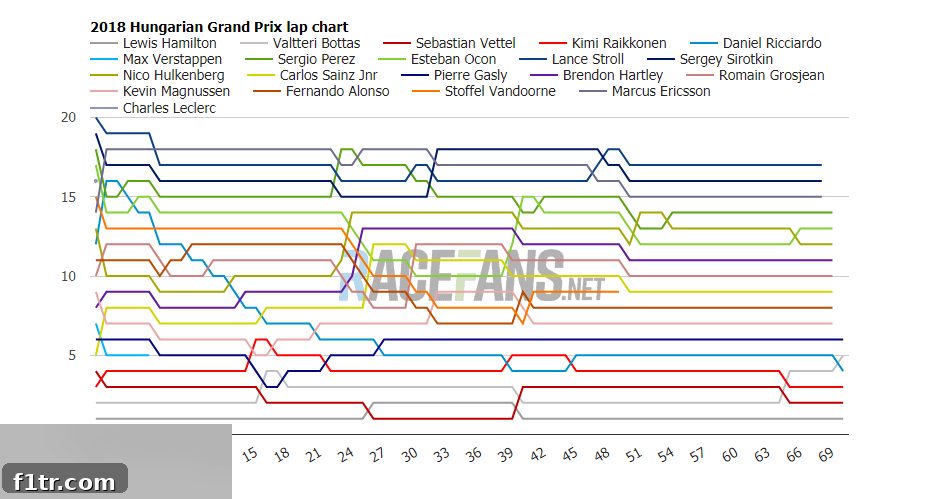
2018 Hungarian Grand Prix: A Strategic Masterclass and Fierce Battles at the Hungaroring
The 2018 Formula 1 Hungarian Grand Prix, held at the notoriously tight and twisty Hungaroring, delivered a compelling spectacle of strategic depth, tyre management, and a relentless pursuit of positions. Known for being one of the most challenging circuits for overtaking on the calendar, this year’s edition certainly lived up to its reputation, forcing drivers and teams alike to push the limits of strategy and skill to gain an advantage.
As the summer break approached, the championship battle was intensely poised, with Mercedes and Ferrari trading blows at every opportunity. The Hungaroring, with its high downforce demands and often sweltering conditions, presented a unique challenge that tested the adaptability of both car and driver. The race ultimately unfolded into a fascinating tactical duel, punctuated by late-race drama that kept fans on the edge of their seats until the very last lap.
The Podium Struggle: Mercedes vs. Ferrari
From the outset, the race was set to be a clash of titans, with the Mercedes of Lewis Hamilton starting from pole position, flanked by his teammate Valtteri Bottas. Ferrari, with Sebastian Vettel and Kimi Räikkönen starting from fourth and third respectively, knew they had a monumental task ahead to break the Silver Arrows’ front-row dominance on a track where track position is king. The Scuderia spent the vast majority of the race attempting to find a way past the two Mercedes, employing different tyre strategies and hoping for a critical moment or mistake.
Vettel’s Tireless Pursuit and Bottas’s Tyre Degradation
The strategic battle intensified as the race progressed, with tyre degradation playing a pivotal role. Valtteri Bottas, driving a strong race in the second Mercedes, found himself under immense pressure from the chasing Ferraris. His decision to run a longer stint on his initial set of tyres, or perhaps an inherent characteristic of his car, led to significant tyre wear in the closing stages. This vulnerability was expertly exploited by Sebastian Vettel, who, after a strategic pit stop for fresh tyres, unleashed a late-race charge. The German driver’s persistence paid off dramatically in the final two laps when he finally forced his way past a struggling Bottas, whose badly worn tyres could no longer offer sufficient grip or defence. This critical overtake secured a crucial second-place finish for Ferrari, salvaging important championship points.
Daniel Ricciardo’s Heroic Drive and the Final Lap Clash
The drama was far from over for Bottas, however. Following his encounter with Vettel, he immediately fell into the clutches of a charging Daniel Ricciardo. The Red Bull driver, known for his aggressive yet precise overtaking, had been on an incredible recovery drive throughout the race. The pair engaged in a thrilling battle, with an initial clash that saw both drivers momentarily compromised. Despite the contact, Ricciardo demonstrated remarkable resilience and skill, recovering to snatch fourth place from the Mercedes on the very final lap of the race. This sensational manoeuvre meant Ricciardo finished an astonishing eight places higher than he started, a testament to his fighting spirit and the performance of his Red Bull-TAG Heuer package. His incredible climb from 12th on the grid marked him as the biggest mover of the race.
Ricciardo’s stellar performance was particularly impressive considering an early setback where he lost four places from his original starting position. He then began his ascent, aided in part when Sergio Perez was advised by his team to let Ricciardo through after the Force India driver had passed him off-track on the opening lap. This early cooperation allowed Ricciardo to regain momentum and unleash his potent race pace.
Adding another feather to his cap, Daniel Ricciardo also set the fastest lap of the race with a blistering 1’20.012. While a phenomenal effort, he was unable to surpass Michael Schumacher’s formidable track record from 2004. Interestingly, Ricciardo’s best lap was only one-tenth of a second quicker than the fastest lap from the previous year, which was unusually set by Fernando Alonso in a McLaren, highlighting the challenging nature of the circuit and potentially evolving car characteristics year-on-year.
Analyzing Driver Performances: Gains and Setbacks
While some drivers celebrated significant gains, others faced challenges that led to a drop in positions. The Hungarian Grand Prix often creates these stark contrasts due to its demanding nature and the difficulty of recovering lost ground.
Carlos Sainz Jnr’s Challenging Start and Strategic Woes
Despite the late-race drama for Valtteri Bottas, he did not suffer the most significant drop in positions. That unfortunate distinction belonged to Carlos Sainz Jnr, who ultimately finished four places lower than his starting grid position. Sainz had a promising start on his soft tyres, getting off the line well, but he was quickly crowded out in the opening laps. He found himself vulnerable to those behind him who started on the ultra-soft compound, which offered superior initial grip. By the end of lap one, Sainz had already fallen to eighth place. Reflecting on his struggles, a frustrated Sainz commented to his team at the end of the race, “We need to look at something because from P5 to P9, we didn’t do something right,” indicating a need for a thorough post-race analysis of their strategy and opening lap execution.
Other Notable Movers Across the Field
Beyond the headline battles, the “Position Change” table reveals a dynamic race across the entire grid. Drivers like Sergio Perez, Esteban Ocon, Lance Stroll, and Sergey Sirotkin all made commendable progress, gaining three or four places from their starting positions, showcasing the importance of a clean start and consistent pace. Conversely, alongside Sainz and Bottas, drivers such as Brendon Hartley and Marcus Ericsson also experienced a net loss of positions, underscoring the relentless competitive pressure in Formula 1.
To provide a clearer picture of how each driver performed in terms of position changes from start to finish, the following table details their starting grid spot, their change in position on the first lap, and their overall position change by the end of the race:
Position Change Summary
| Driver | Start position | Lap one position change | Race position change |
|---|---|---|---|
| Lewis Hamilton | 1 | 0 | 0 |
| Valtteri Bottas | 2 | 0 | -3 |
| Sebastian Vettel | 4 | 1 | 2 |
| Kimi Raikkonen | 3 | -1 | 0 |
| Daniel Ricciardo | 12 | -4 | 8 |
| Max Verstappen | 7 | 2 | |
| Sergio Perez | 18 | 3 | 4 |
| Esteban Ocon | 17 | 3 | 4 |
| Lance Stroll | 20 | 1 | 3 |
| Sergey Sirotkin | 19 | 2 | 3 |
| Nico Hulkenberg | 13 | 3 | 1 |
| Carlos Sainz Jnr | 5 | -3 | -4 |
| Pierre Gasly | 6 | 0 | 0 |
| Brendon Hartley | 8 | -1 | -3 |
| Romain Grosjean | 10 | -2 | 0 |
| Kevin Magnussen | 9 | 2 | 2 |
| Fernando Alonso | 11 | 0 | 3 |
| Stoffel Vandoorne | 15 | 2 | |
| Marcus Ericsson | 14 | -4 | -1 |
| Charles Leclerc | 16 |
The Strategic Underpinnings: Tyre Choices and Pit Stop Precision
The Hungaroring’s demanding layout and often high temperatures mean tyre management is always a critical factor. The 2018 race was no different, with teams experimenting with various compounds and pit stop timings to gain a strategic edge. Understanding the differing approaches taken by each team provides valuable insight into the unfolding race narrative.
Tyre Strategies Unveiled
Teams adopted diverse tyre strategies, primarily revolving around the ultra-soft, soft, and medium compounds. Lewis Hamilton and Daniel Ricciardo, for instance, started on softer compounds and then switched to harder ones, while Sebastian Vettel opted for a reverse strategy, starting on softs and moving to ultra-softs for his second stint. Kimi Räikkönen was one of the few drivers to execute a two-stop strategy, suggesting either higher degradation on his car or an attempt to maximize pace with fresher rubber. The choice between aggressive two-stop strategies and more conservative one-stop plans, often influenced by starting tyre compounds and track position, ultimately dictated a significant portion of the race outcome.
Below is a detailed breakdown of the tyre strategies employed by each driver throughout the 2018 Hungarian Grand Prix:
| Stint 1 | Stint 2 | Stint 3 | |
|---|---|---|---|
| Lewis Hamilton | Ultra soft (25) | Soft (45) | |
| Sebastian Vettel | Soft (39) | Ultra soft (31) | |
| Kimi Raikkonen | Ultra soft (14) | Soft (24) | Soft (32) |
| Daniel Ricciardo | Soft (44) | Ultra soft (26) | |
| Valtteri Bottas | Ultra soft (15) | Soft (55) | |
| Pierre Gasly | Ultra soft (32) | Soft (38) | |
| Kevin Magnussen | Ultra soft (31) | Soft (38) | |
| Fernando Alonso | Soft (39) | Medium (30) | |
| Carlos Sainz Jnr | Soft (25) | Medium (44) | |
| Romain Grosjean | Ultra soft (29) | Soft (40) | |
| Brendon Hartley | Ultra soft (24) | Medium (45) | |
| Nico Hulkenberg | Soft (23) | Medium (27) | Ultra soft (19) |
| Esteban Ocon | Soft (39) | Ultra soft (30) | |
| Sergio Perez | Ultra soft (22) | Soft (47) | |
| Marcus Ericsson | Ultra soft (6) | Medium (62) | |
| Sergey Sirotkin | Soft (31) | Medium (37) | |
| Lance Stroll | Medium (47) | Ultra soft (21) | |
| Stoffel Vandoorne | Soft (40) | Medium (9) | |
| Max Verstappen | Ultra soft (5) | ||
| Charles Leclerc |
The Crucial Pit Stops
In a race where every tenth of a second counts, pit stop efficiency can make or break a driver’s race. The 2018 Hungarian Grand Prix saw a range of pit stop times, highlighting the incredible precision of some teams and the occasional setbacks for others. Quick pit stops were vital for drivers looking to undercut rivals or maintain track position, while slower stops could lead to significant losses, as Sebastian Vettel’s comparatively longer stop (23.111s) might have marginally impacted his ability to challenge Hamilton earlier.
The fastest pit stop of the race belonged to Lance Stroll and the Williams team, completing their tyre change in an impressive 21.291 seconds. This exemplary speed underscores the ongoing pursuit of perfection in the pit lane. In contrast, Kevin Magnussen experienced the slowest stop at 25.126 seconds, a delay that could certainly disrupt a driver’s rhythm and strategy.
The following table illustrates the pit stop times for each driver, demonstrating the variance in performance:
2018 Hungarian Grand Prix Pit Stop Times
| Driver | Team | Pit stop time | Gap | On lap | |
| 1 | Lance Stroll | Williams | 21.291 | 47 | |
| 2 | Valtteri Bottas | Mercedes | 21.337 | 0.046 | 15 |
| 3 | Daniel Ricciardo | Red Bull | 21.364 | 0.073 | 44 |
| 4 | Lewis Hamilton | Mercedes | 21.480 | 0.189 | 25 |
| 5 | Sergey Sirotkin | Williams | 21.509 | 0.218 | 31 |
| 6 | Pierre Gasly | Toro Rosso | 21.684 | 0.393 | 32 |
| 7 | Stoffel Vandoorne | McLaren | 21.732 | 0.441 | 40 |
| 8 | Romain Grosjean | Haas | 21.733 | 0.442 | 29 |
| 9 | Fernando Alonso | McLaren | 21.795 | 0.504 | 39 |
| 10 | Kimi Raikkonen | Ferrari | 21.829 | 0.538 | 38 |
| 11 | Brendon Hartley | Toro Rosso | 21.831 | 0.540 | 24 |
| 12 | Carlos Sainz Jnr | Renault | 21.914 | 0.623 | 25 |
| 13 | Nico Hulkenberg | Renault | 21.966 | 0.675 | 23 |
| 14 | Esteban Ocon | Force India | 22.258 | 0.967 | 39 |
| 15 | Sergio Perez | Force India | 22.561 | 1.270 | 22 |
| 16 | Marcus Ericsson | Sauber | 22.640 | 1.349 | 6 |
| 17 | Nico Hulkenberg | Renault | 22.650 | 1.359 | 50 |
| 18 | Sebastian Vettel | Ferrari | 23.111 | 1.820 | 39 |
| 19 | Kimi Raikkonen | Ferrari | 24.471 | 3.180 | 14 |
| 20 | Kevin Magnussen | Haas | 25.126 | 3.835 | 31 |
The Pursuit of Speed: Fastest Laps of the Race
The fastest lap of a Grand Prix often tells a tale of raw pace, car performance, and a driver’s ability to extract the absolute maximum from their machinery at a specific moment. At the 2018 Hungarian Grand Prix, despite the circuit’s reputation for being difficult for flat-out speed, several drivers managed to unleash impressive lap times, with Daniel Ricciardo leading the charge.
Ricciardo’s 1’20.012 on lap 46 underscored his recovery drive and the potential of his Red Bull on softer tyres. Hot on his heels were the Ferrari duo of Sebastian Vettel and Kimi Räikkönen, both posting times within half a second of Ricciardo’s benchmark, demonstrating Ferrari’s strong race pace. Notably, Vettel’s fastest lap came on the penultimate lap of the race, a clear indicator of his aggressive pursuit of Bottas.
Here is a detailed breakdown of each driver’s fastest lap during the 2018 Hungarian Grand Prix:
2018 Hungarian Grand Prix Fastest Laps
| Rank | Driver | Car | Fastest lap | Gap | On lap |
|---|---|---|---|---|---|
| 1 | Daniel Ricciardo | Red Bull-TAG Heuer | 1’20.012 | 46 | |
| 2 | Sebastian Vettel | Ferrari | 1’20.056 | 0.044 | 70 |
| 3 | Kimi Raikkonen | Ferrari | 1’20.292 | 0.280 | 55 |
| 4 | Lewis Hamilton | Mercedes | 1’21.107 | 1.095 | 63 |
| 5 | Nico Hulkenberg | Renault | 1’21.261 | 1.249 | 69 |
| 6 | Kevin Magnussen | Haas-Ferrari | 1’21.302 | 1.290 | 60 |
| 7 | Pierre Gasly | Toro Rosso-Honda | 1’21.685 | 1.673 | 64 |
| 8 | Valtteri Bottas | Mercedes | 1’21.736 | 1.724 | 39 |
| 9 | Fernando Alonso | McLaren-Renault | 1’22.090 | 2.078 | 68 |
| 10 | Romain Grosjean | Haas-Ferrari | 1’22.606 | 2.594 | 58 |
| 11 | Brendon Hartley | Toro Rosso-Honda | 1’22.612 | 2.600 | 62 |
| 12 | Lance Stroll | Williams-Mercedes | 1’22.660 | 2.648 | 51 |
| 13 | Carlos Sainz Jnr | Renault | 1’22.774 | 2.762 | 58 |
| 14 | Esteban Ocon | Force India-Mercedes | 1’22.876 | 2.864 | 63 |
| 15 | Stoffel Vandoorne | McLaren-Renault | 1’23.077 | 3.065 | 46 |
| 16 | Sergio Perez | Force India-Mercedes | 1’23.263 | 3.251 | 56 |
| 17 | Marcus Ericsson | Sauber-Ferrari | 1’23.671 | 3.659 | 53 |
| 18 | Sergey Sirotkin | Williams-Mercedes | 1’23.708 | 3.696 | 53 |
| 19 | Max Verstappen | Red Bull-TAG Heuer | 1’23.985 | 3.973 | 5 |
| 20 | Charles Leclerc | Sauber-Ferrari |
A Memorable Hungarian Grand Prix
The 2018 Hungarian Grand Prix proved to be a fitting prelude to the summer break, delivering a race rich in strategic intrigue and on-track excitement. The Hungaroring, true to form, challenged every aspect of Formula 1 racing, from driver skill and tyre management to pit stop precision and overall team strategy. Lewis Hamilton’s dominant victory solidified his championship lead, but the battles behind him, particularly Sebastian Vettel’s late charge and Daniel Ricciardo’s spectacular recovery, provided much of the race’s indelible highlights. The event underscored why the Hungarian Grand Prix remains a beloved fixture on the Formula 1 calendar, consistently offering compelling narratives despite its reputation for difficult overtaking.
For those eager to delve deeper into the statistics and storylines of this thrilling race, explore our related articles for more insights:
- No win for Raikkonen in his last 30 podium appearances
- Top ten pictures from the 2018 Hungarian Grand Prix
- 2018 Hungarian Grand Prix Star Performers
- Hamilton extends points lead as Mercedes contain Ferrari
- Vettel doubts slow pit stop ended his victory shot
Browse all 2018 Hungarian Grand Prix articles