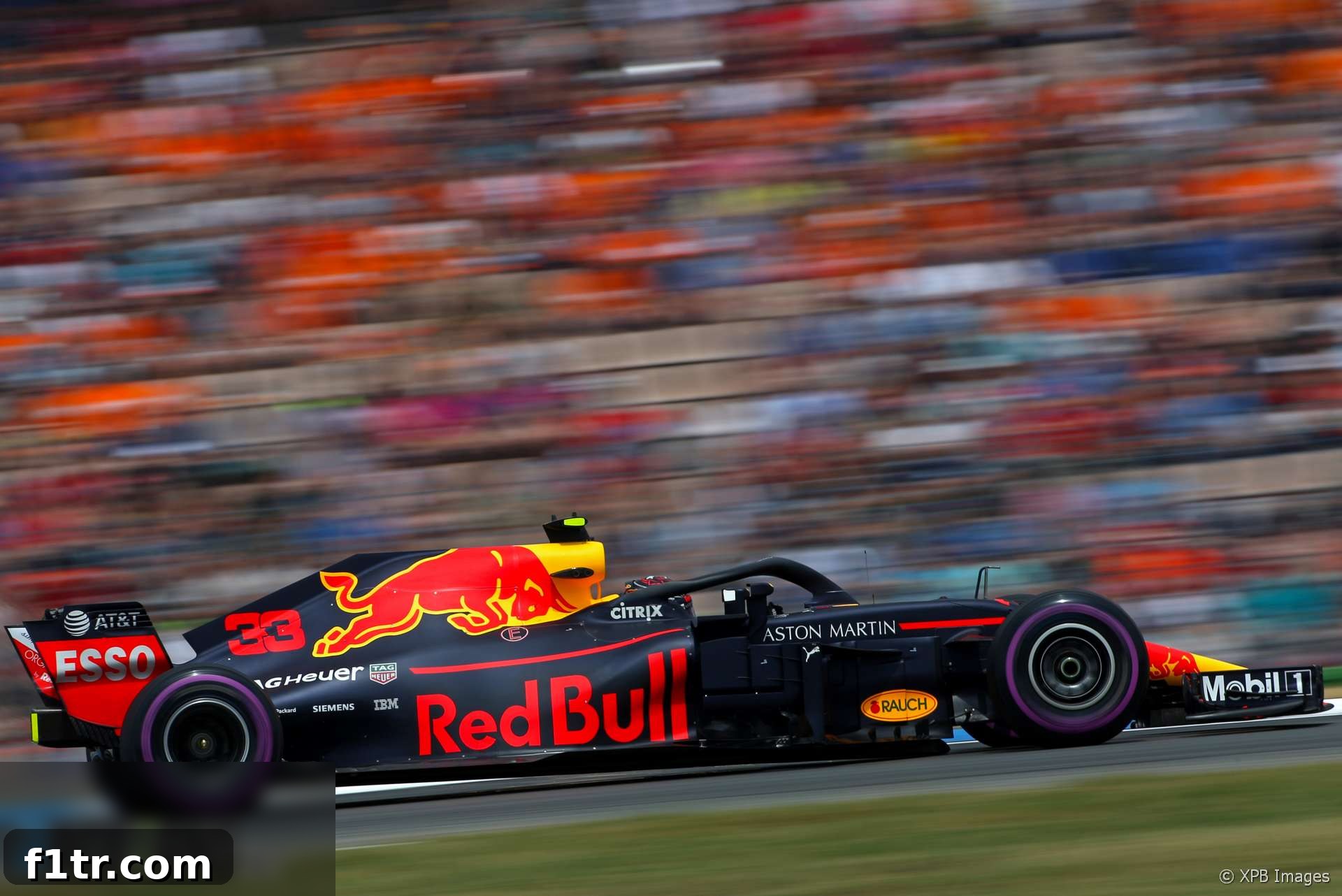
Max Verstappen on Red Bull’s Qualifying Conundrum and the Art of Overtaking Among F1 Elites
Red Bull Racing’s talisman, Max Verstappen, frequently finds himself battling the inherent limitations of his machinery during the crucial qualifying sessions of a Formula 1 Grand Prix weekend. His recent observations shed light on a persistent challenge for the Milton Keynes-based squad: a noticeable power deficit compared to their primary rivals, Ferrari and Mercedes. This disadvantage, Verstappen explains, not only hampers their single-lap pace but also profoundly influences the dynamics of racing, making overtakes significantly more difficult when vying against the sport’s leading contenders than when navigating through the midfield pack.
In a recent qualifying session, Verstappen secured a respectable fourth-place grid slot for Sunday’s race. However, this position came with a tangible gap, as he trailed the third-placed Kimi Raikkonen’s Ferrari by nearly three-tenths of a second. The front row was ultimately occupied by the two Ferraris, with Valtteri Bottas’s Mercedes completing the top three. This consistent pattern of Red Bull being marginally off the pace in qualifying has become a familiar narrative, prompting direct questions about the team’s ability to challenge for pole position.
The Engine Mode Enigma: Red Bull’s Qualifying Challenge
When pressed on why Red Bull couldn’t compete directly for a front-row start, Verstappen’s response was unequivocal and succinct: “It is just the engine mode, very clear.” This statement encapsulates the core of Red Bull’s qualifying struggle. Modern Formula 1 power units, especially those from the leading manufacturers like Ferrari and Mercedes, possess specialized ‘party modes’ or high-power engine settings designed for maximum output over a single qualifying lap. These modes push the engine to its absolute limits, sacrificing reliability and fuel economy for raw, unadulterated pace.
For Red Bull, and by extension, their engine supplier, the ability to deploy such aggressive engine modes for sustained periods in qualifying has often been a limiting factor. This disparity in qualifying engine performance means that even when Red Bull’s chassis and driver are performing optimally, the sheer power advantage of their rivals can be insurmountable over a single lap. Verstappen, ever the fierce competitor, expressed no personal disappointment with his own performance, stating, “I wasn’t depressed, I was really happy with my lap. But we know in qualifying we don’t have a chance so I just gave it all I had to at least be fourth.” This sentiment highlights a pragmatic acceptance of their current reality: maximizing the available package, even if it doesn’t translate to pole position.
Despite the qualifying deficit, Verstappen remains optimistic about his prospects on race day. The reason for this optimism lies in the equalization of engine modes. During the race, teams cannot consistently run their power units at peak qualifying settings due to concerns over fuel consumption, engine wear, and reliability over a longer distance. This necessitates a more conservative approach, effectively levelling the playing field to some extent. “We should be closer tomorrow, they can’t use the power mode they have all the time so that will bring us a little bit closer,” Verstappen affirmed, pointing to the shift in dynamics that often favors Red Bull’s race pace.
The Intricacies of Overtaking: A Top-Team Dilemma
Verstappen further elaborated on the complexities of overtaking in contemporary Formula 1, distinguishing between battling midfield teams and challenging the front-runners. He posited that while some tracks might offer more opportunities, the act of passing becomes significantly more challenging when engaging with fellow top teams. “It’s going to be a bit easier than some other tracks but between Mercedes, Ferrari and us then it’s going to be a bit more difficult,” he explained.
This difficulty stems from multiple factors inherent to top-tier F1 competition. Firstly, the performance parity among leading cars is much tighter. Unlike a situation where a superior car can easily “drive by” a slower one – as Verstappen illustrated with a hypothetical “If I was next to a Williams or something then you just drive by” – the cars of Mercedes, Ferrari, and Red Bull are all meticulously engineered machines, often within fractions of a second of each other in terms of performance. This means any advantage one car has over another is marginal and hard-won.
Secondly, aerodynamic factors play a crucial role. Modern F1 cars generate significant downforce, but this comes at a cost when following closely. The ‘dirty air’ created by the car ahead severely disrupts the airflow over the trailing car’s wings, reducing its downforce and making it incredibly difficult to maintain high cornering speeds or achieve superior straight-line speed due to drag. This effect is magnified when both cars are designed to maximize aerodynamic efficiency, as is the case with the top teams.
Finally, the calibre of drivers among the leading teams is exceptionally high. Top drivers are masters of defensive driving, expertly positioning their cars, managing their tires, and utilizing energy recovery systems (ERS) to fend off challenges. This combination of highly developed cars and elite driving talent transforms overtaking into a strategic and often painstaking battle, requiring precise timing, impeccable execution, and sometimes, a stroke of luck.
Navigating the Start and Early Laps: Seizing Opportunities
Starting from the second row, a strong start becomes paramount for Verstappen to immediately mitigate his qualifying disadvantage. While acknowledging the potential, he cautioned against complacency. “No it won’t be easy but it’s definitely possible, I think I did that in 2016 as well but you need a bit of luck to be in the right place,” he remarked, recalling past successes but emphasizing the unpredictable nature of the opening lap.
The early phases of a Grand Prix are often chaotic and full of opportunities. Verstappen highlighted the importance of gaining a ‘tow’ – utilizing the slipstream of a car ahead to gain speed on a straight – particularly into key braking zones like Turn 2 and Turn 6 on the specific circuit. A successful tow can provide the crucial momentum needed to launch an overtake or gain track position. However, capitalizing on such moments requires not only a good start but also “a good exit” from the preceding corner to maximize straight-line speed. “Let’s just hope that I have a good exit because otherwise I’m struggling on the straight but we’ll find out,” he concluded, underscoring the fine margins involved in gaining an advantage.
The implications of starting fourth are significant. It places Verstappen firmly in the mix with the leading cars, offering direct battle opportunities but also exposing him to the intense pressure and close-quarter racing of the initial laps. Successfully navigating these early stages, potentially gaining a position or two, could be transformative for his race strategy and ultimately, his chances of a podium finish.
Red Bull’s Persistent Quest for Performance Parity
Verstappen’s insights underscore Red Bull Racing’s enduring challenge in the hybrid era of Formula 1. While consistently praised for developing one of the finest chassis on the grid, their aspirations for consistent championship contention have often been tempered by a power unit that, at least in qualifying trim, couldn’t consistently match the benchmarks set by Mercedes and Ferrari. This dynamic forces drivers like Verstappen to extract every ounce of performance from their car, often driving on the very edge of the limit to compensate for the straight-line speed deficit.
The team’s strategy often revolves around harnessing their strong aerodynamic package and race-day tire management to outmaneuver rivals, rather than relying on outright power. Verstappen, with his aggressive driving style and exceptional car control, is perfectly suited to this philosophy, consistently pushing the boundaries to achieve results that often surpass the perceived potential of the car. His ability to perform “happy with my lap” even when knowing a front-row start is out of reach, speaks volumes about his mental fortitude and dedication to maximizing every opportunity.
Ultimately, Verstappen’s candid assessment paints a clear picture of the finely balanced ecosystem within Formula 1’s elite. Every tenth of a second, every ounce of power, and every strategic decision matters immensely. While qualifying remains a hurdle for Red Bull, the race offers a different battleground where skill, strategy, and consistent performance can often turn the tide, making Sunday’s racing a spectacle of determination and calculated risks for Max Verstappen and his team.
Further Reading on the 2018 F1 Season and Beyond
- F1 feared “death knell” for Drive to Survive after Ferrari and Mercedes snub
- McLaren staff told us we were “totally crazy” to take Honda engines in 2018 – Tost
- ‘It doesn’t matter if we start last’: How Red Bull’s junior team aided Honda’s leap forward
- Honda’s jet division helped F1 engineers solve power unit problem
- McLaren Racing losses rise after Honda split
Browse all 2018 F1 season articles