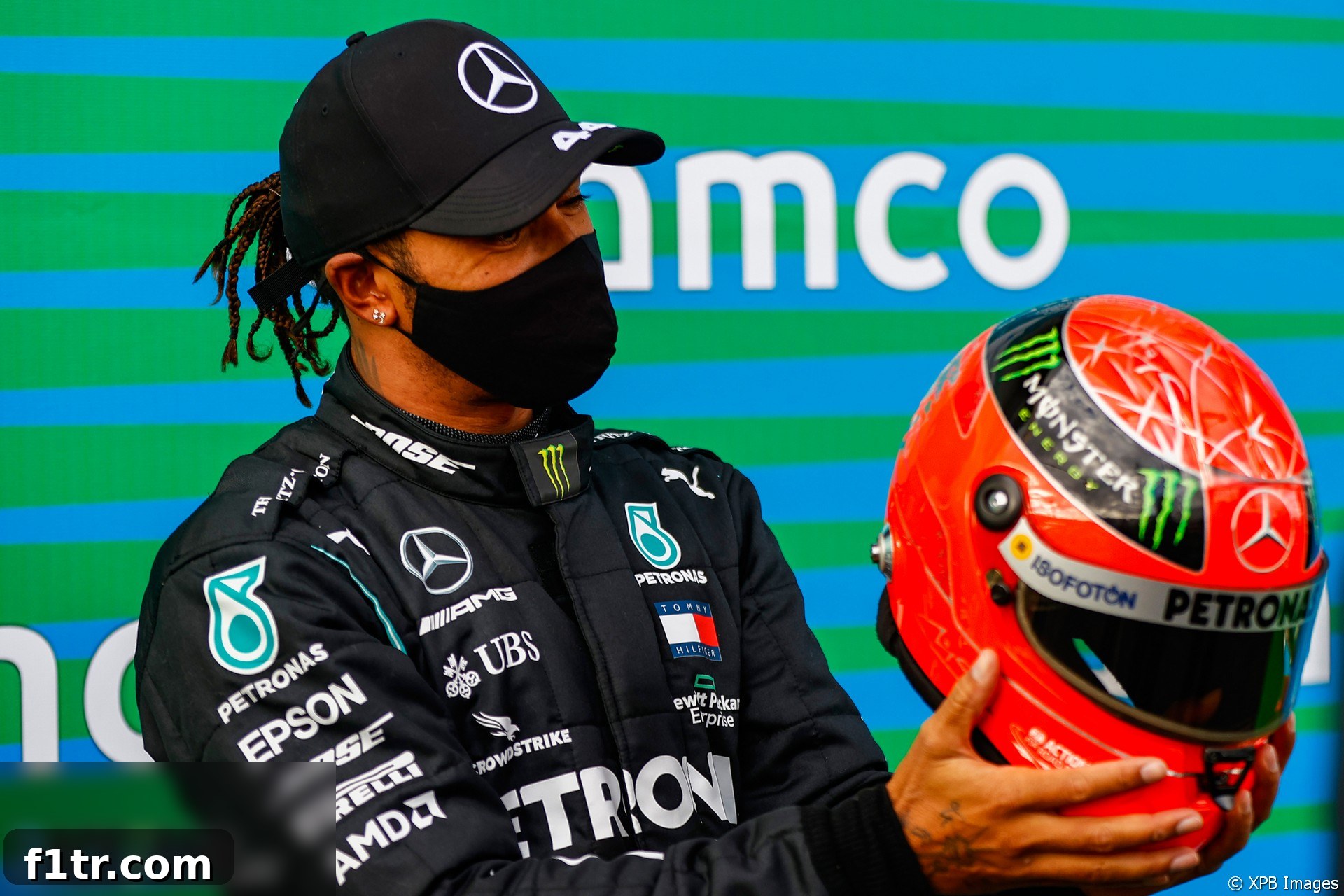
In the high-octane world of Formula 1, where legends are forged and records are shattered, few comparisons captivate fans and experts alike as much as that between Lewis Hamilton and Michael Schumacher. Both titans of the sport, their careers have been marked by unparalleled dominance and a relentless pursuit of excellence. The conversation gained fresh momentum when Lewis Hamilton equaled Michael Schumacher’s astonishing record of 91 Grand Prix victories at the iconic Nürburgring. This historic moment provided a unique opportunity to delve into the driving philosophies and work ethics of these two extraordinary athletes, as observed by a man who has worked closely with both: Mercedes trackside engineering director, Andrew Shovlin.
Advert | Become a Supporter & go ad-free
Speaking in the wake of Hamilton’s record-tying achievement, Shovlin offered profound insights into the Briton’s approach to racing, dispelling common misconceptions. He highlighted what he believes is an often-underestimated aspect of Hamilton’s success: his extraordinary dedication and relentless work ethic. “He works very hard,” Shovlin affirmed, challenging the notion that Hamilton’s speed is purely innate talent requiring minimal off-track effort. “He’s a driver that I think, perhaps, his rivals like to think is just fast in the car but doesn’t put the hours in. But he’s one of the hardest working drivers we’ve ever known.” This perspective underscores that Hamilton’s consistent triumphs are not merely a product of natural ability, but rather the culmination of immense personal investment and an unwavering commitment to improvement.
Shovlin elaborated on Hamilton’s continuous evolution, describing his “relentless” search for improvement as a defining characteristic. This pursuit is a collaborative effort, meticulously undertaken with his dedicated engineering crew, including race engineer Peter Bonnington and performance engineer Marcus Dudley, as well as the wider Mercedes team. Their collective aim is to dissect every aspect of performance, leaving no stone unturned in the quest for perfection. Hamilton’s capacity to absorb complex technical information and translate it into tangible on-track gains is central to his ongoing success. “It’s the more he can understand about the tyres, about how the car works, about how to use all the available tools – he’s able to take that and build it into his driving.” This intricate process involves deep dives into telemetry, strategy sessions, and constant feedback loops, all designed to refine his driving style and optimize the car’s performance. Every session, every lap, and every race is treated as a learning opportunity.
“It’s just in this relentless way: Every missed opportunity is something that needs fixing before the next race goes. He goes off and works with Bono and Marcus, his engineering crew and with the wider team trying to understand the issues.” This quote perfectly encapsulates Hamilton’s proactive and analytical approach. He doesn’t simply drive the car; he actively engages with its mechanics, its tires, and its dynamic behavior. Even in his fourteenth season in Formula 1, a stage in a career where many drivers might settle into a routine, Hamilton remains committed to personal growth. “So long into a career, you think drivers would sort of top out their skillset but Lewis keeps finding new and different things to do and how to get the most out of the car and the tyres,” Shovlin observed. This extraordinary capacity for continuous improvement, for pushing the boundaries of what’s possible even after achieving so much, is a testament to his enduring passion for the sport and his competitive spirit.
Andrew Shovlin’s unique perspective stems from his experience working directly with both Michael Schumacher and Lewis Hamilton during their tenures at Mercedes. Schumacher, a seven-time world champion, retired from the sport before Hamilton took his place. While Shovlin readily admits that “the two characters couldn’t be more different” on a personal level, he points out that they share some remarkably similar traits that distinguish them from their peers and contribute significantly to their legendary status. These shared characteristics, often subtle but profoundly impactful, provide a fascinating window into the psychology of a champion driver.
Advert | Become a RaceFans supporter andgo ad-free
One of the most striking commonalities is an almost obsessive focus on pursuing every last hundredth of a second. In Formula 1, where races are often decided by fractions of a second, this relentless pursuit of marginal gains is paramount. “If you look at how they drive, when Michael arrived in our team, the things that stood out about him were the way he would always go after the marginal gains. It doesn’t matter if it’s one hundredth of a second, he’d try and do it and he’d collect those up,” Shovlin explained. This philosophy is not about making one grand improvement, but rather about accumulating countless tiny advantages that collectively amount to a significant performance edge over a race distance or an entire season. This microscopic attention to detail, the willingness to constantly seek out and exploit even the minutest performance opportunities, is a hallmark of true greatness in motor racing. It speaks to a deep analytical mind combined with an unyielding drive for perfection, transforming every corner, every braking point, and every gear shift into an opportunity for optimization.
Another critical trait shared by both drivers is their remarkable adaptability. The ever-changing nature of Formula 1, with varying track conditions, tire compounds, and car setups, demands a driver who can adjust their style to extract maximum performance regardless of the circumstances. “Michael also had an ability to drive whatever balance was quickest; if it was an understeering car that you needed, he’d do it, if you needed to move the work onto the front tyres, he could so he was very, very adaptable in his driving style,” Shovlin noted. This means not being dogmatic about a preferred car setup or a specific driving characteristic, but rather being able to master any configuration that proves to be the fastest. An understeering car, for instance, typically pushes wide in corners, while an oversteering car tends to rotate too much. A driver’s ability to not only cope with these different behaviors but to actively exploit them for lap time is rare. “Those are certainly two characteristics that Lewis very much has,” Shovlin added, confirming Hamilton’s similar prowess. “A lot of the good drivers don’t have a particular style, it’s just whatever’s quick, they’ll adapt to do it.” This flexibility is crucial in a sport where optimizing the car for diverse conditions – from scorching heat to torrential rain, or from high-speed circuits to technical street tracks – is a constant challenge. Their capacity to adapt is not just about coping; it’s about actively finding the fastest way, irrespective of how uncomfortable or unnatural it might initially feel, separating them from even other highly talented drivers.
Beyond their physical driving skills, Schumacher and Hamilton also demonstrated an extraordinary mental capacity to process and apply complex engineering advice. Modern Formula 1 cars are intricate machines, and their performance is heavily influenced by a myriad of adjustments drivers can make from the cockpit. “With Michael, it doesn’t matter how many things you told him to do on a lap, whether it was moving the brake bias, where to look after tyres, what he needed to do to get them in the right window, he’d be able to sort of put them all together,” Shovlin recounted. This ability to layer multiple, nuanced instructions – concerning brake balance adjustments for different corners, tire management strategies, or energy recovery system settings – and seamlessly integrate them into their driving without compromising pace is a rare cognitive feat. It requires an exceptional level of focus, memory, and spatial awareness. “And again, that’s one that Lewis does – quite quietly, often – you don’t need loads but you can just keep layering one thing on top of another and he doesn’t forget it. He just does it and then if you give him more things to do, he adds that on top.” This intellectual processing power, combined with their physical dexterity, allows them to be extensions of their engineering teams, transforming complex data into concrete performance gains on the track. They are not just driving the car; they are actively engineering it in real-time, making micro-adjustments that make a significant difference over a race distance.
Shovlin’s observations culminate in a fascinating conclusion: “So I think just in terms of that way they are in the car, they’re actually more similar than you might believe. It’s just that out of the car they’re two quite different people.” This powerful statement summarizes the essence of their shared greatness. While their public personas, communication styles, and personal journeys may diverge, their fundamental approach to extracting every ounce of performance from a Formula 1 car – through relentless work, an unyielding pursuit of marginal gains, supreme adaptability, and an extraordinary capacity to process complex information – makes them remarkably alike where it truly counts: on the racetrack. These shared attributes are the bedrock of their respective legacies, cementing their status as two of the most dominant and complete racing drivers in the history of Formula 1. Their influence continues to shape the sport, inspiring future generations to push the boundaries of human and mechanical achievement.
Advert | Become a RaceFans supporter andgo ad-free
2020 Eifel Grand Prix Related Coverage
- Renault “not scared of anywhere” in remaining races
- Bottas “needs a miracle” to overturn Hamilton’s 69-point lead
- 2020 Eifel Grand Prix Star Performers
- Leclerc sees “quite a few positives” in Ferrari’s Nürburgring weekend
- Mercedes relied on DAS “more than ever” at cold Nürburgring
Browse all 2020 Eifel Grand Prix articles