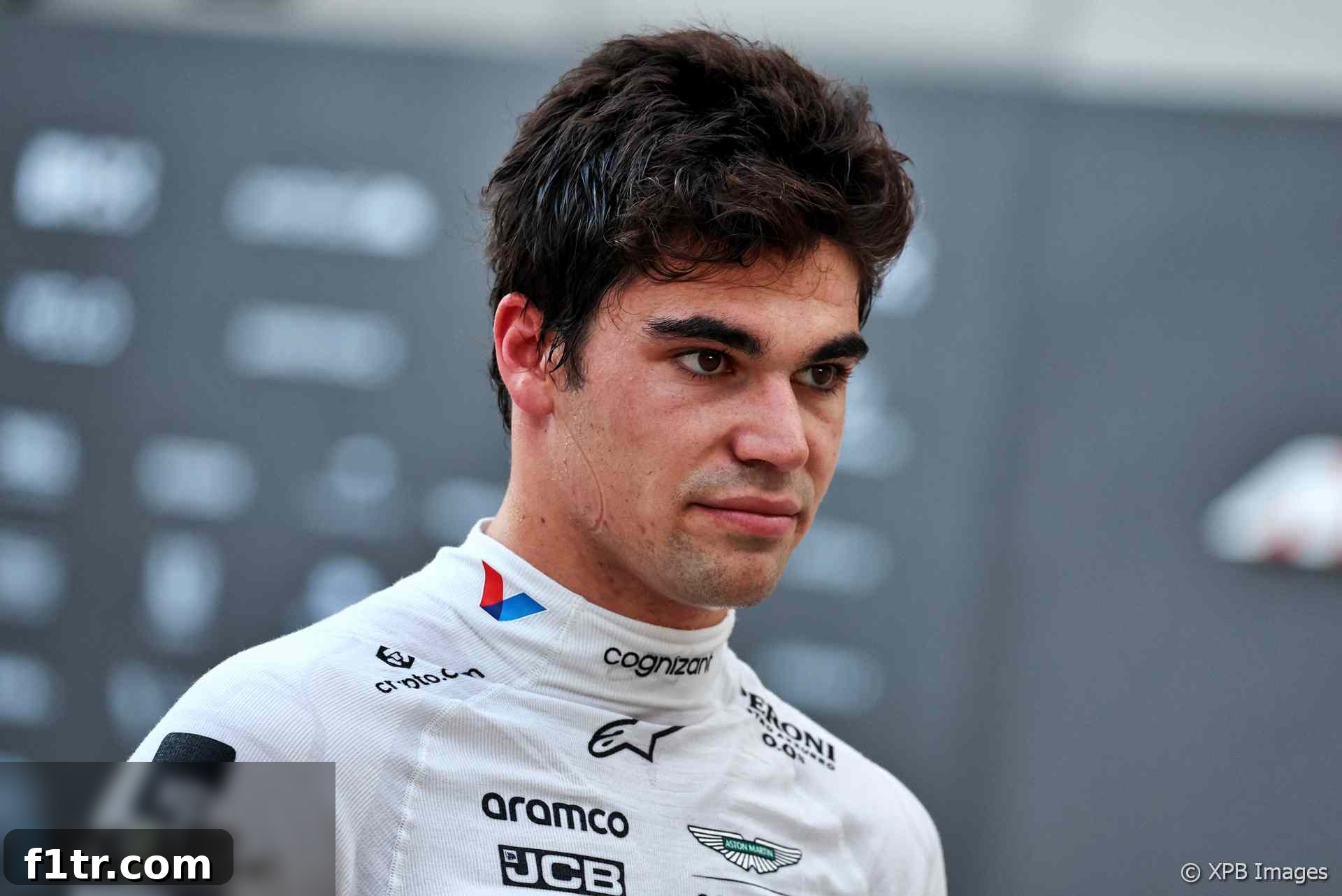
Lance Stroll Navigates Turbulent Waters: Qatar GP Incident, Performance Challenges, and Unwavering Spirit
The high-stakes world of Formula 1 often brings moments of intense pressure and raw emotion. For Lance Stroll, the 2023 Qatar Grand Prix weekend brought these to the forefront, culminating in a highly publicised post-qualifying incident. Caught on camera shoving his osteopath and performance coach, Henry Howe, after yet another disappointing Q1 exit, Stroll’s frustration was palpable. However, in the aftermath, the Aston Martin driver has spoken candidly about the event, his team’s struggles, and his determination to overcome the significant challenges currently facing him and the AMR23 car. This comprehensive look delves into the incident, Stroll’s current mindset, the technical hurdles with his car, and the stark contrast with his teammate Fernando Alonso’s recent performances.
The Viral Moment: Unpacking the Qatar Incident and Stroll’s Response
Friday’s qualifying session at the Lusail International Circuit in Qatar saw a dramatic display of raw emotion from Lance Stroll. Having failed to progress beyond Q1 for the fourth consecutive race weekend, the Aston Martin driver’s frustration boiled over. Footage captured him throwing his steering wheel from the cockpit of his AMR23 and subsequently clashing with his osteopath and performance coach, Henry Howe, by shoving him. The incident, broadcast by Formula 1 and widely circulated across social media platforms, immediately sparked debate and criticism regarding Stroll’s behaviour.
Despite the public scrutiny, Stroll was quick to downplay the severity of the interaction with Howe, insisting that their relationship remained strong. “We’re good,” Stroll stated, emphasizing the deep bond forged through the intense environment of Formula 1. “He’s a bro. We go through the frustrations together and we ride together, so we’re cool.” This insight highlights the unique and often intense relationship between F1 drivers and their support staff, who witness first-hand the immense pressure and emotional toll of the sport. Such relationships are built on trust and shared experiences, making moments of heightened emotion understandable, even if regrettable in public.
Addressing the widespread criticism on social media, Stroll adopted a dismissive stance. “I’m not looking at social media,” he remarked, reiterating his focus on the task at hand. “I’m in the car driving this weekend.” This approach is common among athletes who choose to shield themselves from external noise to maintain mental clarity and concentration. In the high-octane world of F1, where every performance is analysed under a microscope, managing external perceptions while battling internal demons becomes a critical skill for drivers.
Navigating a Deep Rut: Aston Martin’s Performance Dip and Stroll’s Point Drought
The Qatar incident serves as a stark symptom of a deeper malaise for Lance Stroll and, to some extent, for Aston Martin Racing. Stroll has openly admitted to a significant performance dip, acknowledging that the team is “in a rut and it’s not getting better.” Since the summer break, Stroll has been unable to add to his points tally, marking a significant downturn from the team’s early-season promise. This prolonged struggle has naturally fostered a sense of collective frustration within the entire Aston Martin garage.
The psychological impact of such a run of poor results on a highly competitive individual like an F1 driver cannot be overstated. Constantly pushing boundaries and battling for every tenth of a second, the inability to extract performance is profoundly challenging. Stroll articulates this clearly: “Frustration is just, I think, in the whole group right now. I mean, we want to do better, we want to get better, but it’s just a struggle right now.” This collective sentiment underscores how tightly knit an F1 team is; a driver’s struggle often reflects underlying issues with the car and impacts the morale of engineers, mechanics, and strategists alike.
Despite his obvious dissatisfaction with recent outcomes, Stroll maintains his passion for competing at the pinnacle of motorsport. “I’m just struggling with the car and just getting to grips with the balance,” he explained. “I’m just not able to extract performance from it right now, which is just difficult and frustrating.” This statement is key to understanding the nuances of his predicament. It’s not a lack of effort or desire, but a fundamental disconnect between driver and machine, hindering his ability to unlock the car’s full potential.
The Enigma of the AMR23: Unpacking Stroll’s Struggle with Car Dynamics
Delving deeper into the technical aspects, Stroll’s struggle is heavily intertwined with the specific characteristics of the AMR23. He reveals a consistent lack of comfort and confidence at the wheel, a feeling that has persisted since the Austrian Grand Prix in July. His detailed description paints a picture of a car that is unpredictable and challenging to drive at the limit: “There’s high levels of understeer, snap oversteer, a lack of grip.” These issues are a driver’s nightmare, as they fundamentally undermine the ability to push hard and trust the car’s reactions.
Understeer, where the front wheels lose grip and the car doesn’t turn as much as commanded, and snap oversteer, where the rear suddenly loses grip, can be incredibly difficult to manage, especially on demanding circuits. Stroll articulates the profound impact these characteristics have on his driving style: “I feel like I can’t really lean on the car and drive it with confidence without dealing with snaps and understeer and just a balance that I really don’t particularly enjoy driving.” Confidence is paramount in Formula 1; without it, a driver cannot attack corners aggressively, brake late, or consistently find the limit, leading to a significant performance deficit.
Furthermore, Stroll hypothesizes that the car’s development trajectory throughout the season might have moved it away from a setup that initially suited his driving style. “I know we’ve changed the car a lot throughout the year and the characteristic of the car has changed a lot throughout the year,” he added. “So maybe we moved away from something that suited me better at the beginning of the year.” This highlights a common challenge in F1; as teams introduce upgrades, the car’s fundamental characteristics can shift, requiring drivers to adapt. If the new characteristics don’t align with a driver’s natural style, a performance gap can emerge, as appears to be the case for Stroll.
A Tale of Two Styles: Contrasting Stroll’s Challenges with Alonso’s Adaptability
The starkest illustration of Stroll’s current predicament comes from comparing his performance with that of his illustrious teammate, Fernando Alonso. While Aston Martin’s overall performance has undeniably dipped in the second half of the season, Alonso has consistently managed to reach Q3 and score points more often than not. This persistent disparity is particularly evident, with Alonso starting the Qatar Grand Prix from fourth on the grid, a formidable 13 places ahead of Stroll.
Stroll offers his theory on this intriguing contrast, pointing to Alonso’s unique ability to cope with the car’s evolving handling. “I think he has a particular driving style,” said Stroll. “The way that he gets around the corners might be very different to mine.” This suggests that Alonso’s driving technique, perhaps characterized by a greater adaptability or a different approach to managing understeer and oversteer, allows him to extract more from the current AMR23 package. In essence, Alonso might be better equipped to “drive around” the car’s limitations, which Stroll finds more challenging to overcome.
He further elaborates on this point, suggesting that the car was initially more accommodating to a wider range of driving styles. “At the beginning of the year I think the car was giving a bigger window for different driving styles to work. And right now it has a lot of limitations that I don’t like that I think he kind of drives around and deals with and that doesn’t bother him as much.” This insight is crucial for understanding team dynamics in F1. When a car’s development inadvertently narrows its operating window, it can disadvantage one driver significantly, creating a performance gap that is difficult to bridge mid-season. The challenge for Aston Martin will be to develop a car that offers a broader operating window, catering to both drivers’ preferences, or for Stroll to adapt his style to the car’s current demands.
The Road Ahead: Qatar Grand Prix Outlook and Stroll’s Unyielding Spirit
Following the Q1 elimination that ignited his anger on Friday, Lance Stroll started the Qatar Grand Prix from 17th position, having been classified 15th (last of those running) in Saturday’s sprint race after being penalised for repeatedly exceeding track limits. His outlook for the main race was understandably pessimistic. “We’re locked in and it’s going to be tough,” he admitted, acknowledging the limitations of the car and his current struggles. His hopes largely rested on strategic gambles and external factors: “We’re going to see what we can do with strategy. Hopefully a few things happen in front of us.”
Stroll’s candid assessment of his confidence level underscores the depth of his challenges. “But in terms of actual pace, I’m not super-confident because I know the limitations of the car and I know that I’m not confident driving it right now.” This honest self-reflection is a testament to the immense psychological toll of competing at the highest level without the necessary confidence in your machinery. Despite the difficulties, Stroll’s overarching message remains clear: he is happy to be in F1, even when facing such adversity.
Perhaps the most revealing statement from Stroll came when discussing his future approach to frustration. With a raw and unapologetic honesty, he declared, “I fucking hate having a bad day. It’s not going to change.” This powerful statement encapsulates the intense competitive fire that burns within every Formula 1 driver. It highlights that while his methods of expressing frustration may be critiqued, the underlying passion and hatred for underperformance are fundamental to his identity as a racer. It suggests that while lessons may be learned, the core drive and emotional intensity that define him will likely remain unchanged, a testament to his unwavering commitment to excel.
In conclusion, Lance Stroll is navigating a particularly turbulent period in his Formula 1 career. Battling not only the pressures of competition but also significant car handling issues and the psychological toll of underperformance, his candour provides a fascinating insight into the life of an F1 driver. The Qatar incident, while regrettable, served as a raw expression of the immense frustration building within him. As he continues to seek solutions with Aston Martin, his resilience and enduring passion for the sport will undoubtedly be tested, but his determination to overcome these challenges remains undimmed.