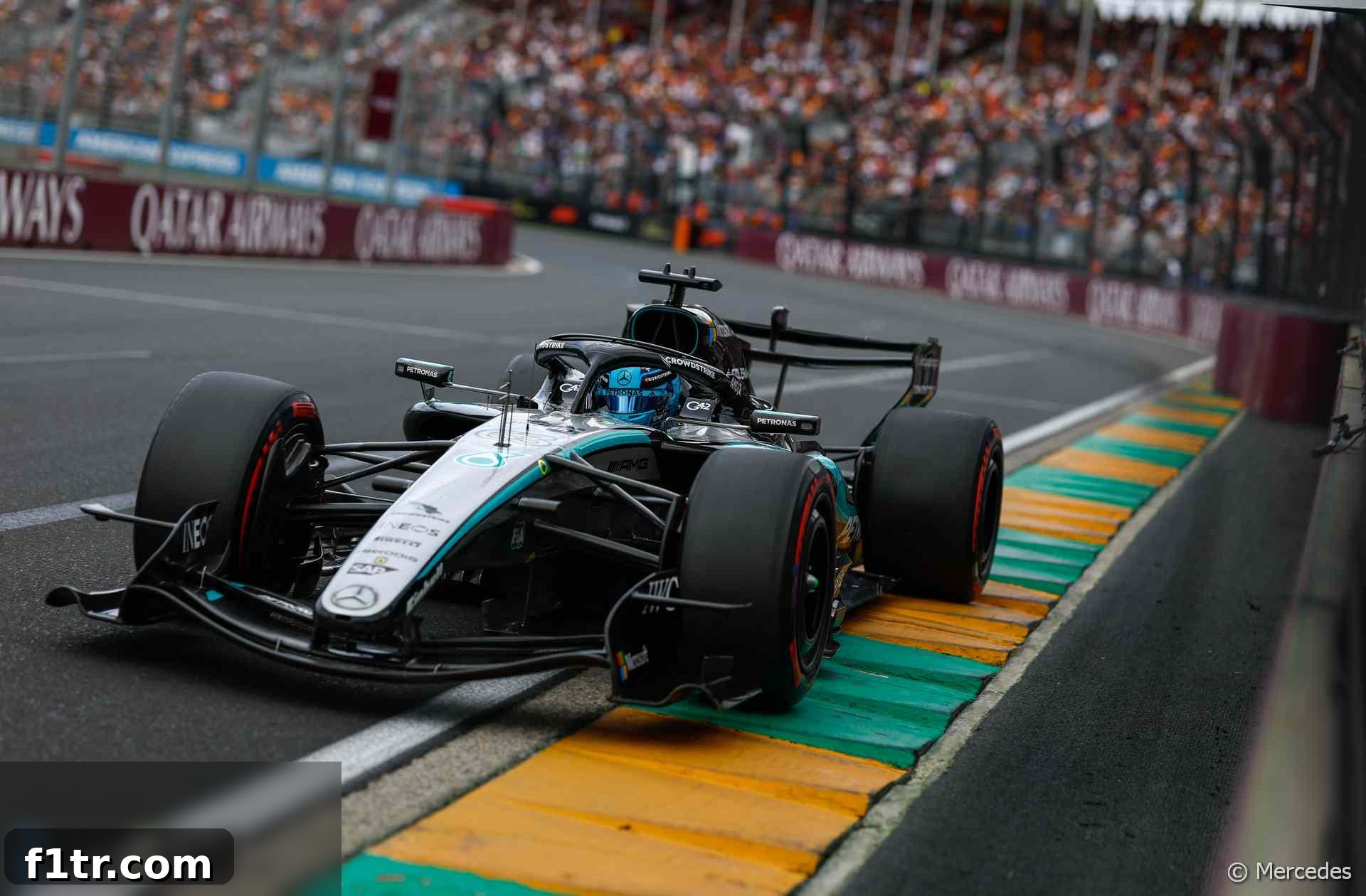
George Russell, a prominent voice among the current crop of Formula 1 drivers and a staunch advocate for the sport’s progressive new technical regulations, has recently highlighted critical areas where he believes improvements are not just desirable but essential for both safety and the quality of racing. While the new era of F1 cars, designed to promote closer wheel-to-wheel action, has largely been praised, specific operational aspects have begun to draw scrutiny, particularly from those on the front lines of competition.
The core of Russell’s concern revolves around the behaviour and stability of the cars within the designated “Straight Mode” zones. These zones, primarily understood as areas where drivers are permitted to deploy their Drag Reduction System (DRS) – an adjustable rear wing mechanism – and potentially other aero-optimisation tools, are designed to facilitate overtaking by dramatically reducing aerodynamic drag and increasing top speed. However, the precise manner in which these systems interact with the car’s overall downforce profile, especially concerning the front wing, has emerged as a significant talking point among drivers, prompting calls for revisions to enhance driver confidence and safety.
Advert | Become a Supporter & go ad-free
The issue gained particular prominence during the recent Australian Grand Prix, held at the challenging Albert Park circuit in Melbourne. For that specific race weekend, an unprecedented five such zones were configured around the track. While the intention was to maximise overtaking opportunities and enhance the spectacle, the sheer number and placement of these zones, particularly those traversing sections of the track that were not entirely straight – such as the high-speed, curving run from turn seven to turn nine – exacerbated the inherent problems associated with aggressive downforce reduction. Drivers reported a noticeable and sometimes alarming instability as cars entered these zones, a direct consequence of the sudden and sharp decrease in aerodynamic grip.
This sharp reduction in downforce, particularly at the front of the car, is a cause for considerable concern among a growing number of drivers, with George Russell leading the charge for reform. The problem manifests as an immediate and pronounced increase in understeer, making the car difficult to control, especially at high speeds. This effect is compounded when a driver is following closely behind another car, navigating through the turbulent “dirty air” created by the lead vehicle. In such scenarios, the already reduced aerodynamic efficiency of the following car, coupled with the aggressive downforce drop in “Straight Mode,” can render the front end almost unresponsive, significantly increasing the risk of an incident.
Russell, who holds a crucial position as a director of the Grand Prix Drivers’ Association (GPDA), an organisation dedicated to representing driver interests and safety, views this as a fundamental safety matter that warrants immediate attention from the sport’s governing body, the Fédération Internationale de l’Automobile (FIA). He firmly believes that adjustments to the current regulations are necessary to mitigate these risks without compromising the racing spectacle that DRS and similar systems are designed to foster. His direct experience in the heat of battle provides a compelling foundation for his arguments.
Reflecting on his experience during the Australian Grand Prix, where he was actively engaged in intense battles on track, Russell articulated his specific request to the FIA. “Having experienced the race today and battling,” he stated, “the only thing I would request from the FIA is that with the Straight Mode, the front wing doesn’t drop as aggressively.” He elaborated on the precise sensation and danger this aggressive drop creates: “When we open Straight Mode we will have lots of understeer, and when I was behind Charles [Leclerc] and I was trying to duck out of his slipstream it was like my front wing wasn’t working. So I think from a safety aspect, that would make the racing safer, better. I don’t see a downside of doing it.” This vivid description underscores the critical nature of the problem, highlighting how drivers are left with compromised control at moments of peak performance and vulnerability.
The inherent danger is particularly acute when drivers attempt to manoeuvre out of a rival’s slipstream, a common tactic for setting up an overtake. The sudden loss of front-end grip can lead to unpredictable car behaviour, making precise steering inputs incredibly challenging and potentially leading to significant accidents, especially given the proximity of other cars. Russell’s argument is compelling because he frames it not as a performance disadvantage but as a clear safety imperative, suggesting that a recalibration of the front wing’s response within these zones would improve driver confidence, allow for more predictable car handling, and ultimately lead to safer and potentially even more exciting racing due to greater driver confidence in pushing the limits.
The debate surrounding these zones reached a peak during the Australian Grand Prix weekend itself. Following Friday practice sessions, several drivers voiced significant concerns specifically about the fourth “Straight Mode” zone, which spanned the unconventional, curving section from turn seven to turn nine. The consensus among these drivers was that deploying DRS in this high-speed, non-straight section presented an unacceptable level of risk due to the car’s instability. Initially, the FIA, in response to these serious safety concerns, announced its decision to deactivate this particular zone prior to the final practice session. This move was widely seen as a prudent and responsive measure, prioritizing driver safety based on real-world feedback.
Advert | Become a RaceFans supporter andgo ad-free
However, the situation quickly became a point of contention within the paddock. Following the FIA’s initial decision to deactivate the zone, there were complaints from other teams, presumably those who believed the zone offered a strategic advantage or who had designed their car setups around its availability. In a rapid reversal, the FIA subsequently reinstated the zone, opting to proceed with all five planned “Straight Mode” areas for the race. This decision, while understandable from a competitive standpoint, highlighted the ongoing tension between driver safety concerns and the desire for enhanced racing spectacle, often influenced by team strategies and preferences. Russell’s current call for a more permanent and systemic change regarding the front wing’s behaviour is therefore a direct response to such compromises and the recurring safety implications.
The complexities of aerodynamic regulations in Formula 1 are continuously evolving. The current generation of cars, introduced in 2022, aimed to reduce the disruptive “dirty air” effect, allowing cars to follow each other more closely. While successful in many aspects, unintended consequences, such as the aggressive front wing downforce reduction in DRS zones, demonstrate the intricate balance required in designing these high-performance machines. George Russell’s position, backed by the collective voice of the GPDA, emphasizes that while the pursuit of faster cars and more exhilarating racing is paramount, it must never come at the expense of driver safety. The request for a modification to how the front wing reacts in these “Straight Mode” zones is a relatively minor technical adjustment that could have significant positive repercussions for the predictability and safety of racing, without necessarily diminishing the effectiveness of the DRS system itself.
This ongoing dialogue between drivers, teams, and the FIA is crucial for the continuous improvement of Formula 1. Driver feedback, especially from those at the pinnacle of the sport like Russell, provides invaluable insights into the real-world performance and safety implications of complex technical regulations. Addressing concerns such as the aggressive front wing drop in DRS zones is not merely about comfort; it is about ensuring that drivers can push their multimillion-dollar machines to their absolute limits with confidence, fostering thrilling battles while mitigating unnecessary risks. The sport thrives on innovation, but also on a steadfast commitment to the well-being of its participants. Russell’s proactive stance is a testament to this commitment, advocating for refinements that will make F1 not only more exciting but also inherently safer for all involved.
Miss nothing from RaceFans
Get a daily email with all our latest stories – and nothing else. No marketing, no ads. Sign up here:
Explore More: 2026 Australian Grand Prix Insights
Delve deeper into the events and discussions surrounding the 2026 Australian Grand Prix with our comprehensive coverage. From strategic team decisions to driver insights and regulatory debates, stay informed on all the key developments from Albert Park and beyond. Here are some related articles you might find interesting:
- Briatore “not happy at all” with Alpine’s “very weak” performance – An inside look at team frustrations and performance struggles.
- Drivers want rules changes to cut “dangerous” risk of crash at start – Another critical safety discussion highlighting driver concerns about race start procedures.
- Russell becomes the 68th different Formula 1 driver to lead the world championship – Celebrating a significant milestone in George Russell’s F1 career, showcasing his growing influence.
- Hadjar told Red Bull his car’s performance was “embarrassing” and “just c***” – Raw driver feedback on performance challenges, reflecting the intense pressure in F1.
- “How did you not call the pit?” Ups and downs in Hamilton’s first race with new engineer – Examining the intricate relationship between driver and race engineer, and critical race decisions.
Browse all 2026 Australian Grand Prix articles