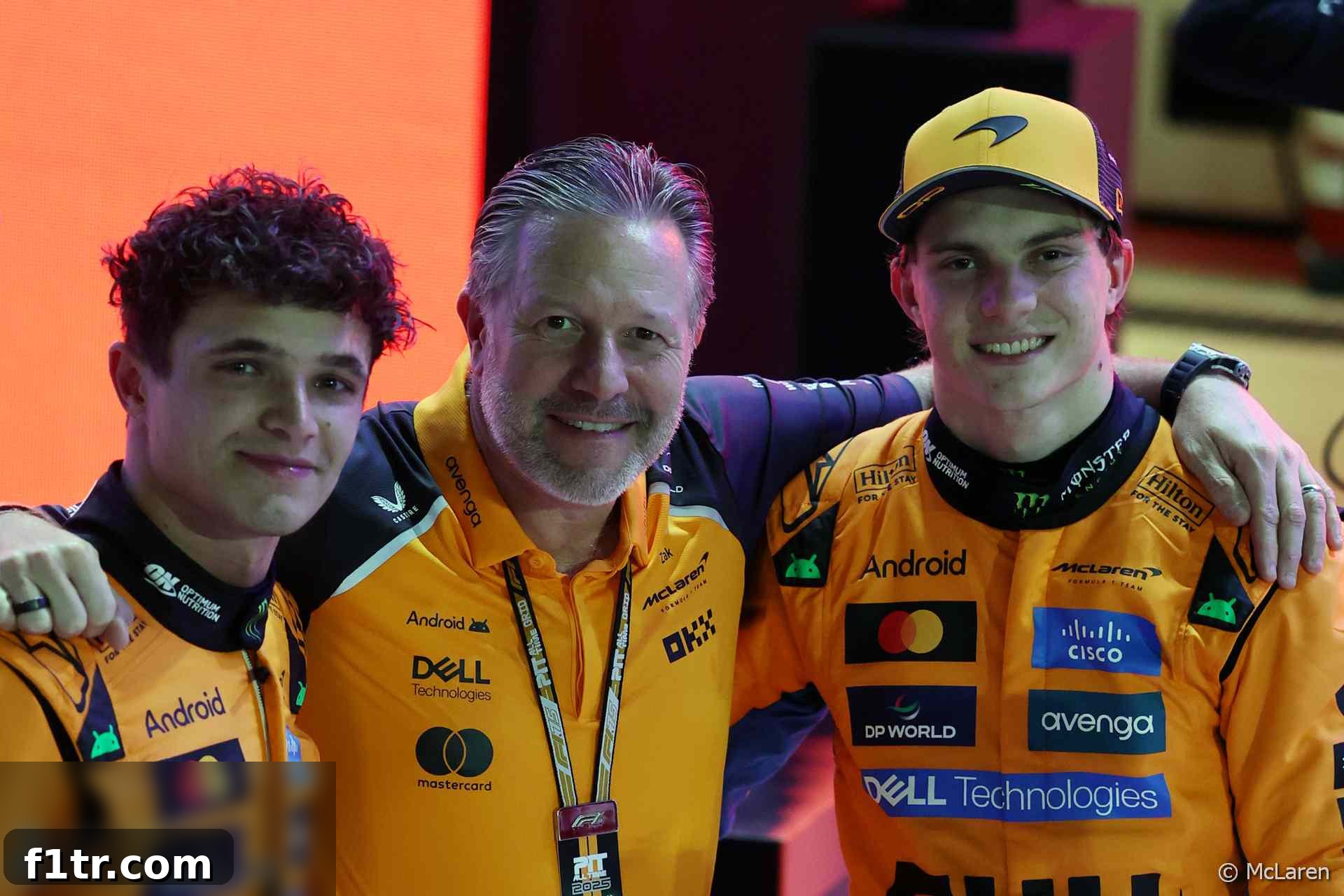
The highly anticipated championship-deciding Abu Dhabi Grand Prix is set to ignite the final battles of the Formula 1 season, and at the heart of the drama is the McLaren team. With two of their drivers, Lando Norris and Oscar Piastri, firmly in contention for the prestigious Drivers’ Championship, the Woking-based outfit faces a delicate balance between allowing pure competition and implementing strategic team orders. McLaren’s CEO, Zak Brown, has affirmed the team’s readiness to intervene, should the high-stakes situation demand it, prioritizing the ultimate goal of securing the world title.
As the weekend commences, McLaren pledges an initial approach of equal opportunity for both Norris and Piastri. This commitment allows both talented drivers to showcase their skills and compete freely, fostering an environment of healthy rivalry that has defined much of McLaren’s resurgence this season. Lando Norris currently holds a crucial 12-point lead over Red Bull’s reigning champion Max Verstappen, while Oscar Piastri trails Norris by a further four points, making the championship a thrilling three-way contest that promises an unforgettable finale. The narrow margins mean every point, every position, and every strategic decision will be magnified under the desert lights of Yas Marina.
The Initial Stance: Fair Play and Free Racing
Zak Brown articulated McLaren’s foundational philosophy: “As long as both drivers have a chance to win the world championship, which they clearly do sitting here right now, then it’s business as usual. They’re free to race.” This initial declaration underscores a longstanding principle within McLaren – a commitment to competitive integrity and allowing their drivers to demonstrate their full potential without artificial constraints. This approach is vital not only for driver morale but also for maintaining the team’s image as one that fosters genuine sporting contest.
Historically, Formula 1 teams have grappled with the complex dynamics of managing two competitive drivers vying for the same prize. McLaren themselves have a rich history of allowing their drivers to race freely, leading to some of the sport’s most iconic battles and, occasionally, internal tensions. However, in a championship scenario as finely poised as this, the desire for an unblemished internal competition must eventually yield to the overarching objective: bringing home the Drivers’ World Championship trophy. Brown’s initial stance provides a clear guideline: until the statistical or practical reality of the race dictates otherwise, both Norris and Piastri are empowered to pursue victory on their own terms.
The Pragmatic Shift: When Strategy Takes Precedence
While the initial intent is clear, Brown also laid out a pragmatic roadmap for potential intervention. He stated that if the race weekend, or indeed the Grand Prix itself, unfolds in a way that makes it clear one driver possesses a significantly better chance of clinching the title, McLaren is prepared to act. “Obviously we’ll be practical and realistic that if as the weekend develops, as the race develops, it becomes clear that one has a significantly better chance than another, then we’re a team that wants to win the drivers’ championship and we will race accordingly to do whatever we can to get whatever that driver is in front to try and win the race.”
This statement highlights the stark reality of modern Formula 1: while sporting integrity is valued, the ultimate goal of any top-tier team is championship glory. The decision to implement team orders is never taken lightly, often sparking debate among fans and pundits. However, for a team on the cusp of a world championship, overlooking a strategic advantage in the name of pure internal competition can be seen as a dereliction of duty. Brown emphasized this point, stating, “Our team orders have been around giving equal opportunity to win the championship, but as if the race plays out, if it becomes clear that both can’t, then we’re going to do what’s in the best interest of the team and try and win the drivers’ championship.” This pragmatic approach reflects a strategic decision to maximize the team’s chances, rather than jeopardizing a potential title win.
Justifying the Decision: Common Sense and Championship Ambition
Brown openly acknowledged the potential criticism that such an approach might attract, but firmly defended McLaren’s stance as one driven by “common sense.” For a team investing heavily and striving for years to reach the pinnacle of the sport, letting a Drivers’ Championship slip through their fingers due to an unwavering commitment to internal competition is simply not an option. “We’re not going to throw away a drivers’ championship over a sixth and seventh place, a third and a fourth place, a fifth and a sixth place, if one of our drivers doesn’t have the opportunity,” Brown asserted. This sentiment resonates with the cut-throat nature of Formula 1, where every point and every strategic advantage must be seized.
The McLaren CEO also highlighted the transparency with which these decisions are communicated to the drivers. “I think everything we do, we do with the drivers, so they know what the game plan is for this weekend.” This collaborative approach is crucial for maintaining team harmony and ensuring that both Norris and Piastri understand the broader team objectives. Brown recognized the “damned if you do, damned if you don’t” predicament that teams often face regarding team orders, facing either public backlash for intervention or internal regret for inaction. However, he remained steadfast: “We’re going to just stay true to our racing principles: we want to win the constructors’ [championship], which we’ve done, we want to win the drivers’ [championship], and so we’ll see how the race plays out.” This unwavering focus on championship success guides every strategic consideration for the team.
Consistency in Strategy: Learning from the Past
Brown was keen to dismiss any notion that McLaren was performing a “U-turn” on its racing principles, asserting that their approach remains consistent with previous seasons. “I don’t think it’s a U-turn,” he clarified. “We’re going to start the weekend like we have the other 23, which is going in, giving both drivers equal opportunity.” He then cited a specific example from the previous season to underscore this consistency, relating to the Baku Grand Prix.
“Last year, once it became clear that Lando had the best chance to catch Max, and Oscar was almost statistically out of it in Baku, we then asked Oscar to support Lando. It ended up being Lando supported Oscar in that particular race and Oscar won the race.” This example illustrates that McLaren’s policy is not about arbitrary favoritism, but rather about dynamic assessment of the championship landscape. It also highlights the fluid nature of racing, where circumstances can change rapidly, and a planned sacrifice can sometimes turn into an unexpected victory for the supporting driver, reinforcing the intricate balance of team dynamics.
The Drivers’ Perspective: Ambition and Professionalism
The drivers themselves have remained professional about the situation, acknowledging the possibility of team orders but emphasizing that no specific discussions had taken place yet regarding their implementation. As the current points leader and the one with the strongest championship credentials, Lando Norris would undoubtedly be the primary beneficiary of any team interference. When asked about the prospect of receiving support, Norris admitted, “Honestly, I would love it, but I don’t think I would ask for it.” This response reflects a driver who is fiercely competitive and confident in his own abilities, yet also understands and appreciates the strategic considerations that a team must make in such high-pressure circumstances.
For Oscar Piastri, the situation presents a different psychological challenge. As a rookie sensation who has impressed immensely, finding himself in a position to potentially aid his teammate’s championship bid rather than pursuing his own would be a test of his team loyalty and professionalism. While his ambition to win is undeniable, his commitment to McLaren’s collective goals is equally important. The ability of the team management to navigate these individual aspirations while maintaining a cohesive unit will be critical to their ultimate success in Abu Dhabi.
The Broader Implications for Formula 1
The debate surrounding team orders extends far beyond the McLaren garage, touching upon fundamental aspects of Formula 1’s sporting integrity. For purists, team orders detract from the raw competition that defines the sport, preferring drivers to battle purely on merit. For strategists and team principals, however, they are an undeniable tool in the pursuit of championships, a necessary evil in a sport where collective effort often outweighs individual brilliance. The McLaren scenario in Abu Dhabi perfectly encapsulates this ongoing tension.
Ultimately, this championship showdown is not just a test of driver skill and car performance, but also a profound examination of team management, strategy, and the very spirit of competition. The global spotlight will be firmly fixed on McLaren as they attempt to clinch their first Drivers’ Championship in years. How Zak Brown and his team manage the delicate balance between empowering their drivers and making the tough strategic calls will undoubtedly be a defining narrative of the 2025 Abu Dhabi Grand Prix. The outcome will shape not only the immediate history of the sport but also spark renewed discussions about the role of team orders in deciding the pinnacle of motorsport glory.