The world of Formula 1 finds itself at a crucial juncture, grappling with a profound ethical and logistical challenge. Following Russia’s military actions in Ukraine, team principals were set to convene for an urgent meeting to determine the fate of the Russian Grand Prix, scheduled for September. This high-stakes discussion reflects the growing pressure from within the sport and from the international community to re-evaluate the appropriateness of holding a major global event in a nation engaged in such conflict.
Advert | Become a Supporter & go ad-free
The call for decisive action gained significant momentum when four-time world champion Sebastian Vettel publicly declared his refusal to race in Russia, asserting that such an event would be indefensible under the prevailing circumstances. Vettel’s unequivocal stance set a precedent, prompting other drivers to voice their concerns during press conferences. Pierre Gasly, for instance, used social media to express his profound sympathy for the people of Ukraine, highlighting the human toll of the unfolding crisis and underscoring the moral dilemma facing the motorsport community.
F1’s Moral Compass: Navigating Geopolitical Tensions
The situation casts a stark light on the intricate relationship between sports, politics, and global ethics. Formula 1, as a premier international sport, often prides itself on uniting people across borders. However, when geopolitical tensions escalate to military conflict, the sport’s role and responsibilities are brought into sharp focus. The decision regarding the Russian Grand Prix transcends mere sporting logistics; it becomes a powerful statement about the values Formula 1 upholds and its commitment to global peace and human dignity.
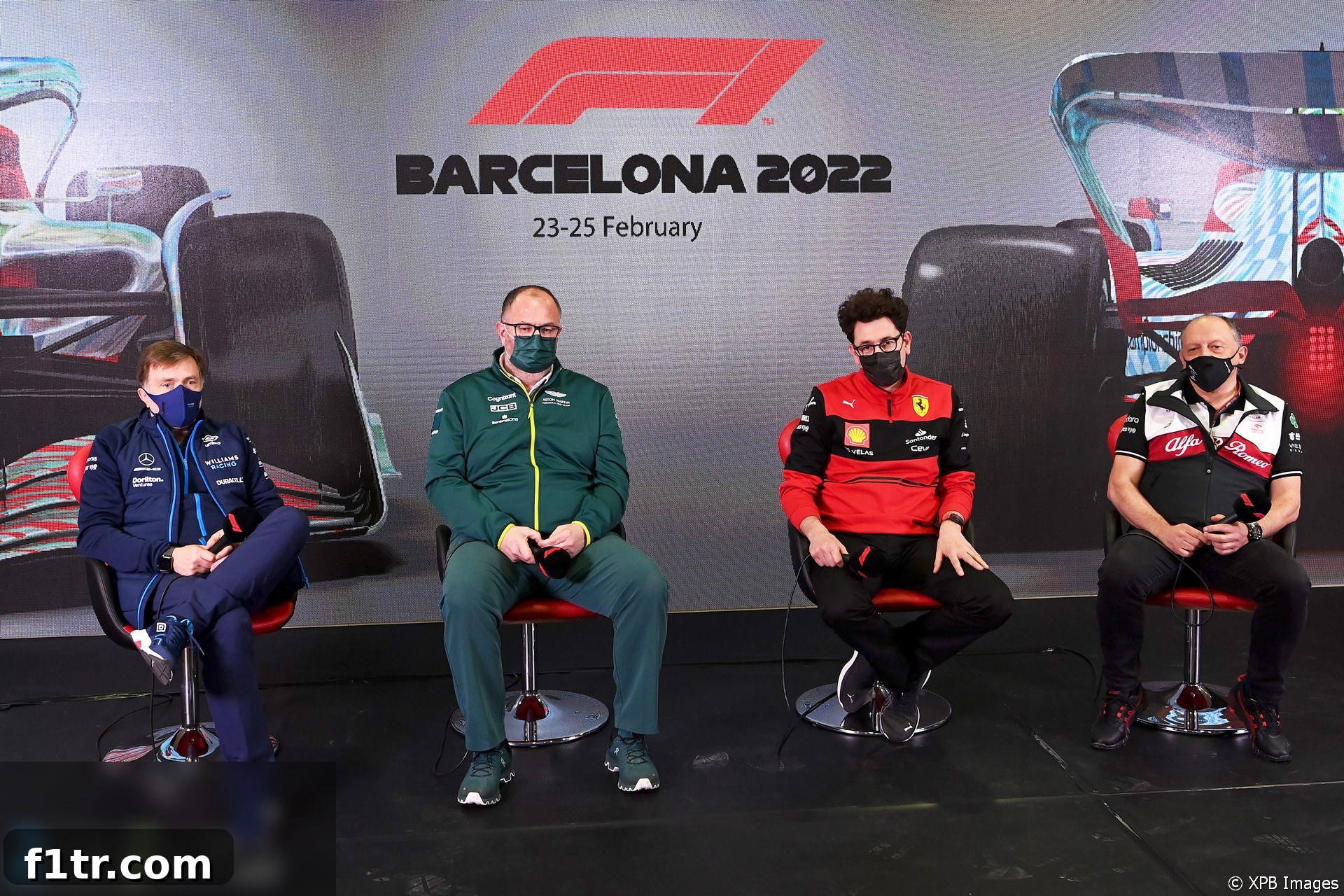
Speaking at the FIA press conference held at the Circuit de Catalunya, Ferrari team principal Mattia Binotto articulated the widespread sentiment within the paddock. “It’s an awful situation, I think it’s very sad,” Binotto stated, his words echoing the gravity of the events unfolding in Eastern Europe. He emphasized the collective hope for a rapid resolution to the conflict, acknowledging that while the race in September might seem distant, the immediate suffering and uncertainty demand urgent attention and empathy.
Binotto further explained the delicate position F1 finds itself in, trying to manage a situation far beyond the confines of motorsport. “At the moment what we can do is only to wait and see and hope for the better,” he continued. “From now until the race in September, there is time and my wish is that somehow everything will stop very soon.” His comments underlined the reactive nature of the sport’s response, awaiting clearer direction while grappling with the moral imperative to act responsibly.
A Collective Reassessment: F1’s Place in a Troubled World
The F1 meeting was not an isolated incident but part of a broader trend across the global sports landscape. Other major sports organizations faced similar pressures to reconsider their ties with Russia. Reports indicated that UEFA, European football’s governing body, was on the verge of announcing the relocation of the Champions League final, originally slated for St. Petersburg in June. This parallel situation provided a precedent and reinforced the idea that F1 could not ignore the wider geopolitical currents.
“F1 is trying to manage the situation,” Binotto reiterated, highlighting the complexity of balancing commercial interests with ethical responsibilities. “We will have a meeting between us tonight to try to understand what’s the situation and how to manage it.” He candidly admitted that “F1 in that situation is not the most important one. What’s happening there is. It’s very sad.” This sentiment resonated deeply, acknowledging that the spectacle of racing pales in comparison to the unfolding human tragedy.
The Ferrari chief elaborated on the internal discussions taking place, emphasizing the need for thorough deliberation. “At the moment we can only try to, not stand by, but certainly try to have between us the discussion and understand all the implications and what is the right choice for the future,” Binotto concluded. His consistent message underscored a profound shift in perspective: Formula 1, for all its glamour and global reach, must recognize its subordinate role when faced with matters of war and peace.
The meeting, initiated by F1 CEO Stefano Domenicali, brought together the influential figures of the sport to forge a united front. Their collective decision would inevitably send a strong message about Formula 1’s values and its alignment with international norms.
Beyond the Grid: Prioritizing Human Values
The sentiment that Formula 1 takes a backseat to human suffering was echoed emphatically by Williams CEO Jost Capito. Reflecting on the broader implications of the crisis, Capito stated, “It shows us when we look in the mirror that Formula 1 is not the most important [thing] in the world. There are bigger issues than Formula 1.” His words provided a sobering reality check for an industry often consumed by competitive striving and technological advancement.
Capito drew a poignant contrast: “We think about the performance of our cars [while] other people are scared to lose their lives. I think we have to have this in mind and I think we’re all aligned on this.” This collective understanding among team principals highlighted a shared moral compass, guiding their discussions towards a decision that would reflect compassion and responsibility. The emphasis was clearly on human life and security over sporting ambition.
The Williams CEO expressed confidence in the sport’s governing bodies to make the right call. “What happens in the future? We have a very good relationship with FOM and with the FIA – these are the governing bodies and they aware about the situation, they are on top of it and they will take a proper and the right decision for all of us,” Capito affirmed. This points to the critical roles of Formula One Management (FOM), which holds the commercial rights, and the Fédération Internationale de l’Automobile (FIA), the sport’s regulatory body, in navigating this unprecedented challenge.
The Haas Conundrum: A Team Under Scrutiny
The geopolitical situation placed particular scrutiny on the Haas F1 team, which has significant Russian connections. Team principal Guenther Steiner was notably absent from a scheduled press conference, with the FIA stating he was “no longer available.” This cancellation fueled speculation and drew attention to the team’s unique predicament.
The only Russian driver in Formula 1, Nikita Mazepin, drives for Haas. Furthermore, the team’s title sponsor, Uralkali, is a Russian potash fertilizer producer, owned by Mazepin’s father, Dmitry Mazepin. This direct link between the team, a Russian driver, and a prominent Russian company placed Haas in an acutely difficult position amidst widespread calls for sanctions and boycotts against Russian entities.
The intertwining of sport, nationality, and corporate sponsorship presents a complex web of ethical and commercial considerations. Any decision regarding the Russian Grand Prix or broader F1 policy towards Russia would inevitably have direct and significant repercussions for Haas, potentially forcing them to re-evaluate their sponsorship agreements and even their driver line-up. This illustrates the ripple effect of geopolitical events, extending from international policy into the heart of global sports organizations.
Advert | Become a RaceFans supporter andgo ad-free
The Path Forward: Decisions and Implications
The outcome of the F1 team principals’ meeting, alongside subsequent statements from the FIA and FOM, holds immense significance for the sport’s immediate future and its long-term image. Cancelling the Russian Grand Prix would demonstrate a clear commitment to moral principles, aligning Formula 1 with international condemnation of the conflict. However, such a decision also involves complex contractual obligations, potential financial penalties, and the need to adjust a meticulously planned global calendar. The governing bodies would need to navigate these commercial realities while prioritizing ethical considerations.
The situation highlights the delicate balance Formula 1, and indeed all global sports, must maintain between entertainment, commerce, and social responsibility. As the world witnesses profound geopolitical shifts, the expectation for prominent organizations to take a stand, to reflect global values, and to prioritize humanity over spectacle has never been stronger. The discussions initiated by the F1 leadership are not just about a single race; they are about defining the sport’s identity and its place in a rapidly evolving, and often troubled, world. The decision made in the coming days will undoubtedly shape how Formula 1 is perceived for years to come, solidifying its commitment to being more than just a race on a track, but a responsible global citizen.
2022 F1 season
- Mercedes told me “you’re wrong” about 2022 car’s problems – Hamilton
- FIA confirms all 10 F1 teams complied with 2022 cost cap
- Steiner “not ashamed” of panning “slow” Schumacher in Drive to Survive
- Albon believes year out of F1 improved him as a driver
- Hamilton sees diversity gains in F1 years on from his ‘traumatising’ experience of racism
Browse all 2022 F1 season articles